Dog toy size should be judged by what the dog can actually grip, carry, mouth and potentially swallow, not by an S, M or L label alone. A useful toy is large enough that the whole object cannot slip too far into the mouth, while still being manageable for the dog’s jaw and play style. Exact manufacturer dimensions, the toy’s shape, the dog’s current mouth size and the way the dog uses the toy all matter. Size also needs another check when a puppy grows, a toy becomes damaged or dogs of very different sizes share the same play area.
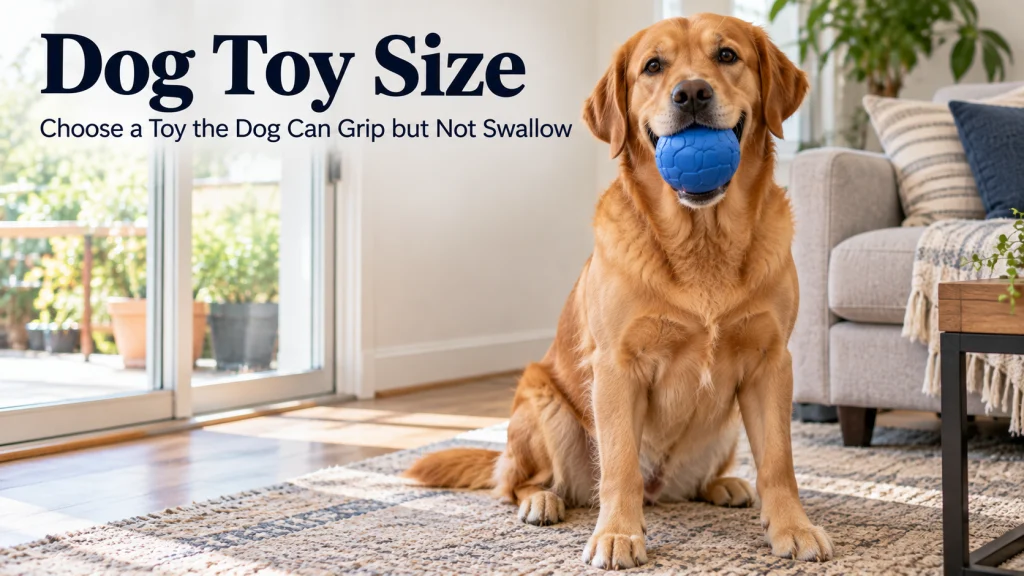
Check whether the toy can disappear too far into the mouth first
Dog toy size becomes a safety decision the moment an object can slide so far into the mouth that the dog may swallow it or struggle to release it. Start by watching how the dog picks the toy up, where it sits between the jaws and whether the entire object can vanish behind the lips during normal play. The goal is not to find the smallest toy the dog can carry. The goal is to find a size the dog can control without giving the whole object easy access to the back of the mouth.
This is one reason a broader approach to choosing dog toys should begin with the job the toy has to do and the way the dog interacts with it. Toy choice also sits inside the larger question of keeping a dog mentally stimulated, because a toy that is unusable or risky does not become better enrichment simply because the package says it matches the dog’s size. I would treat the package label as a starting clue, then check the actual object against the dog’s mouth and play behavior. That keeps size selection grounded in the dog in front of you rather than in a generic label.
Treat S, M and L labels as manufacturer specific rather than standardized sizes
An S, M or L printed on a package is useful only inside the sizing system that manufacturer uses for that toy. One company may classify a toy by overall length, another by diameter, and another may use a dog weight range as a shopping cue. Those systems do not create one universal physical size. Two toys carrying the same size letter can therefore differ in shape, width, length and how deeply a dog can take them into the mouth.
Before buying, look for the exact listed dimensions and identify which dimension matters for the way the toy will be used. Diameter matters strongly for round objects, while width, thickness and overall shape may matter more for plush, rubber or irregular toys. If a listing gives only a size letter and no useful measurements, it leaves an important fit question unanswered. I would choose the option that gives enough information to compare the real object with the dog rather than assuming the label is standardized.
| Current manufacturer example | Published size label | Published dimension | What the comparison shows |
|---|---|---|---|
| Outward Hound Orbee Tuff Planet Ball | Small | 2.25 inches | The label only has meaning inside this product’s sizing system. |
| Outward Hound Orbee Tuff Planet Ball | Large | 4 inches | A Large here is a specific measured object, not a universal Large. |
| West Paw Jive | Small | 2.5 inches | The same Small label is 2.25 inches in one system and 2.5 inches in the other, so the letter does not define one measurement. |
| West Paw Jive | Large | 3.25 inches | The same Large label is smaller than the Large example above, so the letter alone cannot establish fit. |
The practical comparison is therefore not S versus M versus L by itself. Current manufacturer pages show why: a Large Outward Hound Orbee Tuff Planet Ball is listed at 4 inches in diameter, while a Large West Paw Jive is listed at 3.25 inches. That difference is enough to show that the label is not a cross brand measurement standard, even before shape and play style enter the decision. Use the exact published dimensions for the toy in front of you, then judge whether that measured shape gives the dog usable grip without excessive mouth access.
Compare exact dimensions to the dog’s mouth and the way the toy is used
Overall body weight does not tell you exactly how a toy will sit in a particular dog’s mouth. A dog may be able to carry a long toy safely because much of it remains outside the mouth, while a much shorter round object can travel farther inward. Shape changes the fit. That is why the useful comparison is between the toy’s actual dimensions and the way the dog grips, mouths, tosses or carries that specific shape.
Watch the first interactions closely and look for control rather than mere interest. The dog should be able to pick the toy up, reposition it and release it without repeatedly forcing the whole object deeper into the mouth. A toy can be too large as well, especially if the dog cannot get a useful grip or has to strain just to manipulate it. The safe direction is not simply bigger forever; it is large enough to reduce swallowing access while still remaining usable.
- Check the manufacturer’s exact dimensions instead of relying only on the size letter.
- Look at the narrowest part of the toy, not only its longest dimension.
- Watch how much of the toy remains outside the mouth during normal carrying and mouthing.
- Notice whether the dog can release and reposition the toy without struggling.
- Recheck fit if the dog changes how the toy is used, especially if gentle carrying turns into intense chewing.
These checks turn sizing into an observable fit decision rather than a guess based on breed name or body weight. If the dog can carry, release and reposition the object without losing control, the size is doing useful work. If the fit looks marginal, do not treat a size label as reassurance. Compare another size or shape and choose the one that preserves control while leaving a safer margin against swallowing.
Size up when a ball, squeaker toy or small object can fit completely into the mouth
Round toys deserve extra attention because a ball that looks proportionate beside the dog can still be small enough to travel deep into the mouth. AKC guidance specifically warns against choosing a ball small enough for the dog to swallow, and its choking guidance identifies undersized balls as a risk. If the dog can close the mouth around the entire ball with little or nothing remaining outside, I would move to a larger size rather than accepting the fit because the package says it is appropriate. The same logic applies to compact toys with a shape that can slip inward as one piece.
Squeaker toys add another size consideration because the outer toy can change once damaged. PetMD advises matching the toy to the dog’s size and chewing behavior and notes that powerful chewers need toys that do not fit completely in the mouth. A plush toy may look large at first but become a much smaller object if fabric, stuffing or an internal component is exposed. That is why dog toy safety includes both the starting size and what remains after wear or damage.
Warning: If a toy can fit completely into the dog’s mouth or has broken into a piece that can, remove it from play rather than waiting to see whether the dog swallows it.
The decision is especially important for dogs that tend to gulp, crush or dismantle toys instead of carrying them gently. Size cannot make every toy indestructible, but it can reduce one obvious route by which the entire object becomes easy to swallow. If a larger version still disappears fully into the mouth, change the toy shape rather than assuming another label will solve the problem. The practical goal is a toy the dog can use without turning the whole object into a single swallowable piece.
Replace puppy size toys as growth changes what the dog can swallow or break
A toy that fit a small puppy can become a poor fit after the dog’s mouth and jaw grow. The object has not changed, but the dog’s ability to take more of it into the mouth has. AKC puppy guidance specifically notes that toys sized for a small puppy can later become choking hazards and recommends moving to age and size appropriate toys. That makes toy sizing a repeated check during growth, not a decision made once when the toy is first purchased.
The simplest habit is to reassess the older toys alongside the dog’s current ones. Pick up each toy and ask whether it now disappears farther into the mouth, whether the dog can break it more easily and whether its material was intended for a younger stage. A favorite toy does not earn permanent exemption from a fit check. If growth has changed the swallowing risk or the toy can no longer tolerate the dog’s current use, replace it with a better matched size or retire that toy type.
| What changed | What to recheck | Practical response |
|---|---|---|
| The puppy’s mouth is larger | Whether the whole toy can now fit too deeply | Move to a larger appropriate size |
| Jaw strength increased | Whether pieces can now be removed or crushed | Retire the toy if damage creates swallowable pieces |
| Play style became rougher | Whether carrying changed into destructive chewing | Choose a toy type suited to the new job |
The useful lesson is not that every puppy needs a particular size progression. Growth is individual, so the trigger is a visible change in fit, strength or play behavior. Rechecking those factors keeps the decision tied to the dog rather than to a generic breed schedule. A toy can stay familiar and still become the wrong size, so familiarity should never replace a fresh fit check.
Keep grip and usability in mind because a toy can also be too large to manipulate comfortably
Sizing up is useful when a toy can fit too deeply into the mouth, but an oversized toy can fail in the opposite direction. If the dog cannot get a stable grip, pick the object up or reposition it during play, the toy may simply be frustrating or ignored. The relevant dimensions depend on shape: a long soft toy can be easy to grab even when its overall length is large, while a thick rigid object may be difficult to mouth. This is why one number cannot define ideal toy size across every toy family.
Look for a middle ground between safer mouth access and practical control. The dog should have enough purchase on the object to carry or manipulate it without repeatedly dropping it or struggling to release it. If moving to a larger size makes the toy impossible to use, the answer may be a different shape rather than dropping back to an undersized object. I would change the format before sacrificing either control or the safety margin.
Key point: The correct size is not the largest object available. It is the size and shape the dog can use normally without being able to swallow the whole toy.
That tradeoff is especially useful when comparing balls with elongated toys, plush shapes or irregular rubber toys. Different shapes can create very different mouth access even when their package labels look similar. If one size becomes awkward to grip, compare another shape before moving back to something smaller simply because it is easier to carry. Usability and safer mouth fit should be solved together, not as competing goals.
Recheck size after damage makes the toy smaller than it was when purchased
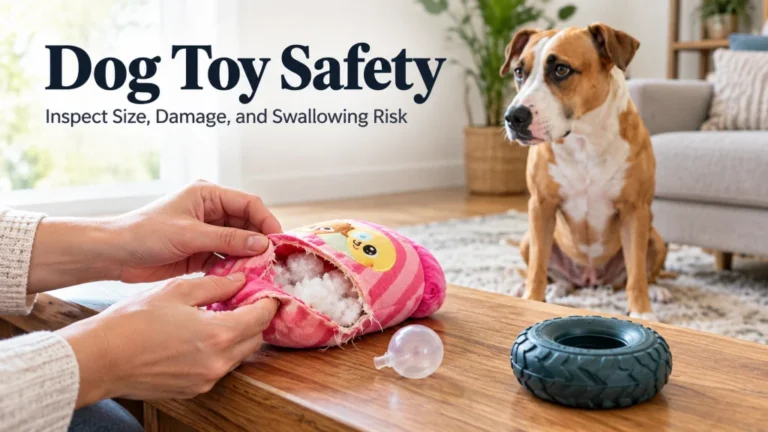
Original dimensions stop being useful once the dog tears, crushes or removes part of the toy. A long toy can become a short piece, a plush shell can expose a small internal component and a damaged edge can create detachable fragments. At that point, the question is no longer whether the product was the right size when new. The question is whether the remaining object is still too large to swallow and still structurally suitable for play.
Inspect toys often enough to notice meaningful changes before returning them to the dog. Look for missing sections, exposed squeakers, split seams, detached ends, loose fibers and any part that has become small enough to disappear into the mouth. AKC advises discarding toys that are breaking or tattering, and its toy guidance warns about swallowed pieces and exposed squeakers. If damage changes the toy’s dimensions or exposes a smaller component, retire it rather than treating the original package size as proof that it is still suitable.
This check matters even for a toy the dog has used without trouble before. Safe fit depends on the object that exists now, not the dimensions it had at purchase. Wear can change that condition, so replacement is part of sizing as well as maintenance. When damage materially changes the shape or leaves smaller pieces, judge those remaining parts as new objects rather than relying on the original label.
Use specialized sizing rules when fetch or chewing is the actual play job
General mouth fit is the right starting point, but some toy jobs create extra constraints that deserve their own decision. A fetch object has to work with repeated carrying, retrieval and release, while a chewing object has to match both mouth access and the dog’s chewing behavior. Those extra demands can change the best shape, material and dimensions. The general rule here should not replace the more specific checks that come with the actual play task.
For retrieval equipment, continue with the sizing and handling factors in dog fetch toys. For an object intended mainly for sustained chewing, use the fit and chewing considerations in dog chew toys. Those decisions begin with the same boundary, the dog should not be able to swallow the whole object, but they add task specific questions that a general sizing article should not flatten into one chart. Routing by play job keeps the recommendation precise without pretending every ball, plush toy and chew follows the same sizing formula.
Final Thoughts: choose by actual dimensions and mouth fit
The most useful dog toy size is not a universal S, M or L and it is not a fixed measurement tied to breed name or body weight. Check the manufacturer’s exact dimensions, the shape of the toy, how the dog grips it and whether the entire object can travel too far into the mouth. Size up when swallowing access is the concern, but do not ignore usability if the dog can no longer control the toy. If safer sizing makes the current shape unusable, switch shapes instead of accepting a toy that is easy to swallow.
Then repeat the check when conditions change. Puppy growth, rougher play, damage and access by a larger dog can all turn a previously acceptable toy into the wrong size. A quick fit reassessment is more reliable than assuming the original label still answers the question. The best final check is simple: the dog can control the toy, while the whole object still stays out of easy swallowing range.
FAQs
📏 How do I know if a dog toy is too small?
Treat the toy as too small if the whole object can fit deeply or completely into the dog’s mouth, especially with round or compact shapes. Compare the actual dimensions with the dog’s mouth and watch how the dog carries and repositions it.
🐕 Can I choose toy size by my dog’s weight?
Weight can be a broad shopping reference when a manufacturer uses it, but it does not describe mouth shape, jaw size or play style precisely. Use exact toy dimensions and real mouth fit before deciding.
🎾 How big should a ball be for a dog?
Choose a ball large enough that the dog cannot swallow the whole object or take it too deeply into the mouth. The exact size depends on the dog’s mouth and the ball’s actual diameter, so avoid relying on a universal breed chart.
🐶 Do puppies need larger toys as they grow?
Yes, when growth changes how far the toy can enter the mouth or how easily the dog can break it. Recheck older puppy toys against the dog’s current mouth size, strength and play behavior.
🏠 Can a small dog and large dog share the same toys?
They can share only toys that are safe for both dogs to access. If a toy that suits the small dog can fit too deeply into the larger dog’s mouth, reserve it for separated play or remove it from the shared area.
🧸 Can a dog toy become too small after damage?
Yes. Tearing, crushing or losing parts can leave a smaller piece or exposed component that is easier to swallow, so damaged toys need a fresh size and condition check.
References and Sources
- AKC toy shopping guidance: Supports choosing balls that a dog cannot swallow and removing damaged toys or exposed squeakers.
- AKC puppy toy guidance: Supports replacing toys as puppy growth changes size fit and chewing capability.
- AKC guidance for small and large dogs playing together: Supports using shared toys that are large enough for the bigger dog.
- PetMD squeaky toy guidance: Supports matching toy size to the dog and chewing behavior and avoiding toys that fit completely in the mouth.
- Outward Hound Orbee Tuff Planet Ball specifications: Provides current manufacturer dimensions for the Small, Medium and Large size labels used in the comparison.
- West Paw Jive specifications: Provides current manufacturer dimensions for the Small and Large examples used in the size label comparison.