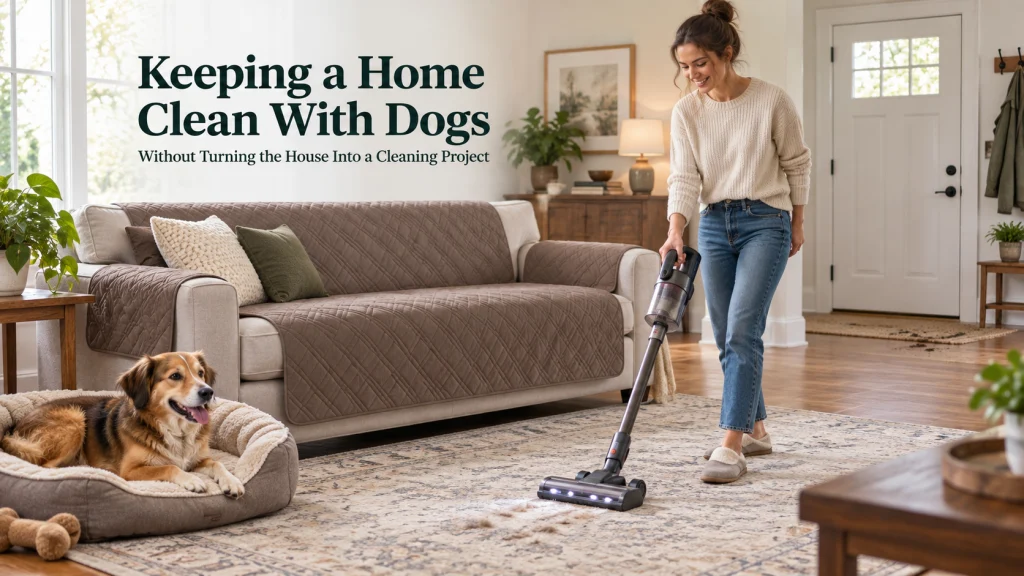
Keeping a home clean with dogs works best when hair, odor, organic accidents, tracked dirt, surface wear, and yard waste are treated as different jobs. Start with the mess and the surface, then decide whether the goal is prevention, routine cleaning, targeted cleanup, or physical protection. Ordinary cleaning is often enough, while disinfecting should be reserved for situations that call for it and should always follow the product label. The result is a smaller, more practical routine instead of a collection of cleaners and tools that all try to solve the same problem.
Start with the mess, not the cleaner
Keeping a home clean with dogs becomes much easier once the mess is named before a tool or cleaner is chosen. Loose hair on upholstery is not the same problem as urine in carpet, muddy traffic on a hard floor, a stale odor in fabric, or scratches on a couch arm. Each mess reaches a surface differently and creates a different workload. Treating them as one generic pet cleaning problem usually means buying more supplies while still repeating the same work.
I would sort the problem by source, surface, and goal before changing the routine. Hair needs removal, odor needs a source check, an organic accident needs prompt targeted cleanup, tracked dirt needs traffic control and floor care, and surface wear may need protection more than cleaning. Waste outdoors is a separate pickup and disposal job rather than a floor care problem. That simple split keeps the routine focused on what is actually happening in the home.
| Mess | Where it usually shows up | Primary goal | Best next path |
|---|---|---|---|
| Loose hair | Carpet, rugs, upholstery, bedding, hard floors | Lift or collect it before it embeds | Match removal method to the surface |
| Persistent odor | Soft surfaces, bedding, rooms, hidden accident areas | Find and remove the source | Check fabrics, padding, floors, and repeat problem spots |
| Urine, feces, or vomit | Carpet, upholstery, hard floors, washable fabrics | Contain and clean the affected material | Use a surface appropriate accident cleanup process |
| Tracked dirt and water | Entry routes, halls, kitchens, living areas | Limit spread and simplify routine floor care | Manage traffic and clean according to floor material |
| Surface wear | Couches, chair arms, floors, corners, high traffic areas | Reduce repeated contact damage | Add practical protection before more cleaning |
| Dog waste | Yard, waste station, outdoor route | Remove it consistently and dispose of it appropriately | Build a pickup routine that fits the household |
The first table separates the physical mess. The next step is choosing which household cleanup route owns the job, because cleaner selection is its own decision rather than a catchall for every stain, smell, or dirty surface. Use the seven routes below as the handoff point. If two problems occur together, route each one separately.
| Main problem | Continue with |
|---|---|
| Loose hair | Dog hair removal |
| Persistent odor | Dog smell in the house |
| Organic accidents | Pet stain and odor removal |
| Cleaner selection | Cleaning product selection |
| Floor mess | Floor cleaning and maintenance |
| Furniture wear and mess | Couch and furniture protection |
| Outdoor waste | Dog poop cleanup |
This route map is not a shopping list. It identifies the problem before you compare methods or equipment. A basic method is enough when it keeps up without damaging the surface or adding unnecessary work. Add a specialized tool class only when a specific workload, material, or access problem remains unsolved.
Decide whether the job is ordinary cleaning or actually needs disinfecting
Cleaning and disinfecting are different jobs, and the distinction matters in a home with dogs. Cleaning removes dirt and material from a surface, while disinfecting uses a product intended to kill germs on that surface. For many ordinary household messes, cleaning is the practical first job rather than automatic disinfecting. If disinfecting is appropriate, the surface should be compatible with the product and the label should control how it is used.
That means a muddy floor, loose hair, or routine grime should not trigger a stronger chemical routine just because a dog is involved. A product may require precleaning, a specific contact condition, ventilation, or a period when pets stay away from the area. Do not assume that a product described as natural is automatically safe around a dog, and never improvise mixtures between cleaners. If a label gives pet access instructions, those instructions are part of the cleaning decision rather than an optional extra.
Key point: Use cleaning for ordinary dirt and residue. Use disinfecting only when the situation calls for it. Follow the current label exactly, and do not mix bleach with other cleaners. Keep the dog away from wet disinfectant or treated areas until the label says the area is ready for contact.
A stronger product is not automatically a better answer. Use the simplest routine that removes the mess without conflicting with the surface or household conditions. If the job moves into suspected exposure, poisoning, or illness, stop treating it as housekeeping. That boundary keeps cleaning advice out of toxicology and medical treatment.
Remove loose dog hair according to the surface and how deeply it is trapped
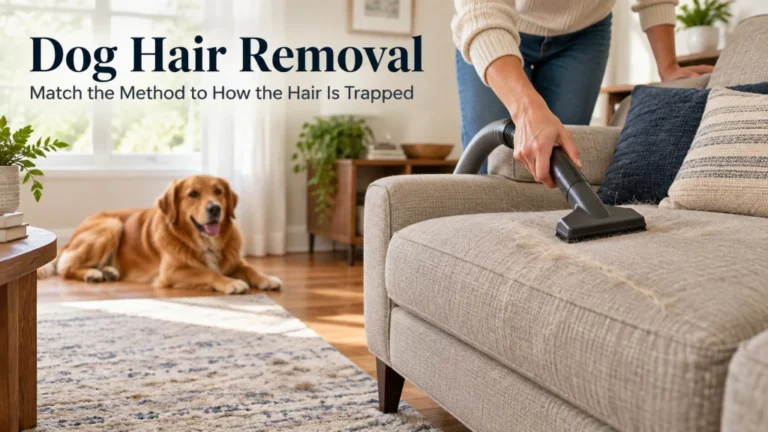
Loose hair behaves differently on a hard floor, a flat woven rug, deep carpet, clothing, and upholstered furniture. On smooth surfaces, the job is mainly collection before air movement and foot traffic spread the hair farther. On fabric, hair can work into fibers and creases, so the first pass may remove only what is sitting on top. The right method depends more on the surface and how embedded the hair is than on how powerful a tool sounds.
Start with the least aggressive method that can lift the hair without damaging the material, then work deeper only where needed. A vacuum attachment, washable cloth, rubber edge, brush, or reusable hair lifting tool may each make sense in different places, but none is a universal answer. If hair is the main problem, surface specific dog hair removal methods help match the method to carpet, upholstery, bedding, or hard flooring. Coat care that reduces loose hair before it reaches the room belongs in grooming rather than in the household cleanup routine.
- Hard floors: collect loose hair without pushing it from room to room.
- Carpet and rugs: remove surface hair first, then address what is trapped deeper in the fibers.
- Upholstery: work seams, cushion edges, and fabric direction instead of only cleaning the flat center.
- Bedding and washable covers: remove excess hair before laundering so the laundry step is not doing all the work.
Frequency should follow actual buildup rather than a universal schedule. A heavy shedding dog on dark fabric can create more work than a low shedding dog on smooth flooring. Watch whether hair accumulates faster than the routine removes it. Adjust frequency before buying another tool that performs the same job.
Treat whole home dog odor as a source finding problem rather than a fragrance problem
A room that smells like dog does not automatically need a stronger fragrance. Odor can come from washable bedding, an old accident below the visible surface, damp fabric, a frequently used couch, a crate mat, or a floor area that is not drying fully. Covering the smell can make the room seem better briefly while leaving the source unchanged. The useful question is where the odor is strongest and what material is holding it.
Work outward from the likely source instead of treating the entire room at once. Wash what is washable according to its care instructions, inspect soft surfaces and hidden edges, and check whether repeated odor lines up with a known accident or damp area. For odor that keeps returning, finding and removing dog smell in the house starts with locating the material that is holding the source. If the odor is coming from the dog’s body rather than the home, household deodorizing is the wrong system and should not replace appropriate dog care.
Handle urine, feces, and vomit as targeted organic accident cleanup
An organic accident is easier to manage when the first goal is containment rather than scrubbing. Remove solid material where present, absorb or lift excess moisture, and keep the mess from spreading into a larger area. The next step depends on whether the surface is washable fabric, carpet, upholstery, sealed hard flooring, or a porous material that can absorb liquid. Rubbing, flooding, or applying an unsuitable cleaner can make the cleanup harder by spreading residue or damaging the surface.
Use a cleaner only when its label and the surface instructions fit the job, and test material compatibility where that is appropriate. For urine, feces, vomit, or residual odor, choosing a pet stain and odor remover means matching the formula to the mess and material rather than assuming one formula belongs everywhere. Prompt cleanup is useful, but speed should not replace reading the label or checking the surface. A cleaner also cannot solve why an accident happened in the first place.
| Situation | Prevention focus | Cleanup focus |
|---|---|---|
| Repeated traffic on a washable surface | Use a removable cover or easier cleaning route | Clean the affected cover or surface before residue builds |
| Occasional urine accident | Keep suitable cleanup supplies accessible | Blot or extract moisture, then use a compatible labeled cleaner |
| Muddy entry route | Limit how far dirt travels through the room | Remove dry debris before wet cleaning when practical |
| Furniture wear | Add a washable barrier or change access | Clean only the material that is actually soiled |
Prevention and cleanup should not be confused with training or medical explanations. Repeated accidents in a previously reliable dog may need more than household cleaning. Marking and house training need behavior focused guidance rather than stronger deodorizer. Cleanup should remove the mess without pretending to explain its cause.
Choose household cleaners by label, surface, and pet contact conditions
A cleaner should fit three things at the same time: the mess, the material, and the way the dog uses the area. A floor the dog walks and lies on creates different contact conditions from a high shelf the dog never reaches. A porous fabric also behaves differently from sealed tile or finished wood. The useful decision is not whether a cleaner sounds pet friendly, but whether its current instructions fit the surface and the household setup.
Before using a product, check what it is intended to clean, whether rinsing is required, how the area should be ventilated, and when pets can return. When the main decision is the formula itself, choosing cleaning products for a home with dogs should start with the label, the surface, and the dog’s likely contact with that area. If the dog can lick, step on, or sleep against the treated surface, contact instructions matter even more. Skip any product whose directions do not make sense for the surface or the way the space is used.
- Confirm the surface is listed or clearly compatible with the cleaner.
- Check whether the product is for cleaning, disinfecting, stain removal, odor removal, or another specific job.
- Follow dilution, application, rinse, ventilation, and drying directions exactly when the label provides them.
- Keep the dog away for the period required by the label, especially while disinfectant is wet.
- Do not combine products or assume a homemade mixture is safer because the ingredients sound familiar.
This checklist is also a buying filter. Keep overlapping products only when one solves a surface or access constraint the other cannot. Fewer clearly assigned products are easier to use and verify. The goal is a small set of methods with defined jobs, not a cabinet full of pet labeled cleaners.
Maintain floors around fur, tracked dirt, water, and daily traffic
Floors take several dog related loads at once, which is why one cleaning method rarely handles everything efficiently. Hair can move with airflow, grit can scratch finishes, water can spread soil, and repeated traffic can concentrate grime along the same route. It helps to separate dry debris removal from wet cleaning rather than reaching for a mop every time the floor looks untidy. The floor material should control what comes next because sealed wood, tile, vinyl, carpet, and rugs have different care limits.
Build the routine around the route the dog actually uses through the house. Entry areas, water stations, favorite resting spots, and the path to the yard usually need more attention than low traffic rooms. A floor specific routine for keeping floors clean with dogs should match fur, grit, water, traffic, and the material underfoot. If a floor needs frequent aggressive cleaning to stay acceptable, prevention at the traffic source may be more useful than increasing chemical strength.
Protect couches and furniture before repeated wear becomes a cleaning problem
Furniture problems are often a mix of hair, body oils, dirt, moisture, and physical wear rather than a single stain. If the same cushion or arm is used every day, cleaning alone may not keep up with repeated contact. A washable cover, removable throw, access change, or protected resting area can sometimes reduce the job more effectively than another upholstery cleaner. The best option depends on the fabric, how the dog uses the furniture, and how much maintenance the household will actually keep doing.
For a couch, check where hair collects, whether moisture reaches the cushion insert, and whether claws or repeated jumping are creating wear that cleaning cannot reverse. When repeated contact is the real problem, protecting a couch from dogs is more useful than repeatedly deep cleaning the same area. Protection should be easy enough to remove and wash or it can become another chore that is ignored. A barrier that is difficult to secure, store, or clean may solve less than a simpler one that stays in use.
Build a routine for picking up and disposing of dog waste
Outdoor dog waste is a routine removal job, and it works best when pickup is tied to a route the household will actually follow. A large yard with several dogs may need a different cadence from a small yard used by one dog, but the basic goal is the same: keep waste from accumulating where people and dogs walk. Pick a consistent collection path, keep disposal supplies where they are easy to reach, and make responsibility clear if several people share the task. A routine that depends on remembering at random usually turns into a larger cleanup later.
For the outdoor route, dog poop cleanup and disposal should be organized around reliable pickup, a practical collection path, and appropriate disposal. The useful equipment is whatever makes pickup reliable without creating unnecessary storage or maintenance. That may be a very simple setup rather than a dedicated device. I would judge the system by whether it keeps up with the yard, not by how specialized the tool looks.
Keep dog body cleanup, entry layout, and potty causes in the right system
Household cleanup starts after the mess reaches the home, but several related tasks belong elsewhere. Bathing, coat care, and removing loose hair from the dog are grooming decisions, so move to grooming a dog at home when the problem is still on the coat. Entry layout, storage, washable zones, and traffic control belong in the home setup decision, including a practical dog mudroom setup when the household needs one. Separating those jobs prevents the cleaning article from becoming a general dog care checklist.
Repeated indoor accidents can also require a different path. Cleaning removes the mess, but it does not teach a dog where to eliminate or explain marking, routine disruption, or a sudden behavior change. For training decisions, move to potty training a dog rather than trying to solve the cause with stronger odor control. If a previously reliable dog’s elimination changes suddenly or other health signs appear, the owner level cleanup routine should stop short of diagnosis.
| If the main problem is | Keep the next decision with |
|---|---|
| Hair already on floors, rugs, upholstery, or clothing | Household cleanup |
| Loose coat, bathing, coat maintenance, or paw cleaning | Dog grooming and coat care |
| Entry zone layout, storage, gates, or washable home zones | Dog home setup |
| House training, marking, or routine behavior causes | Training and behavior guidance |
| Suspected poisoning, illness, hazardous exposure, or medical cause | Veterinary or poison control guidance |
| Deep contamination, sewage, structural damage, or material failure | Qualified cleaning or restoration professional |
The handoff matters because the same mess can point to different tasks. A dirty floor may need cleaning, while a recurring urine spot may need behavior guidance or a health evaluation as well. Keeping those decisions separate prevents one cleaner from becoming the answer to every cause. It also makes the next step clearer when ordinary cleaning is no longer enough.
Stop ordinary home cleanup when the problem becomes poisoning, illness, sewage, structural damage, or restoration
Some situations should not be solved by trying another household cleaner. Suspected ingestion of a cleaning product, contact with a hazardous chemical, unusual illness after exposure, or a sudden health related change in elimination needs appropriate professional guidance rather than a homemade treatment. The same boundary applies when contamination involves sewage, widespread mold, soaked building materials, or structural damage. Ordinary owner cleanup is useful only while the problem remains an ordinary household cleaning task.
If a dog may have contacted a cleaner, gather the product container and label information so a veterinarian or poison control professional can assess the actual substance and exposure. Do not induce vomiting, mix a neutralizing solution, or invent a treatment from household ingredients. If the problem is damage rather than exposure, stop when the material, subfloor, wall, or furniture cannot be cleaned safely with normal care instructions. Knowing when to stop is part of a practical cleaning system, not a failure of it.
Final thoughts: solve the mess that exists instead of buying one cleaner for every dog problem
A clean home with dogs does not require treating every surface as a special pet problem. Name the mess, identify the material it reached, decide whether the goal is removal, source control, targeted cleanup, or protection, and then use the simplest method that fits. Hair, odor, accidents, tracked dirt, wear, and yard waste become more manageable when each has a defined route. That is more useful than building one oversized routine around the idea that the entire house always needs deep cleaning.
Keep labels and surface instructions in the decision, especially when disinfectants or other chemical cleaners are involved. Add equipment only when it solves a real workload or access problem, and route grooming, home layout, training, medical concerns, and restoration to the system that actually owns the next decision. A smaller routine is easier to repeat and easier to verify. The practical goal is a home that recovers from normal dog life without turning cleanup into a second job.
FAQs
🐾 How do I keep my house clean with a dog that sheds a lot?
Remove hair according to the surface before it becomes deeply embedded, and focus more often on the rooms and furniture the dog actually uses. If hair is still building faster than the routine can handle, adjust collection frequency or method before adding another tool with the same job.
🧼 Do I need to disinfect every surface my dog touches?
No. Ordinary cleaning is enough for many routine household jobs, while disinfecting is an additional step for situations that call for it. When you do disinfect, follow the current label and keep the dog away for the required contact and drying conditions.
🛋️ What is the easiest way to keep a couch cleaner with a dog?
Reduce repeated contact with a washable barrier or another simple protection method that fits the way the dog uses the couch. Then clean hair, dirt, or moisture from that removable layer before the mess reaches deeper upholstery.
🧽 Why does a dog smell come back after I clean the room?
The source may still be present in bedding, upholstery, carpet padding, wood, or another absorbent material. Find where the smell is strongest and inspect the material there before adding more fragrance or repeating the same surface treatment.
🏠 Should I use one cleaner for floors, furniture, and pet accidents?
Only if the label and surface instructions clearly support each use. Different materials and messes can require different handling, so a product that fits one job may be unnecessary or unsuitable for another.
🐕 Can cleaning stop a dog from having accidents in the house?
Cleaning can remove the mess and residual odor, but it does not replace house training, marking management, or veterinary evaluation when a sudden health related change is possible. Treat cleanup and the cause as separate decisions.
References and Sources
- CDC cleaning and disinfecting guidance: Supports the distinction between cleaning and disinfecting, following disinfectant labels, avoiding cleaner mixtures, and keeping pets away from wet disinfectants.
- PetMD cleaning product exposure guidance: Supports owner level prevention around household cleaner exposure and the boundary between routine cleaning and veterinary guidance.
- AKC dog hair removal guidance: Supports matching hair removal methods to carpet, upholstery, clothing, and other household surfaces.
- AKC dog urine cleanup guidance: Supports prompt, surface specific cleanup and the distinction between removing an accident and addressing repeated elimination causes.