Bringing home a new dog goes more smoothly when the transition is put in order instead of treated as one giant checklist. Prepare the household, collect the important handoff information at pickup, keep arrival calm, build a simple routine, and adjust the pace to the dog in front of you. Puppies, rescue dogs, existing pets, children, work schedules, and health questions can change what needs attention next. The goal is to create a stable starting point and route specialized tasks to the right next step.
One arrival day creates several different timelines
Bringing home a new dog can make an ordinary household feel like it suddenly has twelve urgent jobs. Food, bathroom access, sleep, identification, household rules, work coverage, training, introductions, and health questions all matter, but they do not all need the same amount of attention at the same moment. I would put the transition in a simple order: make the home workable before the dog arrives, keep arrival quiet, establish predictable basics, then expand the routine as the dog gives you useful information. That sequence is more practical than trying to complete an ambitious first week checklist while the dog is still learning where the water bowl is.
The starting point also depends on who is coming home. A young puppy may need much more supervision and a puppy specific routine, while an adult rescue dog may arrive with gaps in history, unfamiliar habits, or a stronger need for space and observation. A home with children or other pets has introduction decisions that a one person household does not. This page gives the transition map, while more specific questions should move to the guide that actually owns that decision.
Start after the dog has been selected, not before
This transition begins once you have chosen or committed to a particular dog. Before leaving the pickup point, confirm the information that can travel home: health and vaccination records, medication or care instructions, identification details, the current feeding pattern, and useful notes about bathroom habits, handling, sleep, or behavior. Treat missing history as unknown instead of filling it with assumptions. If selection is still open, use the guide to choosing a dog that fits your household first.
The trip home is part of the handoff, so keep departure and arrival as calm and direct as the situation allows. Preserve the known feeding routine until there is a reason to change it, and bring records and instructions into the household plan instead of leaving them in a folder. A puppy, a large adult dog, or a dog with an uncertain history may still need very different supervision once home. Arrive with the known facts intact, then learn the unknowns from ordinary routine.
Prepare the household before arrival day
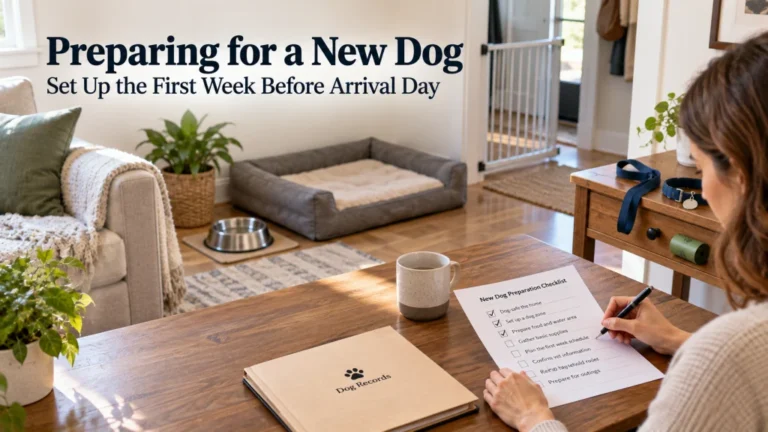
A useful homecoming setup removes avoidable friction before the dog arrives. Decide where the dog can rest, where food and water will go, how bathroom access works, and who covers each basic care task. Move medications, cleaners, food, trash, cords, fragile items, and unsafe objects out of the dog’s accessible area. For a fuller room by room setup, use the guide to preparing for a new dog before arrival.
Household rules should also be settled before the dog has to learn them. Conflicting rules about furniture, doors, feeding, sleeping areas, and children offering food make a new routine harder to understand. Have enough in place to cover known basic needs, but wait on optional choices that depend on the dog’s actual size, habits, coat, mobility, containment response, or routine. A short household agreement and a workable starting setup are more useful than buying for every possibility before the dog has shown what the home really needs.
| Universal priority | What may change by situation |
|---|---|
| Water and feeding plan | Food routine, placement, and professional guidance when health changes the plan |
| Quiet rest area | Bed, gated room, pen, crate, or another setup that suits the dog |
| Bathroom access | Supervision, mobility, previous habits, and household layout |
| Controlled home access | Age, behavior, chewing, mobility, and supervision |
| Clear care roles | Work schedules, children, shared households, or outside help |
Keep the universal needs stable while leaving room for the individual dog. Prepare the parts that protect basic care and safety now, then let observed fit, habits, and workload guide choices that can reasonably wait.
Choose the transition path that matches the dog in front of you
There is no single homecoming routine for every new dog. Age, previous living situation, behavior, health, handling comfort, and household experience can change the supervision and structure that make sense. Ask whether the setup helps the dog eat, rest, eliminate, move through the home, and interact without unnecessary pressure. Keep the framework stable while changing the details the dog needs.
Broad advice should split into a more specific path here. Puppies have developmental and supervision needs that differ from adult dogs, while an adopted dog may arrive with incomplete history or routines that do not transfer cleanly. A confident adult may handle home access quickly yet still need careful introductions. Those differences guide the next step without becoming a score for whether the transition is going correctly.
A puppy needs a puppy specific homecoming plan
A puppy is still learning household patterns, so supervision, rest, bathroom access, safe exploration, and simple communication matter more than a long command list. The home also has to account for chewing, body size, coordination, and puppy specific health guidance. Use bringing home a puppy for that sequence instead of treating a puppy as a smaller adult dog.
A newly adopted or rescue dog may arrive with more unknowns
A rescue dog’s history may be detailed, partial, or unknown, so early behavior should be interpreted cautiously. Quietness, restlessness, clinginess, withdrawal, or routine difficulty can have more than one explanation. Use bringing home a rescue dog for a manageable transition path without turning first observations or popular timelines into fixed labels.
Keep the first day smaller than the owner’s excitement suggests
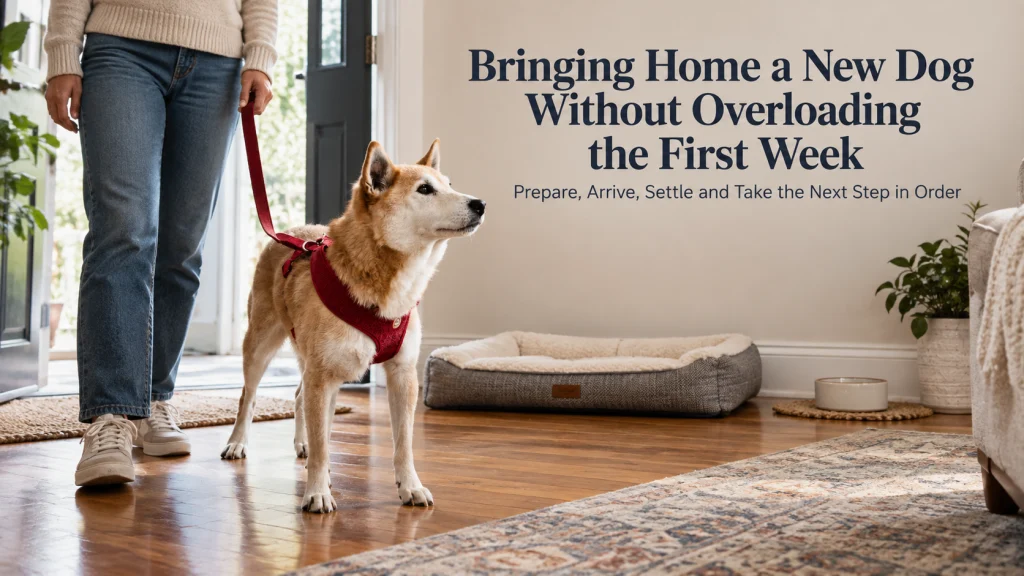
The first day is not a test of how many rooms, people, walks, or experiences the dog can handle. Arrival already brings new smells, rules, sounds, people, and surroundings. Keep the environment calm, show the basic areas that matter, provide water, follow the known feeding plan, offer bathroom access, and make rest easy to find. If the dog wants less interaction than expected, space can be more useful than another welcome session.
That does not mean every dog should be isolated or handled by a rigid decompression formula. Some dogs seek contact or explore quickly, while others need a narrower environment and more observation. Watch eating, drinking, elimination, rest, body language, and reactions to people, then adjust access rather than forcing a milestone. The owner still sets safe boundaries, but the pace should follow the dog’s response instead of a social schedule.
First week priority: keep the basics predictable before adding complexity. Food, water, bathroom access, rest, safe home access, identification, supervision, and a clear care schedule matter more than filling the calendar.
A smaller first day gives you cleaner information about what the dog actually needs. It also makes the next routine easier to build because fewer variables are changing at once.
Build the first week around predictable basics instead of an ambitious task list
A new dog routine should answer ordinary questions before it tries to optimize everything. Decide how food, water, bathroom trips, rest, home access, and care coverage work during normal household life. Predictability helps the owner notice changes and helps the dog learn what the home is asking. I would rather use a modest routine the household can repeat than a schedule that fails when normal life returns.
Routine should flex around age, health guidance, previous habits, work coverage, and the dog’s ability to settle. A puppy may need more supervision than an adult, while mobility or medical concerns may require veterinary input. If the dog cannot manage the plan safely or comfortably, change the setup instead of defending the schedule. Move specialized questions to the appropriate guide or professional.
Food, water, bathroom access, and rest create the daily skeleton
Keep the known feeding routine consistent enough that changes are easy to notice, and make water and bathroom access practical. Food choice, growth, and medical needs may require veterinary guidance, so this page should not become a nutrition prescription. Use feeding a dog in everyday life for the mealtime system while keeping basic care predictable and observable here.
Home access and containment should already have a workable plan
A dog does not need immediate access to every room to feel welcome. Gates, pens, closed doors, or other management can keep the environment understandable while you learn about chewing, house habits, rest, and everyday reactions. Use setting up a home for a dog when the decision becomes about zones, containment, beds, gates, or crates instead of assuming one tool is mandatory.
Training starts with simple communication, but detailed training belongs elsewhere
The first week is a good time to reward useful choices and make household expectations consistent, but every interaction does not need to become a formal lesson. Focus on communication the dog can understand and management that prevents repeated conflict. Use basic dog training guidance when the question becomes teaching cues, leash manners, house training, or a behavior plan.
Introduce the new dog to the existing household deliberately
People often think of an introduction as one moment, but household integration is usually a series of managed interactions. Children need clear rules about approaching, touching, feeding, and giving the dog space, while adults need to supervise instead of assuming friendliness guarantees comfort. Existing dogs may need neutral space, distance, separate resources, and repeated short interactions before shared access becomes ordinary. Cats and other animals need their own safety plan rather than being treated as another version of a dog introduction.
Do not force proximity to make the household feel officially integrated. If either animal cannot disengage, rest, eat, or move away comfortably, increase management and reduce pressure rather than extending the interaction. The same principle applies to visitors: the new dog does not need to greet everyone simply because people are excited to meet them. For the full household sequence, use the guide to introducing a new dog to people and pets, where the interaction itself can be handled in more detail.
- Give children a simple rule for when to approach and when to leave the dog alone.
- Keep food, resting areas, and valued items managed when another pet is present.
- Use barriers or distance when either animal needs a break.
- Supervise until the household has enough information to change the management plan safely.
- Seek qualified help when behavior raises safety concerns or the household cannot manage interactions reliably.
Deliberate introductions are not about making the dog socialize faster. They are about creating enough control and choice that the household can learn what works without turning every meeting into a high pressure event.
Watch adjustment without treating one timeline as a deadline
New dog adjustment is uneven because dogs do not all arrive with the same history, temperament, age, health, or household demands. A dog may eat normally before resting well, become affectionate before feeling comfortable alone, or understand the bathroom routine while still feeling uncertain around visitors. That is why fixed milestone formulas should be treated cautiously rather than used as a scorecard. The more useful comparison is the dog’s own pattern across repeated ordinary situations.
Look for practical trends you can actually use. Is the dog finding the resting area more easily, moving through routine transitions with less prompting, eating and eliminating in a more predictable pattern, or recovering more readily after normal household activity? Also note setbacks without assuming they erase all progress, because new environments keep revealing new triggers and preferences. When the pattern suggests a health or significant behavior concern, stop interpreting it as ordinary settling and move to qualified help.
| Observation | Useful next question |
|---|---|
| The dog rests well in one quiet area but not in busy rooms | Can the household protect that rest area while expanding access gradually? |
| The dog is comfortable with adults but avoids children | Can contact be reduced while children follow clearer space and supervision rules? |
| The dog follows the home routine but struggles when left | Does the leaving plan need a separate training or behavior discussion? |
| Eating, drinking, elimination, movement, or behavior changes sharply | Is this outside ordinary transition uncertainty and better handled by a veterinarian or qualified professional? |
The purpose of observing adjustment is to choose the next action, not to assign the dog a label. A timeline can organize your notes, but it should not overrule the dog in front of you.
Separate normal transition uncertainty from questions that need qualified help
Some uncertainty is expected when a dog enters a new home, but this article should not turn health or behavior changes into a home diagnosis. Changes in appetite, drinking, elimination, mobility, pain related behavior, persistent distress, or other concerning physical signs need veterinary context rather than a settling theory. Likewise, aggression, severe fear, escape risk, or behavior the household cannot manage safely deserves qualified support instead of internet improvisation. A transition plan is useful only while it stays inside ordinary owner level care.
Keep records that make professional help easier. Save health and vaccination records, adoption or breeder information, medication instructions, feeding details, microchip information, and any known behavior notes, then write down changes you observe without trying to diagnose the cause. If a shelter, rescue, breeder, foster home, veterinarian, or trainer already knows the dog, their history may help explain what is new and what was present before the move. Evidence is more useful than guessing, especially when the dog’s early behavior is being shaped by several changes at once.
Choose the next step by what the dog actually needs
Let the next guide follow the first real constraint the household uncovers. If leash access is making bathroom trips difficult, walking guidance becomes relevant; if home zones are failing, home setup moves forward; if meals are inconsistent, feeding deserves attention. This keeps the homecoming page focused on transition while the specialized guide handles the deeper decision. Recurring friction is the useful signal.
Prioritize by consequence and frequency. Safety and basic care come first, recurring routine problems come next, and convenience upgrades can wait until the dog shows whether they would solve anything. An active dog may need exercise planning sooner, a long coated dog may need grooming sooner, and a household that travels often may need transport planning earlier. Different sequences can all be reasonable.
| Question | Where to continue |
|---|---|
| Training and manners | Basic dog training guidance |
| Feeding routine and equipment | Everyday feeding guidance |
| Home zones and containment | Home setup guidance |
| Walking and exercise | Walking and exercise guidance |
| Grooming and hygiene | Home grooming guidance |
| Play and enrichment | Enrichment guidance |
| Vehicle travel | Dog travel guidance |
| Health or serious behavior concern | Veterinarian or appropriately qualified professional |
Use the table after you can name the problem clearly enough to choose the guide that owns it.
Walking and everyday exercise
When the next question becomes leash activity, outdoor access, or exercise, use walking and exercising a dog. The homecoming page only needs enough movement planning to keep daily care workable. Exercise should match the individual dog, not the owner’s excitement about a new routine.
Grooming and hygiene
If brushing, bathing, nail care, handling, or tools become the next issue, use how to groom a dog at home. Do not add unnecessary handling because grooming appears on a checklist. Start with what the coat and hygiene situation actually requires.
Enrichment and play
When the dog is ready for more structured activity, use keeping a dog mentally stimulated to match play and enrichment to the dog. More toys are not automatically better while the dog is learning to rest. Add activity because it serves the dog, not because the house looks under supplied.
Transport and travel
Future vehicle travel deserves its own setup rather than an improvised repeat of pickup day. Carrier, restraint, vehicle fit, and safety depend on the dog and exact equipment. Use traveling with a dog when transportation becomes the real task instead of burying safety sensitive gear questions here.
Build one transition map with prepare, arrive, settle, integrate, and handoff stages
The simplest way to avoid overload is to give each decision a stage. Preparation comes first, arrival covers immediate basics, settling builds routine and observation, integration manages household relationships, and handoff moves specialist topics to the right guide. The stages can overlap, but the order prevents every question from becoming urgent at once. Safety sensitive or medically concerning issues can move directly to qualified help.
Use the map as a decision tool rather than a deadline. A puppy may need more supervision, while an adopted adult may need more observation before access expands. Another dog may handle the home quickly but require slower pet introductions. The map works when it helps you choose the next task without pressuring the dog to match a preset schedule.
| Stage | Main job | What to avoid | Handoff when needed |
|---|---|---|---|
| Prepare | Make the home safe, assign care roles, confirm handoff records and routine | Buying for every possible scenario | Home setup or feeding |
| Arrive | Keep the trip home and entry calm, then provide basic care | Extra stops, forced greetings, and too much novelty | Puppy or rescue guidance |
| Settle | Repeat basics and observe | Using a fixed timeline as a test | Training or qualified help |
| Integrate | Manage introductions and expand access | Assuming one good meeting proves compatibility | Household introduction guidance |
| Handoff | Choose the next specialized task | Solving every care system at once | Relevant specialist guide |
The owner gets one practical map while each deeper decision keeps a clear place to go. If one stage exposes a problem, address that problem before expanding the next stage.
Final thoughts: a smoother homecoming comes from sequencing, not doing everything immediately
A new dog does not need a perfect household on arrival. The dog needs basic care that works, a manageable environment, consistent people, and enough room for the routine to change as you learn more. Prepare what can be prepared, keep the first day small, build predictable basics, and make introductions deliberate. That gives you better information than an overloaded schedule full of new tasks.
From there, let the dog’s actual needs choose the next guide. Puppy care, rescue transition, introductions, training, feeding, home setup, exercise, grooming, enrichment, travel, and qualified health or behavior help all have different decision logic. You do not need to solve them all at once to help a dog adjust to a new home. A good transition is an organized beginning, not a race to finish dog ownership in the first week.
FAQs
🐾 What should I do first when I bring a new dog home?
Start with a calm entry, water, bathroom access, a safe resting area, and the feeding routine you already know. Keep access manageable and avoid stacking visitors, introductions, training sessions, and outings onto the same arrival period.
🏠 Should I let my new dog explore the whole house immediately?
Not necessarily. Open space according to the dog’s age, chewing, house habits, mobility, confidence, and your ability to supervise, then expand access when the current setup is working.
🛏️ How do I make the first week easier for a new dog?
Keep food, water, bathroom access, rest, supervision, and household rules predictable. Add new experiences gradually enough that you can tell whether the dog is coping comfortably instead of changing several things at once.
🐕 Does the same adjustment timeline work for every dog?
No. Age, history, health, temperament, previous routine, household activity, children, other pets, and the dog’s response to the environment can all change the pace, so use timelines for organization rather than as deadlines.
👨👩👧 Should family and friends meet the new dog right away?
Keep early contact limited to what the dog can handle comfortably and what the household can supervise well. A dog that is tired, avoiding contact, unable to settle, or overwhelmed by activity may benefit from fewer introductions and more protected rest.
🩺 When should I stop treating a problem as normal adjustment?
When the concern involves health, pain, significant changes in eating or drinking, elimination, mobility, severe distress, aggression, or a safety problem the household cannot manage, move beyond general settling advice. Use a veterinarian or other appropriately qualified professional for the specific concern.
References and sources
- AAHA new dog checklist: supports preparation, information handoff, settling, routine, and professional support.
- AKC guidance on decompression: supports individual adjustment and lower pressure interaction.
- AKC dog introduction guidance: supports managed introductions and supervision.
- BC SPCA new dog moving in guidance: supports home preparation, exploration, and child guidance.