
Good dog training starts by separating the method, the skill, the environment, and the seriousness of the behavior. Reward based teaching and sensible management give owners a practical starting point for cues, house training, crate work, leash skills, socialization, routine handling, and common manners. Age, history, distraction level, fear, physical comfort, and the home setup can change the right next step. This guide helps you choose the correct training path while keeping medical concerns, panic, aggression, and other serious cases outside ordinary do it yourself training.
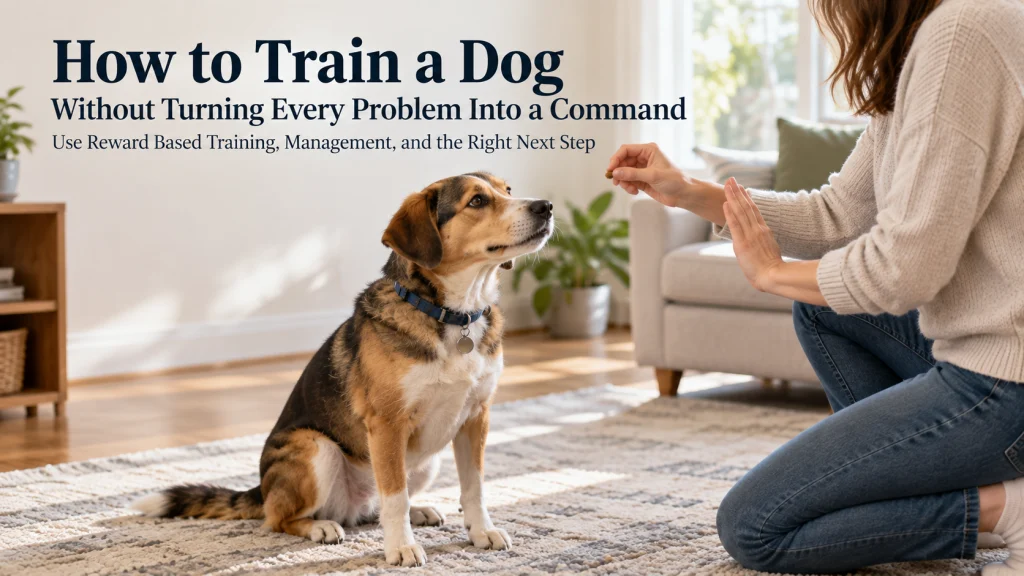
Start by separating method, skill, environment, and severity
Learning how to train a dog gets confusing when every issue is treated as the same problem. A dog that does not know a cue needs teaching, while a dog struggling around distractions may need easier conditions or better management. Those are different jobs even when they appear together. I would identify the job first, then choose the exercise instead of adding commands or reaching for a correction.
This distinction keeps ordinary manners from swallowing problems that need different help. Pulling from unfinished leash skills is not the same as freezing outdoors in fear, and jumping is not the same as a sudden change that may involve pain. A practical plan begins with what the dog can do now, what is happening around the dog, and whether everyone can stay safe. The table below sorts the problem before practice begins.
| Question | What it means | Owner level next step |
|---|---|---|
| Method | How the dog learns what pays off | Use reward based teaching and clear feedback |
| Skill | The behavior the dog is learning | Practice one clear response at an achievable level |
| Environment | Distractions, access, distance, and setup | Make the situation easier and prevent repeated failure |
| Severity | Whether fear, panic, aggression, pain, or safety risk is involved | Hand off when the case exceeds owner scope |
Use this framework before choosing an exercise. It is the base for the more detailed dog training basics path. It also prevents a broad guide from becoming one giant command list. Route the task once you know what kind of problem it is.
Use reward based training as the default method
Reward based training teaches the dog which behavior is worth repeating, then arranges practice so the dog can make that choice. The reward can be food, play, access, or another outcome that matters to that dog in that setting. A short marker word or click can identify the exact behavior that earned reinforcement, but timing matters because the marker needs to happen as the behavior occurs. A quiet room and a busy sidewalk create different difficulty, so cues, rewards, and distractions still have to match the setting.
Owners can create behavior in several basic ways. Luring guides the dog into a position, capturing rewards a useful behavior the dog offers on its own, and shaping reinforces small steps toward a more complex behavior. These are teaching mechanics, not separate philosophies, and each works best when the dog can understand what earned the reward. Management and boundaries still matter, and AVSAB recommends reward based methods while advising against aversive methods as a training foundation.
- Choose one behavior you can describe clearly.
- Practice where the dog can still notice you and respond.
- Reward the response you want repeated.
- Reduce distractions or distance if success falls apart.
- Use management so the unwanted behavior is not constantly rehearsed between practice sessions.
Rewards are part of a learning system, not a bribe that replaces structure. The dog still needs clear expectations. The environment still needs sensible management. Once those pieces are clear, individual skills become easier to organize.
Teach a shared language of everyday cues
Cues are useful because they give the household and the dog a shared, predictable way to communicate. Sit, down, come, stay, leave it, and a release cue can support daily routines, but the useful set depends on the household rather than on a universal obedience checklist. A dog who understands a cue in the living room may not understand it beside visitors, food, wildlife, or street noise because the context is harder. Build reliability by changing one difficulty at a time instead of assuming the word itself should work everywhere.
Consistency also means the people in the home should agree on what a cue means and what response earns reinforcement. If one person uses the same word for several different actions, the dog is being asked to solve a language puzzle before solving the training task. Keep the cue clean, help the dog succeed, and reward the behavior you actually want. The basic dog commands guide is the better next step when the main question is how to teach and practice specific everyday cues.
Build toileting habits as a separate house training system
House training works best when it is treated as a routine and supervision problem, not as a test of whether a dog is being obedient. The owner controls access, notices patterns, provides appropriate opportunities to eliminate, and reinforces success in the correct place. Accidents tell you that some part of timing, supervision, access, communication, or the dog’s physical condition needs another look. Punishing an accident after it happened does not teach the location choice you wanted.
Puppies, newly adopted dogs, and adult dogs with a disrupted routine may need different levels of supervision and different opportunities, so a rigid schedule is not the point. If elimination changes suddenly, becomes unusually frequent, appears difficult, or comes with other concerning signs, basic training should not be used to explain away a possible medical issue. For the actual setup and progression, use the potty training a dog guide. That keeps the broader training plan focused while giving house training enough detail to stand on its own.
Teach calm crate use and ordinary alone time without treating panic as a crate problem
A crate can be part of a routine, but the training goal is calm, voluntary comfort with the space rather than simply keeping the door closed until the dog stops responding. Start with the dog’s current comfort level, pair the area with positive experiences, and make the steps easy enough that the dog can still settle and engage. The physical setup matters too, because crate dimensions, placement, household traffic, temperature, and access are home management questions as well as training questions. For choosing and arranging the space itself, the broader home setup guide owns that decision.
Ordinary protest, uncertainty, and true panic should not be treated as interchangeable. Repeated escape attempts, intense distress, injury risk, or severe responses to being alone are not problems to solve by extending confinement or adding stronger corrections. The crate training guide covers the owner level learning process, but serious distress needs a qualified behavior or veterinary path. That boundary protects the dog from having a fear problem mislabeled as a simple crate manners problem.
Train leash skills separately from deciding how much exercise the dog needs
Loose leash walking is a skill about how the dog and handler move together, while exercise planning is a different decision about activity needs and physical capacity. A dog can need more activity and still need easier leash practice, or have good leash manners while needing an exercise plan adjusted for age, health, climate, or fitness. Mixing those questions often creates poor training choices, such as expecting a long walk to teach leash position by repetition alone. Skill practice should be clear enough that the dog can notice and earn the behavior you want.
For leash learning, start where pulling is manageable, reinforce the position or attention pattern you want, and change direction, distance, or distraction before frustration takes over. For the broader question of activity amount and outdoor routine, use the walking and exercising a dog guide. When the problem is specifically the walking skill, the leash training guide is the more focused path. Keeping these decisions separate prevents exercise advice from pretending to be training instruction.
Solve everyday unwanted behavior by teaching alternatives and changing reinforcement
Jumping, barking for attention, counter surfing, grabbing household items, and other common problems often persist because the behavior keeps producing something valuable or because the dog has not learned a better alternative. The useful owner question is not whether the dog is being stubborn. Ask what happens before the behavior, what the dog gains from it, what you want the dog to do instead, and how the environment can make that alternative easier. That turns a vague complaint into a training problem you can actually define.
Management is especially important here because practice changes behavior in both directions. If food remains within reach, visitors continually reward jumping with attention, or the dog rehearses fence barking throughout the day, a short training session is competing with a much larger pattern. The everyday dog behavior problems guide helps sort ordinary owner level issues from cases that need more support. Fear, aggression, panic, compulsive behavior, and sudden major changes should not be reduced to a manners worksheet.
Train cooperative participation in routine handling and care
Training is also useful when nothing looks like traditional obedience. A dog can learn to approach a handling station, hold a comfortable position briefly, offer a paw, accept gentle touch, or pause while routine care is prepared. These skills can reduce conflict around ordinary owner tasks because the dog knows what behavior is expected and has a predictable path to reinforcement. The exact plan should match the dog’s comfort, body sensitivity, history, and the care task.
Cooperative participation does not mean pushing through obvious fear, pain, or unsafe resistance. If handling suddenly becomes difficult, the dog reacts as if something hurts, or the task moves into professional grooming or veterinary procedure territory, training should not be used to mask the underlying issue. The cooperative care dog training guide focuses on the owner level skills that can be practiced safely. The goal is better communication during routine care, not forcing compliance.
Match the training plan to the dog’s age, environment, and current ability
The same exercise can be easy for one dog and impossible for another because learning does not happen outside context. A young puppy may have limited attention and little experience with the environment, while an adult dog may arrive with established habits or uncertainty in a new home. Noise, floor surface, visitors, other animals, access to windows, yard layout, and the handler’s routine can all change the difficulty of a task. I would lower the challenge until the dog can succeed, then build from that point rather than treating mistakes as proof of defiance.
Newly adopted dogs also need room for settling and observation before the household turns every waking moment into a lesson. Early priorities may be predictable routines, safe access, toileting, rest, name response, and simple communication rather than a long list of cues. The bringing home a new dog guide covers that transition in the correct context. Training can begin gently during settling, but the plan should respect what the dog is currently able to process.
Use a simple first training plan
A useful first plan is small enough that the owner can tell what changed. Pick one task, define the behavior in plain language, choose a practice environment where the dog can respond, decide what reward will matter there, and note the management needed between practice attempts. If the dog repeatedly fails, change the setup before assuming the dog needs more pressure. This worksheet keeps the plan tied to observable conditions instead of vague goals.
| Plan question | Example of a useful answer |
|---|---|
| What do I want the dog to do? | Keep four paws on the floor when a familiar person enters |
| Where can the dog succeed? | At a comfortable distance with one calm visitor |
| What will I reinforce? | Standing calmly or moving to a chosen spot |
| What will I manage? | Use distance and controlled access so jumping is not repeatedly practiced |
| What tells me to make it easier? | The dog stops responding, cannot disengage, or becomes increasingly stressed |
Once the dog is succeeding, change one part of the challenge at a time. Watch what changes in the response. Make the task easier again if success falls apart. This keeps the plan readable and practical for the household.
Use management to prevent repeated failure while a skill is still being learned
Management changes the environment so the dog does not keep practicing the behavior you are trying to replace. That might mean controlling access to food on a counter, using distance from a trigger, arranging a calmer greeting, closing access to a distracting window, or choosing a quieter practice location. Management is not a substitute for teaching when a skill is needed, but it gives teaching a better chance to work. It also protects the household from expecting perfect behavior before the dog has learned it.
The best management choice is usually the one the household can apply consistently without creating a new welfare or safety problem. A complicated setup that nobody follows is less useful than a simple change that reliably prevents rehearsal. As the dog’s skill improves, management can be adjusted according to real performance rather than removed because the calendar says it should be gone. Training and management work together because one builds the behavior and the other controls the conditions around it.
Know when veterinary or qualified behavior help is the correct next step
Owner level training has a clear boundary. A sudden behavior change can be associated with pain or another medical issue, so a new and unexplained shift in behavior deserves veterinary consideration instead of an assumption that the dog has become disobedient. Serious fear, aggression, panic, repeated escape attempts, self injury risk, or realistic danger to people or animals also changes the decision. These cases may still involve learning, but they should not be handled as ordinary manners problems by trial and error.
Professional titles in dog training and behavior do not all mean the same thing, so method, education, credentials, and scope matter when choosing help. Look for professionals who use humane reward based methods, can explain what they are doing, and recognize when veterinary assessment is needed. Avoid guarantees and correction first approaches that promise to dominate or suppress the problem without understanding its cause. The table below keeps the handoff simple without pretending to diagnose the dog.
| Situation | Reasonable owner step | When to hand off |
|---|---|---|
| Dog is learning a new everyday cue | Use clear reward based practice and manageable distractions | Get coaching if progress stalls or the plan is unclear |
| Common manners problem without major fear or safety risk | Teach an alternative and manage the environment | Use a qualified trainer if the household cannot safely or consistently apply the plan |
| Sudden major behavior change | Do not assume a training cause | Seek veterinary assessment |
| Fear, aggression, panic, or credible bite risk | Prioritize safety and avoid forced exposure | Seek qualified behavior help, with veterinary involvement when appropriate |
This boundary is part of good training judgment. It keeps ordinary teaching in owner scope. It also prevents serious cases from being reduced to manners. Knowing when to stop experimenting matters as much as knowing how to reinforce a cue.
Choose the training path that matches the actual task
A broad dog training guide is most useful when it helps you stop searching broadly. Once you know whether the issue is a method question, a specific skill, a house routine, a social experience, an everyday behavior problem, or routine handling, you can move to the narrower guide that owns that decision. That prevents one topic from being stretched until it becomes generic advice. It also keeps exercise, home setup, grooming, feeding, enrichment, and travel decisions in the parts of the site built for those tasks.
Use the table as a routing map, not as a checklist that every dog must complete. A household dealing with house training may not need a leash lesson next, while another dog may already be clean indoors and need help with calm greetings or cooperative handling. Start with the problem that affects daily life now, then move only when another task becomes relevant. The right sequence is the one that fits the dog and household in front of you.
| Training need | Where to go next |
|---|---|
| Method, reinforcement, timing, and practice structure | Dog training basics |
| Teaching everyday cues | Basic dog commands |
| Indoor toileting habits | Potty training a dog |
| Calm crate learning and ordinary alone time | Crate training a dog |
| Loose leash skills | Leash training a dog |
| Safe learning around people, dogs, places, and events | Dog socialization |
| Common unwanted behavior and owner level management | Dog behavior problems |
| Participation in routine handling and care | Cooperative care dog training |
If the task is really about exercise, crate selection, grooming, feeding equipment, enrichment, or travel, route to that topic. Do not force it into training. Each task needs its own decision logic. A clear boundary makes the answer more useful.
Final thoughts: train the task in front of you instead of forcing every problem into one method
Dog training becomes easier to reason about when you stop treating every unwanted behavior as a command problem. Use reward based teaching to show the dog what works. Manage the environment so learning can happen, and practice at a level the dog can currently handle. Then route the task by what it actually is: a cue, toileting routine, crate skill, leash skill, social experience, everyday behavior issue, or handling skill.
The same framework also tells you when to stop. Sudden behavior change, significant fear, aggression, panic, pain concerns, and serious safety risk should not be hidden inside ordinary owner training. Adjust the plan to the dog’s age, history, environment, and current ability, and use qualified veterinary or behavior support when the problem crosses that boundary. Good training is not about having a command for everything; it is about making the next decision clear and humane.
FAQs
🐕 What should I teach my dog first?
Start with the skill that most improves daily communication or safety. The best first skill depends on age, history, environment, and what is creating the most friction at home.
🎯 Do I need treats every time I train?
You need reinforcement the dog values, and food is only one option. Play, access, praise, or another meaningful outcome can also work, while harder skills usually need more consistent reinforcement.
🏠 Why does my dog listen at home but not outside?
Outside environments add distractions, movement, smells, distance, and competing rewards. Increase distance, choose a calmer location, or ask for an easier version of the behavior before building difficulty again.
🦮 Is leash pulling a training problem or an exercise problem?
It can involve both, but they are different decisions. Teach loose leash skills separately while considering exercise needs according to age, health, activity level, environment, and veterinary guidance when relevant.
🧠 Does reward based training mean ignoring bad behavior?
No. Reward based training can include preventing access, changing the environment, and teaching an alternative that earns reinforcement. The plan relies on teaching and management rather than pain, fear, or correction first methods.
⚠️ When should I stop trying to solve a behavior problem myself?
Stop treating it as a basic training problem when there is significant fear, aggression, panic, injury risk, a credible bite risk, or a sudden unexplained behavior change. Veterinary assessment or qualified behavior help may be the correct next step.
References and sources
- AVSAB position statements: supports the reward based method boundary and guidance against aversive methods.
- Vieira de Castro and colleagues: provides peer reviewed evidence comparing reward and mixed training approaches.
- PetMD dog training basics: supports owner guidance on reinforcement, cues, house training, crate training, leash skills, and trainer selection.
- AKC mark and reward guidance: supports marker timing, luring, capturing, and shaping as practical ways to teach behavior.
- PetMD aggression guidance: supports veterinary assessment when a dog shows a sudden behavior change that may involve pain.