Dog toy safety depends on what the toy becomes during real play, not only on what the package says when it is new. Size, chewing style, exposed internal parts, sharp damage, loose fragments, and cleaning limits can all change whether a toy is still suitable for a particular dog. The practical habit is simple: choose for the dog in front of you, supervise new toys, inspect wear, and retire anything that can be swallowed, cut the mouth, or expose parts the dog can pull free. Medical concerns after swallowing material, choking, ongoing vomiting, abdominal pain, or a suspected tooth injury belong with a veterinarian rather than a home toy check.
Dog toy safety can change during a single play session
A toy’s safety is not decided once by the label because a dog can change the toy with teeth, paws, pulling, and repeated impact. A toy that begins as one solid object can become a loose squeaker, an open seam, a cracked edge, or several small pieces after hard play. That is why I would inspect the toy as it exists now, not as it looked when it came out of the package. For the broader role toys play in daily activity, start with keeping a dog mentally stimulated, then use the dog toys guide to match toy type to the job.
The most useful way to think about safe dog toys is to combine the dog’s body size with the way that dog actually plays. A gentle carrier may keep a soft toy intact for a long time, while a dog that grips, shakes, pins, and tears can expose the same toy’s weak points quickly. Most everyday dog toy hazards become easier to judge when you look for a change in size, shape, surface, seams, or accessible parts. The label can help you start, but the condition of the toy during use should decide whether play continues.
Start with a toy that cannot be swallowed whole during normal play
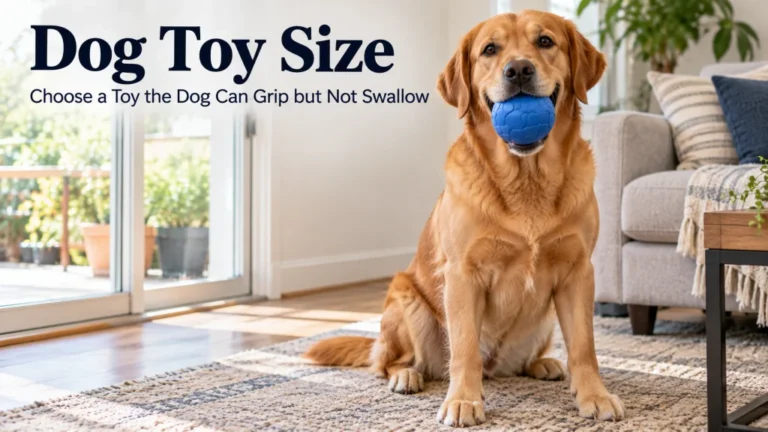
A toy should be large enough that the dog cannot take the entire object deep into the mouth during normal carrying, chewing, or fetch. The right size therefore depends on more than the dog’s weight because head shape, mouth size, grip style, and the way the toy compresses can change the practical fit. A soft ball that collapses under pressure may behave very differently from a rigid object with similar outside dimensions. If size is the main uncertainty, use the more detailed dog toy size check before deciding whether the toy belongs in the rotation.
A dog toy choking hazard can also develop after wear makes a once acceptable toy smaller or creates a detachable piece. Check whether a damaged end, torn flap, broken chunk, or loosened component can now fit fully into the mouth even if the original toy could not. I would treat that change as a reason to stop play and reassess rather than waiting for the dog to remove the piece completely. A favorite toy does not earn extra safety margin just because the dog has used it many times before.
Supervise every new toy until you understand how this dog uses it
Supervision is most useful when it helps you learn the dog’s play pattern instead of serving as a vague promise to watch closely. Notice whether the dog carries the toy, gnaws one spot, crushes it, picks at seams, tries to remove parts, or turns a fetch item into a chew object. A toy that works for one style of play may fail quickly when used for another job. Early observation gives you the information needed to decide whether the toy can stay available, should be limited to interactive sessions, or should be removed.
Build the inspection around repeatable checks so the household notices changes before they become easy to miss. Run your fingers over the surface, look at seams and attachment points, compare the current size with the original shape, and check whether any internal part is becoming reachable. High intensity play deserves another look afterward because damage can appear suddenly rather than building in a neat, predictable way. The checklist below keeps attention on failure points rather than on marketing language.
- Check that the toy is still too large to swallow whole during the dog’s normal play.
- Look for open seams, exposed stuffing, loose squeakers, detached caps, loosened eyes, tags, ribbons, or other parts the dog can pull free.
- Check rope and fabric toys for frayed sections or long loose strands that the dog could pull off and swallow.
- Feel for cracks, sharp edges, splinters, deep damage, or sections that are thinning enough to break away.
- Watch for repeated attempts to tear off or swallow pieces instead of simply carrying or interacting with the toy.
- Remove the toy when meaningful damage changes its size, structure, or accessible components.
A checklist is only useful if it changes the decision. When a toy passes, keep matching supervision to the dog’s actual play style rather than assuming it is permanently safe. When it fails, retire it or move to a different toy type instead of trimming, taping, or improvising a repair that the maker does not support. That keeps inspection focused on observable condition rather than on trying to rescue every favorite toy.
Remove plush toys when seams open and stuffing becomes accessible
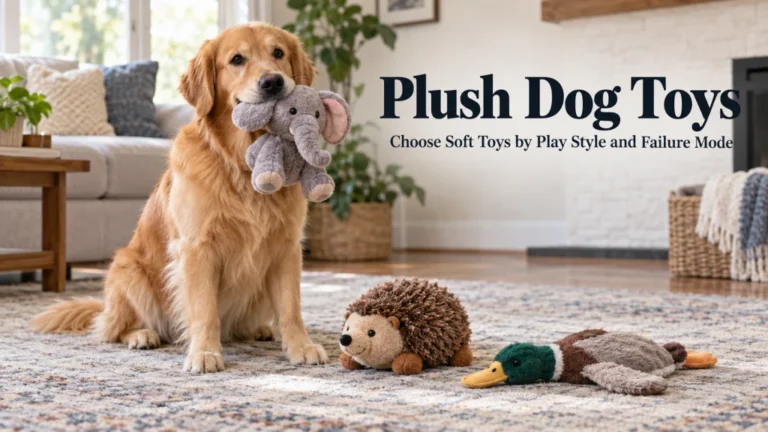
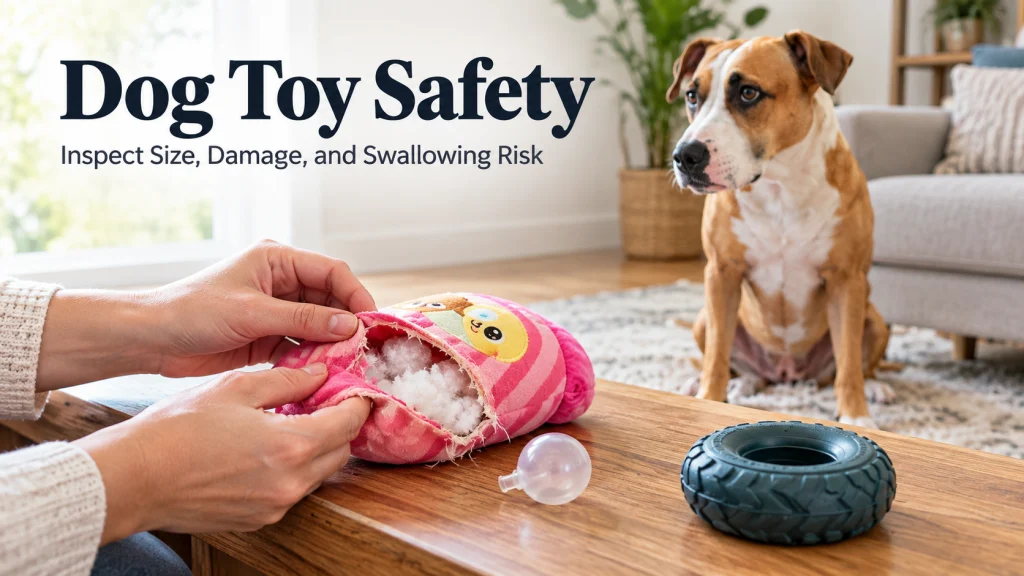
Plush toys deserve a seam check because fabric damage can turn soft filling and internal components into loose material the dog can pull out. A small opening matters more when the dog immediately works at that spot with the front teeth, because the opening can widen fast. Once stuffing is accessible, I would remove the toy rather than push the filling back inside and return it to play. For buying and construction decisions specific to this toy type, use the separate guide to choosing plush dog toys.
The practical threshold is structural failure, not whether the outside still looks mostly presentable. Flattened fabric, cosmetic staining, or worn fuzz may be less important than a seam that has opened enough to expose what is inside. A dog that carries plush toys gently creates a different workload from one that braces the toy with the paws and pulls at a single weak point. Match the retirement decision to the damage you can see and the behavior that is acting on it, not to how much you paid for the toy or how attached the dog seems to be.
Remove squeaky toys when the squeaker or other internal parts become reachable
A squeaker is useful only while it remains contained inside a toy that is still structurally sound. If a seam, puncture, or torn panel lets the dog reach the squeaker, stop the session before the dog has the chance to pull it free and mouth it as a separate object. The same logic applies to other internal parts that were not intended to be played with on their own. For construction and buying choices that are specific to sound making toys, see the guide to squeaky dog toys.
Do not use the dog’s past behavior as proof that an exposed part is harmless. A dog that ignored a squeaker before may become interested once it is loose, easier to grip, or moving separately from the rest of the toy. Supervision helps you interrupt that transition, but it does not make an exposed component acceptable for continued play. Once the internal part is reachable, the safer decision is to remove the damaged toy rather than wait to see what the dog does next.
Retire toys that crack, splinter, develop sharp edges, or shed pieces
Harder toys can fail differently from plush toys, so the inspection should move from seams to edges, cracks, missing material, and fragments. A deep crack can create a sharp lip, a thinning section can snap, and repeated chewing can reduce an end until a piece becomes easy to swallow. Do not wait for complete breakage when the current damage already changes the surface or creates a detachable section. The relevant question is whether the dog can safely keep interacting with the toy in its present condition.
Use the dog’s chewing pattern as part of that judgment because a small cosmetic mark on one toy may become the focus of intense gnawing on another. If the dog repeatedly attacks the same damaged point, the chance of further material loss is different from a dog that simply carries the item. I would also skip home repairs that add tape, glue, fasteners, or other parts unless the manufacturer specifically provides a supported repair method. The table below separates ordinary wear from conditions that should end or change the play session.
| What you see | What it means for play | Practical next step |
|---|---|---|
| Light surface marks with no loose material | The toy may still be usable if size and structure have not changed | Keep inspecting and match supervision to the dog’s play style |
| An opening seam or reachable stuffing | Internal material can now be pulled out and swallowed | Remove the toy from use |
| A reachable squeaker or detached internal part | The part can become a separate object small enough to fit in the mouth | Remove the toy immediately |
| Frayed rope, loose string, ribbon, tag, eye, or similar external part | The dog can pull free and swallow a strand or detachable component | Stop use when the part is loose, fraying, or easy to remove |
| A crack, sharp edge, splinter, or missing chunk | The surface or structure has meaningfully failed | Retire the toy and choose a better match for the workload |
| A worn section that is now small enough to swallow | The original size choice no longer protects against swallowing | Stop use and replace the item with a more suitable size or type |
The table is a decision aid, not a promise that an undamaged toy has zero risk. Continue watching how quickly the dog changes the toy and whether a new failure pattern appears. If damage repeatedly develops in the same way, changing toy type can make more sense than repeatedly buying the same construction. That shift is especially important when the issue is not ordinary wear but a mismatch between the toy and the dog’s chewing intensity.
Treat extremely hard chewing products as a separate chew toy decision
Firmness changes the risk profile because a product can resist visible damage while still being a poor match for a dog’s teeth or chewing force. That makes very hard chewing items a different decision from checking whether an ordinary play toy has an open seam or loose part. I would not treat resistance to destruction as automatic evidence that a toy is safer. When hardness is the main issue, move to the dedicated guide to choosing dog chew toys rather than trying to solve the question with a general toy inspection rule.
Keep the boundary clear because tooth injury is a medical concern, not something to diagnose from a web article. If a dog suddenly avoids chewing, shows mouth discomfort, or you suspect a tooth has been damaged, stop the chewing session and contact a veterinarian for appropriate assessment. For routine shopping, the better goal is to match the item to the dog’s size, chewing style, and intended use instead of searching for the hardest possible material. A product that lasts longer is not automatically the better choice if the tradeoff is unsuitable firmness for that dog.
Clean dirty toys by material without inventing a cleaning method
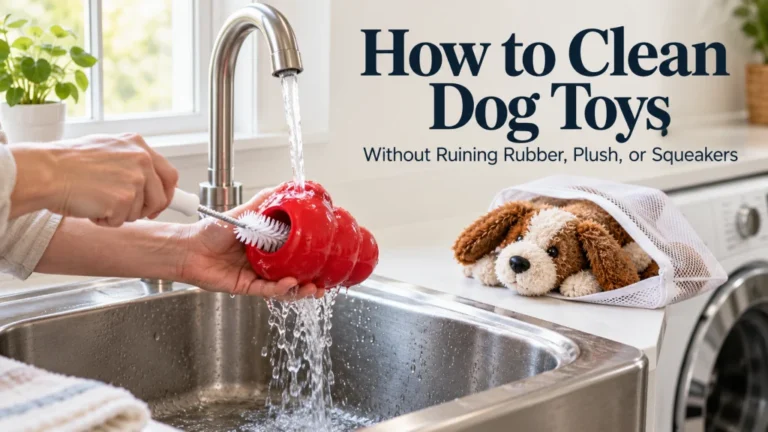
Dirt alone does not tell you how a toy should be washed because fabric, rubber, plastic, rope, and toys with internal components can have different care limits. Start with the maker’s care instructions when they are available, especially when heat, machine washing, dishwashing, soaking, or cleaning products could affect the material. Do not assume a method is safe simply because it worked on another toy that looks similar. For the full maintenance decision, use the guide on how to clean dog toys.
Cleaning is also a good inspection point because wetting, squeezing, and handling can reveal damage that was easy to miss during play. Check seams, edges, attachment points, surface changes, and whether any part has loosened before putting the toy back into rotation. If cleaning exposes structural failure, the answer is retirement rather than a stronger cleaning cycle. A clean toy is not a safe toy if its size, structure, or accessible parts have already changed in a meaningful way.
Contact a veterinarian promptly when play turns into a medical concern
Toy inspection can help prevent obvious hazards, but it cannot tell you whether swallowed material has passed safely or whether an injured tooth needs treatment. If you know or strongly suspect that the dog swallowed a toy piece, contact a veterinarian promptly rather than waiting for a home inspection to answer a medical question. Choking, persistent vomiting, abdominal pain, or a suspected tooth injury also moves the situation beyond ordinary toy maintenance. Do not induce vomiting after swallowed toy material unless a veterinarian specifically directs you to do so for that situation.
Keep the handoff simple by telling the veterinarian what the dog was playing with, what part may be missing, and what signs you have observed. If the remaining toy or packaging is available, keep it where you can refer to the material, construction, or missing component without giving it back to the dog. This is where careful inspection earns its value because noticing a missing squeaker, fragment, or section gives the veterinarian more useful context. The goal is not to diagnose the outcome at home, but to recognize when the toy safety decision has become a veterinary decision.
Call a veterinarian: Seek veterinary guidance promptly after a swallowed toy piece, choking, persistent vomiting, abdominal pain, or a suspected tooth injury. Do not try to solve these signs by changing toys, feeding something to push material through, or inducing vomiting without veterinary direction.
Final Thoughts: inspect what the toy has become
The safest choice is not the toy with the strongest label, the highest price, or the toughest marketing language. It is the toy that still fits the dog’s size and play style after you inspect its current condition. Keep watching for changes that create loose parts, exposed filling, reachable squeakers, sharp damage, or swallowable fragments. When the structure meaningfully fails, retirement is a better decision than squeezing one more play session out of it.
If you are deciding when to throw away dog toys, focus on what has changed and what the dog can now reach, break, or swallow. A toy can move from suitable to unsuitable quickly, especially during intense chewing, shaking, or tearing. Supervision helps you notice that change, while regular inspection makes the decision repeatable for everyone in the household. When a missing piece or possible injury turns the problem medical, stop evaluating the toy and contact a veterinarian.
FAQs
🐾 Are toys labeled for dogs automatically safe for every dog?
No. A label can be a starting point, but size, chewing style, play behavior, and the toy’s current condition can change the decision. Inspect a new toy during use and remove it if damage creates loose, sharp, or swallowable parts.
🧸 How do I know when a plush toy should be thrown away?
Retire it when seams open, stuffing becomes accessible, or an internal part can be reached. Cosmetic wear matters less than structural damage that lets the dog pull out or swallow material.
📣 What should I do if my dog exposes the squeaker?
Remove the toy from play rather than waiting for the dog to pull the squeaker free. Once the squeaker is reachable, it can become a separate object that may be chewed or swallowed.
🦴 Can a toy be too hard even if my dog cannot destroy it?
Yes. Resistance to visible damage does not automatically make a chewing item a good match for a dog’s teeth or chewing force. Treat very hard products as a separate chew toy decision, and contact a veterinarian if you suspect tooth injury.
🚮 How do I know when to throw away dog toys?
Throw a toy away when damage changes its size, structure, edge, seams, or accessible parts enough to create a meaningful swallowing or injury risk. Common stop signs include loose pieces, open seams, exposed stuffing, reachable squeakers, sharp edges, cracks, splinters, or a section small enough to swallow.
🩺 What should I do if my dog swallows part of a toy?
Contact a veterinarian promptly and explain what material or component may be missing. Do not induce vomiting unless a veterinarian specifically directs you to do so for that situation.
References and Sources
- American Kennel Club toy shopping guidance: supports size matching, squeaker and stuffing concerns, and removing damaged toys that can create swallowing or choking risk.
- PetMD dog toy safety guidance: supports supervision of new toys, small part ingestion concerns, and caution against treating broad safety labels as a complete guarantee.
- ASPCA dog chews and treats position statement: supports matching size and chewing habits, preventing consumption of significant pieces, and contacting a veterinarian after a chunk is swallowed.
- AAHA indoor enrichment guidance: supports choosing toys for dog size and chewing style, supervising new enrichment items, inspecting toys, and discarding items damaged enough to create swallowing or choking hazards.
- Embark dog toy safety guidance: supports removing detachable strings, plastic eyes, and other loose parts, and retiring rope toys that fray into strands a dog could swallow.
- Merck Veterinary Manual guidance on gastrointestinal obstruction: supports the veterinary handoff for swallowed foreign material, vomiting, and abdominal pain.