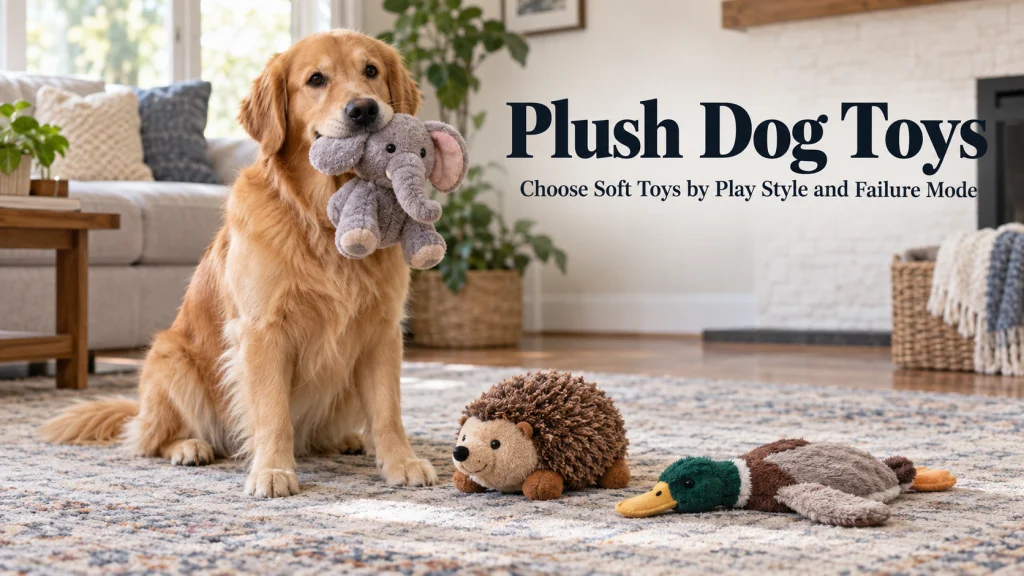
Plush dog toys make the most sense when a dog likes to carry, cuddle, shake, or gently mouth a soft toy without immediately tearing it apart. The right choice depends on the dog’s mouth size, play style, interest in seams and squeakers, and how quickly fabric damage appears. Stuffed and stuffing free designs create different cleanup and ingestion concerns once a seam opens, but neither format should be treated as indestructible. Choose around the dog in front of you, supervise new toys, inspect them often, and retire damaged toys before internal components become accessible.
Start with how your dog actually uses a soft toy
Plush dog toys can be a great match for a dog that carries and shakes toys, and a poor match for a dog whose favorite game is opening a seam as fast as possible. That difference matters more than the character shape, color, or a toughness claim on the package. A gentle carrier may keep the same soft toy intact for a long time, while a determined destroyer may expose the inside during the first few play sessions. Before buying another plush, watch what your dog does with the soft toys already in the house.
Soft toys can still have a useful place in a broader mental stimulation routine for dogs, but the activity has to fit the individual dog’s habits. The main dog toy selection guide is the better starting point when you are still deciding between plush, chew, tug, retrieve, or other toy formats. For plush specifically, the useful question is whether the fabric body stays intact long enough to serve its purpose. If the dog immediately hunts for a weak seam, a different toy format is usually the more practical decision.
The second pattern does not mean the dog is doing something wrong. It means plush construction may not fit that dog’s normal way of playing, especially when the toy is expected to survive unsupervised chewing. Reinforced fabric may delay damage, but it does not change the basic mismatch between soft construction and a dog that persistently disassembles it. Use the dog’s actual behavior as the deciding evidence.
Size the toy so the whole plush body cannot disappear into the dog’s mouth
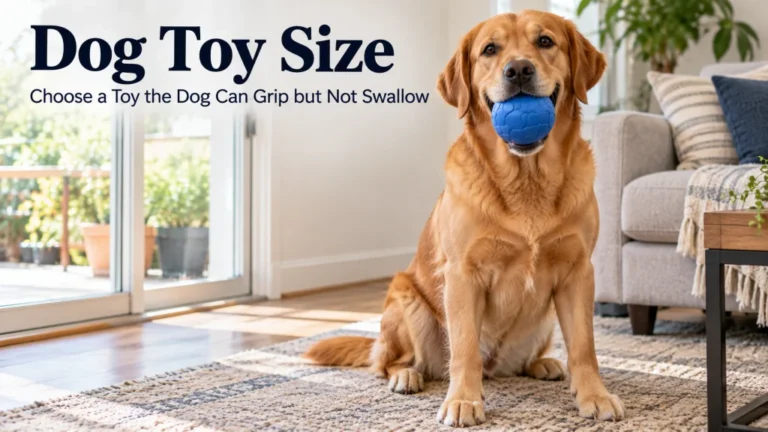
A plush should be comfortable enough to pick up and carry without being small enough for the dog to gulp or push the entire body deep into the mouth. Package size labels can help narrow the shelf, but they are not a substitute for looking at the individual dog’s mouth and the toy’s shape. A long flat toy and a compact round toy can behave very differently even when their listed overall dimensions look similar. The safest practical choice leaves enough toy outside the mouth that carrying does not resemble swallowing.
Size also needs another look in homes with more than one dog. A toy chosen for a smaller dog may be accessible to a much larger dog that can fit far more of it into the mouth. If that happens, the larger dog’s access should set the more conservative size decision for shared toys. For a fuller sizing check, use the dog toy size guide rather than relying only on a small, medium, or large label.
Key point: Size for the dog that can access the toy, not only the dog the toy was originally purchased for.
Recheck size after damage too. A plush that started large enough can become a smaller object if an ear, limb, tail, or section of the body tears away. Once the toy changes shape, reassess it as a different object rather than assuming the original size choice still applies. Damage can turn a previously workable size into an avoidable risk.
Compare stuffed and stuffing free designs by what happens when a seam fails
Stuffed dog toys feel fuller in the mouth and may hold a rounded shape that some dogs enjoy carrying or cuddling. The tradeoff is that an opened seam can release a large amount of loose fill, creating both a cleanup problem and material that a dog may try to mouth or swallow. A stuffing free design removes most or all of that loose fill, so a seam failure can create less mess. It does not remove the need to inspect the fabric body or any squeakers, crinkle material, rope core, or other components inside.
Choose between these formats by thinking about the dog’s usual failure pattern, not by assuming one design is universally safer. If a dog gently carries toys and rarely damages fabric, either format may work when the size and construction fit. If a dog reliably opens seams but you still use plush during supervised interaction, a flatter stuffing free design may reduce loose fill when damage begins, although the damaged toy still needs to be removed. For a dog that swallows fabric or internal parts, changing the plush format is less important than moving away from toys the dog can readily dismantle.
| Design | What it can offer | What to check if it fails |
|---|---|---|
| Stuffed plush | Fuller body for carrying, cuddling, and shaking | Open seams, loose fill, exposed squeaker, detached fabric pieces |
| Stuffing free plush | Flatter body and less loose fill if the outer shell opens | Fabric tears, exposed squeakers, crinkle layers, rope cores, loose attachments |
Neither row in the table is a durability guarantee. The useful comparison is what becomes accessible when the outer fabric fails and how likely your dog is to keep working at that opening. A toy that creates less mess can still be a poor choice if the dog immediately removes and swallows internal parts. The individual failure mode stays more important than the marketing label.
Check seam construction without treating reinforced stitching as an indestructible guarantee
Seams deserve attention because they join panels and often sit next to ears, limbs, tails, or other shapes a dog can grip and pull. Look for straight, closed stitching with no visible gaps, loose threads, or fabric already separating near the edge. A second row of stitching or an internal fabric layer may add structure, but those details only describe construction. They do not prove that the toy will survive a dog that deliberately targets the seam.
Run your fingers around the toy before the first session and repeat the check after play. Focus on high stress areas such as narrow necks, attachment points, corners, and the place where the dog repeatedly clamps down. If a seam starts puckering, stretching, or opening, that change is more useful than a package claim about toughness. The goal is to notice the beginning of failure before the opening becomes large enough to expose the inside.
- Check every seam for gaps, loose thread, and fabric separation.
- Look closely at ears, legs, tails, handles, and other attached pieces.
- Press around the toy gently to see whether an internal component is moving toward a damaged area.
- Compare the condition after play with how the toy looked before the session.
- Remove the toy when a seam opens enough for the dog to reach internal material.
A reinforced seam should therefore change your inspection expectations, not your supervision boundary. It may be a useful feature for a dog that plays gently and creates only light wear. It is not a reason to leave a known destroyer alone with a plush toy. Construction helps only when it matches the dog’s real play style.
| Purchase check | What to verify | Where to verify it |
|---|---|---|
| Size | The complete toy is large enough for the dog using it and does not disappear into the mouth during normal carrying. | Product dimensions plus the dog’s actual mouth and carrying behavior |
| Seams | Stitching is closed, attachments are secure, and no obvious gaps or loose threads are present before use. | Physical inspection and manufacturer construction details when disclosed |
| Stuffing | Whether the toy is stuffed, lightly filled, or stuffing free, and what material is disclosed inside. | Package description or manufacturer product information |
| Internal components | Whether the toy contains squeakers, crinkle material, rope cores, plastic pieces, or other components that could become separate objects after damage. | Manufacturer product information and physical inspection |
| Care | The stated washing and drying method for the exact toy rather than an assumption based on fabric type. | Care label, packaging, or manufacturer instructions |
Use this worksheet before purchase when two soft toys look similar on the shelf. A tougher sounding fabric claim should not outweigh a poor size match, unclear internal construction, or a care routine that does not fit the household. When important specifications are not disclosed, treat the unknown as part of the decision rather than filling it in with an assumption. The better plush choice is the one whose construction you can understand and monitor after the dog starts using it.
Treat an internal squeaker as a separate component the dog may try to remove
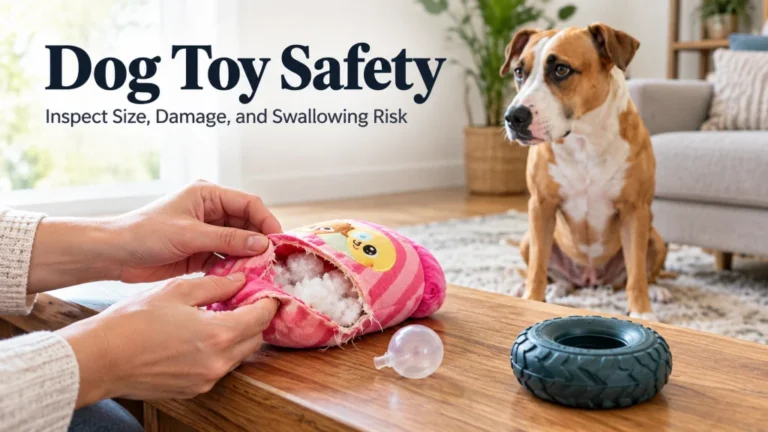
A plush toy can look like one object from the outside while containing a squeaker that becomes its own object as soon as the fabric opens. Some dogs ignore the sound source and simply carry the toy, while others keep biting one area until they can reach it. That difference should affect how closely you supervise the toy and how quickly you retire it after damage. A squeaker should never be treated as harmless just because it started inside a soft outer shell.
If sound is the main reason your dog engages with the toy, the squeaky dog toy guide covers that component and the related choice in more depth. For plush selection, the key check is whether the dog starts searching for the squeaker rather than playing with the whole toy. Once the squeaker is visible, loose, or partly removed, end the session and take the toy away. Do not push it back inside and treat the opened seam as a cosmetic problem.
Warning: A squeaker or other loose internal piece can be swallowed if the dog gets it free from the toy.
Also check for other hidden components that could become separate objects after damage. Crinkle sheets, rope cores, internal knots, plastic pieces, or small fabric parts can change the risk profile even when a toy contains little or no stuffing. Check the package description or manufacturer information for disclosed internal components, and use the care label when it provides additional construction or handling details. If the construction is unclear, choose a simpler toy you can inspect with more confidence.
Supervise new plush toys closely when the dog has a history of opening fabric toys
The first sessions with a new plush are useful because they show what the dog targets before you have to guess about long term durability. Stay close enough to see whether the dog carries, shakes, mouths, pins, tears, or repeatedly works one seam. A dog that looks gentle for the first minute can still settle down and start dissecting the toy once the exciting movement stops. Supervision should therefore last long enough to observe both active play and what the dog does when left to mouth the toy quietly.
A known fabric destroyer needs a stricter standard. Use plush only as a shared activity if you can interrupt the session before the outer shell opens, and put the toy away when active play ends. If the dog repeatedly beats that supervision plan by opening seams quickly, the practical answer is not to keep buying progressively tougher plush and hoping for a different outcome. Choose a toy category that better matches the chewing behavior instead.
Pro Tips: Compare the toy before and after each of the first few sessions. A small change in one seam, attachment, or squeaker position can reveal the failure pattern before a larger tear appears.
Supervision is not a promise that damage cannot happen. It is a way to learn how this dog uses this construction and to remove the toy when the condition changes. That matters especially with a dog that has previously swallowed toy pieces or consistently seeks internal components. In that situation, soft toys may simply be the wrong format for unsupervised access.
Retire the toy when stuffing, a squeaker, rope core, or another internal component becomes accessible
The retirement point should be based on access, not on whether the toy still looks mostly intact from across the room. A small opening is enough to matter when the dog can widen it with the teeth or pull material through it. Exposed stuffing, a loose squeaker, a visible rope core, or a detachable fabric piece means the construction has moved from worn to failed. At that point, take the toy out of use rather than waiting to see how much farther the dog can dismantle it.
This boundary is especially important because torn plush can create several different objects from one original toy. Loose fill can scatter, the squeaker can separate, and fabric sections can become small enough to swallow. The broader dog toy safety guide covers damaged toy checks across other materials as well. For plush, the simple rule is that accessible internal parts end the session.
- Retire the toy if stuffing can be pulled through a seam.
- Retire the toy if the squeaker is visible, loose, or partly removed.
- Retire the toy if a rope core or other internal layer is exposed.
- Retire the toy if an ear, tail, limb, or fabric panel is close to detaching.
- Retire the toy if the remaining body has become small enough to create a swallowing concern.
Repair is not automatically the better answer just because the outer fabric can be stitched closed. A home repair changes the construction, and it may not restore the original seam strength or keep the same components contained. Unless the manufacturer provides a repair method for that exact product, replacement or a different toy format is the clearer choice. The dog’s failure pattern should guide what comes next.
Wash plush only according to the product care instructions and dry it completely
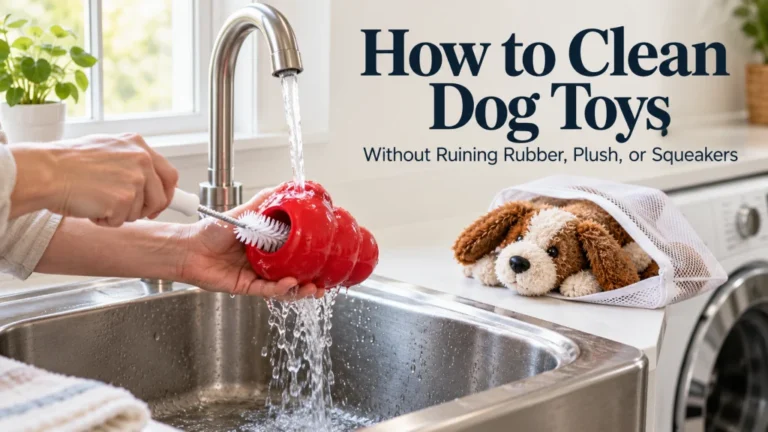
Fabric type alone does not tell you whether a plush belongs in a washer, should be hand washed, or has components that need another care method. Check the product label, packaging, or manufacturer care information before cleaning it. Follow the stated washing method, water guidance, and drying instructions rather than assuming every soft toy can handle the same cycle. This protects the toy’s construction and avoids inventing a care routine the maker did not specify.
Cleaning is also a good time to inspect condition, because wet fabric and handling can make weak seams, worn areas, and shifted components easier to notice. If the toy comes out of cleaning with an opening, loose part, damaged squeaker area, or changed shape that affects safe use, do not return it to the dog simply because it is clean. Let the toy dry completely before it goes back into rotation, using the product’s care directions as the boundary. For a broader cleaning workflow across toy materials, see how to clean dog toys.
| What to verify | Where to check | Why it matters |
|---|---|---|
| Washing method | Care label, packaging, or manufacturer instructions | Prevents guessing from fabric feel alone |
| Drying method | Care label or manufacturer instructions | Helps avoid returning a damp toy to use |
| Internal components | Product description and physical inspection | Shows what may be affected by washing or seam failure |
| Condition after cleaning | Hands on inspection before the next session | Confirms seams and components are still intact |
The care instruction is part of the buying decision, not an afterthought. If the household needs a frequently washable toy, confirm that the exact product supports a workable cleaning routine before purchase. A plush that is inconvenient to clean may spend more time dirty or out of rotation than expected. Choose a care burden that fits the way the toy will actually be used.
Final Thoughts: plush works best when soft construction survives normal play
Plush works best when the dog enjoys what makes plush different without immediately defeating the fabric shell. Start with play style, then check size, stuffing, seams, internal components, and the care instructions for the exact toy. A reinforced seam or flatter construction can change how a toy fails, but neither turns soft fabric into a heavy chewing solution. The dog still decides the real durability test through normal play.
Use the first sessions to learn the dog’s failure pattern and inspect the toy before the damage becomes obvious. If seams stay closed and the dog carries, cuddles, shakes, or gently mouths the toy, plush can be a sensible part of the toy rotation. If the dog persistently opens fabric and seeks stuffing or squeakers, choose another format rather than escalating toughness claims. The right plush is the one that fits the dog’s behavior well enough to remain useful and inspectable.
FAQs
🧸 Are plush dog toys safe for dogs that destroy toys?
They are a poor choice for unsupervised access when a dog consistently tears fabric and swallows pieces. If you use plush for a known destroyer, keep it to closely supervised interaction and remove it as soon as the shell begins to open.
📏 How large should a plush toy be for my dog?
Choose a size the dog can pick up comfortably without fitting the whole plush body deep into the mouth or attempting to swallow it. Recheck the decision for larger dogs in the household and whenever damage makes the remaining toy smaller.
🪡 Do reinforced seams make a plush toy indestructible?
No. Reinforced stitching can add structure, but a dog that persistently works at seams can still open the toy, so construction must be matched to the dog’s real play style.
🔊 Should I remove a plush toy when the squeaker becomes visible?
Yes. Once the squeaker is visible, loose, or partly removed, the dog can treat it as a separate object, so end the session and retire the damaged toy.
🧺 Are stuffing free dog toys safer than stuffed toys?
They can reduce the amount of loose fill released when a seam opens, but they are not automatically safe for a dog that shreds fabric or removes internal components. Check for squeakers, crinkle material, rope cores, and torn fabric just as carefully.
🧼 Can every plush dog toy go in the washing machine?
No. Follow the care instructions for the exact toy because construction and internal components vary, then let it dry completely before the next play session.
References and Sources
- American Kennel Club toy shopping guide: Supports removing torn plush when stuffing or a squeaker becomes accessible and reconsidering plush for dogs that consistently destroy stuffed toys.
- PetMD dog toy safety guidance: Supports matching toys to the individual dog’s play style, monitoring new toys, and avoiding unattended soft toys for dogs that tear them into small pieces.