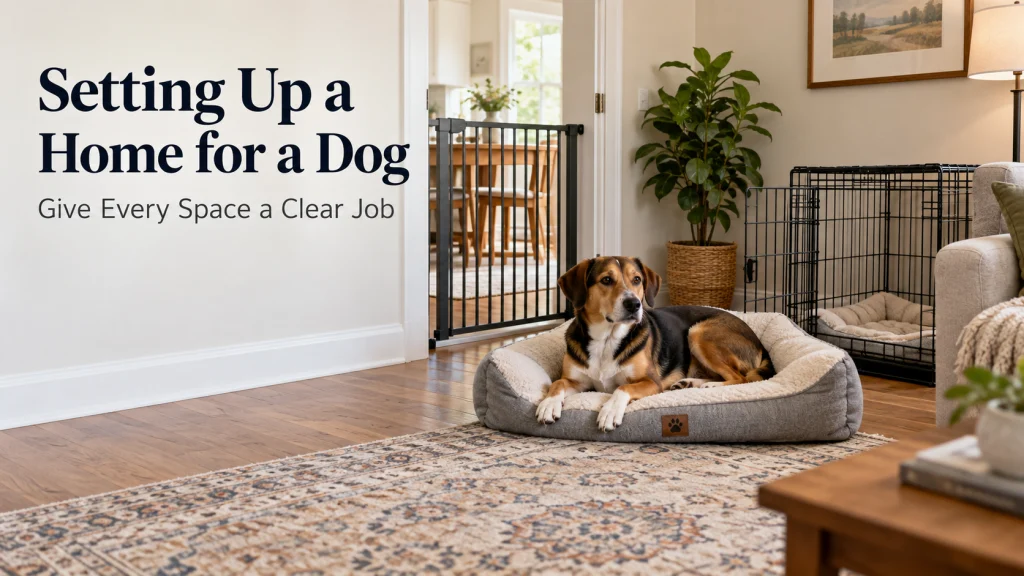
Setting up a home for a dog works best when each space has one clear job. A crate, playpen, gate, bed, room zone, fence, dog door, outdoor run, and shelter solve different problems, so the right choice depends on the dog, the household layout, supervision, behavior, weather, maintenance, and access needs. Start with the function, then verify fit, installation, escape risk, comfort, cleaning, and any product specific limits before buying more equipment. The goal is a home that is easier for the dog to understand and easier for the household to manage.
Start with the job, not the equipment
Setting up a home for a dog becomes simpler when you name the job before choosing the object that will occupy the space. Close confinement, a larger managed area, room access control, rest, indoor zoning, yard containment, independent yard access, enclosed outdoor time, and weather shelter are different needs. A dog that needs a quiet resting place may not need a crate, while a dog that needs more managed movement may fit a pen or safe room better. I would start with the smallest number of systems that clearly solve the household’s real problems.
The dog changes the decision as much as the floor plan does. Size, jumping, chewing, digging, comfort with confinement, age, mobility, and activity can all change whether a barrier or resting setup works. The household matters too because a system that blocks traffic, complicates cleaning, or needs constant rearranging may not remain useful. Treat the first setup as a working plan that can change with the dog or the home.
| Job | System | First check |
|---|---|---|
| Close confinement or compact rest | Crate | Fit, comfort, ventilation, response |
| Larger managed indoor area | Playpen | Stability, climbing, floor space |
| Room or stair access control | Gate | Opening, mounting, latch, jumping |
| Dedicated rest | Bed | Size, sleep style, location, cleaning |
| Several daily functions | Dog zone | Traffic, storage, separation, cleanup |
| Yard perimeter | Fence | Gates, gaps, terrain, escape routes |
| Independent yard access | Dog door | Destination, fit, security, installation |
| Smaller outdoor enclosure | Kennel or run | Containment, footing, weather, water |
| Outdoor weather shelter | Dog house | Dryness, ventilation, location, exposure |
Use the table as a filter, not as a shopping list. If one safe room already solves rest and management, more equipment may add burden without adding function. Skip anything that does not solve a distinct problem.
Use a crate when the job truly requires close home confinement or a defined resting space
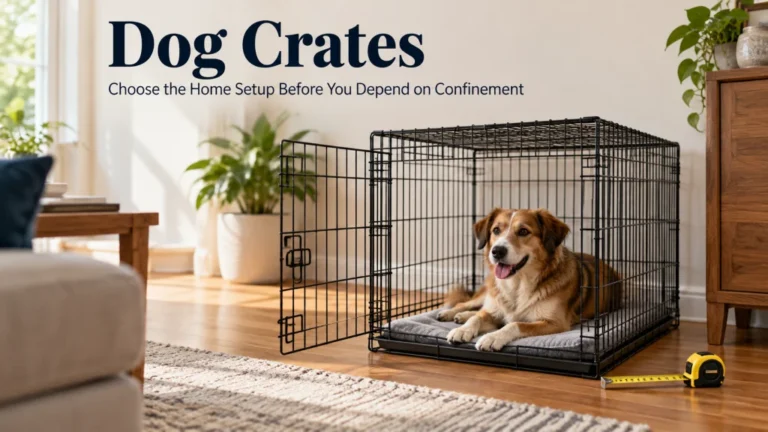
A crate can help when a dog needs a compact, predictable space for rest or short periods of home management, but it is not mandatory for every dog. Cornell notes that some dogs do not tolerate confinement well and should not be forced to remain crated when they show substantial distress. The practical question is whether close confinement solves a real need for this dog. The dog crate guide is the next step for crate type, fit, material, placement, and ordinary use.
Fit matters because the dog should be able to stand, turn, lie down, and rest comfortably. A crate also does not replace exercise, social contact, toilet access, or normal movement through the day. If the dog persistently pants, drools, vocalizes, eliminates, or tries to escape during confinement, buying a stronger crate does not solve the underlying problem. Change the management plan and involve a veterinarian or qualified behavior professional when distress is substantial.
| Need | Crate | Playpen | Gate or safe room |
|---|---|---|---|
| Compact rest | Often suitable | Possible but larger | Possible if the room is calm |
| More managed movement | Usually too restrictive | Often a better fit | Useful for a whole room |
| Block room access | Indirect solution | Uses more floor space | Usually most direct |
Many home problems are access problems, not crate problems. Choose the system that matches the job instead of increasing confinement because a crate is familiar.
Use a playpen when the dog needs more room inside a managed boundary
A playpen makes sense when the dog needs more managed indoor space than a crate provides but should not have an entire room. It can allow room for resting, repositioning, toys, and ordinary movement inside a clear boundary. The important comparison is how much space the dog needs and how secure the boundary must be. The dog playpen guide can help with size, layout, material, stability, and placement.
Before relying on a pen, watch what the dog actually does around barriers. A setup that works for a calm small dog may slide, tip, or invite climbing for a larger or more active dog. Floor surface also matters because some freestanding systems are less stable on smooth floors. If the pen needs improvised bracing or furniture to stay useful, a gated room or another management approach may be simpler.
Use gates when the problem is access to rooms, stairs, or household zones
A gate is often the cleanest answer when the job is to block one area while leaving the dog more freedom elsewhere. It can manage kitchens, entry areas, work zones, bedrooms, or other rooms whose access changes during the day. Choose around the opening, mounting surface, dog size, jumping or climbing behavior, and how people move through the space. The dog gate guide covers barrier types and fit in more detail.
Do not treat every gate as interchangeable just because it spans an opening. Around stairs or other higher consequence locations, follow the manufacturer’s approved mounting method and location limits instead of improvising. Check that openings cannot trap the dog’s head or paws and that nearby furniture does not create an easy launch point. If the dog repeatedly crashes into, climbs, or defeats the barrier, different management or training may be more appropriate than simply adding height.
Choose a bed around body size, sleeping style, maintenance, and the place where the dog rests
A dog bed has a different job from a crate or gate because its main function is a consistent resting surface. Watch whether the dog stretches out, curls up, leans against an edge, or moves between warmer and cooler places. The bed must also fit its location without blocking doors, walkways, vents, or household traffic. The dog bed guide covers shape, support, surface, cover design, and maintenance.
Cleaning burden deserves as much attention as softness. A bulky bed that is difficult to wash or dry may be a poor fit for a dog that sheds heavily, tracks in dirt, or brings outdoor debris inside. Removable covers and clear care instructions can matter more than decorative styling. If the dog already rests comfortably on a suitable washable surface, another bed is not automatically an improvement.
Build a functional dog zone when several home needs must work together
A functional dog zone can help when several ordinary tasks happen in one part of the home, such as rest, storage, feeding access, leashing up, or temporary separation. It does not need to be a dedicated room, and larger is not automatically better. The useful test is whether the layout keeps daily items accessible without crowding incompatible jobs together. The dog room ideas guide can help when deciding which functions belong in the same space.
I would map the routine before adding furniture or storage. Put the resting place away from constant traffic, keep walking gear near the exit that is actually used, and store cleaning supplies where the dog cannot reach them. Avoid asking the dog to rest beside noisy equipment or a busy doorway. A calmer layout often comes from removing functions rather than adding more.
In a multi dog household, one shared zone is not always the simplest setup. If dogs rest differently, crowd each other around doorways, or need breaks from one another, separate resting or access zones can make supervision clearer. Gates or room boundaries can create that separation without treating every dog as a crate problem. The useful test is whether each dog can reach a calm space without being forced through another dog’s resting or feeding area.
| Worksheet check | Permanent | Temporary |
|---|---|---|
| How often is it needed? | Part of the normal routine | Used for a changing need |
| Must it be fixed? | Only when the job justifies it | Prefer safe movable systems |
| What if the dog changes? | Allow for growth or aging | Make reconfiguration easy |
| What is the burden? | Cleaning and access | Storage when not in use |
Recheck the job when the routine changes. Keep what still solves a problem and remove what does not.
Treat a yard fence as a perimeter system, not as a substitute for supervision, exercise, or training
A yard fence has one primary job: define the physical perimeter the dog should not cross. It does not teach recall, guarantee that a determined dog will never escape, or turn the yard into a complete exercise plan. Check gate latches, gaps, grade changes, climbable objects, digging areas, and places where landscaping changes the effective barrier. The dog fence guide is the next step for comparing physical fence options, property constraints, and maintenance.
Match the decision to the dog’s real escape behavior instead of appearance alone. A barrier that works for one calm dog may not fit a dog that jumps, climbs, squeezes, pushes gates, or digs. Check local property rules and installation requirements before treating a system as compatible with the site. Aversive boundary systems should not be the default substitute for a well planned physical perimeter and appropriate supervision.
| Question | Indoor | Yard |
|---|---|---|
| Boundary | Walls, doors, gates, pens | Fence, gates, enclosed run |
| Main variables | Layout, traffic, chewing, jumping | Terrain, escape behavior, weather |
| Does not replace | Training, activity, routine | Supervision, exercise, shade, water |
This keeps containment separate from exercise, comfort, weather, and behavior. If a full perimeter is not practical, a smaller managed outdoor area may better match the real job.
Add a dog door only when the destination, security, and home construction make independent access workable
A dog door changes access, not just convenience. Decide where the dog will go after passing through it and whether that destination is securely contained and suitable for independent access. The opening must fit the dog, and the installation surface must match the product’s approved use. The dog door guide can help with fit, access control, placement, and feature trade offs.
Security and construction limits are reasons to slow down rather than improvise. Doors, walls, glass, and other surfaces can require different products or qualified installation, so broad compatibility language is not enough. A locking feature also does not fix an insecure yard or a dog that should not be outside independently. If the destination or installation is questionable, manually opening the door can remain the simpler routine.
Use an outdoor kennel or run when a smaller enclosed outdoor area solves the real containment job
An outdoor kennel or run can fit a household that needs a smaller enclosed area rather than access to the whole yard. It can simplify supervision, block access to parts of the property, or create a predictable outdoor management zone. The enclosure still has to match the dog’s size, jumping, climbing, digging, and pushing behavior. The outdoor dog kennel guide covers enclosure layout, footing, weather exposure, and maintenance.
Outdoor containment also creates responsibilities that indoor barriers do not. Shade, fresh water, surface temperature, drainage, weather exposure, and access back to a suitable environment all matter. AVMA guidance emphasizes water and shade during warm conditions, while cold or wet weather can make outdoor exposure inappropriate even when shelter is present. Treat the run as one part of a managed routine, not as a substitute for ordinary home life.
Use a dog house as temporary outdoor shelter, not as the yard boundary itself
A dog house solves a weather shelter problem, not a containment problem. It should sit inside a secure area rather than being treated as the reason a dog can remain loose on a property. The location should stay as dry and protected as practical, with usable shelter from the relevant weather. The dog house guide covers shelter size, material, placement, ventilation, and cleaning.
Weather sets the limit of what shelter can accomplish. Humane World advises keeping companion animals indoors in cold conditions and describes dry, protected shelter as necessary when a dog is outdoors. In warm weather, shade and water remain essential, and an enclosed shelter can be a poor resting place if it traps heat. Evaluate the conditions and the dog instead of assuming that owning a shelter makes outdoor time automatically appropriate.
Keep prearrival hazard removal separate from permanent containment choices
Removing household hazards before a new dog arrives is a different job from choosing long term containment. A home can have a crate, gate, or pen and still contain accessible cords, chemicals, food, small objects, or unstable items outside that boundary. If you are preparing for a new arrival, use the dog proofing your home guide for the prearrival safety pass. That keeps the permanent setup focused on how the household will function after the transition.
This separation also prevents temporary management from becoming permanent by default. The dog may need less restriction as skills improve, or a different barrier may become useful once size, jumping, chewing, and routine are clear. An adult dog can also reveal access or escape problems that were not obvious at first. Revisit the setup based on observed needs instead of assuming the first arrangement must stay forever.
Build crate comfort, recall, and boundary skills through gradual training rather than equipment alone
Containment equipment manages space, but it does not teach the dog what to do when the barrier is absent or the door opens. Calm crate use, waiting at a gate, returning when called, and settling in a room are learned skills. For broader method and sequencing, use how to train a dog rather than asking stronger hardware to do the work of training. Equipment and training can support each other, but neither is a magic fix.
Crate comfort deserves its own progression because closing a dog into a confined space is different from placing a crate in the room. VCA recommends gradual, reward based acclimation and professional guidance when distress is substantial rather than forcing the dog through it. The crate training guide covers that learning process in detail. Keep this article focused on choosing the right space, then route skill building to the training plan that owns it.
Rework the setup when age or mobility changes how the dog moves through the home
A layout that worked for years can stop working when the dog moves more slowly, avoids slippery surfaces, hesitates at steps, or struggles with narrow routes. Start by observing where movement has become difficult and remove avoidable obstacles. That may mean relocating a bed, changing a doorway, widening a managed path, or moving daily supplies closer. The older dog care guide covers age specific accessibility decisions more fully.
Do not turn a mobility change into a diagnosis based on the home setup alone. New weakness, pain behavior, slipping, or difficulty rising can have many causes, and medical interpretation belongs with a veterinarian. At owner level, reduce unnecessary physical demands and make ordinary routes easier while the cause is assessed when needed. A simpler path can help without requiring new equipment.
Know when installation, medical restriction, or behavior risk needs qualified help
Some home setup decisions stop being ordinary owner projects when failure has serious consequences. Structural changes, electrical work, uncertain wall or door modifications, and complex fence installation should follow product documentation and qualified installation when appropriate. Medical confinement after surgery or injury should follow veterinary instructions rather than general home guidance. Severe distress, repeated escape attempts, aggression risk, or unsafe containment behavior also deserves professional assessment instead of stronger improvised barriers.
A good handoff keeps the owner involved without asking them to work outside their scope. Bring exact product instructions, measurements of the location, and a clear description of what the dog does around the setup. For behavior, describe the context without diagnosing the cause yourself. For installation, verify the surface, product model, mounting requirements, and property restrictions before work begins.
Professional handoff: Use a veterinarian for medical restriction or unexplained physical change, a qualified behavior professional for severe distress or behavior risk, and an appropriate installer or tradesperson when work exceeds ordinary product setup.
- Verify the exact model, size range, materials, mounting method, and approved use.
- Check that the instructions match the actual wall, doorway, floor, yard, or outdoor location.
- Check for trapping, climbing, chewing, pushing, or escape risks in the finished setup.
- Count cleaning, storage, inspection, and replacement as part of the ownership burden.
- Skip the product when a safe room, closed door, supervised routine, or simpler barrier already solves the job.
The checklist matters because a home system has to work after initial setup. If a critical claim cannot be confirmed, narrow the use or choose a simpler approach.
Final Thoughts: Give every space one clear job before buying more equipment
A practical dog home is not the one with the most gear. It is the one where each barrier, resting place, access point, and outdoor space has a clear function that matches the dog and the household. Start with the job, verify the fit and limits, and keep only the systems that make daily management clearer. When one simple solution safely covers the need, adding another product can create more clutter than value.
Recheck the setup when the dog grows, ages, changes behavior, or starts using the home differently. Watch what actually causes friction: an ignored bed, a gate that invites jumping, a pen that moves, a yard gate that does not latch reliably, or a route that has become hard to navigate. Adjust the space before assuming the answer is more restriction or more equipment. A home that adapts to the dog is usually easier to live with than a collection of fixed solutions.
FAQs
🐾 Does every dog need a crate at home?
No. A crate can be useful for some dogs and household situations, but it is a management tool rather than a universal requirement. A pen, gate, safe room, or ordinary resting area may fit the job better when the dog does not need close confinement.
🚪 Should I use a gate or a playpen?
Use a gate when the main job is controlling access to an existing room or zone. Use a playpen when you need to create a defined managed area within a larger space. Dog size, jumping, pushing, floor surface, and available room can change which option is workable.
🛏️ Where should I put my dog’s bed?
Choose a place where the dog can rest without being constantly disturbed and where the bed does not block normal household traffic. Consider temperature, floor surface, nearby noise, and how easy the area is to clean. The dog’s preferred sleeping position and usual resting location are useful clues.
🏡 Is a fenced yard enough exercise for a dog?
No. A fence defines a perimeter, but it does not automatically provide enough physical activity, mental engagement, training, or social interaction. Build the dog’s activity routine separately from the containment plan.
🌦️ Can a dog house make it safe for a dog to stay outside?
A shelter can reduce some weather exposure, but it does not make every outdoor condition appropriate. Shade, fresh water, wind, wetness, heat, cold, supervision, and the individual dog still matter. Outdoor time should be adjusted to the real conditions rather than justified by the presence of a dog house.
🔐 Is a dog door a good idea for every fenced yard?
No. The destination has to be secure and appropriate for independent access, and the opening must fit both the dog and the approved installation surface. If the yard, neighborhood, weather, dog behavior, or home security makes unsupervised access a poor fit, manual door access remains the simpler choice.
References and Sources
- Cornell University College of Veterinary Medicine: Supports crate fit, confinement limits, and the need to respond appropriately when a dog shows distress in a crate.
- VCA Animal Hospitals: Supports gradual crate acclimation, confinement alternatives, and the boundary between ordinary management and distress that needs professional guidance.
- American Kennel Club dog gate guidance: Supports choosing gates around home layout, dog size, behavior, mounting, and latch considerations.
- American Kennel Club dog bed guidance: Supports matching a bed to size, resting needs, location, and cleaning considerations.
- American Kennel Club dog door guidance: Supports evaluating dog door fit, home setup, and access considerations before installation.
- American Veterinary Medical Association: Supports fresh water, shade, and warm weather safety boundaries for outdoor access.
- Humane World for Animals: Supports cold weather shelter, dryness, and limits on leaving companion animals outdoors.