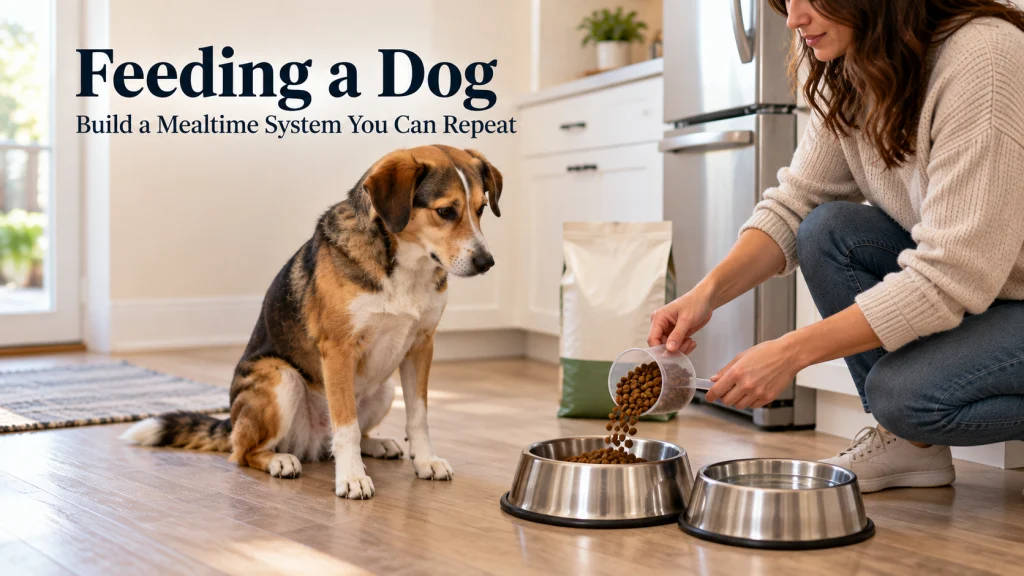
Feeding a dog becomes easier to repeat when the household treats mealtime as a system rather than a bowl filled whenever someone remembers. The core decisions are how the daily amount is divided, how portions are measured, where food and water are served, who can reach each bowl, and how food is stored. Bowls, slow feeding, automatic feeding, and meal extras can help when they solve a clear problem for that dog and household. Label directions are a starting point, while growth, weight, appetite, disease, and therapeutic diets belong with the veterinary team.
Build the mealtime system before optimizing individual products
Feeding a dog works best when everyone in the home can answer four questions without guessing: what amount is being served, how that amount is divided, where the dog eats, and who is responsible for the next meal. A suitable food can still be served inconsistently when caregivers measure differently. I would fix that handoff before changing bowls or adding equipment. Consistency makes it easier to notice whether the routine itself is working or whether something has changed.
The system has eight practical parts: schedule and portion execution, the ordinary bowl, eating pace, automatic feeding when useful, water access, storage, access control in homes with more than one pet, and optional meal extras. None should be treated as a universal upgrade. A calm adult dog in a predictable household may need very little equipment, while a fast eater or a home with several pets may need more structure. The goal is a repeatable, easy to check mealtime.
| Household problem | Start with | Verify |
|---|---|---|
| Different people serve different amounts | Portion method and handoff | Amount, tool, and meal record |
| The bowl moves or fits poorly | Bowl fit and stability | Fit, material, grip, and cleaning |
| The dog finishes too quickly | Eating pace | Whether slower access helps |
| Meal timing is hard to execute | Automatic feeding | Food, dispensing, power, and oversight |
| Water is often empty or inconvenient | Water setup | Access, capacity, and cleaning |
| Food loses its label or gets messy | Storage | Traceability, cleanliness, and access |
| Pets reach each other’s food | Separate access | Separation and individual portions |
| Extras keep being added | Meal extras rule | Purpose, amount, and label |
That sequence prevents a common beginner mistake: buying a device before defining the problem. A feeder cannot correct an unclear daily amount, and a new bowl cannot tell the household whether someone already served the meal. Solve the ownership task first, then choose the simplest setup that makes it easier. Equipment should support the routine rather than become the routine.
Set a feeding schedule that separates the daily amount from the number of meals
The first schedule decision is not a clock time. It is the relationship between the total amount intended for the day and the number of meals used to serve it. If the daily amount is divided into several meals, each meal is part of that total rather than an extra feeding event. A written or shared household routine helps prevent double serving when more than one person is involved.
The right pattern can change with age, health needs, household routine, and veterinary guidance, so one frequency should not be treated as correct for every dog. The food label can provide feeding directions, but AAFCO describes those directions as guidelines that may need adjustment for the individual animal. If growth, body condition, weight trend, appetite, or a medical condition changes the decision, the veterinary team should guide the individualized plan. For practical execution, the separate guide to a repeatable dog feeding schedule goes deeper without turning the routine into a medical calorie prescription.
| Step in the day | Household action | Purpose |
|---|---|---|
| Before the first meal | Confirm the planned amount and measuring tool | Use the same plan |
| At each meal | Serve the meal share and mark the handoff | Avoid double feeding |
| After the meal | Handle leftovers and clean the serving setup | Keep intake visible |
| Later in the day | Account for extras and training food | Keep additions visible |
A schedule should reduce uncertainty, not become a rigid ritual that ignores the dog in front of you. Keep execution consistent enough that changes are visible. Use the current product directions as the starting reference. Then seek veterinary guidance when the ordinary routine no longer fits the dog’s needs.
Choose food bowls by material, size, stability, and the dog’s way of eating
An ordinary bowl has a simple job: hold the meal in a way the dog can reach while the household can clean and manage it reliably. Size matters because a small bowl can crowd the muzzle, while a very large one may spread food farther than necessary. Stability matters for dogs that push a bowl across smooth floors. Shape can also matter when long ears, a broad muzzle, or a short muzzle changes access.
Material is a tradeoff rather than a ranking. Stainless steel is commonly chosen for durability and easy cleaning, ceramic adds weight but should be checked for damage, and plastic can be light and inexpensive but may scratch or wear. I would choose the simplest bowl that fits the dog, stays where it should, and suits the household’s cleaning routine. The detailed dog food bowl guide is the better place to compare fit, materials, stability, and maintenance.
Watch an ordinary meal before replacing anything. If the dog can reach the food, the bowl stays stable, and cleanup is straightforward, the current setup may already be doing its job. A heavier or more complicated bowl is not automatically better. The useful question is which specific problem a change would solve.
Slow the meal only when eating pace is the problem you are solving
A slow feeding setup is useful when the dog takes large mouthfuls so quickly that the household wants access to be more gradual. The important distinction is between slowing access and fixing every issue associated with mealtime. A patterned bowl can make food harder to collect quickly, but that does not make it better for a dog that already eats calmly. It also should not be used to explain repeated vomiting, swallowing difficulty, or another concerning change without veterinary input.
Fit matters as much as the idea of slowing down. Grooves that are too tight for the dog’s muzzle or tongue can create frustration, while a pattern that is too open may barely change the pace. I would compare the dog’s actual eating behavior before and after the change rather than assuming more complexity is an improvement. For dogs that genuinely need slower access, the slow feeder dog bowl guide explains how to match the format to the dog and meal.
Use automatic feeding for timing and portion logistics without replacing daily human care
An automatic feeder can help when the household problem is execution: a planned meal is difficult to serve consistently, several portions need controlled release, or responsibilities shift between people. That is a logistics job, not a substitute for checking the dog, the food, and the device. A feeder still needs loading, cleaning, power or battery management, and confirmation that food actually dispensed. If another pet can reach it, access control becomes part of the setup.
Match the feeder to the food format and read the current manufacturer instructions for portion settings, cleaning, power behavior, and limitations. I would keep a manual fallback because a jam, empty hopper, power problem, or curious second pet can break an otherwise neat routine. The article on choosing and using an automatic dog feeder covers those equipment checks in more detail. Automate a known daily feeding routine, not one the household has never clearly defined.
Set up clean, accessible water independently from the food schedule
Water should not depend on whether a food meal is being served. The practical job is to keep clean water accessible in a location the dog can reach, with enough capacity and a refill routine that fits the household. Placement matters because a bowl behind a closed door, blocked by another pet, or repeatedly tipped over is not reliable access. In a larger home, more than one water location may be easier to maintain.
The bowl or fountain also creates a cleaning task, so convenience includes how easily its surfaces and parts can be washed and inspected. A large reservoir is not an advantage if it encourages the household to ignore cleaning. I would choose capacity around realistic refill habits rather than trying to maximize volume. The dedicated dog water bowl guide goes deeper on bowl size, materials, fountains, placement, and household fit.
Changes in drinking are observations, not diagnoses. If the dog suddenly drinks much more or much less, or the change appears with illness or behavior changes, treat that as a veterinary question rather than a bowl shopping problem. The owner level task is to keep water available and clean. It should also be easy enough to monitor that a meaningful change is noticed.
Store food so each meal starts from clean, traceable product
Storage is part of feeding because it affects what the household can verify later. FDA guidance recommends keeping pet food in its original container or bag so the product name, lot information, manufacturer details, and best by information remain available if there is a problem. Placing the original bag inside another container can add a physical barrier while keeping that information with the food. If food is transferred, the identifying information should still be saved.
The storage location should also fit the actual home. Food needs a cool, dry place and a container or cabinet the dog cannot raid, while scoops and containers need regular cleaning rather than endless topping up over old residue. I would prioritize traceability and easy maintenance before decorative storage. The full dog food storage guide covers bag in bin setups, transferred food, scoops, access control, and routine cleaning.
Wet or opened foods can have different handling instructions, so the exact product label remains the first check. The larger principle stays simple: keep the food identifiable, protect it from heat and moisture, and make new packages easy to track. A storage system should preserve information rather than hide it. That makes routine feeding easier and problem reporting more useful if something goes wrong.
Separate access when multiple pets should not share the same food
In a home with several pets, a portion is controlled only if the intended pet is the one eating it. Two dogs may need different amounts, different foods, or different eating speeds, and a cat’s food may need to stay out of a dog’s reach. Separate bowls are a start, but distance, barriers, closed doors, or supervised feeding may be needed when one pet moves toward another pet’s meal. The goal is calm access control, not forcing animals to negotiate over food.
AKC guidance on multi pet feeding emphasizes routines, separate eating areas, and preventing pets from interfering with one another during meals when conflict is possible. I would make the physical setup do as much of the work as possible instead of relying on repeated verbal correction around food. The feeding multiple dogs guide covers separation options and household flow in more detail. If there is ongoing guarding, aggression, or conflict, that moves beyond simple feeding logistics and may need qualified behavior support.
Shared water can be a separate decision because the ownership problem is different from individual food portions. Even then, the water setup needs enough access and cleaning for the animals using it. Keep food access controlled enough that individual intake remains visible. If one pet regularly finishes another pet’s leftovers, the system is no longer measuring each animal separately.
Use the food label as a starting point, not an individualized veterinary prescription
The label gives the household a traceable place to start. AAFCO explains that complete and balanced pet foods generally carry feeding directions and a nutritional adequacy statement, and that feeding directions are guidelines that may need modification for the individual pet. Read the directions for the correct life stage and product rather than copying a serving amount from another food. Use a consistent measuring tool so the amount served can be repeated.
The label cannot account perfectly for every dog’s activity, body condition, growth, health status, or other individual needs. WSAVA places individualized nutrition assessment within the veterinary health care team and includes body condition tools in that process. I would use changes in weight or body condition as reasons to review the plan, not as permission to invent a medical calorie target at home. When the current amount no longer appears to fit the dog, the next useful question is what changed and whether veterinary guidance is needed.
| Owner level task | Veterinary nutrition task |
|---|---|
| Read feeding directions and life stage information | Individualize nutrition when health status changes the plan |
| Measure and record what is served | Set medical nutrition goals or therapeutic instructions |
| Notice changes in weight, body condition, appetite, and routine | Evaluate concerning changes and their causes |
| Keep treats and extras visible | Advise on therapeutic diets and condition specific nutrition |
This boundary keeps a practical feeding article useful without pretending a package can replace individual assessment. The label tells you what the product says and how its maker directs feeding. The dog’s response and health context determine when that starting point needs professional review. Household consistency makes that review easier because the veterinary team can see what was actually being served.
Contact the veterinarian when growth, weight, appetite, disease, or a therapeutic diet changes the feeding decision
Household organization can solve missed meals, inconsistent scoops, dirty bowls, poor access, and food theft between pets. It cannot diagnose why appetite has changed, why weight is moving unexpectedly, or whether disease changes nutrient needs. Growing dogs also should not have an adult routine copied onto them without checking the food and appropriate veterinary guidance. The same boundary applies when a dog is already on a therapeutic diet.
The practical handoff is to bring useful information rather than guesses. Record the exact food, how it is measured, what extras are added, whether the dog finishes meals, and what changed in the routine. Keep the current package information available so the veterinary team can see the product and feeding directions. That turns the household system into better evidence for an individualized discussion.
Important: A sudden or concerning change in appetite, weight, eating ability, or general condition should not be managed by repeatedly changing bowls, feeders, or meal extras. Those tools solve logistics and access problems, not underlying medical causes.
Once the veterinary plan is clear, return to the same execution principles used throughout this article. Measure consistently, control access, keep water available, store food properly, and make each handoff visible. Good logistics support professional guidance instead of competing with it. The household’s job is reliable execution, not diagnosis.
Add toppers or other meal extras only after the core food and portion routine are clear
Meal extras are easy to add and easy to forget when several people share dog care. A topper, treat, training food, or other addition can become part of the dog’s intake even if nobody thinks of it as a meal. The first question should be why it is being added: taste, training, enrichment, or another clear purpose. If there is no clear purpose, more ingredients can make the routine harder to track without solving a problem.
The exact product label matters because some items are complete foods while others are intended only for supplemental or intermittent feeding. I would keep extras visible and consistent enough that they do not obscure what the dog is actually eating. If the dog suddenly needs extras to show interest in food, especially alongside other changes, treat that as an observation worth discussing rather than automatically escalating toppings. The separate guide to dog food toppers and meal extras covers when they add practical value and when they mostly add complexity.
Extras should sit on top of a clear system, not become the system. When the base food, daily amount, and handoff are already easy to understand, it is easier to judge whether an addition is helping. It is also easier to keep different caregivers from stacking several additions onto the same meal. Clear ownership beats a bowl that changes every time someone enters the kitchen.
Make household handoffs clear enough that another person can feed the dog correctly
A feeding system is repeatable only if it survives a change in who is holding the scoop. Instructions should be clear enough for a family member, sitter, or other responsible caregiver to serve the correct food without reverse engineering someone else’s habits. The food should be identifiable, the measuring tool obvious, the portion clear, and each pet’s feeding location known. Any separation rule should be written where the caregiver will actually see it.
I would keep the handoff short enough that people use it. Long notes can hide the few details that prevent errors, while vague notes such as “normal amount” depend on prior knowledge. A simple checklist also makes temporary care easier without pretending every dog needs a complicated protocol. Veterinary instructions should remain exact rather than being rewritten from memory.
- Exact food identification and storage location.
- The measuring tool and amount assigned to each meal.
- Which bowl and feeding location belong to each pet.
- Whether pets must be physically separated while eating.
- Which regular extras are already part of the routine.
- How to mark that a meal has been served.
- Who to contact if appetite, access, or the setup changes unexpectedly.
The same checklist helps even when the usual caregiver is home. It exposes weak points that were being covered by memory. If another responsible adult cannot follow the system without guessing, the system is still too dependent on one person. Fixing that gap is often more useful than buying another feeding accessory.
Final Thoughts: make feeding easy to repeat and easy to monitor
A good feeding system does not need to look impressive. It needs a clear daily amount, a workable meal pattern, a bowl the dog can use, reliable water access, safe storage, and enough access control that the intended dog eats the intended food. Slow feeders, automatic feeders, and meal extras belong only when they solve a defined problem. The simpler option is often better when it produces the same reliable result with less cleaning, setup, and monitoring.
Keep the label and product information available, measure consistently, and make household handoffs visible. Watch for changes in appetite, weight, body condition, or eating behavior instead of assuming every change can be solved with different equipment. When growth, disease, therapeutic diets, or concerning changes affect the decision, involve the veterinary team. That leaves the household free to do what it can do well: execute the feeding plan cleanly and consistently.
FAQs
🍽️ How many times a day should I feed my dog?
There is no single meal frequency that fits every dog. Age, health, the food being used, household routine, and veterinary guidance can change the answer, so start with the current food directions and the plan appropriate for your dog.
🥣 Should I measure dog food or just fill the bowl?
Use a consistent measuring method so the household knows what was actually served. Filling by eye makes it harder to compare the routine with label directions or notice when different caregivers serve different amounts.
🐕 Does every fast eating dog need a slow feeder?
No. A slow feeder is useful when slower access is the specific problem, but the pattern still has to fit the dog’s muzzle and eating style. Concerning or sudden eating changes belong with the veterinarian rather than a more difficult bowl.
🏠 How do I stop one dog from eating another dog’s food?
Use separate bowls plus enough physical control to prevent access, which may mean different rooms, a barrier, or supervised meals. If food causes ongoing guarding or aggression, increase separation and seek qualified behavior support rather than forcing shared feeding space.
📦 Is it okay to pour dog food into a storage container?
FDA guidance favors keeping the original bag or retaining its identifying information so the product and lot can be traced if there is a problem. If you transfer food, use a clean, dry container and save the product name, manufacturer, lot information, and best by information.
🩺 When should feeding questions go to my veterinarian?
Ask the veterinary team when growth, unexpected weight change, appetite change, disease, a therapeutic diet, or another health concern changes the feeding decision. Household routines can improve execution, but they do not replace individualized nutrition assessment.
References and Sources
- AAFCO reading labels: Supports feeding directions as label based guidelines and explains nutritional adequacy and calorie information.
- WSAVA global nutrition guidance: Supports individualized veterinary nutrition assessment and body condition monitoring.
- FDA pet food storage guidance: Supports original package traceability, clean storage containers, dry storage, and food handling practices.
- AKC multi pet feeding guidance: Supports separate feeding areas, routines, supervision, and physical boundaries when pets should not access one another’s meals.