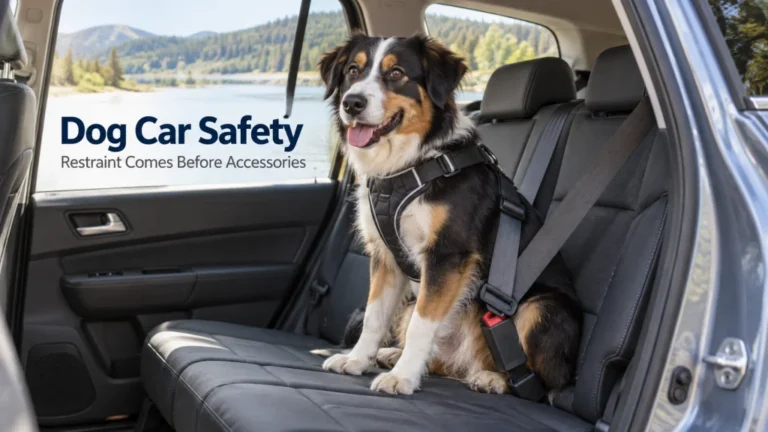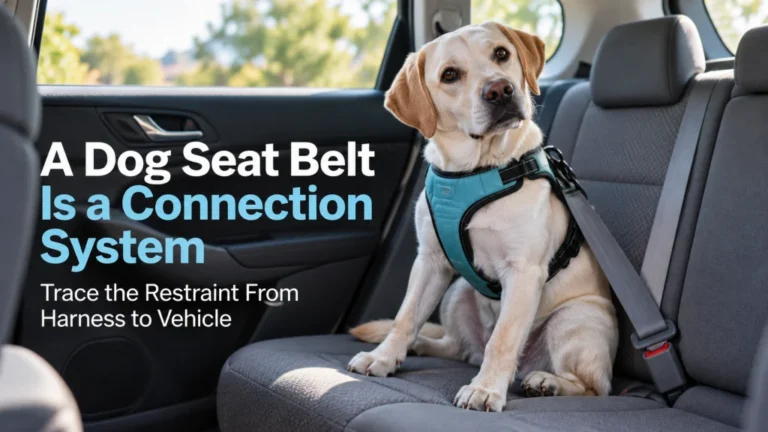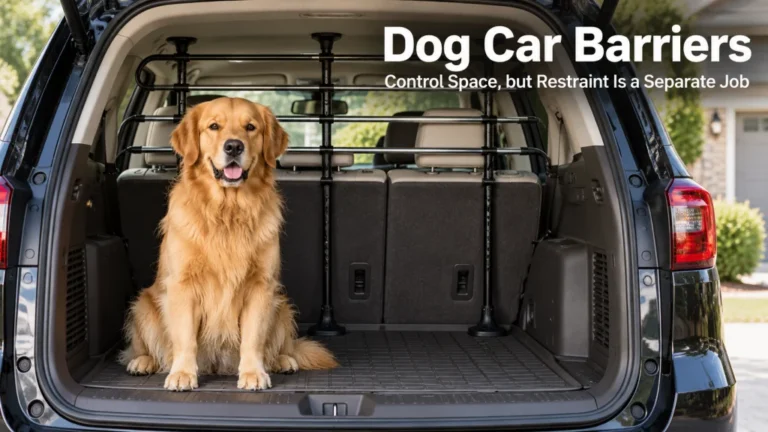
A dog car harness should be judged by evidence for the exact model and size, not by padding, hardware, or a broad crash tested claim. Independent certification records, fit instructions, and the documented attachment method should describe the same setup you plan to use. Evidence for one configuration should not be stretched to another size, generation, or connection method without support. The useful choice is the restraint whose tested configuration fits your dog and can be reproduced correctly in your vehicle.
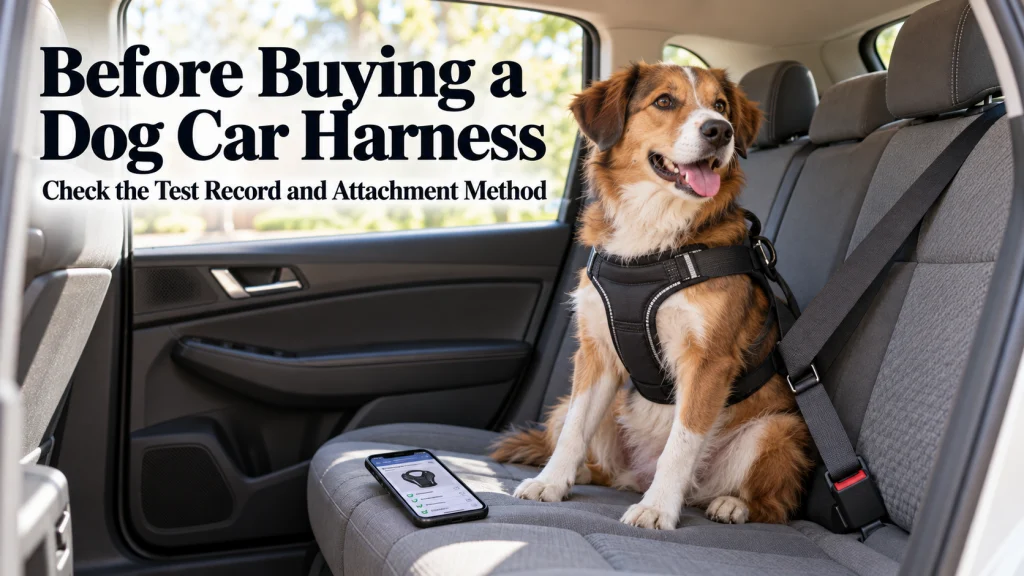
Start with the test record, not the padding
A dog car harness can look substantial, fit comfortably, and still tell you very little about how it behaves during a collision. Before comparing padding or style, check how the exact restraint fits into your broader plan for traveling safely with a dog. Then make sure the harness works within your actual dog car travel setup, including the seat position and the vehicle belt path. Comfort matters, but it comes after evidence that matches the exact restraint you are considering.
The key distinction is between a claim and a reproducible test record. Words such as strong, reinforced, or crash tested can describe different evidence, and they do not automatically mean an independent organization certified the exact model. A useful record identifies the product, protocol, result, and enough configuration detail to show what was evaluated. If those pieces cannot be matched to the harness, treat the safety claim as incomplete rather than filling in missing parts yourself.
Check whether the exact harness model appears in a current independent certification record
Start with the independent record itself rather than a retailer badge or a sentence copied from packaging. Center for Pet Safety publishes certified product records that can identify the product name, listed sizes, pass status, test protocol, test number, test evidence, and test dog weight. Those fields let you compare the item you are considering with what was actually evaluated. If the product name or generation does not match, do not assume a similar looking harness inherited the same result.
This is also where the wider restraint decision belongs in context. If you are still unsure whether a body worn restraint is the right format for your dog and vehicle, the broader dog car safety choices should be settled before you focus on harness details. A current certification record can support a specific tested setup, but it cannot decide whether your dog fits that setup physically or whether your vehicle lets you reproduce it correctly. Evidence is the first gate, not the entire buying decision.
| Record field | What to verify | Why it matters |
|---|---|---|
| Product identity | Exact model name and current generation | A similar name does not prove the same construction or test result. |
| Size coverage | Which sizes are explicitly included in the record | Evidence should not be stretched to an unlisted size. |
| Result | Whether the tested configuration passed the stated protocol | Testing and passing are not the same statement. |
| Protocol and test number | Whether a defined protocol and traceable record are shown | Traceable evidence is more useful than a vague crash tested label. |
| Test evidence | Whether supporting results or video are available | It helps show how the tested setup was configured. |
Use the table as a reading guide, not as a substitute for the original certification page. Open the current record, compare every identifying detail with the exact harness, and save the model information you will need when you check fit and routing. If the listing is vague about which version is covered, stop there and verify before buying. That small pause is more useful than trying to infer protection from materials, price, or appearance.
Verify which sizes and test weights the evidence actually covers
A model name can span several sizes, but the evidence still needs to tell you what was evaluated. Do not read one test dog weight as proof that every size, chest shape, or fit range behaves identically. The current certification record may list covered sizes separately from the test weight, so read both fields instead of blending them together. If your dog’s size is not clearly inside the documented coverage, the correct next step is verification, not extrapolation.
Fit labels can create another shortcut that looks safer than it is. A dog that falls inside a weight recommendation may still need a particular chest or rib cage measurement, and current manufacturer fit pages can pair body measurements with weight guidance. Measure the body area the manufacturer actually specifies and use the current size chart for that exact model. Do not transfer a size from a walking harness, another brand, or an older version simply because the letter on the tag looks familiar.
| Verification item | What to record | Stop and verify if |
|---|---|---|
| Exact model | Name shown on product and certification record | The names or generation markers differ. |
| Harness size | The dog’s selected size | That size is not clearly included in the evidence. |
| Body measurement | The measurement required by the current fit guide | The dog sits between ranges or the required area is unclear. |
| Weight guidance | The current manufacturer recommendation when provided | The dog falls outside the published guidance. |
| Test weight | The weight shown in the independent test record | You are treating that single value as a universal size claim. |
Think of this worksheet as a mismatch detector. It is useful when a retailer page, old review, and current manufacturer page use slightly different names or sizing language. Your goal is not to force the dog into the closest labeled size; it is to confirm that the body measurement, published size range, and independent evidence all point to the same current product. If they do not, choose a setup with clearer documentation rather than guessing.
Fit the chest and body according to the exact manufacturer instructions
Once the evidence matches the model and size, fit becomes the next separate check. Automotive restraint fit should follow the current instructions for that exact harness, including the specified body measurement, strap placement, adjustment sequence, and any limits on how the vest should sit. A walking harness that feels comfortable is not automatically fitted correctly for vehicle use. Do not invent a finger rule, strap angle, or chest position when the manufacturer gives a different method or does not publish one.
Body shape can matter even when two dogs have similar weight. A narrow chest, deep chest, broad rib cage, heavy coat, or unusual proportion can change how a vest sits and whether straps remain where the design expects them to be. Check the dog while standing naturally, then confirm that the harness does not twist, gap, or sit over a place the instructions identify as incorrect. If correct adjustment cannot be achieved within the published size range, that is a fit failure rather than a reason to tighten beyond the instructions.
- Use the body measurement named in the current fit guide.
- Confirm the exact size against the current manufacturer chart.
- Follow the published strap placement and adjustment order.
- Check that the harness lies flat without twisting or obvious gaps.
- Do not connect the automotive restraint to a collar.
Recheck fit after the dog changes weight, grows, loses coat volume, or starts wearing a garment that affects the harness position. Also recheck whenever you replace the harness, because a new generation can use a different pattern or size chart even under a familiar product family name. The goal is not maximum tightness; the goal is the exact fit the tested system requires. When the instructions and the dog’s body do not line up, a different restraint format may be the better choice.
Use the vehicle seat belt routing or connection method supported by that harness
A certified harness is only one part of the tested configuration. The vehicle belt, loops, attachment points, and seating position need to match the method documented for the exact restraint. Route the seat belt through the places shown in the current instructions and complete the connection in the order the manufacturer specifies. Do not substitute a convenient clip, spare strap, or cargo hook simply because it can be made to connect.
The distinction matters because generic connection hardware is a different decision from a harness whose vehicle attachment is part of its tested design. If your main question is about clips, buckle inserts, or other connection systems, use the separate guide to choosing a dog seat belt connection. For an automotive harness, preserve the documented belt path and the supported seat location instead of mixing parts from unrelated systems. A setup that looks tidier can still be a different setup from the one supported by the evidence.
| Harness attachment path | ||||
|---|---|---|---|---|
| Vehicle seat belt | → | Manufacturer specified harness loops or guides | → | Vehicle buckle |
| The dog remains in the supported rear seat position while the belt follows only the routing shown for the exact harness. | ||||
| Do not insert: an extension tether, zipline, collar connection, cargo hook, spare strap, or alternate clip unless the exact system documentation supports it. | ||||
After routing the system, compare the finished setup with the manufacturer illustration or instructional video rather than relying on memory. The belt should not be twisted or routed around an unintended part of the vest. If the vehicle geometry prevents the documented connection, do not improvise around it. That is a compatibility problem and should push you toward another supported restraint setup.
Do not add an extension tether or zipline unless the exact system supports it
Extra freedom of movement can feel kinder during a normal drive, but it can change what happens during a sudden stop or collision. Center for Pet Safety specifically warns against extension tethers and zipline style devices because additional travel can increase excursion and alter the protective behavior of a restraint. Adding one to a certified setup can turn a documented configuration into an undocumented one. The fact that two parts clip together does not mean they were designed or tested to work together.
This is a common place where convenience defeats the evidence. An owner may buy a well documented harness, then add a longer connector so the dog can reach another seat position or move farther across the bench. That modification changes the distance and motion the system must control, which is exactly the part you should not improvise. If the dog needs a different amount of space or a different riding position, choose a restraint format designed for that need rather than extending the tested setup.
Keep ordinary walking harness claims separate from automotive restraint evidence
Strength is useful, but strength alone is not proof of crash performance. Center for Pet Safety has used preliminary static strength testing to screen harnesses before dynamic crash testing and explicitly notes that passing the strength stage is not an indicator of crash protection. That distinction matters when marketing focuses on heavy webbing, metal hardware, reinforced stitching, or a high pull strength. Those features may describe durability, but they do not by themselves show how the whole restraint controls a dog’s movement in a collision.
A walking harness and an automotive harness can even share familiar materials while doing different jobs. Walking equipment manages everyday leash forces and movement, while a vehicle restraint has to work as a system with the dog, the vehicle belt, the seat, and the tested attachment geometry. Do not upgrade a walking claim into a safety claim just because the harness feels strong in your hands. If the independent evidence is missing, call it a walking harness with unknown crash performance rather than guessing.
| Question | Walking harness evidence | Automotive restraint evidence |
|---|---|---|
| What is being shown? | Fit, control, comfort, or material strength for everyday use | Performance of a defined restraint configuration under a stated test protocol |
| Is strong hardware enough? | It may support normal leash use. | No. Whole system performance still needs appropriate evidence. |
| Does a crash tested phrase settle the question? | No. | No. Check who tested it, what passed, and which configuration was evaluated. |
| Can one claim be transferred to another size or generation? | Not without matching documentation. | Not without matching documentation. |
Ask what the evidence actually proves. A pull test can support a statement about strength under that test, while an independent crash protocol can support claims about the configuration evaluated under that protocol. Neither result should be stretched beyond its conditions. Keeping those evidence types separate prevents a strong looking walking harness from being mistaken for a documented vehicle restraint.
Recheck current certification when a product name, generation, or hardware changes
Product names can stay familiar while construction changes underneath them. A revised buckle, different webbing path, new vest shape, updated size range, or changed attachment method can matter because the evidence belongs to a defined configuration. Old reviews and retailer descriptions may continue circulating after a product changes, so they are not reliable proof that the current item matches an older test record. Recheck the independent record and the manufacturer’s current instructions before treating the evidence as current.
The same rule applies when you already own the harness. If replacement hardware, a redesigned part, or a new version changes how the system connects, confirm that the updated configuration is still supported rather than assuming the old record carries forward. You should also recheck if the product page starts using a different model name or size chart. A safety claim is only useful when the evidence can still be tied to the exact restraint in your hands.
- Recheck after a model name or generation changes.
- Recheck after buckles, loops, webbing paths, or included hardware change.
- Recheck after the manufacturer publishes a new size chart or fit method.
- Recheck when a retailer description conflicts with the current manufacturer instructions.
- Recheck when the independent certification page no longer matches the product you can buy.
This trigger list is deliberately conservative because safety documentation is configuration specific. It does not mean every cosmetic revision changes performance, but it keeps you from assuming that a meaningful hardware change is cosmetic. When the current record and current product agree, the decision becomes clearer. When they do not, wait for evidence that resolves the mismatch or choose a better documented option.
Compare a harness with a carrier or crate when the vehicle setup is still undecided
A harness is not automatically the right restraint format for every dog or vehicle. Dog size, body shape, available rear seat space, vehicle geometry, and the dog’s ability to fit the documented harness can all change the decision. Cornell advises securing dogs in the vehicle rather than allowing them to roam freely, and it identifies crash tested harnesses, seat belt systems, and travel crates as restraint options. The practical job is to choose the format that has appropriate evidence and can be installed as documented in your specific vehicle.
A carrier or crate may make more sense when the dog fits that format well and the vehicle can secure it according to the relevant instructions. A harness may make more sense when the dog fits the certified size range and the rear seat allows the specified belt routing without improvisation. Neither choice deserves a universal winner label because the dog and vehicle have to match the tested setup. If every harness option requires a workaround, that is a reason to revisit restraint format rather than accepting a compromised connection.
| Condition | Harness may fit the decision when | Reconsider the format when |
|---|---|---|
| Dog fit | The dog fits a documented size and body range. | Correct fit cannot be achieved within the instructions. |
| Vehicle compatibility | The supported rear seat routing can be reproduced. | The required belt path or seat position cannot be used. |
| Evidence | The exact model and size match current independent records. | The claim depends on a different model, generation, or setup. |
| Daily use | You can install and check the system correctly on each trip. | The setup invites shortcuts or repeated undocumented changes. |
Once you know the format, return to the exact instructions for that system. Do not use a harness article to invent crate anchoring rules, and do not borrow carrier assumptions for a body worn restraint. Each format needs its own evidence, fit, and installation check. The safest practical decision is the one you can verify and reproduce without adding your own engineering.
Final Thoughts: use the configuration you can actually reproduce
The useful dog car harness is not the one with the thickest padding or the strongest sounding marketing copy. It is the one whose exact model and size match current independent evidence, whose fit can be achieved on your dog’s body, and whose documented attachment method works in your vehicle. Keep those checks separate so one good feature does not hide a weak link elsewhere in the setup. If any part depends on guessing, stop at that boundary and verify it.
Then preserve the configuration that the evidence supports. Do not add a longer tether, change the connection point, move the dog to an unsupported position, or transfer an old result to a new generation without documentation. Recheck fit and current instructions when the dog or product changes. A restraint becomes practical only when you can set it up correctly every time without improvising around the parts that matter most.
Frequently asked questions
The questions below focus on the places where harness shopping most often becomes ambiguous: test language, sizing, connection method, and changes to the tested setup. The same rule runs through all of them, which is to match the claim to the exact product and configuration. Do not use a strong sounding label as a substitute for a traceable record. When a detail is unclear, the safest answer is to verify rather than infer.
These answers also stay within owner level selection and setup. They do not promise that any restraint can prevent every injury or make every collision safe. Vehicle conditions, crash severity, dog fit, and exact restraint design all matter. Use current independent evidence and the manufacturer’s current instructions together.
🚗 What does it mean when a dog car harness is labeled crash tested?
By itself, the phrase does not tell you who performed the test, what protocol was used, whether the product passed, or which size and setup were evaluated. Look for a current independent record that identifies the exact product and the result.
📏 Can I choose a car harness for dogs by weight alone?
Not unless the exact manufacturer instructions say weight is the only sizing input. Many harnesses use a chest or rib cage measurement as well, so follow the current fit guide for that exact model.
🔗 Can I add a longer tether so my dog can move around more?
Do not add an extension tether or zipline to a tested configuration unless the exact system explicitly supports it. Extra travel changes the restraint geometry and can move the setup outside the evidence you relied on.
🐕 Can I attach a vehicle restraint to my dog’s collar?
No. Use the body worn automotive harness and connection method specified by the restraint manufacturer. A collar is not a substitute attachment point for a system designed to manage forces across the body.
🧾 Do I need to recheck certification if the product name stays the same?
Yes when the generation, hardware, size chart, fit method, or attachment design changes. The useful question is whether the current item still matches the exact configuration covered by the current evidence.
References and Sources
The safety distinctions here rely on independent restraint testing, current certification records, veterinary travel guidance, and current manufacturer fit information. Those sources separate strength from crash performance and show why the documented attachment method matters. They also support checking product identity, size coverage, and fit at the exact model level. The article stays within those evidence boundaries.
Independent records support crash performance and certification status, while manufacturer information supports model specific fit and setup. The two source types are not interchangeable. Manufacturer instructions explain how a product is fitted and connected. Independent testing documents performance under its stated protocol.
- Center for Pet Safety certified products: Provides current independent certification records and the fields used to verify exact product identity and test status.
- CPS harness crashworthiness study results: Supports the distinction between products that reached dynamic testing and the performance observed in complete restraint setups.
- CPS strength testing explanation: Explains that preliminary strength testing is not evidence of crash protection by itself.
- CPS extension tether advisory: Supports avoiding extension tethers and zipline style devices that add movement or change the tested configuration.
- Cornell canine travel guidance: Supports securing dogs in vehicles and using an appropriate tested restraint format rather than allowing free movement.
- Current manufacturer sizing guidance: Shows why exact model sizing can depend on body measurements as well as weight guidance.