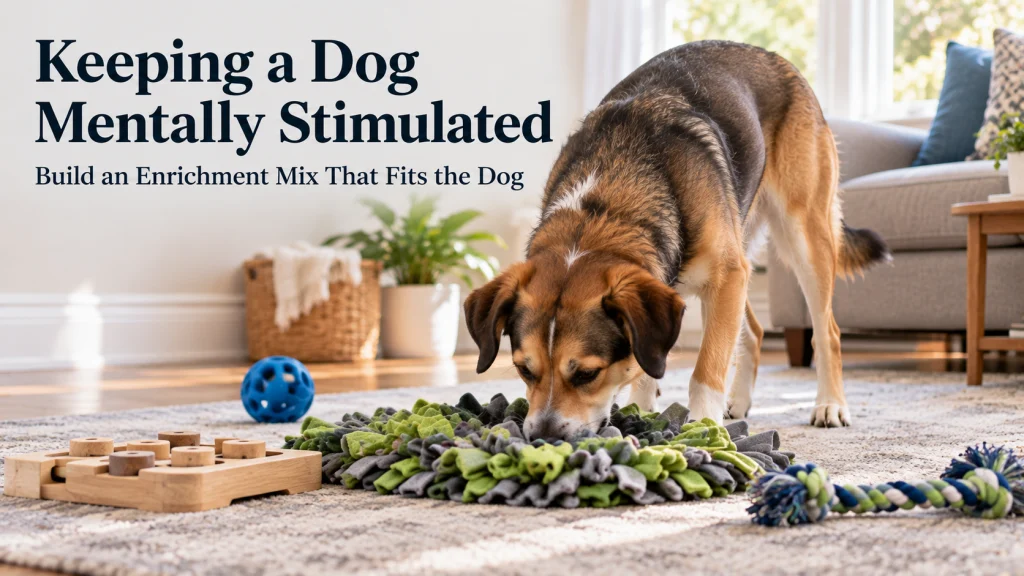
Keeping a dog mentally stimulated works best when enrichment matches the behaviors that already hold that dog’s attention. A useful mix can include ordinary toys, chewing, problem solving, food based activities, scent work, retrieve play, tug or chase play, and indoor games. The right balance depends on size, age, body type, activity, play style, chewing style, home setup, supervision, and how the dog responds to difficulty. Enrichment should support normal behavior and daily engagement, not replace veterinary care, behavior treatment, or an appropriate exercise plan.
Start with the behavior your dog already wants to use
Mental stimulation is not one toy and it is not a fixed number of minutes. Start by watching what the dog chooses when there is no elaborate setup: sniffing along a room edge, carrying objects, settling down to chew, searching for crumbs, chasing movement, pulling against a toy, or working to reach food. Those choices give you a better starting point than buying a pile of unrelated enrichment gear. A dog that loves to search may get more value from scent work than from a difficult puzzle, while a dog that prefers carrying and returning objects may engage more readily with retrieve play.
I would build the first enrichment mix around two or three behaviors the dog already understands, then add variety rather than constant novelty. The goal is not to make every activity harder each time, because difficulty and engagement are not the same thing. A useful activity should give the dog a clear way to interact, a reasonable chance to succeed, and a safe stopping point when interest fades. That approach keeps the household focused on fit and response instead of treating boredom as a reason to keep buying new things.
| What the dog tends to do | Activity format to try | What to watch |
|---|---|---|
| Carries, mouths, tosses or bats objects | Ordinary toy play | Size, material condition and how the dog uses the toy |
| Settles and gnaws | Nonfood chewing activity | Chewing intensity, wear and possible ingestion |
| Works at barriers or hidden access points | Puzzle problem solving | Whether challenge stays productive instead of frustrating |
| Enjoys searching for food | Food based enrichment | Food amount, cleanup and difficulty |
| Sniffs deeply and follows trails | Scent and search games | Safe search area and a clear finish |
| Chases and returns objects | Fetch and retrieve play | Space, footing and arousal level |
| Pulls or pursues moving objects | Tug and chase play | Handling, space and the dog’s ability to pause |
| Needs engagement in limited space | Indoor mental games | Flooring, furniture, noise and household traffic |
Choose ordinary toys by size, play style, failure mode and maintenance
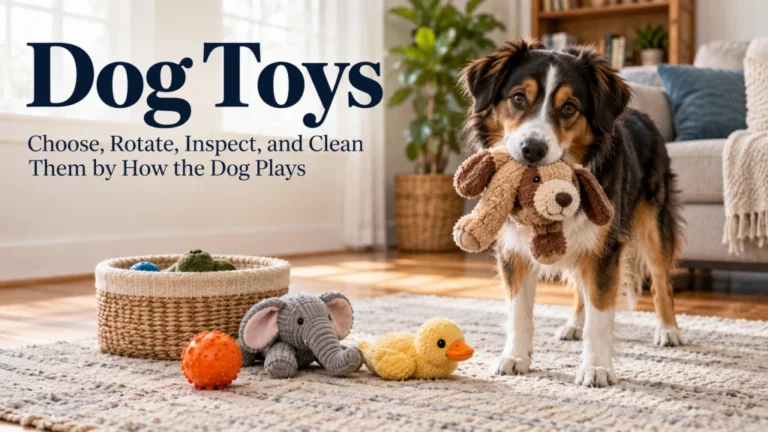
Ordinary dog toys are useful when the main job is carrying, mouthing, tossing, batting, light chewing, or interactive play without a separate food or puzzle task. Size should match the individual dog’s mouth and play style, not just the broad size label printed on packaging. A toy that is easy for one medium dog to carry can be too small for another dog with a wider mouth or a stronger tendency to swallow pieces. Start with the way the dog actually handles objects, then choose a shape and size that remain easy to supervise.
Failure mode matters just as much as the material name. Plush fabric can tear, rope can fray, rubber can split, seams can open, and small attached parts can loosen, so inspection needs to be part of the routine rather than an occasional cleanup task. Rotation can make familiar items interesting again, but rotation should not return a damaged toy to use simply because the dog still wants it. A small set of intact toys that match different play styles is more useful than a large basket of items that no longer fit the way the dog plays.
- Check whether the toy is large enough for the dog’s mouth and usual handling.
- Watch how quickly seams, edges, rope fibers or flexible material begin to fail.
- Remove damaged items when pieces could be pulled free or swallowed.
- Clean and dry toys according to their material and manufacturer instructions when those instructions apply.
Give chewing its own nonfood outlet when chewing is the primary activity
Chewing deserves its own place in an enrichment mix because the dog is doing a different job from fetching, searching, or solving a puzzle. If the dog settles happily to gnaw, look at dog chew toys as a category built around sustained mouth use rather than as generic toys that happen to tolerate some biting. The best fit depends on the dog’s size, jaw use, chewing intensity, and tendency to remove or swallow pieces. No toy should be treated as indestructible, and a material that survives one dog can fail quickly with another.
Supervision should rise with uncertainty. A new chew item deserves closer observation than one with a well understood wear pattern, and any change in cracking, shredding, missing pieces, or swallowing behavior should change the decision. If chewing suddenly becomes unusual, frantic, painful, one sided, or connected with another health or behavior change, do not try to solve that shift by simply offering a tougher object. Enrichment can give normal chewing a safer outlet, but it does not diagnose why a dog’s behavior has changed.
| Supervision level | When it fits | Owner action |
|---|---|---|
| Close observation | New item, unknown chewing style, fast material wear | Stay nearby and interrupt if pieces loosen or ingestion becomes possible |
| Routine check | Known item with predictable wear and calm use | Inspect before and after use and remove it as condition changes |
| Stop and reassess | Repeated swallowing attempts, sharp damage, unusual chewing behavior | Remove the item and reconsider the activity or seek appropriate professional guidance |
Use puzzle toys when the dog needs a problem to solve
Dog puzzle toys make sense when the dog enjoys manipulating parts, testing openings, moving covers, or repeating actions that lead to access. A good first puzzle makes the rule easy to discover, because the point is successful problem solving rather than proving that the dog can tolerate confusion. If the dog paws, noses, nudges, or rotates the item and then reaches the goal, the activity is doing its job. If the dog only bites the entire object, walks away, or escalates into frantic behavior, the setup may be too difficult or simply mismatched.
Increase difficulty by changing one variable at a time, such as adding another simple step or making the target less obvious. Do not use frustration as the measure of mental work. A dog that finishes an easy puzzle calmly may be getting more useful engagement than a dog that spends a long session trying to tear apart a harder one. When chewing becomes the main strategy, return to an easier problem or move to a different activity format that better matches the dog’s preferences.
Key point: A puzzle is successful when the dog can understand the task and interact safely, not when the task keeps the dog busy for the longest possible period.
Use food based enrichment when eating can become part of the mental task
Food enrichment for dogs works when food itself can become part of searching, licking, nosing, rolling, uncovering, or extracting. The mental job should remain clear enough that the dog can learn how the setup works without switching to destructive access. Food can be placed in a suitable puzzle, spread across a snuffle style surface, hidden in safe locations, or used in another supervised format that matches the dog’s size and behavior. The specific setup matters less than whether the dog can engage safely and whether the household can clean and manage it afterward.
Food used for enrichment still belongs inside the dog’s overall feeding plan. If an activity adds extra food on top of regular meals, the owner can unintentionally turn a mental game into a calorie problem, so using part of the normal food allocation can be simpler when appropriate. Ingredient choice, diet restrictions, swallowing concerns, and clinical nutrition questions are not solved by an enrichment article. When those issues matter, the feeding plan or veterinary guidance should control what food is used.
- Choose a format the dog can physically access without forcing or damaging the item.
- Keep the food amount visible in the household’s normal feeding decisions.
- Clean food contact surfaces thoroughly and replace items that cannot be kept in usable condition.
- Reduce difficulty if the dog shifts from solving the task to destroying the container or surface.
Use scent games when sniffing and searching are the main activity
Some dogs would rather investigate a scent trail than chase a moving toy. For those dogs, scent games for dogs can turn sniffing into a clear search job without requiring a large room or elaborate equipment. Begin with an easy search area and an obvious target the dog already values, then let the nose do most of the work. The owner should make the problem understandable before making the hiding place more difficult.
Search areas need practical boundaries. Avoid hiding targets where the dog has to knock over furniture, squeeze into unsafe gaps, climb unstable surfaces, or raid places that should normally stay off limits. End the search clearly once the target has been found so the dog is not encouraged to keep tearing through the room for something that is no longer there. As the dog becomes more confident, vary location and difficulty gradually while keeping the physical setup safe and predictable.
Pro Tips: If the dog keeps searching after the target is gone, make the finish easier to recognize before making the next search harder.
Choose fetch toys when retrieve play is the job
Fetch is a better fit for dogs that enjoy pursuing an object and then carrying it back than for dogs that only want the chase. The dog fetch toys decision should therefore start with retrieve behavior, mouth size, footing, available space, and the way the dog handles the object after catching it. A lightweight object that is easy to see may work in one setting, while a different shape may be easier for another dog to pick up comfortably. The activity should make the retrieve easy to understand without encouraging unsafe speed or collisions in a cramped area.
Indoor and outdoor fetch should not be treated as the same setup. Hallways, slick floors, furniture corners, stairs, fences, uneven ground, heat, and nearby people can all change whether a chase path is sensible. If the dog becomes overexcited, starts body checking furniture, or stops returning the object and begins shredding it, the game has shifted away from the original job. Shorter paths, a different location, or another enrichment format can be a better answer than throwing faster or farther.
Choose tug and chase toys for interactive pulling and pursuit play
Interactive pulling and pursuit suit dogs that enjoy resistance, motion, and a person participating in the game. Dog tug toys should give both dog and handler enough usable space to hold the item without hands crowding the dog’s mouth. The material and length should also fit the dog’s size and pulling style, because a toy that feels manageable with a small dog can be awkward or hard to control with a larger, stronger dog. Keep the game on stable footing and away from furniture or household traffic that could turn normal movement into a collision risk.
The useful household question is whether the dog can move in and out of the game without the arousal level taking over the room. A pause can be built into play without turning the whole session into formal training. If the dog cannot disengage, redirects onto hands or clothing, guards the item, or shows another concerning behavior change, enrichment advice is no longer enough to explain what is happening. Those situations belong with appropriate training or behavior guidance rather than simply changing to a stronger toy.
Use indoor games when the goal is mental engagement in limited space
Indoor games for dogs are most useful when the household needs mental engagement without turning a small room into an improvised obstacle course. Searching for a visible or lightly hidden target, choosing between safe objects, simple puzzle work, gentle retrieve play, and short scent games can all fit limited space when flooring and furniture allow it. The best choice depends on how much movement the dog uses and how much clear floor area the home actually has. A game that looks easy on paper can be a poor fit if it sends the dog sliding around corners or into busy walkways.
Indoor setups also have a cleanup and storage cost. Food residue, damp lick surfaces, scattered toys, loose fibers, and objects left in traffic paths can turn enrichment into household clutter if no one owns the reset step. I would choose formats that the household can prepare, supervise, clean and put away consistently rather than the most elaborate activity available. A simple search game that happens regularly can be more useful than a complicated setup that stays in a closet because it takes too much work.
| Household condition | Better fit | Reason |
|---|---|---|
| Small room with clear floor space | Scent search or simple puzzle | Engagement can stay concentrated without fast running |
| Slippery flooring | Stationary licking, chewing or puzzle work | Reduces rapid turning and sliding |
| Busy household traffic | Quiet activity in a managed area | Keeps the dog and people from competing for the same path |
| Limited storage | Multipurpose washable items and low equipment games | Reduces clutter and maintenance burden |
Increase variety and difficulty gradually instead of using frustration as a measure
Variety works when it changes the job, the context, or the sensory experience without making every session unfamiliar. Rotating between searching, chewing, problem solving, retrieve play and interactive play gives the dog several outlets while still preserving activities it already understands. You do not need a fixed quota for each format, and there is no universal schedule that fits every household. Watch which activities lead to focused engagement and a calm finish, then adjust the mix as preferences and circumstances change.
Difficulty should rise only when the dog is consistently succeeding with the current version. Make one part slightly less obvious, add one simple step, or change the location before stacking several new challenges together. If the dog stops using the intended strategy and begins barking at, biting, flipping, abandoning, or guarding the setup, treat that as information rather than as proof that more persistence is needed. Lower the challenge, change the activity, or stop and reset.
| Example day | Activity format | What the dog gets to do |
|---|---|---|
| Day 1 | Easy scent search | Sniff and find an obvious target in a familiar room |
| Day 2 | Chewing activity | Settle into sustained, supervised chewing |
| Day 3 | Simple puzzle | Work through a clear problem with an easy success path |
| Day 4 | Retrieve play | Chase, carry and return an object when space and footing allow |
| Day 5 | Food based enrichment | Search, lick, nose or manipulate part of the normal food allocation |
| Day 6 | Tug or chase play | Use interactive pulling or pursuit with enough room to pause safely |
| Day 7 | Indoor mental game | Use a low equipment search, choice or problem solving activity that fits the home |
This is an example week, not a required schedule or a seven day quota. A dog may prefer more scent work, less retrieve play, repeated chewing sessions, or a different mix entirely, and some days may need no planned enrichment activity at all. Keep the formats that produce safe, focused engagement and change them when the dog’s preferences, health, home setup or routine changes. Variety should support the individual dog rather than force the household to complete a checklist.
Keep enrichment separate from training, exercise and behavior treatment
Enrichment, training and exercise can overlap in real life, but they are not interchangeable. A scent search may involve movement, a puzzle may involve learned behavior, and tug can include pauses and cues, yet the primary job can still be mental engagement. Problems start when an owner assumes that a toy should replace a training plan, that a puzzle should replace physical activity, or that more enrichment should fix panic, aggression, compulsive behavior or another serious behavior concern. The right category depends on the problem the household is actually trying to solve.
Use enrichment for normal opportunities to sniff, chew, search, chase, retrieve, investigate and solve. Use training guidance when the goal is teaching a skill, changing manners, managing specific everyday behavior, or building a repeatable response. Use exercise guidance when the main decision is physical workload, walking or conditioning. When the issue involves sudden behavior change, pain, injury, panic, aggression, compulsive behavior, or another concern that may require clinical or specialized assessment, move beyond an enrichment article.
| Main question | Primary lane | Example |
|---|---|---|
| What safe activity gives the dog a natural mental job? | Enrichment | Scent search, chewing, puzzle or retrieve play |
| What response or household behavior needs to be taught? | Training | Teaching a cue, handling skill or everyday manner |
| How much physical activity is appropriate? | Exercise | Walking or workload decisions based on the individual dog |
| Is there a serious behavior or health concern? | Professional assessment | Pain, panic, aggression, compulsive behavior or sudden major change |
Final thoughts: build several safe ways for the dog to use its brain
Good enrichment does not require an endless stream of new products. It requires a small set of activities that match how the dog likes to chew, sniff, search, solve, chase, retrieve, tug, lick or investigate, plus enough rotation to keep those formats useful. Start with behaviors you can already observe, choose setups that fit the dog’s size and the home’s real space, and supervise more closely when an item or activity is new. Then keep what produces focused, safe engagement and remove what repeatedly creates confusion, damage or poor fit.
The strongest enrichment system is easy for the household to maintain. It accounts for cleaning, storage, wear, food amount, supervision and the dog’s changing preferences instead of measuring success by how long an activity keeps the dog occupied. When the main question becomes training, exercise, pain, injury or a serious behavior concern, move to the right source of help rather than forcing enrichment to do a job it cannot do. That keeps mental stimulation practical, varied and grounded in the individual dog.
FAQs
🧩 How do I know whether my dog needs more mental stimulation?
Look first at the dog’s daily opportunities to sniff, chew, search, solve, play and interact, then compare those opportunities with what the dog naturally chooses to do. Restlessness or destructive behavior can have more than one cause, so do not treat those signs as proof that enrichment alone is the answer. Add a safe activity that matches a known preference and watch how the dog responds.
🐕 What type of enrichment is best for a dog that ignores toys?
Try a different activity format instead of assuming the dog needs a more exciting toy. A dog that ignores objects may still enjoy scent searches, food based problem solving, chewing, interactive tug, or another task. Match the format to the behaviors the dog already shows.
👃 Are scent games mentally stimulating for dogs?
Yes, scent games can give a dog a clear search task built around normal sniffing behavior. Start with easy hiding places in a safe area and make the finish clear. Increase difficulty only when the dog understands the game and remains engaged without becoming frustrated.
🍽️ Can I use part of my dog’s regular food for enrichment?
That can be a practical option when it fits the dog’s normal feeding plan. Food used in puzzles, searches or licking activities still counts as food, so keep the amount visible instead of treating enrichment calories as separate. Diet restrictions or clinical nutrition questions should follow appropriate veterinary guidance.
🦴 How often should I rotate my dog’s toys?
There is no fixed rotation schedule that every dog needs. Rotate when familiar items are losing interest, when you want to offer a different behavior outlet, or when the household needs a different type of activity. Always inspect condition before an item returns to use.
🏠 What enrichment works well in a small home?
Scent searches, stationary puzzles, licking activities, chewing and other low movement games can fit limited space well. Choose activities around flooring, furniture, noise and household traffic. Avoid turning a tight room into a fast chase path if the dog cannot move safely.
References and Sources
- AAHA enrichment guidance: Supports variety, toy rotation, fit to the individual pet, and the role of enrichment in meeting natural behavioral needs.
- AAHA indoor enrichment guidance: Supports toy inspection, removal of damaged items, appropriate sizing, supervision and practical indoor variety.
- Merck Veterinary Manual: Supports environmental enrichment as a way to promote species typical behavior and reduce boredom and frustration.
- ASPCA canine enrichment guidance: Supports supervised opportunities for chewing, scavenging, scent work and food based activities, with active monitoring for ingestion risk.