Good dog care is easier to manage when recurring responsibilities have a clear place, a backup person or plan, and a point where a specialist should take over. The practical goal is not to memorize every possible care task but to build a dependable system for the dog in front of you, the household you live in, and the routine you can actually maintain. This framework covers readiness, daily care, costs, absence coverage, identification, emergency planning, and specialist handoffs without pretending one schedule fits every dog.
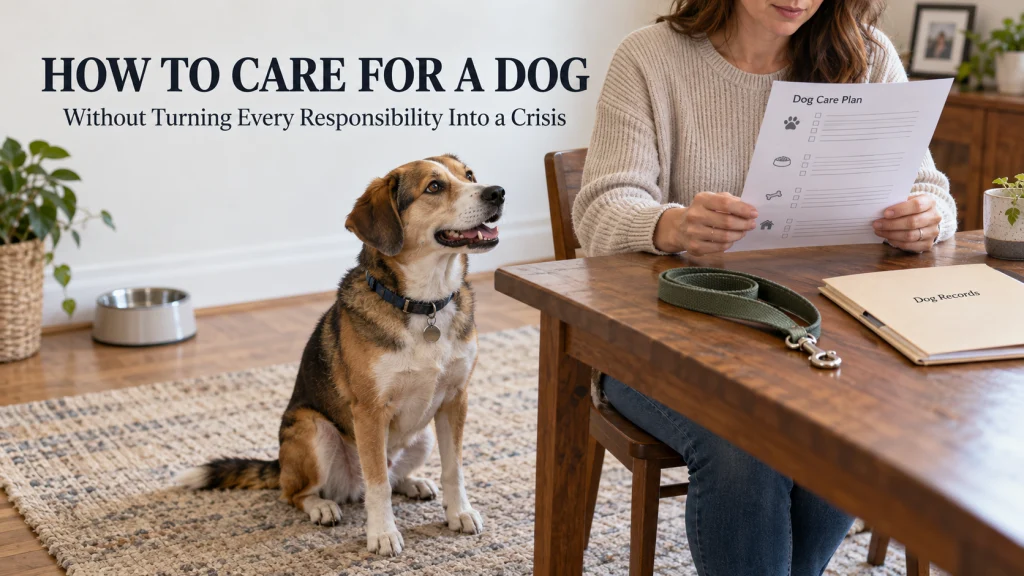
Dog care works best when each recurring responsibility has a place
If you are learning how to care for a dog, the biggest improvement often comes from organizing responsibilities before trying to optimize every detail. Feeding, bathroom access, exercise, training, grooming, cleanup, veterinary care, records, and supervision all compete for attention, but they do not all need the same person, schedule, or level of expertise. A dependable system makes it clear what must happen routinely, what needs a backup, and what should be handed to a veterinarian or another qualified professional. That structure matters even more when work, travel, illness, moving, or a change in the household disrupts the normal day.
I would treat dog care as a set of repeatable ownership jobs rather than a giant checklist that depends on memory. A simple routine should tell you who handles the ordinary task, what condition would change the plan, and who steps in when the ordinary plan fails. The dog’s age, size, body type, coat, activity, behavior, health needs, and home setup can all change the details, so the system needs room to adapt. The point is reliability, not making every household run the same way.
Decide whether dog ownership fits before choosing a dog
Before looking at breeds, adoption listings, or supplies, check whether the household can carry the responsibility without relying on wishful thinking. Time, housing rules, family agreement, daily availability, travel, budget, and access to veterinary care all matter before appearance or personality preferences enter the decision. A person with a flexible schedule but unstable housing faces a different constraint from a household with space but long periods when nobody is home. The deeper before getting a dog guide is the right place to work through those readiness questions in detail.
A useful readiness test asks what happens on an ordinary busy day, not just on a relaxed weekend. Consider who provides food and water, bathroom access, exercise, supervision, training practice, cleanup, companionship, and transport when needed, then ask what happens if that person is unavailable. If the answer to several essential jobs is simply that someone will probably figure it out, the system is not ready yet. Delaying ownership can be a responsible decision when the schedule, housing, budget, or backup coverage cannot support dependable care.
Choose a dog after the household constraints are clear
Once the household is ready for the responsibility, the next question is fit. Size matters, but it is only one part of the picture because activity, coat care, age, behavior, noise tolerance, space, stairs, children, other animals, and transport can create very different daily workloads. A smaller dog can still require substantial exercise, training, grooming, or supervision, while a larger dog may fit a calm household if the space, handling, and routine are appropriate. The choosing a dog guide should be used to compare those constraints before committing to a specific dog.
I would prioritize the dog whose likely daily needs fit the household over the dog that is simply most appealing at first glance. That means asking whether the home can support the dog’s activity, whether everyone can handle the dog safely, whether grooming needs fit the available time and budget, and whether transportation is practical. It also means being honest about predictable friction, such as frequent travel, limited mobility, close neighbors, or a household that cannot provide consistent supervision. Good fit reduces avoidable conflict, but it does not remove the need for training, veterinary care, backup planning, or ongoing adjustment.
Build the routine that keeps ordinary care from being missed
Once a dog is home, dog care basics become easier when the household gives recurring jobs a predictable place in the day. The exact timing and amount of food, exercise, grooming, training, and rest depend on the individual dog and should not be forced into a universal schedule. What matters at this level is that the household knows who is responsible and that changes in appetite, mobility, behavior, coat condition, bathroom habits, or general comfort are not ignored. The daily dog care guide goes deeper into building a routine around the dog rather than around a generic timetable.
A routine should also be simple enough to survive a rushed morning or a late return home. If the care system needs one person to remember ten separate details with no handoff, it is fragile even when it works most days. Put the most important information where another household member or caregiver can understand it without guessing. A short handoff list can cover the practical essentials without turning the home into an operations center.
- Who is responsible for each recurring task and who is the backup?
- What information does the backup need about feeding, access, handling, and routine?
- Which changes should trigger a call to the veterinarian or another qualified professional?
- Where are identification details, veterinary contacts, care instructions, and necessary records kept?
- What part of the routine needs to change when work, travel, weather, age, or mobility changes?
This kind of list is useful because it turns caring for a dog into visible responsibilities rather than assumptions. It also makes it easier to notice when one person is carrying too much of the workload or when a backup plan exists only in theory. The routine can stay simple, but the ownership of each job should be clear. That clarity becomes especially important when care extends beyond the ordinary day.
Plan for the responsibilities that sit outside the ordinary day
Many ownership problems appear outside the normal routine rather than during it. A dog may need care while the owner is away, records may need to be found quickly, expenses may arrive when the household is already stretched, or another person may need to step in with little notice. These are not rare side issues because they are part of maintaining continuity of care. Building the backup before it is needed makes the ordinary routine more resilient.
I would separate these responsibilities into money, absence coverage, identification and records, and emergency planning. Each area answers a different failure point, so combining them into one vague idea of being prepared makes it easy to miss something important. The goal is not to predict every event but to make sure another responsible adult can understand what the dog needs and where the necessary information is kept. That preparation should remain practical and should not drift into veterinary diagnosis or treatment.
Separate ownership costs from the purchase or adoption price
The acquisition price is only the entry point, not the ownership budget. Food, routine veterinary care, preventive care, grooming needs, training support, replacement supplies, boarding or caregiving, housing related costs, and unexpected veterinary expenses can all affect whether the routine remains sustainable. The actual mix varies by dog and household, so a single universal figure would be misleading. Use the dog ownership costs guide to build a budget around the responsibilities you will actually carry.
Decide who cares for the dog when you are away
Travel, long work periods, illness, and family obligations can remove the usual caregiver from the routine. A backup caregiver needs more than a key because they also need clear instructions, realistic access to the dog, contact information, and enough context to know when the ordinary routine is no longer enough. The best arrangement depends on the dog’s age, behavior, health needs, comfort with unfamiliar people, and the length and type of absence. The dog care when away guide covers how to build that coverage without assuming one option fits every dog.
Keep identification and ownership records current
Identification works only when the information can connect the dog with the right person. Keep the dog’s identification details, veterinary contact information, ownership records, and other important documents organized enough that they can be found when needed. If a registry, tag, or record depends on contact information, update it when the household changes. The dog identification and records guide explains what to organize and how to make the information usable.
Write an emergency plan another person can use
An emergency plan should focus on continuity, contacts, transport, access, records, and who has authority to make practical decisions when the usual caregiver cannot. It should not try to become a homemade medical manual because veterinary diagnosis and treatment belong with veterinary professionals. Keep the instructions readable enough that another responsible adult can act without decoding private shorthand. The dog emergency planning guide provides a fuller structure for that handoff.
Know where specialist care needs its own guide
A top level dog care framework should route detailed questions instead of pretending to answer every one of them. Training technique, walking systems, crate setup, grooming methods, feeding equipment, enrichment, travel, senior accessibility, and cleanup each have their own decisions, risks, and household constraints. Keeping those topics separate lets the general ownership system stay useful without flattening everything into generic advice. It also makes it easier to find the right next step when a specific responsibility becomes the problem.
The handoff matters because a broad rule can become misleading when the task changes. A feeding question can involve equipment, routine, or veterinary nutrition; a mobility question can involve home access or a health concern; a behavior question can involve basic manners or a case that needs qualified professional help. Use the specialized guides for the practical task, then use a veterinarian or another appropriate professional when the question crosses that boundary. The goal is to route the problem to the level of detail that can actually answer it.
Training and everyday behavior
Basic manners, handling, household rules, and everyday behavior practice belong in the how to train a dog guide. Training plans should account for the dog’s age, behavior context, environment, and the skill being taught rather than relying on one technique for every situation. If behavior changes suddenly, creates a serious safety concern, or may be connected with health or pain, the problem is no longer just a basic training question.
Walking and exercise
Leash walking, routine activity, outdoor setup, and everyday exercise decisions belong in the walking and exercising a dog guide. Activity needs differ with age, size, body type, health, conditioning, climate, and behavior, so this page should not prescribe a single amount for every dog. When exercise becomes a rehabilitation or medical limitation question, a veterinarian should guide the next step.
Crates, beds, gates and home setup
Rest areas, containment, crates, beds, gates, and household zones belong in the setting up a home for a dog guide. The right setup depends on dog size, mobility, behavior, supervision needs, room layout, and the exact product when a crate, gate, or other containment item is involved. Fit, compatibility, and manufacturer instructions matter more than assuming a larger or more complicated setup is automatically better.
Grooming and feeding
Owner level coat care, bathing, brushing, nail tools, and hygiene routines belong in the how to groom a dog guide. Bowls, feeders, water setup, storage, and practical mealtime systems belong in the feeding a dog guide. Skin disease, medical nutrition, prescription diets, medication, and other clinical questions should be handled with a veterinarian rather than stretched into general grooming or feeding advice.
Enrichment and travel
Toys, play formats, puzzle difficulty, and practical mental stimulation belong in the keeping a dog mentally stimulated guide. Vehicle setup, carriers, travel crates, trip planning, and portable gear belong in the traveling with a dog guide. Both topics depend on the individual dog and the exact setup, so product labels, fit, compatibility, and safety guidance should be checked when equipment is involved.
Senior care and household cleanup
Accessibility, ramps, stairs, beds, and daily living adjustments for an older dog belong in the caring for an older dog guide. Hair, dirt, odor, accidents, floor protection, and practical cleanup systems belong in the keeping a home clean with dogs guide. A change in mobility, continence, appetite, comfort, or behavior can have a medical cause, so cleanup or accessibility changes should not be used as a substitute for veterinary evaluation when a health concern is possible.
Know when a question needs a veterinarian or another qualified professional
Owner level care includes observing the dog, maintaining routines, keeping records, using products as directed, and noticing when the normal pattern changes. It does not include diagnosing disease, prescribing medication, designing clinical diets, treating injuries, or turning a serious behavior problem into a do it yourself experiment. When a concern may involve illness, pain, injury, a major behavior change, or another issue outside ordinary care, contact a veterinarian or the appropriate qualified professional. The earlier the ownership system recognizes that boundary, the less likely a household is to lose time trying to solve the wrong problem.
Household safety deserves the same clarity. Children need active adult supervision around dogs, and ordinary hygiene such as handwashing after handling waste, food, or supplies helps reduce household exposure to germs. Those are broad safety practices, not a substitute for medical advice for either a person or a dog. If the question becomes about a bite injury, human illness, canine illness, treatment, or emergency care, use the appropriate medical or veterinary service rather than relying on a general dog care page.
Boundary: A care routine can tell you what is normal for your household and when to escalate, but it should not be used to diagnose or treat a health or serious behavior problem.
A good handoff includes the facts the professional needs rather than a conclusion the owner has already decided on. Note what changed, what the dog was doing, what products or routines were involved, and what records or instructions are relevant. That makes the next conversation more useful without asking the owner to act as the diagnostician. The same principle applies throughout dog ownership: observe carefully, organize the information, and route the problem to the right level of expertise.
Build one ownership map with routine, backup and escalation columns
The most useful ownership map is short enough to maintain and specific enough that another person can follow it. Start with the responsibilities that recur in your household, then assign a routine owner, a backup, and a clear escalation point. A puppy, an adult dog, and an older dog may need different rows because supervision, mobility, training, coat care, health monitoring, and access can change over time. Review the map when the dog or household changes rather than waiting for a problem to expose an outdated plan.
The table below is a framework, not a universal care schedule. It deliberately avoids fixed feeding, exercise, grooming, or alone time intervals because those depend on the dog and, in some cases, veterinary or product guidance. Use it to decide where each responsibility lives and which detailed guide or professional owns the next question. That keeps the general system clear while still leaving room for individualized care.
| Responsibility | Routine owner | Backup plan | Escalation or specialist handoff |
|---|---|---|---|
| Food, water and mealtime setup | Named household caregiver | Written instructions and backup caregiver | Feeding guide or veterinarian when the question is clinical |
| Bathroom access, walks and daily activity | Named household caregiver | Second caregiver or arranged outside help | Walking guide or veterinarian when health limits activity |
| Training and household behavior | People who handle the dog consistently | Shared cues and household rules | Training guide or qualified professional when the case exceeds basic manners |
| Grooming and hygiene | Person responsible for routine coat and hygiene care | Backup caregiver or qualified groomer when appropriate | Grooming guide or veterinarian when a health concern is possible |
| Identification, contacts and records | Person responsible for household records | Accessible copy for another trusted adult | Registry, veterinarian, local authority, or other relevant record holder |
| Absence and emergency coverage | Primary owner | Named caregiver with access and instructions | Veterinarian, emergency service, boarding provider, or other appropriate professional |
For a one week system check, do not try to perfect every routine at once. Watch where care depends on memory, where two people assume the other person is responsible, where information is hard to find, and where there is no backup if the normal caregiver is unavailable. At the end of the week, fix the weakest handoff first, then update the written map. A small system that people actually use is more dependable than a detailed plan nobody can follow.
One week worksheet: Use one row for each responsibility that caused confusion, delay, missed care, or unnecessary guessing during the week. The goal is not to record every minute of the dog’s day. It is to make the weak handoffs visible enough to fix.
| Responsibility to record | Routine owner | Backup | What the backup needs to know or access | Condition that changes the plan | Next guide, contact or professional |
|---|---|---|---|---|---|
| Daily responsibility that depended on memory | Write the person normally responsible | Write the named backup | Write the instructions, location, contact or access detail they need | Write what would make the normal routine unsuitable | Write the guide, veterinarian or other appropriate contact for the next step |
| Responsibility that was unclear between household members | Assign one routine owner | Assign one backup | Record what must be shared before the backup takes over | Record the household or dog condition that requires a change | Record where the question should go next |
| Responsibility that became difficult when the normal caregiver was unavailable | Write the usual caregiver | Write the person or service that can cover | Record keys, instructions, supplies, records or contact information they need | Record the point at which backup care is no longer enough | Record the appropriate specialist, service or guide |
| Responsibility where important information was hard to find | Write who keeps the information current | Write who else must be able to find it | Record where the current information will be stored | Record what change means the information must be updated | Record the organization, professional or guide that owns the next question |
The final check is whether someone else could care for the dog for a short period without guessing about the basics. If they could find the instructions, contacts, records, supplies, and escalation points, the system is doing useful work. If not, the missing information is more important than adding another product or another rule. Dependable care usually improves through clearer ownership of responsibilities, not through making the routine more complicated.
Final thoughts: dependable care is easier when every responsibility has a home
Learning how to take care of a dog does not require turning every part of ownership into a crisis plan. It requires knowing which responsibilities repeat, who owns them, what backup exists, and when the question belongs somewhere else. The details should change with the dog and household, but the structure can stay simple. Build the routine first, then improve the parts that create real friction.
I would judge a dog care system by how well it works on an inconvenient day, not by how polished it looks on paper. If another responsible adult can understand the routine, find the records, cover an absence, and know when to call a veterinarian or another qualified professional, the system has done its job. Keep the map current as the dog ages and the household changes. Clear responsibility, realistic backup, and timely handoff make good care more dependable without pretending one household can plan for everything.
Frequently asked questions
🐾 What are the most important parts of dog care?
Start with dependable access to food, water, bathroom opportunities, safe housing, appropriate activity, companionship, veterinary care, training, hygiene, identification, and supervision. The exact routine depends on the dog’s age, size, health, activity, coat, behavior, and household setup.
🏠 How do I know whether my household is ready for a dog?
Check time, housing, budget, family agreement, daily coverage, travel, and access to veterinary care before choosing a dog. If essential tasks have no reliable owner or backup, solve that gap before bringing a dog home.
📋 Do I need a strict daily schedule for my dog?
No single schedule fits every dog. Build a consistent routine around the individual dog’s needs, then adjust it for age, activity, health, behavior, weather, household changes, and veterinary guidance when relevant.
💵 How should I plan for the cost of owning a dog?
Plan for recurring care, supplies, veterinary needs, training or grooming support when relevant, absence coverage, and unexpected costs rather than focusing only on the purchase or adoption price. The useful budget is the one built around your dog and household, not a universal total.
🧳 What should I arrange before leaving my dog with someone else?
Give the caregiver clear instructions, access information, veterinary contacts, identification details, routine notes, and an escalation plan. The arrangement should fit the dog’s age, behavior, health needs, and comfort with that caregiver.
🩺 When should a dog care question go to a veterinarian?
Use a veterinarian when the question may involve illness, pain, injury, medication, treatment, clinical nutrition, or another medical concern. General care guidance can help you organize observations and routines, but it should not be used to diagnose the dog.
References and sources
- AVMA selecting a pet dog: Supports the responsibility to match a dog to the household, provide lifelong care, plan for absences, and prepare the home before acquisition.
- AVMA pet care: Supports the use of veterinary guidance for preventive care, illness, safety, travel, and other health questions that exceed general owner guidance.
- CDC dogs and healthy households: Supports household hygiene guidance and adult supervision of young children around dogs.