Dog toys work best when they match what an individual dog actually does during play, not when they are chosen by shelf label alone. Start with safety and size, then decide whether the dog carries, mouths, shakes, tears, chases, chews, or quickly loses interest. A useful collection stays small enough to inspect and clean, while specialized jobs such as sustained chewing, puzzle work, fetch, and tug go to equipment built for those jobs. No toy is automatically suitable for every dog, so supervision and repeated condition checks remain part of the decision.
Choose ordinary toys by what the dog does with them
Dog toys become easier to choose when you stop asking which toy is best and start watching what the dog does once play begins. A dog that carries a soft toy gently has a different job from a dog that immediately pins, shreds, and searches for the squeaker. Start with the broader goal of keeping a dog mentally stimulated, then narrow the choice by mouth size, play style, construction, and the amount of supervision the toy needs. That order keeps the toy decision tied to the dog in front of you instead of to packaging claims.
I would build an ordinary toy set around six checks: safety, size, rotation, cleaning, plush construction, and squeaker construction. Those checks cover the toys many households use for casual carrying, mouthing, shaking, and short play sessions without pretending that every play job belongs in one basket. If the dog mainly performs sustained chewing, problem solving, retrieving, or interactive pulling, a more specialized format usually gives you a clearer fit decision. The table below turns those checks into a simple first pass before you buy or keep another toy.
| Decision | What to check | What changes the answer |
|---|---|---|
| Safety | Loose parts, tears, exposed filling, damaged seams, and swallowable pieces | How quickly the dog damages or tries to ingest material |
| Size | Whether the dog can grip the toy without being able to swallow the whole object | Mouth size, jaw size, and how the dog carries or compresses the toy |
| Rotation | Which toys still earn attention when they return | Interest pattern and whether the dog plays differently with different textures |
| Cleaning | Material, seams, inserts, and the actual care instructions | Manufacturer directions and the condition of the toy |
| Plush | Seam strength, filling access, and the dog’s urge to dissect soft toys | Gentle carrying versus rapid tearing |
| Squeaker | Whether the sound component remains enclosed during normal play | Whether the dog searches for and removes the sound component |
A toy does not need to win every row to be useful. It needs to fit the job you expect it to do and stay in a condition that supports that job.
Check choking, ingestion, tooth, and damage risks before entertainment value
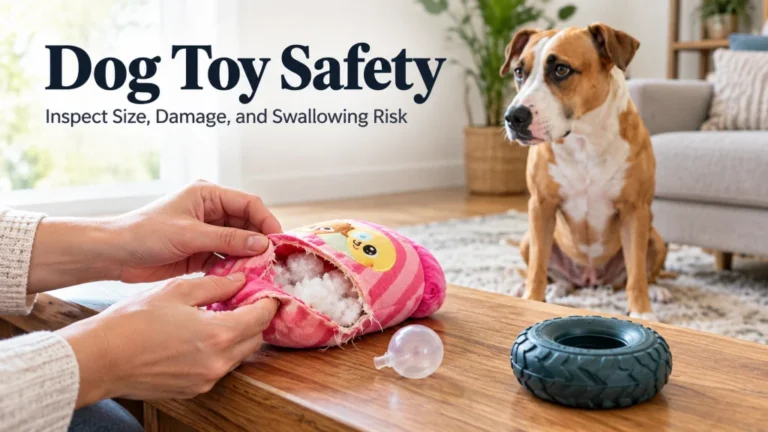
A toy can be exciting and still be a poor match if the dog can break off pieces, expose filling, pull out a sound component, or fit the whole object too far into the mouth. Start every new toy with observation, because the useful question is not whether the package looks sturdy but how this dog interacts with that construction. The broader dog toy safety guide covers the detailed inspection and removal decisions that deserve their own checklist. For an ordinary toy collection, the immediate rule is simpler: damage that creates loose or swallowable parts changes the toy from entertainment into something that should be removed.
Tooth risk also matters, especially when a dog changes from casual mouthing to forceful, repeated biting on a very hard object. Do not treat a hard surface, thick seam, or heavy material as proof that a toy is better, because durability and mouth comfort are separate questions. Watch for fraying, splits, punctures, exposed internal parts, sharp edges, and any change that makes the object easier to swallow in pieces. If safe use depends on constant rescue from predictable damage, the toy is not doing a good job for that dog even if it survives longer than softer alternatives.
- Check the toy before it returns to the dog.
- Remove loose filling, exposed sound components, detached pieces, and badly opened seams.
- Reassess a toy after the dog’s play style changes, not only when the toy looks old.
- Use the dog’s actual interaction as the deciding evidence, not a general safety claim on packaging.
Inspection is not a step you perform only at purchase. It is the maintenance routine that tells you whether yesterday’s acceptable toy is still acceptable now.
Size the toy for the dog’s mouth and play style
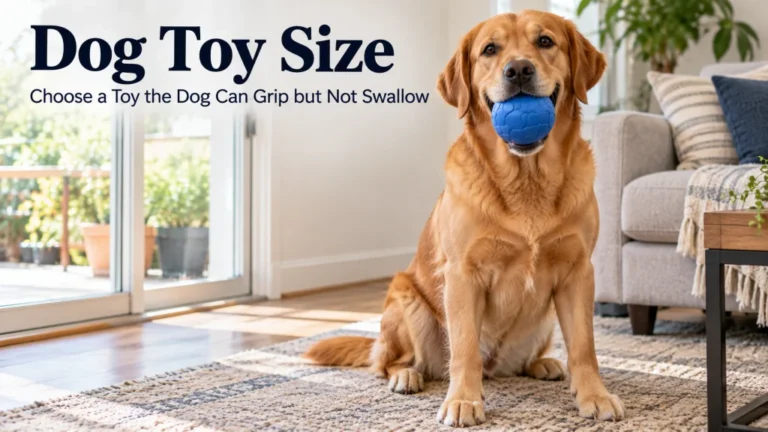
Size labels are only a starting point because two dogs with similar body weight can have different head shapes, mouth dimensions, and ways of gripping a toy. The object should be large enough that the dog cannot simply swallow it whole, yet manageable enough for the intended play without forcing an awkward grip. The dedicated guide to choosing dog toy size goes deeper into mouth fit and household checks. In this broader toy system, size should be reassessed whenever you change toy shape, material, or play job.
A soft toy can compress in a way a rigid toy does not, so matching only the printed size category can miss an important difference. A dog that carries gently may handle one shape comfortably, while a dog that bites down and folds the same toy can effectively make it much smaller. Homes with multiple dogs need an extra check because a toy chosen for the smaller dog may be accessible to a larger dog with a very different mouth and play style. When one shared toy has to serve several dogs, use the dog that creates the stricter swallowing or damage concern as the practical limit.
Key point: Do not use body weight alone as a shortcut for toy fit. Mouth size, toy shape, compressibility, and the way the dog actually handles the object all matter.
Rotate a small selection instead of leaving every toy out
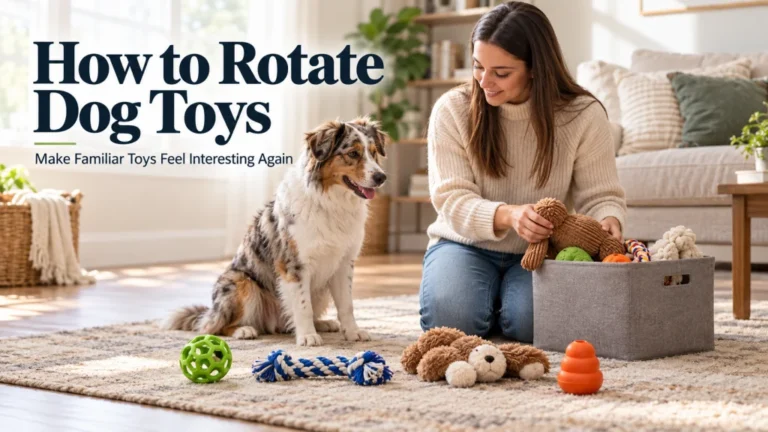
A large floor pile can make it hard to tell which toys still matter to the dog and which ones have become background clutter. Rotation gives you a cleaner way to observe preference because only a small set is available at once, then familiar toys can return after being put away. The practical method in how to rotate dog toys is built around interest, condition, and variety rather than a rigid calendar. That matters because one dog may rediscover a soft carrier toy quickly while another only cares when a different texture or play pattern comes back.
A simple rotation might keep one soft toy, one ordinary rubber toy, and one light interactive option available while the rest stay stored and inspected. When a stored toy returns, watch whether the dog engages differently rather than assuming novelty automatically improved the toy. If the dog consistently ignores an item across several returns, that is useful information about preference, not a reason to keep adding more toys. Rotation works best as an observation tool that helps you maintain variety without turning the house into permanent toy storage.
Pro Tips: Clean and inspect a toy before it goes back into rotation, not after the dog has already rediscovered it.
Clean each toy by its material and care instructions
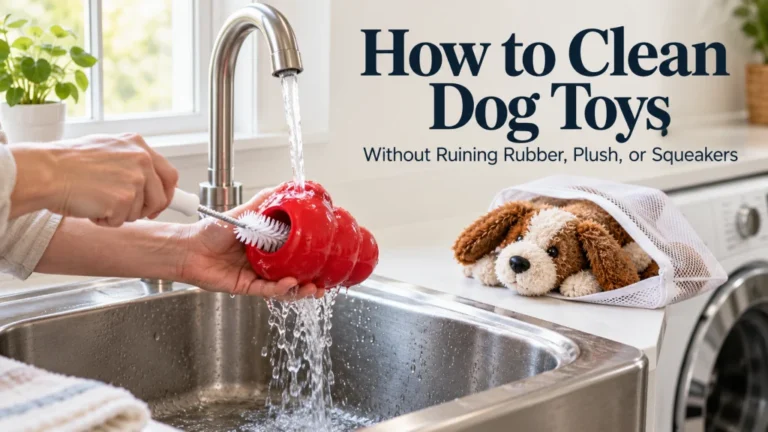
Cleaning should follow the actual material and manufacturer care directions rather than one household method for every toy. Fabric, rubber, rope, internal sound components, glued pieces, and mixed material toys can react differently to water, heat, detergents, and machines. The step by step dog toy cleaning guide handles cleaning methods in detail, while this page keeps the decision at the collection level. If the care label is missing or unclear, choose the least aggressive method that does not require guessing about heat, chemicals, or machine use.
Cleaning is also a good inspection point because wetting, flexing, and handling can reveal seams or cracks that were easy to miss on the floor. Cleaning can reveal condition, but it cannot restore a toy whose structure has already failed. Let the manufacturer’s instructions control machine washing, dishwasher use, drying, and other material specific steps when those directions exist. If you cannot clean the toy as directed or cannot verify how a damaged mixed material toy should be handled, replacing or retiring it can be simpler than improvising.
| Toy construction | Cleaning decision | Check before reuse |
|---|---|---|
| Soft fabric | Follow the care label for washing and drying | Seams, filling access, attached pieces, and shape |
| Rubber or flexible synthetic material | Use only a cleaning method the maker allows | Splits, deep damage, tacky surfaces, and trapped debris |
| Rope or woven fiber | Follow maker directions and avoid assuming all fiber toys are machine washable | Loose strands, knots, and sections that are coming apart |
| Mixed material or sound toy | Check the exact care instructions before soaking or heating | Water trapped inside, opened seams, and exposed internal parts |
The material matrix is a sorting tool, not a substitute for the specific care directions. When instructions and a generic cleaning habit disagree, the instructions win.
Choose plush toys for carrying, cuddling, shaking, or gentle mouthing
Plush toys make the most sense for dogs whose play keeps the soft shell largely intact. Some dogs carry a plush toy around, rest with it, or shake it briefly without trying to open every seam, and that behavior gives the format a reasonable job. The plush dog toy guide can help you compare construction when soft toys are a real fit. If the dog’s predictable pattern is to dissect fabric and search for the filling, the issue is not that you have failed to find the magical stronger plush toy.
Look at seam condition, attached decorations, filling access, and whether repeated gripping is creating one weak point. A small tear matters because it can become a route to internal material, and a dog that discovers the opening may switch from playing with the toy to extracting what is inside. That failure mode is more important than whether the outside still looks mostly clean or attractive. When the same failure happens repeatedly, that pattern is a sign that another play format may better match what the dog is trying to do.
Note: A dog that gently carries one plush toy may still destroy a different shape or construction. Judge the individual toy and the dog’s actual behavior together.
Choose squeaky toys only when the sound component stays enclosed
Sound can make a toy more engaging, but the squeaker becomes a separate decision point once a dog starts hunting for the noise source. A dog that mouths or shakes a squeaky toy without opening it presents a different use case from one that immediately tears toward the sound. The squeaky dog toy guide focuses on that specific construction and the way different play styles change the risk. For an ordinary collection, the sound feature is worthwhile only while it remains securely enclosed during the dog’s normal use.
Inspect the area around the squeaker, seams, punctures, and any spot the dog repeatedly targets. If the internal component becomes visible or accessible, remove the toy rather than allowing the dog to finish the extraction. Do not assume that a dog who ignored the squeaker before will always ignore it, because play behavior can change as the shell softens or damage creates a new opening. A quiet toy is often the better choice when the sound predictably drives fast disassembly instead of stable play.
Warning: If a dog may have swallowed a squeaker, filling, or another toy part, stop treating the situation as a toy selection problem and contact a veterinarian for guidance.
Choose a dedicated chew toy when sustained chewing is the main job
Ordinary toy selection stops being the right frame when the dog settles down to chew for sustained periods and tests the material with repeated force. That is a different job with different tradeoffs around hardness, durability, mouth fit, tooth risk, and how the material wears. The dedicated dog chew toy guide owns that decision instead of turning this page into a power chewer roundup. Routing the job matters because a plush toy that is fine for carrying should not be judged by the same standard as something chosen specifically for chewing.
I would also resist the word indestructible, even when a product feels substantially stronger than the household’s other toys. A dog can change how it uses an object, and wear can change the object itself, so inspection still matters after the initial fit looks good. Stronger is not automatically better if the material becomes too hard for the dog’s mouth or if the dog can still remove swallowable pieces. The useful decision is whether the chew format matches the dog’s size, chewing style, and supervision needs without creating a new problem in pursuit of durability.
Use specialized gear for puzzle, fetch, and tug play
Some toys are hard to judge well when every play style is treated as ordinary toy use. A dog puzzle toy has to match problem solving difficulty and food or piece access, while fetch toys need to fit repeated carrying and retrieval. Interactive tug toys add grip, handling, and shared play to the decision. Sending those jobs to their own systems keeps this ordinary toy collection focused on broad selection, inspection, rotation, and care.
The practical test is to name the job before comparing features. If the dog needs sustained chewing, use the chew system; if the dog needs a problem to solve, use the puzzle system; if the household wants repeated retrieval or interactive pulling, use the fetch or tug system. This prevents a large mixed toy list from pretending that one object should satisfy every kind of play. It also makes replacement easier because you can judge a worn item against the job it was actually supposed to perform.
| Main play job | Best place to continue | Why it is separate |
|---|---|---|
| Casual carrying, mouthing, shaking, and ordinary play | This ordinary toy system | Selection depends on safety, size, rotation, cleaning, and basic construction |
| Sustained chewing | Chew toy system | Hardness, wear, chewing style, and tooth considerations become central |
| Problem solving | Puzzle toy system | Difficulty, access, and interaction design change the decision |
| Repeated retrieval | Fetch toy system | Carry fit, throw pattern, visibility, and retrieval use matter more |
| Interactive pulling | Tug toy system | Grip, handling, shared play, and condition under pulling become central |
Specialization is useful when it clarifies the job, not when it simply adds more products. A smaller set of well matched play tools is easier to inspect, store, and understand than a pile of objects with overlapping purposes.
Final Thoughts: build the collection around how the dog actually plays
A useful toy collection does not need to be large, expensive, or filled with every material on the shelf. It needs toys that fit the dog’s mouth, survive the intended style of play in acceptable condition, and can be inspected and cleaned without guesswork. Rotation can restore interest, but it cannot fix a size mismatch or make exposed parts acceptable again. When a toy repeatedly fails in the same way, treat that pattern as information about the next choice.
Keep ordinary toys focused on carrying, mouthing, shaking, and general play, then move sustained chewing, puzzles, fetch, and tug to the systems built around those jobs. Continue checking the dog rather than relying on a permanent label, because preferences and play habits can change. Keep manufacturer care directions with the cleaning decision, and let repeated damage patterns guide what construction you choose next. The best collection is the one you can understand, maintain, and match to the individual dog without pretending any toy is universal.
Explore the next dog toy decisions
The ordinary toy system becomes more useful when each detailed decision has a clear next place to go. Use these pages when safety, fit, rotation, cleaning, soft construction, or sound construction becomes the main question. Each topic narrows one part of the broader choice instead of repeating the whole toy collection. That keeps the next step practical and avoids turning one page into an oversized roundup.
You do not need to open every page for every purchase. Follow the topic that matches the uncertainty you are actually trying to solve, then return to the broader collection check when the toy enters regular use. A toy can pass one decision and still need a different check later as it wears or the dog’s play changes. The links below keep those decisions separate while still supporting one consistent maintenance routine.
| Topic | What you’ll find |
|---|---|
| Dog toy safety | How to inspect toys for choking, ingestion, tooth, and damage concerns before reuse. |
| Dog toy size | How to judge toy dimensions against mouth fit, shape, and the dog’s actual way of handling the object. |
| How to rotate dog toys | How to use a smaller active selection to maintain variety and learn which toys still earn attention. |
| How to clean dog toys | How to match cleaning to material, construction, condition, and manufacturer care directions. |
| Plush dog toys | How to judge soft toy construction for dogs that carry, cuddle, shake, or gently mouth plush formats. |
| Squeaky dog toys | How to decide whether a sound component fits the dog’s play style without becoming an accessible small part. |
Use the most specific page when one decision becomes the main problem. Keep this broader guide as the place to reconnect safety, size, rotation, cleaning, and construction into one manageable toy collection.
FAQs
🐾 How many dog toys should I leave out?
There is no universal number. Keep a small enough active selection that you can notice what the dog uses, inspect each toy easily, and rotate other safe toys back in when you want more variety.
📏 How do I know whether a dog toy is too small?
If the dog can swallow the toy whole, push it too far into the mouth, or compress it into a much smaller shape, choose another size or design. Mouth shape, toy shape, and play style matter more than a body weight label by itself.
🧸 Should I remove a plush toy when the seam opens?
Yes, remove it when an opened seam gives the dog access to filling or internal parts. Do not wait for the outside shell to be completely destroyed before treating exposed material as a reason to retire the toy.
🔊 Are squeaky toys suitable for every dog?
No. They fit dogs that can use the toy without rapidly opening it to reach the sound component, while dogs that immediately hunt and extract the squeaker need a different format or much tighter supervision.
🧼 Can I wash every dog toy the same way?
No. Follow the care directions for the exact material and construction, especially for mixed material toys, sound components, glued parts, and items with machine restrictions.
🦴 What if my dog destroys ordinary toys because chewing is the main activity?
Treat that as a chew toy decision rather than an ordinary toy shopping problem. Match the chew format to the dog’s size and chewing style, and continue inspecting it instead of assuming a stronger product is indestructible.
References and Sources
- AAHA indoor enrichment guidance: Supports choosing toys by dog size and chewing style, supervising new enrichment items, rotating toys, and removing damaged toys that can create swallowing hazards.
- AKC toy shopping guidance: Supports checking toys for ingestion, choking, tooth, plush, squeaker, and size related concerns.
- PetMD squeaky toy guidance: Supports supervision, matching squeaky toys to dog size and chewing behavior, rotation, and inspection for exposed parts.
- PetMD dog toy label guidance: Supports treating toy suitability as dog specific rather than assuming a general label guarantees a safe fit for every dog.