
Walking and exercising a dog works best when you separate four different questions: whether the dog needs a better everyday walk, a different amount of total activity, a more demanding activity, or a safer plan for the conditions outside. Age, health, body type, fitness, behavior, weather, surface, and environment can all change the right answer. A useful plan starts with the individual dog and the task, then adds distance, intensity, terrain, group recreation, or water activity only when those choices fit. The goal is not to make every dog do more, but to choose movement that matches the dog, the setting, and the purpose.
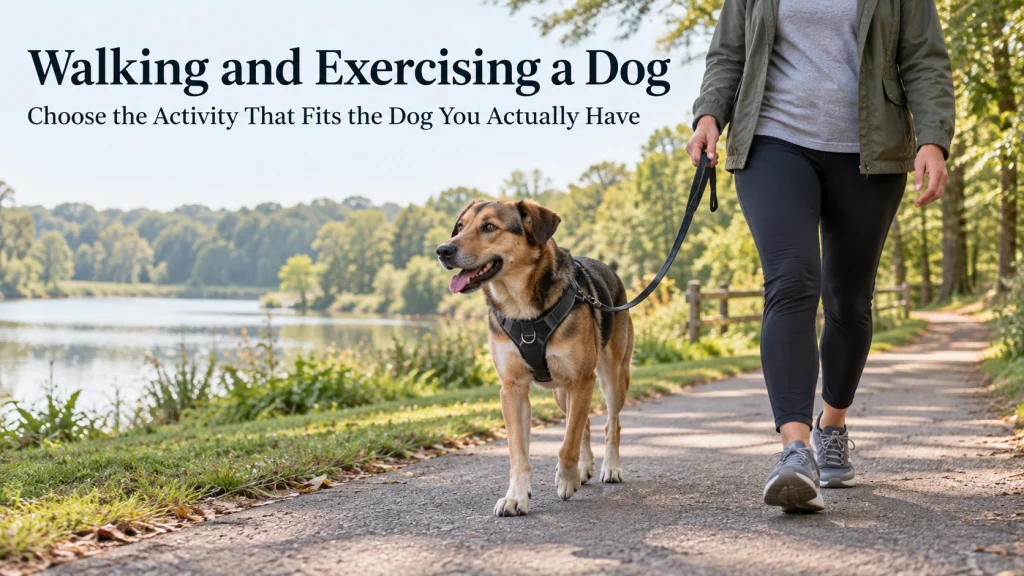
Start by deciding which activity problem you are actually solving
Walking and exercising a dog sounds like one job, but owners may be solving different problems. A rushed familiar route may need better walk quality, not more distance. A dog with useful walks may still need a different total activity level, or may be ready for hiking or recreational running. Weather, surfaces, crowds, water, and health can also change the question from amount to suitability.
I would separate those decisions before changing distance or intensity. More movement does not fix a poor activity match. The same dog may handle a quiet neighborhood route differently from a steep trail, crowded recreation area, or open water. Keeping these choices distinct also prevents owner level guidance from drifting into medical exercise, rehabilitation, or behavior treatment.
| What you notice | The question to solve first | Best next direction |
|---|---|---|
| The walk feels repetitive or rushed | Is the everyday walk useful and engaging? | Improve route quality, pace changes, sniffing opportunities, and handling setup |
| The dog still seems to need more or less activity | Is total physical activity matched to this dog? | Review age, health, fitness, body type, routine, and recovery |
| You want to add trails or running | Is the dog ready for a higher demand activity? | Evaluate terrain, progression, physical readiness, and conditions |
| You are considering a dog park | Is group recreation a good fit? | Evaluate the dog, the environment, and your ability to leave early |
| Heat, cold, darkness, or water changes the plan | Is the environment safe enough for the intended activity? | Modify the route or activity instead of forcing the original plan |
These routes can overlap without being interchangeable. Better walking skills can improve a walk, but they do not set medical fitness limits or make a dog park, run, or swim appropriate.
Make the everyday walk useful beyond distance alone
An ordinary walk can serve movement, bathroom needs, environmental exposure, and a chance to investigate the world, so distance is only one part of its value. A shorter route with room to sniff, change pace, and move calmly through manageable surroundings can be more useful than a longer route that keeps the dog overexcited or constantly pulling. The route also needs to fit the dog and household, including surface, traffic, crowding, weather, available time, and the owner’s ability to manage the leash safely. For a practical look at improving the routine itself, see these dog walking tips for everyday outings.
Walk quality and exercise quantity should be treated as separate controls. Improving one does not prove that the other is correct, and simply adding blocks to a route can hide a problem with pace, environment, or handling. Start by making the existing walk calmer, more purposeful, and easier to repeat, then judge whether the dog still needs a different amount of physical activity elsewhere in the routine. That keeps the owner from using mileage as a substitute for a walk that actually fits the dog and the setting.
| Walk quality question | Exercise quantity question |
|---|---|
| Can the dog move through the route without constant conflict? | Is the overall amount of physical activity appropriate for this individual? |
| Does the route allow useful sniffing and environmental engagement? | Does the dog recover comfortably between activity periods? |
| Are surface, traffic, weather, and distractions manageable? | Do age, health, fitness, and body type change how much activity is sensible? |
| Can the owner repeat the routine consistently? | Would another activity add value without simply adding more strain? |
This distinction prevents a common beginner mistake: treating a tired dog as proof that the walk was well designed. Fatigue can come from distance, heat, stress, difficult surfaces, excitement, or unfamiliar demand, so the better question is whether the outing matched the dog and produced a routine that can be repeated sensibly.
Size total physical activity to the individual dog rather than a universal timer
There is no single daily exercise number that fits every dog because age, health, body type, breed tendencies, fitness, activity history, and the type of movement all matter. A young adult already accustomed to regular activity may handle a different workload than a growing puppy, an older dog, or a dog returning from a quiet period. Even two healthy adult dogs of similar size can differ substantially in energy, recovery, tolerance for heat, and enthusiasm for sustained movement. The practical framework is to compare the dog’s normal baseline with the demand of the activity instead of chasing a generic minutes per day target.
For a deeper framework on this decision, use the guide to how much exercise a dog needs. I would look for a routine that the dog can perform without being pushed through obvious reluctance, unusual fatigue, or a sudden drop in comfort, while remembering that health concerns belong with a veterinarian rather than an online formula. Changes in intensity also deserve more caution than repeating familiar low demand activity. The owner level goal is to adjust the plan around the dog in front of you, not to convert broad guidance into a personal medical prescription.
Key point: More activity is not automatically better. The right amount is the amount that fits the individual dog, the activity, the conditions, and the dog’s ability to recover comfortably.
Treat hiking as a trail activity with its own preparation and rules
A hike adds terrain, duration, footing, access rules, wildlife, water planning, and distance from home, so it should not be treated as an ordinary neighborhood walk with prettier scenery. Before increasing trail difficulty, check whether the dog is already comfortable with sustained walking and whether the route allows dogs under the rules of that specific park or trail system. Trail surfaces can be rough, steep, slippery, hot, or full of debris that would not appear on a sidewalk route. The more remote the outing becomes, the more important it is to think about turnaround points, water, identification, waste cleanup, and the ability to leave before the dog is exhausted.
The dedicated guide to hiking with dogs covers those trail specific decisions in more depth. Build from familiar outings toward harder terrain instead of using the dog’s enthusiasm at the trailhead as proof of endurance. Excitement can carry a dog farther than is sensible, while the return trip still has to happen after that energy has dropped. A simple trail plan should therefore include conditions that would make you shorten the route, turn around, or choose an easier outing.
- Confirm that dogs are allowed on the route and understand leash rules before leaving home.
- Match terrain and distance to the dog’s current conditioning rather than the owner’s planned pace.
- Carry enough water for the outing and plan practical rest opportunities.
- Use identification and keep waste cleanup supplies accessible.
- Check paws and general comfort after rough, sandy, icy, or debris covered terrain.
Preparation is not about turning a recreational hike into an expedition checklist. It is about recognizing that a trail removes some of the easy exit options available on a neighborhood walk, so small planning mistakes can become harder to correct once you are farther from the car or home.
Build recreational running separately from ordinary walking
Running raises speed, repetitive impact, cardiovascular demand, and the consequences of poor pacing, so a dog that enjoys walking is not automatically ready to become a running partner. Development, age, health, body structure, conditioning, weather, and surface all matter, and current veterinary oriented guidance recommends checking with a veterinarian before beginning strenuous new activity. Growing dogs deserve particular caution because their bodies are still developing, while older dogs may need a modified activity plan even if they remain enthusiastic. The practical decision is not whether the dog “likes to run,” but whether sustained running is appropriate for this individual.
Use the separate guide to running with dogs when the goal moves beyond ordinary walking. If running is appropriate, increase demand gradually and keep early outings easy enough to evaluate the dog rather than chase your own training target. Surface, temperature, hydration, and recovery can change the same route from manageable to excessive. A dog should not become a pace tool for a human fitness plan, and owner level guidance should stop where medical fitness, pain, injury, or rehabilitation questions begin.
| Ordinary owner decision | Reason to seek veterinary guidance first |
|---|---|
| Choosing a familiar walking route and manageable pace | Starting strenuous running with a dog whose medical fitness is uncertain |
| Shortening an outing because the dog seems tired or conditions worsen | Planning exercise around known orthopedic, heart, respiratory, or other medical conditions |
| Building difficulty gradually for an otherwise suitable activity | Returning to higher demand activity after injury, surgery, or rehabilitation |
| Changing surface or route to reduce avoidable environmental stress | Trying to diagnose pain, exercise intolerance, or abnormal recovery from activity |
That boundary keeps recreational advice useful without pretending that a general article can clear a particular dog for strenuous exercise. When health status changes the answer, individualized veterinary guidance is part of the activity decision, not an optional extra.
Decide whether a dog park is actually a good fit before using one for exercise
A dog park is a social environment first and an exercise opportunity second, which means it should never be treated as a required way to tire a dog out. Some dogs enjoy appropriate group play, while shy, nervous, easily overwhelmed, reactive, or conflict prone dogs may be poor candidates for an uncontrolled group setting. The physical setup matters too, including secure fencing, entry and exit design, crowding, size mixing, and whether owners are actively supervising. A park that looks convenient on a map can still be the wrong environment for the individual dog.
The guide to dog park safety and fit goes deeper into choosing and using these spaces. I would visit a new park without the dog first when possible, because that lets you evaluate the gates, fencing, crowd behavior, and general management without committing the dog to the situation. Recall and basic responsiveness in distracting environments are useful prerequisites, but they do not turn a poor social match into a good one. If the dog is uncomfortable, the correct exercise plan may simply be to skip the park and use walks, play, or another activity instead.
Note: A dog does not need dog park visits to have a complete activity routine. Group recreation is optional and should be chosen only when the dog and the environment are a good match.
Modify ordinary walks for heat, cold, darkness, and other conditions
The same route can create a different workload when weather or surface conditions change, so a routine that worked comfortably before should not be followed on autopilot. Heat can raise the risk of overheating and can make pavement or asphalt unsafe for paws, while cold, ice, salt, darkness, storms, or poor visibility can create different hazards. Body type, coat, age, health, conditioning, and acclimation can also change how a dog handles the environment. The practical response is often to shorten, move, slow, reroute, or replace the outing rather than insist on the planned distance.
Use the more detailed dog walking safety guide when conditions are the main decision. Check the actual surface the dog will walk on, not just the air conditions shown on a forecast, and favor cooler or more sheltered routes when heat is building. In low visibility, the priority shifts toward being seen, maintaining control, and choosing a route with fewer traffic or footing problems. When the environment changes sharply, the exercise target should be flexible enough to change with it.
| Environment | What changes | Owner level adjustment |
|---|---|---|
| Hot weather or hot pavement | Cooling demand and paw surface risk increase | Choose cooler conditions, shade, safer surfaces, and a shorter outing |
| Cold, ice, or treated sidewalks | Footing and paw exposure change | Choose stable surfaces and check paws after the walk |
| Darkness or poor visibility | Traffic, obstacle, and route visibility decrease | Use a familiar route and prioritize visibility and control |
| Crowded or highly stimulating areas | Behavioral load may rise even if distance stays the same | Reduce exposure, create space, or choose a quieter route |
| Rough trail terrain | Footing and physical demand increase | Slow down, shorten distance, and inspect paws afterward |
Environmental adjustment is not a failure to complete the workout. It is the part of good activity planning that prevents a fixed routine from becoming more important than the dog actually doing it.
Treat swimming as a supervised water activity, not an automatic easy option for every dog
Swimming is often described as exercise, but water adds a safety system that land based activities do not require. Not every dog is a confident or capable swimmer, and even a dog that swims well can become tired, encounter current, struggle with an exit, or get into trouble around a pool, dock, lake, or boat. The owner needs to evaluate the dog, the water, the entry and exit, the level of supervision, and the conditions each time. A dog that avoids the water should not be forced in simply because swimming seems like a convenient way to provide activity.
For the full setup, use the guide to dog swimming safety. Treat a clear exit path and continuous supervision as basic parts of the activity, while remembering that medical conditions can make swimming inappropriate for some dogs. Breaks matter because swimming can be demanding even when it looks smooth from shore. Water recreation can be valuable for a suitable dog, but it should never be assumed to be universally safe or automatically gentle.
Warning: Do not use a general swimming article to decide whether a dog with a medical condition is fit for water exercise. That decision belongs with a veterinarian who knows the dog’s health history.
Use leash and recall skills as prerequisites, not exercise substitutes
Walking skills and recall can make outdoor activity more manageable, but training and exercise solve different problems. A dog that pulls on leash may need training help, yet the dog still has an activity need that must be addressed in a way the owner can safely manage. Likewise, a strong recall can expand options in places where off leash activity is legally allowed and otherwise appropriate, but recall does not determine whether a dog park, trail, run, or swim is physically suitable. Keeping those jobs separate prevents owners from using “more exercise” as a treatment for every behavior issue or using training practice as a substitute for all physical movement.
If leash mechanics, pulling, heel work, recall, or behavior treatment becomes the main problem, that belongs in the training side of the site rather than inside this activity framework. First make sure the owner can control the dog in the chosen environment, then choose an activity whose physical and social demands fit the dog. A quiet sniff walk on leash can be the right answer for one dog, while another may enjoy a more demanding activity after readiness is established. The exercise plan should use training skills as support, not confuse them with the exercise decision itself.
Know when mobility or health limits call for professional guidance
Owner level activity planning works best when the dog is generally healthy and the question is about route, activity type, environment, routine, or gradual progression. Once pain, injury, unusual exercise intolerance, significant mobility change, breathing difficulty, recovery from surgery, or a known medical condition becomes part of the decision, general advice reaches its limit. The same is true when the goal is rehabilitation or a medical exercise prescription rather than ordinary recreation. Those situations need individualized guidance because the appropriate workload may depend on information an article cannot assess.
I would also be cautious when an older dog, growing dog, or previously inactive dog is being moved into a much more demanding routine. The owner can still observe comfort, choose easier surfaces, reduce environmental stress, and stop an activity that is clearly too much, but those observations are not a diagnosis. A veterinarian can help determine whether a proposed strenuous activity is appropriate when health or development makes the answer uncertain. That boundary keeps everyday activity advice practical without turning it into medical fitness clearance.
Final Thoughts: choose the activity that fits the dog, environment, and goal
A useful activity plan starts by naming the problem correctly. Improve the everyday walk when the walk itself is poor, adjust total activity when the amount is mismatched, and treat hiking, running, dog parks, weather changes, and swimming as separate decisions with their own demands. That approach is more useful than assuming every restless dog needs a longer route or every active dog needs a more intense sport. Clear routing also makes later adjustments easier.
The practical test is whether the activity fits the individual dog and the real environment available to the household. Watch how age, health, body type, fitness, behavior, surfaces, weather, and recovery change the answer. Choose the simpler option when it fits better. When health, pain, rehabilitation, or strenuous activity clearance becomes the deciding issue, move the question to a veterinarian.
Explore dog walking and exercise guides
Use these guides when the activity question becomes more specific. Each guide handles a different decision. Start with the closest match. Move between them as the dog, environment, or goal changes.
| Topic | What it helps you decide |
|---|---|
| Dog walking tips | How to make ordinary walks more useful. |
| How much exercise a dog needs | How to size total activity to the individual dog. |
| Hiking with dogs | How to prepare for trail specific demands. |
| Running with dogs | How to judge readiness for recreational running. |
| Dog park safety | How to decide whether group recreation fits. |
| Dog walking safety | How conditions should change an ordinary walk. |
| Dog swimming safety | How to plan supervised recreational water activity. |
Choose the guide that owns the next decision. Keep the dog and setting at the center of that choice. Do not force a more demanding activity just because it is available. Return to the broader framework when the goal changes again.
FAQs
🐕 How much exercise does my dog need?
There is no single daily amount that fits every dog. Age, health, body type, fitness, activity type, environment, and the dog’s normal routine all change what is appropriate.
🥾 Can a regular walking dog start hiking?
Walking fitness is a useful starting point, but hiking adds terrain, footing, duration, access rules, and distance from easy exit points. Start with easier routes and increase demand only when the dog handles the current level comfortably.
🏃 Is every healthy dog a good running partner?
No. Development, age, body structure, conditioning, health, surface, and weather can all change running suitability, and strenuous new activity may warrant veterinary guidance.
🌳 Does my dog need to visit a dog park for exercise?
No. Dog parks are optional group recreation, and some dogs are better suited to walks, play, hiking, or other activities that do not require interacting with unfamiliar dogs.
☀️ Should I shorten a walk when conditions change?
Yes, when heat, cold, surfaces, visibility, storms, or crowding make the planned route more demanding or less safe. Changing the route, pace, surface, or activity is part of good planning.
🌊 Can every dog use swimming as exercise?
No. Swimming ability, confidence, health, water conditions, supervision, and safe entry and exit all matter, and a dog should never be forced into the water.
References and Sources
- American Kennel Club exercise guidance: Supports the principle that exercise needs vary with age, health, breed tendencies, and the individual dog rather than one universal daily rule.
- American Kennel Club hiking guidance: Supports trail preparation, location rules, leash expectations, hydration, identification, and route planning for hiking with dogs.
- American Kennel Club running guidance: Supports individual running readiness, developmental caution, surface considerations, and veterinary review before strenuous running.
- American Kennel Club dog park guidance: Supports evaluating the individual dog, responsiveness, park setup, and the fact that dog parks are not appropriate for every dog.
- VCA Animal Hospitals walking safety guidance: Supports veterinary clearance around new strenuous activity, hydration, hot surface caution, identification, and paw checks.
- VCA Animal Hospitals water safety guidance: Supports supervision, safe exits, water condition checks, breaks, and the warning not to assume every dog can swim safely.
- PetMD summer walking guidance: Supports modifying walks for heat, checking pavement, choosing cooler conditions, using shade, and reducing exertion when weather raises risk.