Caring for an older dog works best when you start with the ordinary task that has changed, not with age alone. A dog that slips on a kitchen floor, hesitates at a step, needs help standing, or cannot keep up on an outing may need a different kind of support in each situation. Home changes and mobility equipment can make daily access easier, but new, worsening, painful, or unexplained changes still belong in a veterinary assessment. The goal is to match the smallest useful adjustment to the task while keeping diagnosis, rehabilitation, exercise prescription, feeding, bedding, and travel decisions in the right place.
Start with the daily task that changed
Caring for an older dog should start with the task that changed, not the birthday on a record. Focus on the moment that is no longer automatic: rising, crossing a smooth floor, using a stair, reaching the yard, entering a vehicle, or staying with the household outside. That observation tells you what problem you are solving before you buy equipment. It also separates an access problem from a medical cause you cannot identify at home.
Look for the smallest repeatable pattern you can describe clearly. A dog may move well on carpet but lose footing on hardwood, handle a low step but refuse a staircase, or move normally at home but tire on an outing. Those are different tasks, so they should not lead automatically to the same aid. I would identify the movement, surface, height, distance, route, or transfer that changed, then decide between an access adjustment and a veterinary conversation.
| What you observe | First question to answer | Likely next route |
|---|---|---|
| The dog loses footing on smooth flooring | Is the main problem grip on this surface? | Improve traction and keep the route clear |
| A jump onto furniture or over a step no longer works | Can the height change be replaced with a gentler access path? | Compare a ramp with compact steps |
| The dog needs help rising or completing a short transfer | Does the dog need controlled owner support rather than independent access? | Discuss a properly fitted mobility harness |
| The dog has substantial weakness or loss of independent gait | What is causing the change, and is wheeled gait support appropriate? | Veterinary assessment before wheelchair selection |
| The dog can participate but cannot comfortably cover the whole distance | Is the need transportation rather than gait support? | Consider passive wheeled transport |
Keep the decision narrow even when more than one issue is present. Better traction does not explain weakness, and a stroller does not tell you how much exercise is appropriate. Each problem still deserves its own answer. A clear task makes it easier to choose a home change, mobility aid, or professional assessment without turning aging into a diagnosis.
Know when a mobility or sensory change needs veterinary assessment before a home fix
Age can change how a dog moves, but it does not explain why a specific change is happening. Pain, orthopedic problems, neurologic conditions, sensory changes, injury, and other health issues can affect movement or confidence, and an owner cannot sort those causes from a symptom list alone. A rug or ramp can improve access, but it should not become a reason to ignore a new pattern. Sudden change, worsening difficulty, repeated falls, obvious discomfort, marked weakness, asymmetric movement, dragging, or major disorientation deserves veterinary attention rather than a home diagnosis.
At home, document the task accurately and reduce obvious hazards while you arrange assessment. Note where the change occurs, which surface or transition is involved, whether the dog can finish the task, and whether the pattern is becoming more limiting. Keep the description factual instead of naming a disease you suspect. That gives the veterinarian useful observations while keeping your decisions focused on safe access.
Accessibility or medical decision path: Use the environmental branch only when the problem is stable, task specific, and clearly improved by changing the route or surface. Use the veterinary branch when the change is new, worsening, painful, asymmetric, difficult to explain, or associated with a clear loss of function.
| What you observe | First branch | What to do next |
|---|---|---|
| A repeatable problem on one surface or height transition | Accessibility first | Improve access and keep observing |
| A new or worsening mobility or sensory change | Veterinary first | Reduce hazards and arrange assessment |
| Pain, repeated falls, weakness, dragging, or asymmetric movement | Veterinary first | Do not treat equipment as a diagnosis |
| An aid helps one task but function keeps declining | Reassess medically | Keep the access change and reassess the problem |
- Describe the exact task that changed rather than writing only that the dog seems old or slow.
- Notice whether the problem appears on one surface, one direction, one height change, or across many activities.
- Watch for a pattern that is sudden, progressive, painful, asymmetric, or associated with a clear loss of function.
- Keep the route safer with secure footing, clear pathways, and blocked hazards while the cause is being assessed.
- Do not start rehabilitation, therapeutic exercise, supplements, braces, or a wheelchair from an online symptom match.
This observation first approach is useful even when the eventual solution is simple. It separates “How can I make this route easier?” from “Why is my dog moving differently?” Home accessibility can answer the first question. That boundary matters. A veterinarian is the right person to investigate the second.
Redesign everyday home routes when access has become the main problem
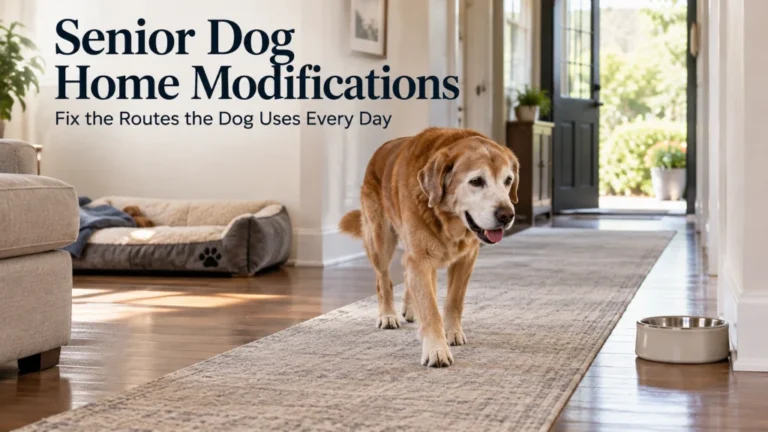
When the problem is access, look at the route the dog repeats instead of redesigning the whole house. Clear clutter that forces sharp turns, secure loose coverings, and keep essential destinations reachable without unnecessary obstacles. If vision or hearing has changed, predictable furniture placement and a clear path can matter as much as new equipment. Consistent low level lighting or a nightlight along a familiar route can also make a doorway or destination easier to find when light is limited.
Start with routes that combine frequent use with real consequence. A guest room matters less than a slick hallway used repeatedly, and an optional staircase can often be blocked rather than solved with more gear. The guide to senior dog home modifications goes deeper into layout, hazards, access points, and routine placement. The aim is access to essential places with fewer difficult transitions, not a house filled with items labeled for senior dogs.
Mobility access map: Match the aid to the physical task before comparing features or buying anything.
| Access system | Best fit for the task | Reason to route elsewhere |
|---|---|---|
| Home route changes | Clutter, poor lighting, or an awkward route | Difficulty continues across environments |
| Ramp | A height transition needs a continuous incline | The dog cannot use it with control |
| Pet steps | The dog can still step safely | Stepping is difficult or unstable |
| Traction | Movement worsens mainly on slick flooring | Slipping occurs on secure surfaces |
| Support harness | The dog needs help standing or transferring | Assistance appears painful or keeps increasing |
| Wheelchair | Professional assessment supports gait assistance | Suitability has not been assessed |
| Stroller | The dog needs passive transport | The question is gait support or exercise |
A useful home change should remove a specific obstacle without creating another. A sliding mat, shifting ramp, or furniture moved into a familiar path can make access less predictable. Improve one route, watch how the dog uses it, and adjust from real movement. That is more useful than buying several aids before you know which task each one should solve.
Use an inclined access surface when a jump or step transition is no longer working
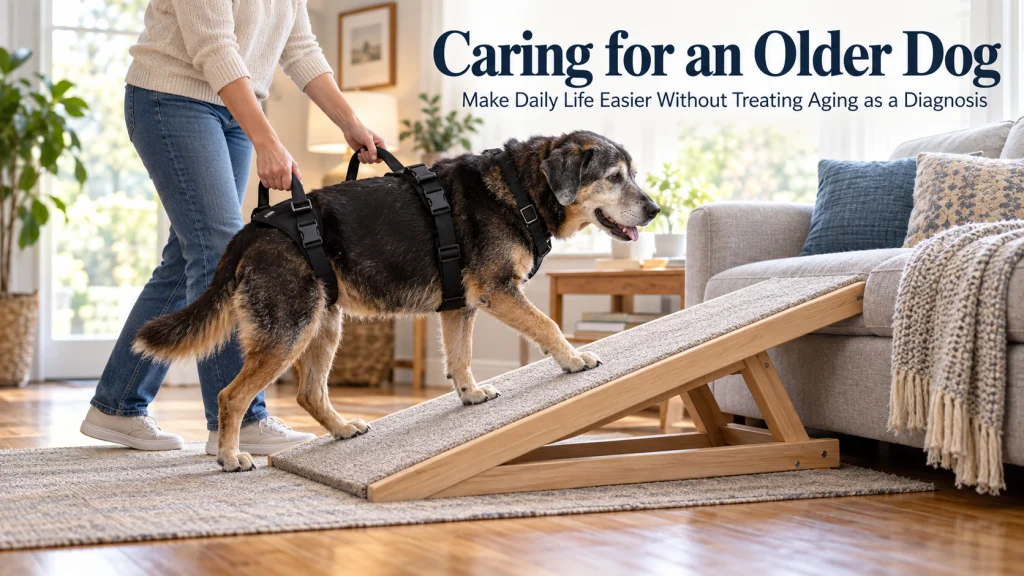
A ramp is most useful when the problem is a change in height and repeated stepping or jumping is no longer a good match for the dog. It can create a continuous route to a porch, furniture, or another raised surface without asking the dog to make a large vertical transition. The surface needs secure grip, the structure needs to stay stable, and the landing area needs enough room for the dog to approach and exit without a sharp turn. A ramp that is too steep, narrow, flexible, or slippery may technically reach the destination while still being impractical for the dog using it.
Measure the rise and available floor space before choosing a ramp, then consider dog size, body length, balance, confidence, and storage. Once the ramp is stable, let the dog inspect it and practice in short, calm attempts rather than pulling or pushing the dog onto it. The guide to choosing and setting up a dog ramp covers fit and placement in more detail. If a familiar transition suddenly becomes difficult, the ramp may improve access while the underlying change still needs veterinary assessment.
Use compact pet steps only when repeated stepping still fits the dog
Pet steps solve a different problem from a ramp because the dog still has to perform repeated step up and step down movements. They may fit a dog that can step with control but no longer manages a larger jump comfortably or confidently. They are less convincing when the dog already struggles with ordinary stairs, loses balance during repeated stepping, or cannot place the feet securely on small treads. Step depth, surface grip, stability, height, and the dog’s body size all matter more than the fact that the product is marketed for older pets.
Before using steps, watch whether the dog can approach straight, place each paw without crowding, and turn away safely. Keep the unit stable and let the dog explore it before expecting repeated use instead of forcing movement onto an unfamiliar surface. The guide to dog stairs explains when compact steps make sense and when another access method is easier. If repeated stepping itself is difficult, making each step smaller does not automatically solve the problem.
Solve slippery indoor footing as its own mobility problem
Slipping on hardwood, laminate, or tile can make a dog look less mobile even when the immediate problem is poor grip on that surface. Start by comparing movement on slick flooring with movement on carpet, a secure runner, or another surface that offers better traction. If the dog moves more confidently where footing is secure, improving the route may remove an unnecessary daily challenge. Cover the path, not just one small island, because the dog still has to reach and leave the protected area without crossing a slick gap.
Traction material should stay flat, resist sliding, and avoid edges that bunch up under the feet. Floor care, nail length, paw condition, and wearable traction products can also affect grip, but those details should be considered carefully rather than treated as universal fixes. The guide to a dog slipping on hardwood floors separates surface setup from other reasons a dog may have trouble standing or walking. If slipping begins suddenly, occurs even on secure footing, or comes with weakness or pain, changing the floor is not a complete answer.
Add owner assisted support when standing or short transfers need help
A mobility support harness is useful when the dog can participate in the movement but needs controlled assistance for standing, a short transfer, or a difficult transition. It is different from an ordinary walking harness because the purpose is to support part of the dog’s body without creating pressure in the wrong place or forcing an awkward posture. Fit matters around the chest, abdomen, hindquarters, and any sensitive areas, and the owner also needs enough leverage to assist without losing balance. With a larger dog, the setup also has to be manageable for the person providing support, not only comfortable for the dog.
I would treat a support harness as a tool for a defined movement, not as an explanation for weakness. The dog mobility harness guide covers support location, fit, handling, and practical use. If lifting seems painful, the dog resists the device, or the amount of help keeps increasing, the equipment choice is no longer the whole question. Veterinary guidance can help determine whether assisted lifting remains appropriate.
Treat a wheelchair as a professionally informed mobility system, not a diagnosis shortcut
A dog wheelchair can support mobility for some dogs with substantial weakness or loss of limb support, but a visible symptom does not identify the right cart or support pattern. Medical condition, remaining strength, limb use, posture, skin tolerance, elimination needs, and home environment can all affect suitability. Proper fit matters because the frame and support points change how the dog bears weight and moves. Buying from a symptom description is especially weak decision making here.
Start with the veterinarian, and involve a veterinary rehabilitation professional when appropriate, before treating a wheelchair as the next purchase. The dog wheelchair guide covers owner level questions about fit, home clearance, daily handling, and maintenance. A cart can be part of a mobility system, but it does not explain paralysis, weakness, dragging, or loss of coordination. Those findings need medical interpretation before equipment carries the plan.
Use passive wheeled transport when the dog needs a ride rather than gait support
A stroller solves a distance and transport problem, not a gait support problem. It can help when a dog can walk part of an outing but cannot comfortably cover the whole route. The dog still needs room to sit or lie naturally, stable footing, secure containment, and an accessible loading method. The person pushing it also needs to manage size, weight, terrain, storage, and entry points.
Do not use a stroller to decide how much activity an older dog should receive. Exercise workload depends on the dog’s health, ability, and veterinary guidance when medical limits are present. The dog stroller guide focuses on sizing, access, stability, route conditions, and transport burden. The key distinction is simple: a stroller carries the dog, while gait support helps the dog move.
Keep walking duration, conditioning, and exercise workload in the exercise system
Mobility access and exercise workload overlap in daily life, but they are not the same decision. A ramp can remove a difficult jump, a traction path can make the hallway easier to cross, and a support harness can help with a transfer, yet none of those answers how far or how intensely a particular dog should walk. Exercise tolerance can change with health, conditioning, weather, terrain, body size, and many other factors. When the question becomes how much activity is appropriate, especially with a medical limitation, that decision needs its own framework and sometimes veterinary guidance.
| Decision | Where to handle it |
|---|---|
| Walking load and conditioning | Exercise guidance |
| Bed construction and ordinary bed choice | Home setup guidance |
| Food amount, nutrition, and bowl decisions | Feeding guidance |
| Vehicle restraint and trip logistics | Travel guidance |
Use the accessibility setup to make necessary movement safer and more practical, then route the activity question to walking and exercising a dog. That keeps this article from quietly prescribing conditioning or rehabilitation through ordinary mobility advice. A dog that reaches the door more easily after you add traction may still need a different outing plan than before. Home access should remove avoidable barriers, not create an unspoken target for distance, pace, or therapeutic exercise.
Keep ordinary bed construction and bed shopping in the home setup system
An older dog may benefit from a resting area that is easy to reach, but accessibility and bed selection are separate decisions. For this article, the important question is whether the dog can get to the resting place, step onto it without a difficult transition, and rise without immediately facing a slick or blocked route. Moving a familiar bed closer to an essential path can sometimes solve more than replacing it. The material, foam construction, cover design, washable features, and ordinary bed buying questions belong in the home setup decision instead.
If you are comparing bed types, sizes, support construction, entry height, or maintenance, use the guide to how to choose a dog bed. That prevents the word senior from turning every bedding decision into a medical claim. A bed can be easier to access and easier to maintain without being presented as treatment for pain or orthopedic disease. If the dog cannot settle, rise, or rest comfortably because of a new physical problem, the next step is not simply to shop for thicker bedding.
Keep food amount, senior nutrition, and bowl decisions in the feeding system
Accessibility can affect where food and water are placed, especially when a long route or difficult floor makes essential resources harder to reach. That does not make this a nutrition article. Food amount, diet choice, feeding schedule, bowl type, and other mealtime decisions need to be handled according to the dog’s nutritional needs and the practical feeding setup rather than folded into a generic senior checklist. Avoid changing diet or feeding equipment just because another dog of the same age uses a different setup.
For everyday mealtime logistics, use the broader guide to feeding a dog and keep medical nutrition questions with the veterinarian. In this accessibility context, your job is simply to make sure the dog can reach the feeding area safely and use it without an avoidable route problem. If bending, standing, swallowing, appetite, or drinking behavior changes, do not assume a new bowl position explains the cause. Observe the change and bring relevant health concerns to a veterinary professional.
Keep vehicle restraint and trip logistics in the travel system
An older dog may need help reaching a vehicle, but getting into the vehicle is only one part of travel. A ramp or assisted transfer can solve the height transition while restraint, carrier fit, temperature management, rest planning, loading space, and destination logistics remain separate travel decisions. Do not let a successful loading aid create the impression that the whole trip setup is automatically suitable. The dog still needs a transport arrangement that fits the vehicle, the trip, and any relevant health limitations.
Use traveling with a dog for the broader transport system and keep this page focused on accessibility. If the dog suddenly refuses vehicle entry, has trouble balancing during loading, or cannot tolerate a trip that was previously routine, that change may also deserve veterinary discussion rather than an immediate equipment purchase. A mobility aid can improve the path to the vehicle. It does not replace travel safety decisions or explain why the dog’s ability changed.
Final Thoughts: make the next daily task easier without explaining the cause from the living room
The most useful senior dog care decision often starts with one ordinary observation. Identify the task, remove obvious hazards, improve access where the problem is clearly environmental, and choose equipment only when it solves a defined movement or transport need. A secure traction path may be enough for one dog, while another may need a ramp, assisted support, or professionally guided mobility equipment. The right answer depends on what the dog can do, where the difficulty occurs, and whether the change has a medical question behind it.
Keep the boundary clear as you make the home easier to use. Accessibility can reduce avoidable obstacles, but it cannot diagnose pain, weakness, sensory loss, or neurologic change, and it should not quietly become rehabilitation or exercise prescription. If a change is new, worsening, painful, or hard to explain, bring the observation to a veterinarian and use home changes to support safe daily life rather than to name the cause. That approach keeps the dog involved in familiar routines while giving each problem the level of attention it actually needs.
FAQs
🐾 What is the first thing I should change for an older dog having trouble at home?
Start with the exact daily task that changed and remove obvious hazards on that route. If the change is sudden, worsening, painful, or not clearly explained by the environment, contact your veterinarian before treating it as a simple aging issue.
🏠 Are rugs enough for a senior dog that slips on hardwood floors?
Secure rugs or runners can improve traction when the surface is the main problem, especially if they cover the full route rather than isolated spots. If the dog also slips on secure surfaces, shows weakness, or has a new gait change, flooring alone is not a complete answer.
📐 Is a ramp always better than dog stairs for an older dog?
No. A ramp avoids repeated step movements, while pet steps still require controlled stepping, so the better choice depends on the dog’s movement, balance, size, available space, and the height transition being solved.
🛞 Should I buy a wheelchair if my older dog is dragging a leg?
Do not choose a wheelchair from that symptom alone. Dragging, weakness, paralysis, and coordination changes need veterinary assessment, and wheelchair suitability and fit are best decided with professional input.
References and Sources
- AAHA senior life stage guidance: Supports accessibility, lighting, clear routes, and sensory or mobility boundaries.
- VCA home mobility guidance: Supports flooring, stairs, routes, ramps, and assisted access.
- AKC mobility device guidance: Supports harnesses, wheelchairs, traction, fit, and professional involvement.
- AKC ramp and stairs guidance: Supports gradual familiarization with stable ramps or steps without force.