How much a dog should eat starts with the feeding directions for the exact food in the bowl, not with a universal cups by body weight chart. The label gives a practical starting amount, but that amount still has to match the food’s calorie content, the dog’s life stage, activity, body condition and health context. Measure the chosen daily amount consistently, divide it across the dog’s normal meals and keep watching whether the starting amount still fits the individual dog. A veterinarian should handle individualized calorie targets, growth concerns, major weight changes and weight loss planning.
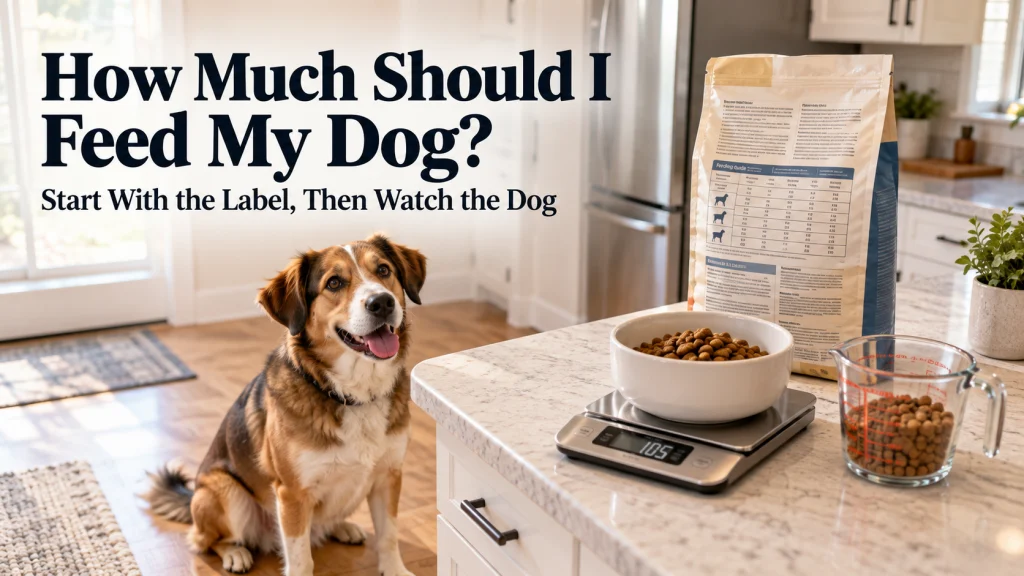
Start with the exact food in front of you
If you are wondering how much to feed your dog, first identify the exact food and find its feeding directions before copying a chart from somewhere else. Two foods can fill the same measuring cup yet provide different amounts of energy, so cup volume alone does not give a universal answer. The broader feeding a dog guide explains the bigger mealtime picture, while this page stays focused on executing a daily amount from the food you are actually serving. That keeps the starting point tied to the product in the bowl instead of to a generic estimate.
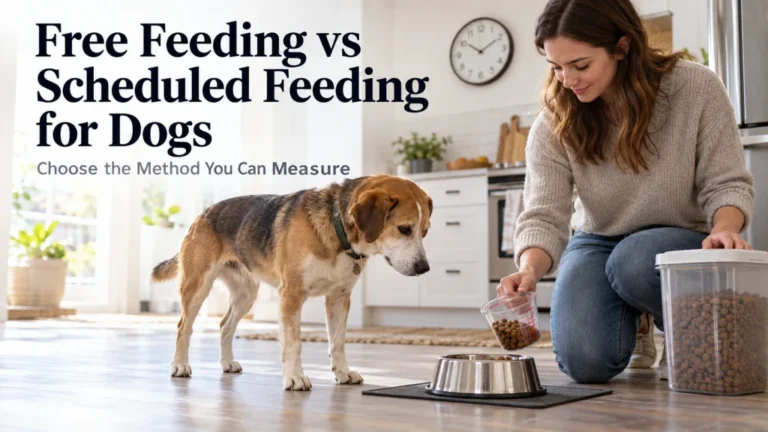
Next, separate amount from schedule because they answer different questions. The label may give a daily quantity, while your household still has to decide how that total fits the dog’s established dog feeding schedule. A dog eating more meals does not automatically need more food overall just because the daily total is split into smaller portions. The useful sequence is exact food, correct life stage, label amount, consistent measurement, meal split and then monitoring.
Read the feeding directions for the exact product and life stage
Begin on the package with the feeding directions and the nutritional adequacy statement. For a food represented as complete and balanced, the life stage matters because a food intended for growth is not interpreted the same way as one intended for adult maintenance. Match the directions to the dog in front of you rather than assuming that every table on every bag uses the same logic. If the package has several charts or separate instructions, use the section that actually applies to that food and life stage.
Do not treat a product name, front panel claim or picture of a dog as the feeding instruction. The working information is usually elsewhere on the label, and the useful parts are the stated feeding directions, calorie statement and life stage information. If the food is a treat, topper or product intended only for supplemental feeding, do not use its directions as though it were the dog’s complete daily ration. When the label purpose is unclear, verify the product’s intended use before doing any portion math.
Check whether the amount is stated per day, per meal or by another unit
A feeding table is only useful if you know what its number represents. Look for wording that tells you whether the listed amount is a total for the day, an amount for each meal or a quantity tied to another unit such as body weight. Do not divide or multiply until that wording is clear. A large portion error can come from perfectly accurate arithmetic applied to the wrong unit.
For example, suppose the package gives one total daily amount and the dog normally eats two meals. The practical task is to divide that known total between those meals rather than feeding the full daily amount twice. If a package uses a range instead of one number, that range is still a starting guide rather than permission to pick the largest amount automatically. Read the unit first, choose the starting point that fits the label context and then measure it the same way each time.
Treat the feeding chart as a starting guideline rather than a prescription
The feeding chart answers a useful first question, but it cannot know everything about one dog. Activity, age, body condition, reproductive status, environment and health can change energy needs, which is why a label amount should not be treated as a fixed prescription. Start from the directions for the exact food, then observe whether that starting amount continues to fit the dog. This is more useful than searching for one universal dog feeding chart that claims to fit every food and every household.
A reasonable starting amount can become a poor fit when the dog or routine changes. A quieter dog and a highly active dog of similar body size may not stay well matched to the same intake, and a health change can make generic adjustment inappropriate. The owner level job is to notice the mismatch and bring good information to the veterinarian, not to invent a medical calorie target. That boundary matters most when weight, appetite, growth or health is changing.
Use the calorie statement to understand why cup volume is not universal
The calorie statement explains why two foods can look similar in a cup yet deliver different amounts of energy. Consider a hypothetical comparison in which Food A provides 300 calories per cup and Food B provides 400 calories per cup. One level cup of each still looks like one cup, but the energy delivered is not equivalent. That is why a generic cups by body weight rule can fail when it ignores the actual food.
This example is not a calorie target for any dog. Its purpose is to show why the familiar scoop from an old food should not automatically be copied to a different food without checking the new label. During a food change, compare the feeding directions and calorie statement on both products before deciding how to measure the new daily amount. If the change requires a personalized calorie calculation, use veterinary guidance rather than estimating from cup size alone.
| Example comparison | Food A | Food B | Decision point |
|---|---|---|---|
| Measured volume | 1 level cup | 1 level cup | The portions look equal by volume. |
| Hypothetical calorie statement | 300 calories per cup | 400 calories per cup | The same cup volume does not provide the same energy. |
| What the owner should do | Read Food A directions | Read Food B directions | Do not copy the old scoop amount without checking the new label. |
The takeaway is not to choose the food with the smaller or larger calorie number. Use the comparison to understand why equal looking portions are not automatically equivalent, then return to the directions for the exact food and the condition of the individual dog. Keep any adjustment deliberate and measurable instead of relying on the visual size of the scoop. That preserves the label first workflow without turning the article into a home calorie calculator.
Measure the chosen daily amount consistently
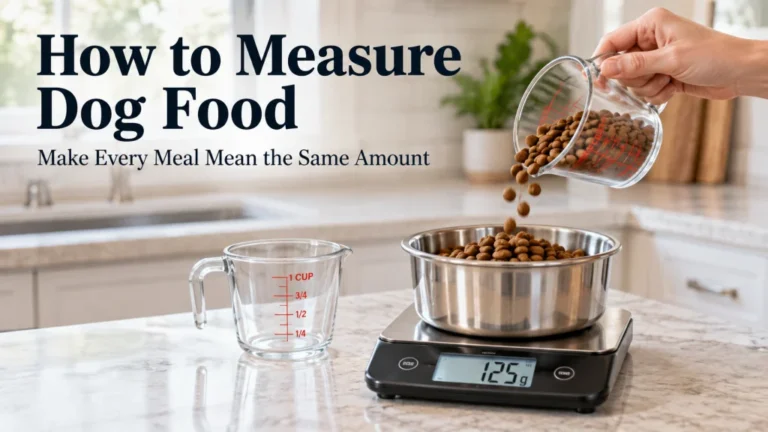
Once you have a starting amount, measurement consistency becomes more important than eyeballing the bowl. A scoop that is heaped one time and level the next can quietly change the amount being served, especially when several people feed the same dog. For dry food, weighing the portion in grams gives a repeatable reference when the product information supports that measurement. A household that prefers a measuring cup should still use the same cup, the same fill method and the same agreed daily total.
A simple routine prevents accidental double feeding and makes later adjustments easier to interpret. Measure the total amount intended for the day, record it if more than one person feeds the dog and divide from that known total rather than starting over at every meal. The separate guide on how to measure dog food goes deeper into choosing and using a consistent measuring method. Good measurement does not decide the correct amount by itself, but it makes the amount you chose real and repeatable.
- Use the exact food and correct label directions.
- Confirm the unit before measuring.
- Keep one household method for measuring the daily total.
- Record changes instead of making several untracked adjustments at once.
Consistency also improves the quality of the information you can give a veterinarian. If the served amount changes from meal to meal, it becomes much harder to judge whether the starting recommendation truly fits. A repeatable method lets you describe what the dog actually receives instead of estimating from memory. That makes any later adjustment easier to track without changing several variables at once.
Divide the daily amount across the dog’s actual meal frequency
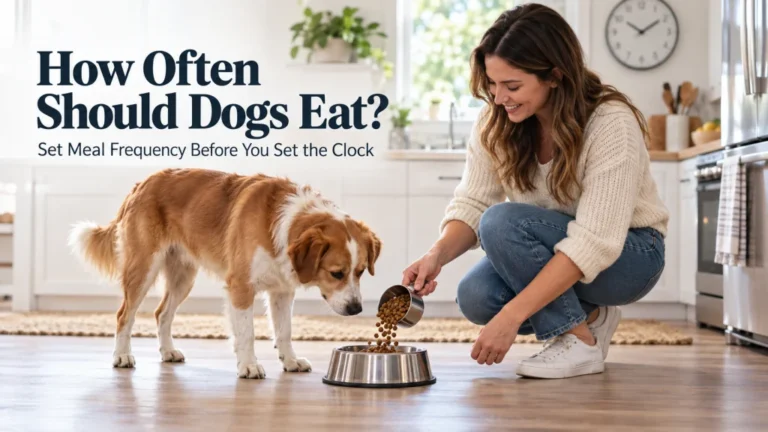
Meal frequency tells you how to distribute a known daily amount, not how to create extra food. If the package amount is clearly stated for the full day, divide that total across the meals the dog actually eats. A household feeding two meals can split the daily ration into two planned portions, while a different routine may divide the same total another way. The arithmetic should follow the established schedule instead of allowing each meal to become a fresh guess.
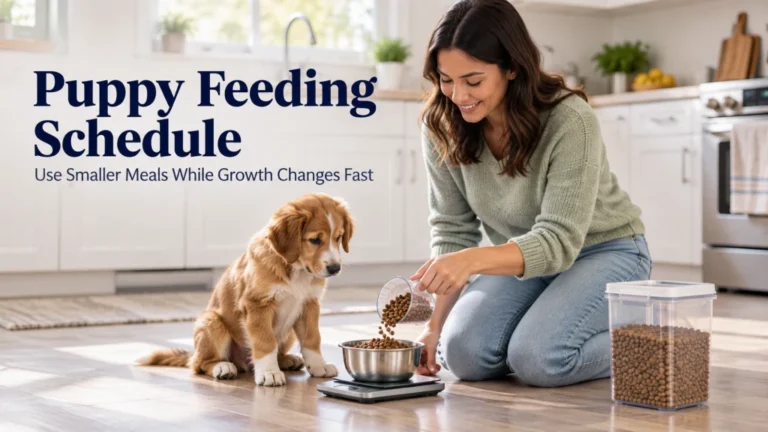
This is also where owners can accidentally confuse feeding frequency with feeding quantity. The companion guide on how often dogs should eat handles the routine decision, while this page keeps ownership of the daily amount itself. Puppies and dogs with medical needs can require different feeding patterns, so do not use a generic meal split to override veterinary guidance. Once the schedule is known, the daily total should remain visible so everyone in the household knows what has already been served.
Recheck body weight and body condition instead of following the bag unchanged
A label gives a starting point, while the dog’s response tells you whether that starting point still fits. Watch body weight trends, body condition, appetite and changes in activity rather than assuming the first amount chosen should remain untouched forever. Body condition tools can help owners notice whether the dog’s shape appears to be moving away from an appropriate range, but they are not a substitute for a veterinary assessment. The important habit is to connect what you measure in the bowl with what you observe in the dog.
A single visual impression should not become a home diagnosis or a drastic feeding change. Coat, body shape, age and muscle can affect how a dog looks, and meaningful weight change may have causes that need professional assessment. Note whether the change is gradual, recent or accompanied by a change in appetite or activity so you can describe the pattern clearly. If you are unsure whether the dog is too thin, overweight or losing weight unexpectedly, bring the current food, label information and measured intake to the veterinarian.
Include treats and extras in the nutrition conversation
The food bowl is not the only place calories can enter the routine. Training rewards, table food, chews, toppers and food used to hide medication can all add to total intake, even when the measured meal portion stays unchanged. That does not mean every extra needs to be banned or converted into a home nutrition formula. It means the veterinarian needs an honest picture of what the dog actually consumes when helping you judge an individualized amount.
This is especially important when an owner has already reduced the bowl but the overall intake has not changed much. Cutting complete food more aggressively while ignoring extras can also distort the diet rather than solve the underlying problem. Keep a simple list of regular extras and bring it into the same discussion as the main food and measured amount. The goal is a complete account of intake, not a false sense of precision based only on what went into the bowl.
Use the veterinarian for individualized calorie targets and major adjustments
Some feeding questions stop being label execution questions and become individualized nutrition questions. Significant weight change, unusual appetite, growth concerns, pregnancy, nursing, chronic illness or a planned weight loss program should not be managed by guessing from a generic chart. The veterinarian can interpret the dog’s body condition, health, life stage and full diet history together. That is different from using the package directions as a reasonable starting point for a healthy dog.
Bring useful inputs rather than trying to solve the clinical calculation first. Useful details include the exact food, the feeding directions, the calorie statement, the measured daily amount, meal frequency, treats and other regular extras. Also mention meaningful changes in activity, appetite or body weight because they can change how the feeding amount should be interpreted. A precise answer is only useful when the information behind it is equally precise.
Final Thoughts: let the label start the decision, then let the dog refine it
The most useful answer to the question of how much to feed your dog is not one universal number. Start with the feeding directions for the exact complete and balanced food and correct life stage, confirm the unit, measure the daily amount consistently and split that known total across the dog’s actual meals. Use the calorie statement to understand why cup volume does not transfer cleanly from one food to another. Then keep the measurement connected to the dog’s body weight, body condition, activity and overall health context.
When the starting amount no longer seems to fit, do not solve the mismatch by making large untracked changes or copying a different chart. Record what the dog is actually eating, include treats and extras, and bring that information to the veterinarian when individualized guidance is needed. A feeding label gives you a concrete place to begin, while ongoing monitoring tells you whether that amount still fits.
FAQs
🐕 How many cups of food should I feed my dog each day?
Check the feeding directions on the exact food rather than using a universal cups chart. The right cup amount can vary with calorie density, life stage, activity, body condition and health, so use the label as a starting point and ask your veterinarian for an individualized target when needed.
🥣 Is the amount on the dog food bag for the whole day?
Often it is, but do not assume. Read the wording around the chart and confirm whether the listed quantity is per day, per meal or tied to another unit before dividing or multiplying it.
⚖️ Is weighing dog food better than using a cup?
For dry food, weighing in grams can make portions more repeatable than estimating scoop volume. The key is to use a method that matches the product information and that everyone in the household can follow consistently.
🍪 Do treats count when deciding how much my dog eats?
Yes, treats and other regular extras contribute to total intake. Include them when you discuss feeding amounts with your veterinarian instead of judging the main meal portion in isolation.
📦 Should I use the same amount when I switch dog foods?
Do not assume the same scoop volume is equivalent across foods. Check the feeding directions and calorie statement on the new product because equal looking portions can provide different amounts of energy.
🩺 When should I ask my veterinarian about feeding amount?
Ask for individualized guidance when there is significant weight change, a health concern, unusual appetite, growth concern or a planned weight loss program. Bring the exact food, measured intake, treats, meal frequency and recent changes in activity or body weight.
References and Sources
- AAFCO pet food label guidance: Supports the use of nutritional adequacy statements, feeding directions and calorie information on pet food labels, and explains that feeding directions are guidelines that may need modification for the individual animal.
- VCA serving size guidance: Supports treating package portions as a guideline and using gram weighing as a repeatable way to measure dry food.
- WSAVA nutrition tools: Supports body condition assessment as part of veterinary nutrition evaluation and provides owner education resources for nutrition discussions.