Better dog walking tips start with deciding what the outing needs to accomplish, not with chasing pace or distance. An ordinary walk can emphasize toileting, movement, sniffing, public behavior, or a practical mix. The structure changes with the dog, household, route, and environment, especially with multiple dogs or crowded city spaces. This guide builds a useful daily dog walk while keeping leash training, exercise quantity, and weather safety in their own lanes.
Decide what job this walk needs to do
Dog walking tips become more useful when you decide what today’s outing is for before judging it by speed or distance. A quick toilet trip, a movement focused walk, a slow exploration walk, and a mixed everyday walk should not all look the same. If the dog needs time to investigate the neighborhood, pushing for a brisk pace can work against the purpose. If the household needs a straightforward trip before work, allowing every scent stop to set the schedule can create a different problem.
I would choose one primary purpose and one secondary purpose, then let those choices set the pace, route, and amount of stopping. That fits naturally within a broader routine for walking and exercising a dog because the daily walk is only one part of the dog’s activity system. The same dog may need a short practical outing at one point and a slower exploratory outing later. Success starts with knowing what this outing needs to accomplish.
| Walk purpose | What to prioritize | What not to overvalue |
|---|---|---|
| Toileting | Efficient access to a familiar relief area and calm handling | Distance covered |
| Movement | Steady walking that suits the dog’s current needs | Constant scent stops |
| Exploration | Sniffing, environmental information, and a flexible pace | Speed |
| Mixed everyday walk | A workable balance of movement, sniffing, and household timing | Making every minute serve the same goal |
| Decision step | Question to ask | Next move |
|---|---|---|
| 1 | Does the dog need a toilet trip first? | Use a familiar relief area, then reassess the outing. |
| 2 | Is exploration the main job? | Choose room for safe sniffing and a flexible pace. |
| 3 | Is movement the main job? | Use a steadier route and pace. |
| 4 | Are crowding, litter, or traffic changing the plan? | Create space, shorten, or reroute before the pinch point. |
| 5 | Is the real problem training, total exercise, or a hazard? | Use the dedicated guidance for that decision. |
This flow keeps one outing from carrying jobs that belong elsewhere. Once the primary purpose and the next constraint are clear, the walk is easier to organize and easier to judge.
Let some walks prioritize sniffing and exploration
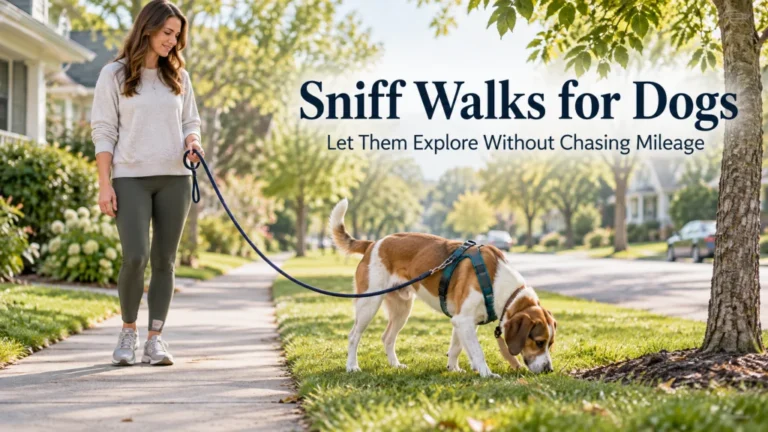
Sniffing changes the value of a walk because dogs gather information through scent that people barely notice. A route that looks repetitive to the handler can still contain new information from other dogs, people, wildlife, food, weather, and environmental change. That is why an exploration focused outing can cover less ground and still be useful. The goal is not to stop at every object forever, but to give the dog appropriate opportunities to investigate rather than treating every pause as wasted time.
It also helps to separate a sniff focused outing from a walk that has a tighter practical purpose. When time allows, the dog can set more of the pace and spend longer examining safe areas; when the household is on a schedule, the handler can keep the outing more direct. A deeper guide to sniff walks for dogs can help when scent exploration itself is the main activity. Sniffing can add mental enrichment, but it should not be presented as a universal replacement for whatever physical activity an individual dog needs.
- Choose safer areas where pausing does not block traffic or force close contact with strangers.
- Allow more investigation when exploration is one of the walk’s stated purposes.
- Shorten or redirect a sniff when the location, debris, traffic, or another dog makes the stop unsuitable.
- Judge the outing by engagement and fit with its purpose, not only by distance.
Make sniffing intentional. When exploration is part of the plan, it is easier to balance the dog’s interest in scent with the household’s need to keep moving.
Walk multiple dogs together only when each dog can handle an ordinary walk individually
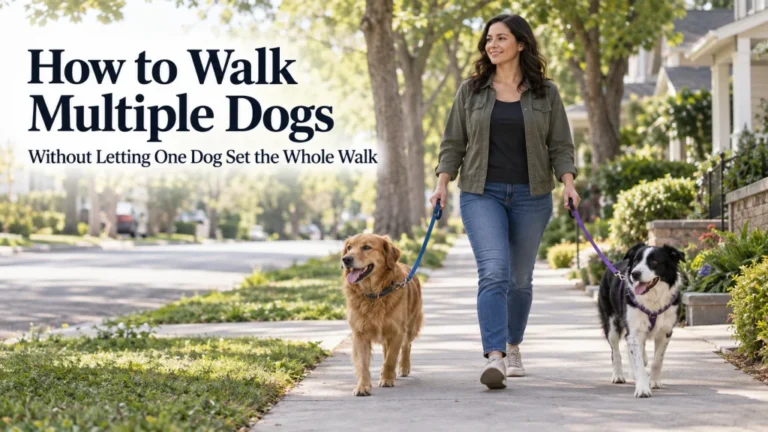
Walking two dogs at once can save time, but convenience is not the right starting point. Each dog should first be manageable alone because a second leash adds pulling, sudden lunging, pace conflicts, and competing interests. A pair that looks calm indoors may react differently around another dog, wildlife, bikes, or a narrow sidewalk. The handler also needs enough control and attention to manage both dogs without spending the outing untangling lines.
Pairing works best when the dogs can move at a compatible pace and recover from ordinary distractions without one dog constantly setting off the other. If one dog needs slower movement, more space, or a separate training setup, splitting the walk can be the more practical choice. The detailed process in how to walk multiple dogs belongs to that more specific handling decision. For the everyday walk, the rule is simple: combine dogs only when the combined outing remains manageable for the dogs and the person holding the leashes.
Key point: A shared walk should reduce household workload without turning one handler into a moving knot of leashes and conflicting dog needs.
If the pair is harder to manage than either dog alone, return to individual walks. The current combination simply does not fit the task yet.
Use group walks when shared movement fits better than free group play
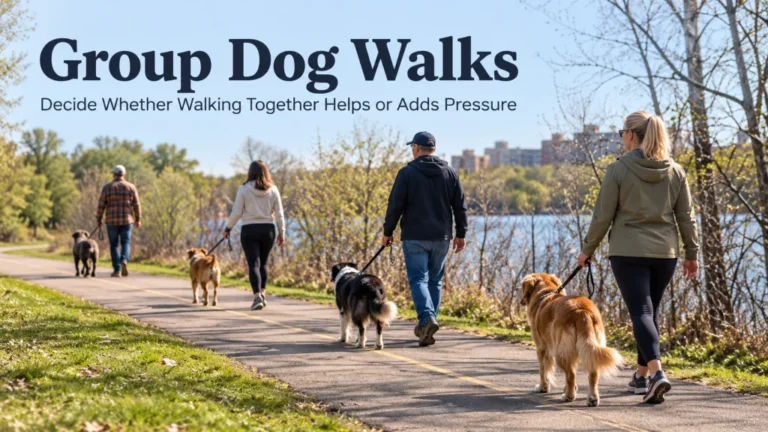
A group walk creates a different social setup from a dog park or loose play session. Dogs can move together while handlers maintain space, manage greetings, and keep the activity structured. That can suit owners who want shared outdoor time without asking unfamiliar dogs to interact closely. It is also easier to leave when one dog becomes uncomfortable because the activity already has forward movement.
Group size, spacing, route width, and the dogs’ ability to remain settled matter more than the idea of a group itself. A crowded sidewalk with leashes crossing in every direction is not improved merely because the outing was labeled social. Readers considering group dog walks should focus on whether the format lets each dog keep a workable amount of space and whether the handler can still respond to the environment. If the dog needs direct behavior help around other dogs, the question has moved beyond ordinary group walk logistics.
A useful group walk should feel like manageable individual walks moving together, not a test of forced proximity. Shared movement works when that structure remains comfortable and controllable.
Use public space etiquette that protects other people and dogs from unwanted interaction
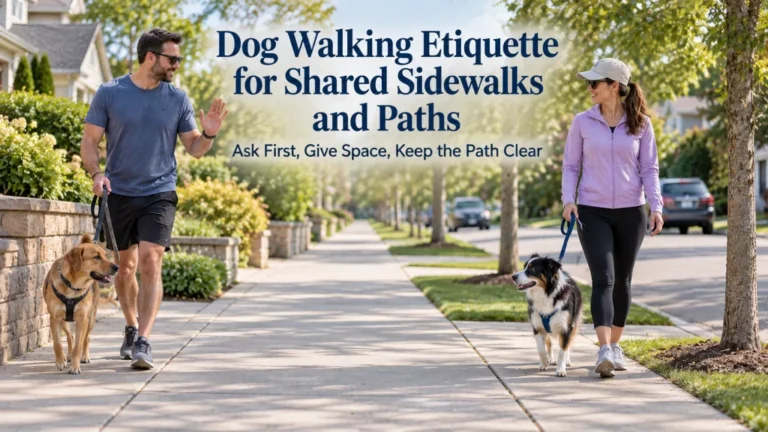
A normal neighborhood walk takes place in shared space, so good handling includes more than keeping one dog comfortable. Other people may be afraid of dogs, managing a reactive dog, using mobility equipment, or simply avoiding interaction. The same applies to dog to dog greetings: a friendly approach is still unsolicited without the other handler’s agreement. Leaving room and asking before contact is more considerate than assuming every visible dog wants to say hello.
Cleanup is another basic part of using public space responsibly, and so is keeping the leash arrangement from blocking a path. On narrow sidewalks, move predictably and avoid allowing the dog to stretch across the full walking lane. The practical details in dog walking etiquette are useful when the main question is how to share space around people, dogs, bikes, and property. Good etiquette reduces unnecessary conflict without requiring the dog to greet anyone.
If the route repeatedly creates unwanted closeness, change the route or timing. Good public behavior is simple: keep moving, give space, clean up, and let others choose whether they want interaction.
Carry a small kit matched to the actual walk
An ordinary daily walk does not need to become an expedition pack, but leaving with nothing can create avoidable problems. Cleanup bags and visible identification are basic because they address predictable responsibilities if the dog eliminates or becomes separated. Water becomes more relevant when distance, heat, dog condition, or access to safe drinking water changes the outing. Beyond that, judge each category by the job it solves, how easy it is to carry and reach, and whether using it competes with safe leash handling.
I would keep routine carry choices small enough that they are actually taken on the walk. Useful gear should fit the route, stay accessible without occupying the leash hand, and avoid more bulk than the outing justifies. The focused guide to dog walking essentials can separate genuine walk needs from items for longer outings or special conditions. For a normal neighborhood loop, the kit should solve likely problems without becoming the main event.
| Item type | Why it may belong | Selection check |
|---|---|---|
| Cleanup supplies | Routine public responsibility | Easy to reach and enough for the dogs and route |
| Identification | Helps reunite dog and owner if separated | Secure, readable, and current |
| Water | Useful when route, conditions, or dog needs increase demand | Practical to carry and use without unnecessary bulk |
| Training rewards | Useful when the walk includes planned skill practice | Quick to access without interfering with leash control |
There is no universal packing list. Carry what this walk is likely to require, choose a form that is convenient to use on the route, and leave the rest for outings where it has a clear job.
Adapt the walk when city sidewalks, elevators, crowds, and limited green space change the logistics
City walking often compresses decisions that are easier in quieter neighborhoods. A dog may move from a hallway to an elevator, a crowded lobby, a narrow sidewalk, traffic, food litter, bikes, and other dogs within a short stretch. Route choice and handler attention therefore become part of the walk itself. Keep enough attention available to notice litter, approaching dogs, vehicles, bikes, driveways, and tight passing points before the dog reaches them.
A shorter route with room to step aside can work better than a longer route with repeated close traffic. Elevators and building exits also create sudden proximity, so waiting for more space can be easier than forcing a crowded pass. The guide to city dog walking goes deeper into shared spaces, traffic, and limited green space. When the problem is a cue such as wait or leave it rather than route logistics, that training work belongs elsewhere.
| Condition | City adjustment | Suburban adjustment |
|---|---|---|
| Space | Plan passing points and quieter side streets | Use wider sidewalks, verges, or lower traffic blocks when available |
| Building access | Manage hallways, lobbies, and elevators | Focus more on doorways, driveways, and street crossings |
| Ground access | Know where toileting and sniffing are realistically allowed | More green space may be available, but property boundaries still matter |
| Distractions | Expect dense pedestrian, traffic, food, and dog activity | Expect more variable wildlife, yards, driveways, and longer gaps between encounters |
Plan routes around predictable pinch points instead of hoping every crowded encounter works out. Situational awareness is part of ordinary walk logistics because noticing a problem early usually leaves more room to respond.
Vary route, direction, and pace when novelty helps
Walking the same route is not automatically bad, and changing the route is not automatically better. Familiar routes can be efficient and predictable, especially for a dog that handles known environments more comfortably. At the same time, a different block, reversed direction, slower section, or new safe sniffing area can add useful novelty when the dog enjoys exploration. The decision should come from the dog’s response and the purpose of the outing rather than from a rule that every walk must be new.
Route variety also does not require traveling somewhere special. Small changes can alter what the dog encounters while preserving a familiar overall structure. A household might keep the same short loop on busy mornings and use a quieter side street or different turn on a more exploratory outing. If a new route produces constant tension, crowding, or difficult handling, novelty is not helping just because the scenery changed.
- Reverse the usual direction through a familiar neighborhood.
- Add one quiet side street instead of replacing the entire route.
- Change where the dog gets more sniffing time.
- Use a familiar route when predictability better fits the dog or household schedule.
Ask whether the route change improves the walk you intended. Novelty is a tool, not a requirement.
Build loose leash skills separately when pulling disrupts the walk
An everyday walk becomes difficult when the handler is trying to solve pulling, teach position, manage distractions, and still complete the outing at the same time. Those are training mechanics, not merely walk design. If pulling is the main reason the route feels unmanageable, changing the sniff schedule or carry kit will not fix the underlying problem. Separate skill practice gives the dog and handler a cleaner learning setup than trying to teach every detail during a necessary household walk.
The dedicated guide to leash training a dog owns the mechanics of loose leash walking and related cues. This page only needs the boundary: everyday walk quality assumes the dog has enough basic leash skill for the outing to be manageable. When that assumption is not true, shorten the practical walk, reduce difficulty where possible, and move the training problem to a more controlled setup. That keeps the daily routine from becoming a repeated tugging contest.
A walk can reinforce known skills, but it should not become a full lesson when the household also needs toileting, movement, or practical travel. Clear separation makes both tasks easier to evaluate.
Decide how much physical activity this walk needs to provide
Not every daily walk needs to satisfy the dog’s entire physical activity requirement. Some dogs get movement from several parts of the day, while others rely more heavily on leash walks because of housing, yard access, routine, or preference. Age, health, body type, activity level, and veterinary restrictions can also change what amount and intensity are appropriate. A universal walking duration or fixed number of walks therefore does not belong in a general everyday walk guide.
If the real question is whether the dog is getting enough activity overall, use the separate guide on how much exercise a dog needs. Once that need is understood, an individual walk can take its proper role. A slow sniff focused outing may be useful without being the main physical workout, while a brisk movement focused outing may offer less exploration. Different outings can contribute different things.
| If the question is mainly about | Use this decision |
|---|---|
| How the ordinary walk should function | Set purpose, pace, route, sniffing, etiquette, and logistics here |
| Total physical activity | Use the exercise needs guidance |
| Pulling or cue mechanics | Use the leash training guidance |
| Environmental hazards | Use the walking safety guidance |
This boundary keeps a daily walk from becoming a catchall exercise answer and makes the outing easier to judge against its actual purpose.
Modify the walk when heat, cold, pavement, darkness, or other hazards change the plan
A walk that works under ordinary conditions may need a different route, timing, duration, or setup when the environment changes. Hot pavement, cold surfaces, poor visibility, heavy traffic, debris, or unusual weather can turn a familiar route into a different task. The dog’s age, health, coat, body type, and tolerance can also change how much a condition matters. That means the handler should notice the environment before treating the usual walk as automatic.
This article does not turn those conditions into one weather rule because safety depends on more than the route. The separate guide to dog walking safety handles hazard specific changes in more depth. For everyday planning, recognize when conditions have changed enough to adjust the routine. Signs of illness, injury, unusual weakness, or distress move beyond ordinary walk design and may require veterinary guidance.
Warning: Do not use a familiar routine as proof that conditions are safe today. Recheck the route, surface, visibility, and the dog before assuming the usual plan still fits.
Good daily walking can become shorter, quieter, slower, or postponed when conditions no longer fit the plan. Adjusting for safety is part of responsible handling.
Final Thoughts: a good daily walk matches its purpose instead of maximizing distance
A useful daily walk is not defined by the largest distance, fastest pace, or most elaborate route. It works because the handler knows whether the outing is mainly for toileting, movement, exploration, practice, or a practical mix, then makes choices that support that purpose. Sniffing, route variety, group walking, public etiquette, and a small carry kit can all improve an outing when they solve a real need. They become less useful when they are treated as rules that every dog and household must follow.
Keep the boundaries clear as well. If pulling is the main problem, work on leash skills; if the question is total activity, evaluate exercise needs; if weather or surfaces change the risk, adjust through the safety system. That leaves the ordinary walk free to do what it does best: give the dog and household a manageable, useful outing that fits the day in front of them. Recheck the purpose when the route, dog, or household routine changes, and let the walk change with it.
Explore related dog walking topics
Use these focused guides when one part of the everyday walk becomes the main decision. Each guide takes over when that issue needs more detail than an overview can provide. Keep the ordinary walk focused on purpose and logistics. Choose the topic that matches the problem in front of you.
| Topic | What you’ll find |
|---|---|
| Sniff walks for dogs | How to make scent exploration the main purpose of an outing without measuring success only by distance. |
| How to walk multiple dogs | How to judge individual readiness, pairing, pace, and handler workload before combining dogs. |
| Group dog walks | How structured shared movement differs from loose group play and when the format fits. |
| Dog walking etiquette | How to handle greetings, shared paths, cleanup, and personal space around people and dogs. |
| Dog walking essentials | How to keep an ordinary walk kit small, useful, and matched to the outing. |
| City dog walking | How to adapt routes for sidewalks, elevators, traffic, crowds, litter, and limited green space. |
Start with the topic that matches the current decision. Use the focused page for the deeper method or setup. Return to this overview when you need to fit that choice back into an ordinary walk. That keeps one walk from carrying every walking problem at once.
FAQs
🐾 Should I let my dog sniff during every walk?
Sniffing can be a useful part of many walks, but the amount should fit the purpose of the outing and the environment. A practical toilet trip may allow less exploration than a walk planned mainly for scent and novelty.
🚶 Is walking the same route every day bad for a dog?
Not automatically. Familiar routes can be efficient and comfortable, while small changes in direction, pace, or sniffing opportunities can add novelty when the dog enjoys it.
🐕 Can one walk be enough exercise for my dog?
That depends on the dog’s age, health, body type, activity level, routine, and other activity during the day. Evaluate total exercise needs separately rather than assuming one daily walk is enough for every dog.
👥 Is it better to walk two dogs together or separately?
Walk them together only when each dog is manageable alone and the pair can move at a compatible pace without overwhelming the handler. Separate walks are often the better choice when one dog needs different speed, space, or training support.
🏙️ What makes city dog walking different?
City routes often compress elevators, hallways, traffic, crowded sidewalks, discarded food, and close dog encounters into a small area. Route choice and spacing therefore become more important parts of ordinary walk logistics.
🎒 What should I carry on a normal dog walk?
Carry what the route and dog are likely to need, starting with cleanup supplies and reliable identification. Add water, rewards, or other items when distance, conditions, or the purpose of the outing makes them useful.
References and Sources
- PetMD scent walk guidance: Supports the distinction between exploration focused scent walks and outings centered more on elimination or physical movement.
- AKC multiple dog walking guidance: Supports individual readiness, compatible pace, and handler control before combining dogs on one walk.
- AKC dog etiquette guidance: Supports permission based greetings, space around other dogs and people, and responsible public behavior.
- PetMD dog walking guidance: Supports staying engaged enough to notice traffic, litter, approaching dogs, and changing conditions.
- VCA dog walking safety guidance: Supports cleanup supplies, hydration, identification, route awareness, and adapting to environmental hazards.
- AKC urban dog skills guidance: Supports the added handling demands created by crowded sidewalks, traffic, food litter, and other city distractions.