Good dog walking etiquette is mostly about managing your own dog so other people are not forced to do it for you. Ask before greetings, keep enough leash control to leave room on the path, clean up waste, respect maintained property, and create distance when another person or dog needs it. Friendliness does not create permission, and a quiet request for space does not need an explanation. Local leash, waste, and access rules vary, so courtesy should work alongside the rules posted where you actually walk.
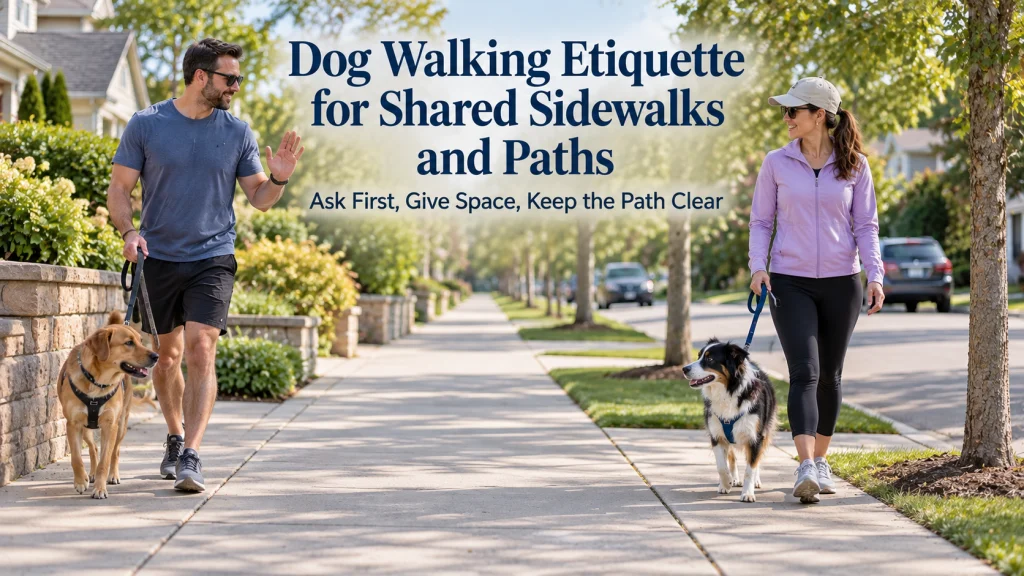
Ask before allowing your dog to greet a person or another dog
A dog can look eager to say hello while the person ahead is trying to avoid an interaction. Ask before allowing your dog to move into reach of a stranger or another dog, and wait for a clear yes before closing the distance. A smile, eye contact, or another dog’s interest is not the same as permission from the person managing that space. If the answer is no, continue the walk without trying to persuade the other person that your dog is friendly.
The simplest scripts are short because a crowded sidewalk is not the place for a negotiation. Ask whether the other person would like the dogs to say hello before moving closer. If you are declining, a simple “No greeting today, thanks” or “Please give us some space” is enough. These small phrases support good dog walking manners because they make the decision clear before leashes, dogs, and people are already tangled together.
- Ask before your dog moves into greeting distance.
- Accept no immediately and move on.
- Do not make another owner explain why they want space.
- Skip the greeting when either dog or person cannot settle enough for a calm interaction.
The useful takeaway is not that every sidewalk greeting is wrong. It is that greeting is optional, while respecting another person’s boundary is not. A dog who passes without saying hello is not missing a required social event. On an ordinary walk, neutral passing is often the easiest outcome for everyone.
Keep enough leash control that others can use the path safely
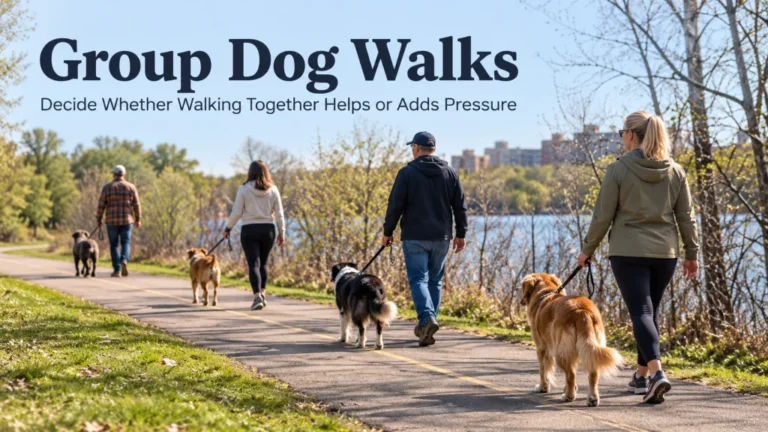
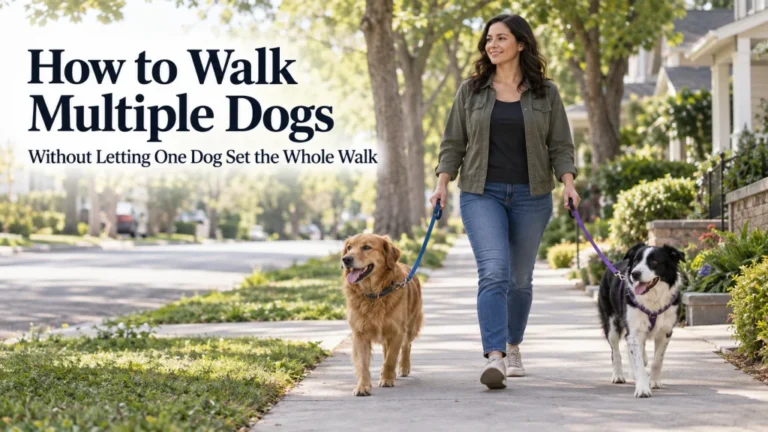
Leash control is less about making the dog walk in one perfect position and more about keeping the dog’s movement inside the space you can safely use. On a wide, empty path, your dog may have room to sniff without affecting anyone else. As another person, stroller, cyclist, runner, or dog approaches, bring the dog closer before the available space disappears. The goal is to make your path predictable enough that someone coming the other way does not have to guess where your dog will move next.
Dog size, strength, excitement level, and the width of the walking area all change how much slack is practical. A leash that feels manageable on an open neighborhood block can become awkward at a narrow corner or busy entrance. Keep your hands arranged so you can shorten the usable distance smoothly without wrapping loose leash around your fingers or letting loops drag where someone can step into them. Good control should reduce surprise without turning the entire walk into a rigid march.
Avoid stretching the leash across sidewalks or shared trails
A leash can become a physical barrier when the owner is on one side of a walkway and the dog is exploring the other. Another walker may see the dog but miss the line between dog and handler until they are close to it. Before someone reaches that line, bring the dog to your side or move with the dog so the leash no longer crosses the travel lane. This matters even when the dog is calm because the problem is the geometry of the path, not the dog’s intention.
Corner turns, benches, parked bicycles, trail posts, and groups walking side by side can make that geometry change quickly. For a straightforward pass, choose one side early, bring your dog onto that same side, keep the leash line inside your half of the path, and hold that position until the other person has cleared you. If you stop for sniffing, leave a usable channel for people to pass rather than occupying both edges at once. The courtesy standard is simple: your leash should connect you to your dog without becoming an obstacle other people have to navigate.
Give space when another handler changes direction or asks not to interact
A handler who crosses the street, steps off the path, turns around, or places their body between two dogs is already communicating a preference for more distance. You do not need to know whether the reason is training, fear, pain, recovery, reactivity, age, or simple preference. Stop your dog from following the movement and keep enough separation for the other team to continue. Respecting that signal is more useful than calling out that your own dog is safe or friendly.
If someone verbally asks for space, answer with action rather than explanation. Move to the side, turn down another route, pause behind a parked car where it is safe, or let the other person pass while your dog stays with you. In a tight area, a calm “Go ahead, we’ll wait here” can remove uncertainty without making the interaction bigger. Dog walking courtesy is often just the habit of noticing that another person has already told you what would make the shared space easier.
Pick up waste and avoid maintained private landscaping
Picking up your dog’s waste is a basic responsibility on neighborhood walks, but property courtesy goes beyond carrying a bag. Keep the dog from wandering deep into a yard, garden bed, planter, driveway display, or other maintained area just because the leash can reach it. A narrow strip beside a sidewalk may look casual to one person and carefully maintained to the resident who lives there. When ownership or access is unclear, staying closer to the public walking surface is the lower conflict choice.
Urination is harder to undo than a paw step, so avoid directing the dog toward ornamental plants, personal objects, bins, tires, furniture, or posted areas where the property owner has made a preference clear. If your route has limited public grass, plan your handling around the spaces that are actually available rather than assuming every lawn edge is shared dog space. Clean up promptly and leave the area as close as practical to how you found it. That approach prevents a routine bathroom stop from becoming someone else’s cleanup or landscaping problem.
Keep off leash time to places where it is permitted and appropriate
Off leash freedom is not just a question of whether your dog usually stays nearby. First check the posted rules and the requirements of the park, trail, beach, or other property you are using. Then consider whether your dog can remain responsive without approaching people or dogs who did not invite contact. A location can permit off leash use and still be a poor fit when visibility is limited, traffic is heavy, wildlife is present, or your dog is too excited to disengage.
Where off leash use is not allowed, keep the leash attached even if the route looks empty. Where it is allowed, be ready to restore control before your dog enters another person’s space, and do not rely on shouting “friendly” as a substitute for recall or permission. If a fenced dog area is the better option for your dog, review dog park safety before treating the gate as automatic permission to interact with every dog inside. The practical rule is to match freedom to the place, the dog, and the amount of control you can actually maintain.
Adjust your handling when crowds, elevators, and tight sidewalks reduce room
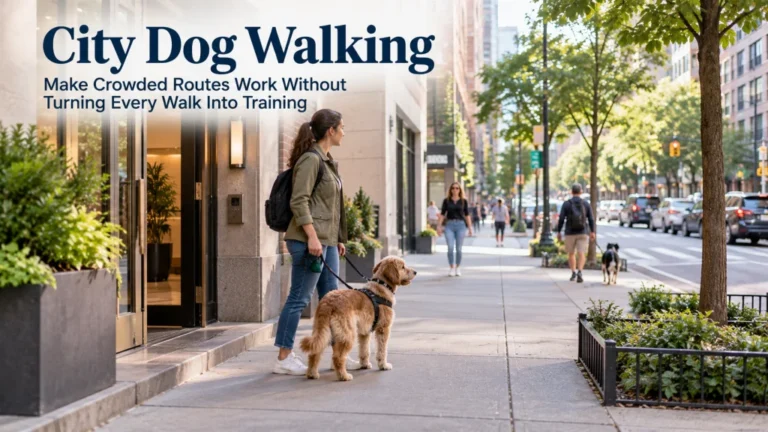
City walking compresses decisions that feel easy in a quieter neighborhood. Building doors, curb cuts, elevators, narrow sidewalks, outdoor seating, delivery carts, and people stopping without warning can reduce your available space in a few steps. Bring the dog closer before entering the bottleneck, rather than trying to gather the leash after another person is already beside you. If there is not enough room for a comfortable pass, wait in a wider spot and let traffic clear.
Elevators and entrances deserve the same shared space logic. Let people exit before moving in, keep the dog from blocking the opening, and avoid placing a stranger between your dog and the only clear route out. On crowded sidewalks, choose predictable movement over maximum sniffing range until the space opens again. You are not removing enrichment from the walk; you are shifting when it happens so the dog’s exploration does not become someone else’s obstacle.
Create more distance when leash skills or reactivity make shared paths harder
Etiquette can reduce pressure, but it is not a treatment plan for barking, lunging, fear, or other difficult behavior. If your dog is struggling to pass at close range, use more distance and simpler routes instead of repeatedly forcing tight encounters in the name of manners. Cross when it is safe, turn before the gap closes, or choose a quieter section of the route where you can manage the dog without blocking others. The immediate goal on the walk is a workable amount of space, not proving that the dog can tolerate every situation.
If the main problem is everyday leash control, work on leash training for a dog separately from the etiquette decisions described here. Training can improve the skills available to you, while etiquette determines how you use the space around other people during the learning process. Do not use another person’s dog as an unplanned practice target by following closely or arranging a greeting they did not request. When behavior creates a safety concern that exceeds ordinary walking management, move beyond this etiquette page and get appropriate qualified help.
Check local leash and waste rules instead of assuming one national standard
Courtesy and law overlap, but they are not the same thing. A polite choice can be sensible even when no posted rule requires it, and a local rule still applies even if your dog is unusually reliable. Check the city, county, park authority, property manager, trail manager, or other body that actually governs the place where you are walking. Signs at entrances and route specific notices matter because access, leash requirements, waste rules, and off leash permissions can change from one location to another.
Do not turn a general dog walking article into a substitute for local verification. Before using a new route, check the rules that affect how you plan to handle the dog there, especially if you expect to use open space, shared recreation areas, or property with posted restrictions. If a rule is unclear, choose the more controlled option until you can verify it rather than assuming the absence of a sign means unrestricted use. Etiquette fills the gaps between formal rules by helping you avoid making other people manage the consequences of your choice.
| Situation | Courtesy decision | What to verify locally |
|---|---|---|
| Passing on a shared path | Keep your dog close enough to leave a clear lane | Any route specific access or leash requirement |
| Allowing a greeting | Ask first and accept no without debate | Any property rule limiting dog access |
| Using open space | Prevent uninvited approaches even when space is wide | Whether off leash use is permitted there |
| Dog waste | Pick it up and leave the area clean | Waste disposal and sanitation requirements |
| Private landscaping | Keep the dog out of maintained or clearly private areas | Property boundaries and posted restrictions when relevant |
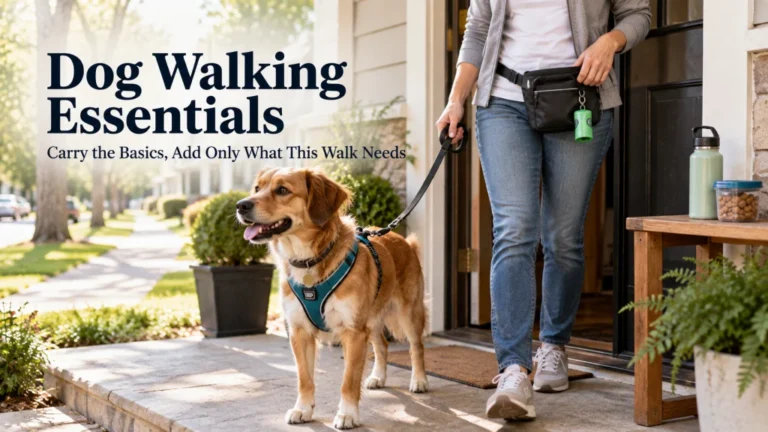
A useful check before the walk is short: know where the dog can be, where the leash must stay attached, where waste can be disposed of, and where you can step aside if another walker needs room. Look for posted restrictions before you enter the route rather than after a conflict starts. Keep the relevant rules in mind when you choose where to pause, pass, or allow more freedom. That preparation reduces the need to improvise when the path gets busy.
Use a simple conflict prevention routine on every shared path
Most walking conflicts become easier when you make decisions before dogs are close enough to create pressure. Scan ahead, notice how much path is available, and identify the easiest place to pass or wait. Bring your dog into a smaller working space before reaching the narrow point, then release more room again after the pass is complete. This keeps management proportional to the situation instead of holding the dog tightly for the entire walk.
The routine also helps when another person behaves unpredictably. You cannot control whether someone approaches too fast, lets a dog pull toward yours, or ignores a request for space, but you can keep your own exit options visible. Move away early when needed, avoid arguments in the middle of the path, and prioritize distance when the situation is becoming harder to manage. The best etiquette is practical because it gives you something useful to do before frustration takes over.
- Look ahead for people, dogs, bikes, strollers, corners, and narrow sections.
- Choose which side you will use before the pass starts.
- Bring your dog closer when the available space shrinks.
- Ask before greetings and accept declined greetings immediately.
- Keep the leash from crossing the travel lane.
- Move away when another handler signals for distance.
- Clean up waste and respect maintained property.
- Check posted and local rules instead of guessing.
After the pass, return the dog to the amount of freedom that suits the route and your normal walking plan. Let the dog sniff or explore again when there is room to do it without blocking someone else. Repeating that pattern helps the walk stay flexible instead of making every approaching person feel like an emergency. Courtesy should make a walk easier to share, not turn it into a constant correction session.
Final Thoughts: good etiquette means other people do not have to manage your dog
Most dog walking rules of etiquette become clearer when you ask who is being required to adjust. If your dog is reaching, blocking, following, greeting, toileting, or moving off leash in a way that forces someone else to solve the problem, make the adjustment on your side first. Ask permission, make room, shorten the usable leash when space is tight, and move on when the answer is no. Those choices work for friendly dogs as well as dogs that need more distance.
Keep the boundary between courtesy, training, and local rules clear. Courtesy tells you how to share space, training gives you better handling skills, and local authorities decide what is legally permitted in a particular place. Check the rules where you walk and choose routes your dog can handle without turning every pass into a confrontation. A good walk leaves room for your dog to be a dog while leaving everyone else room to continue their own day.
FAQs
🐕 Should I let my dog greet every dog we pass?
No. Ask the other handler first, and treat a declined greeting as the end of the decision. Passing calmly without interaction is a normal and useful outcome on a walk.
🚶 Who should move aside when two dogs meet on a narrow path?
There is no universal rule that one specific person must always move. Use the available space, make the safer practical adjustment, and respond early if the other handler signals that they need more distance.
🦮 Is it rude to let my dog walk across the full width of the sidewalk?
It becomes a problem when your dog or leash blocks other people from passing safely. Give the dog more room when the path is open, then bring them closer before someone reaches you.
🌿 Can my dog step onto a neighbor’s lawn during a walk?
Property layouts and local rules vary, so do not assume every lawn edge is shared space. Avoid maintained landscaping, personal objects, posted areas, and deeper entry into private property, and choose the lower conflict route when boundaries are unclear.
📍 How do I know whether my dog can be off leash on a trail or in a park?
Check the rules for that exact property before unclipping the leash. Even where off leash use is permitted, your dog still needs enough control to avoid uninvited approaches and to return to you when the situation changes.
🗣️ What can I say when I do not want another dog to approach?
Use a short, clear sentence such as, “Please give us some space” or “No greeting today, thanks.” You do not owe a stranger a diagnosis, training history, or detailed explanation before moving away.
References and Sources
- AKC dog ownership etiquette: supports permission before greetings, keeping dogs close on shared paths, cleanup, property courtesy, and keeping off leash activity to appropriate permitted areas.
- AKC urban dog skills: supports closer handling in crowded walking areas and avoiding uninvited approaches in city environments.
- AARP dog walking etiquette: supports clear owner communication when declining greetings or requesting more space on a walk.