Dog training basics work best as a communication process rather than a list of cues. Clear marking, useful reinforcement, manageable criteria, and practice in changing environments shape whether a dog understands what earned the reward. Tools or classes can help when they solve a defined problem. The goal is a repeatable system you can adjust to the dog, environment, and skill.
A known cue can fail when the training setup changes
Dog training basics can feel confusing when a dog responds in the kitchen but seems to forget the same cue near guests, outside, or around another dog. That does not automatically mean the dog is stubborn or that the cue was never learned. The setup may now demand more attention, a longer response, more distance from you, or better resistance to distraction. Before repeating the cue louder, I would look at what changed around the behavior.
- Define the behavior: Decide exactly what counts as success.
- Create an easy version: Make the response achievable in the current setup.
- Mark the moment: Identify the behavior you intend to reinforce.
- Reinforce it: Follow with something the dog values in that environment.
- Raise one criterion: Change one meaningful requirement at a time.
- Proof the skill: Rebuild the behavior as the context changes.
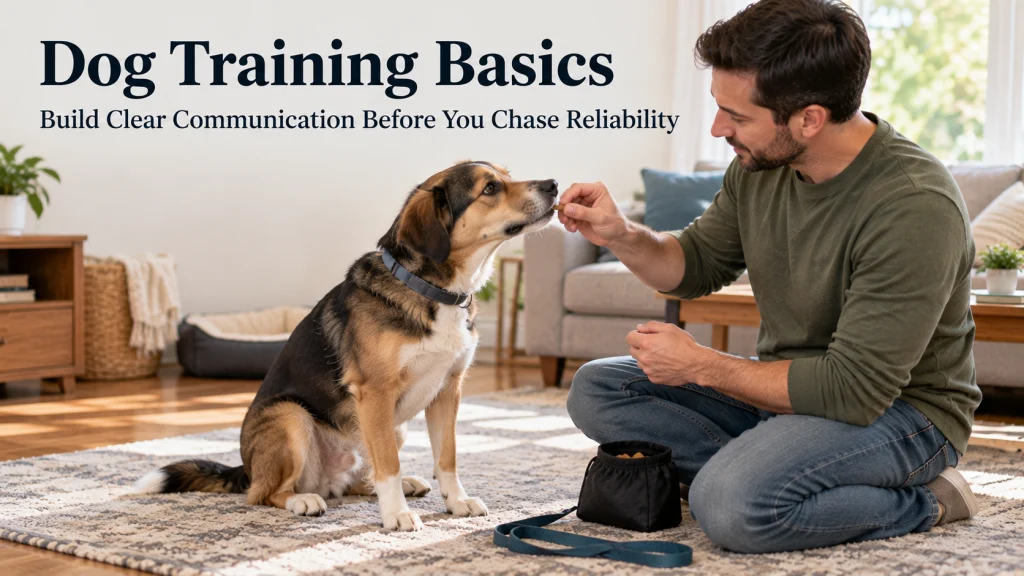
The broader process in how to train a dog follows that same sequence while keeping the requested behavior understandable and achievable. The owner needs a clear marker, a useful reinforcer, sensible repetition, and a gradual plan for difficulty. If the dog repeatedly misses, lower one part of the challenge instead of adding pressure. That reveals the bottleneck and keeps the next repetition teachable.
Start with reward based training instead of correction first methods
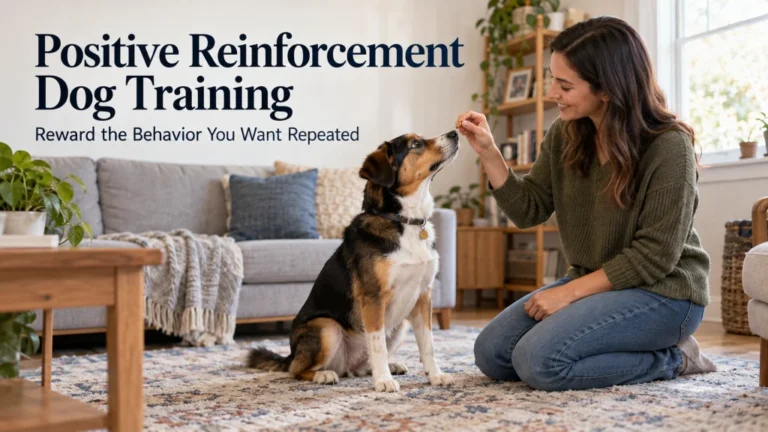
Reward based training focuses on increasing behavior you want by making the consequence valuable to the dog. In practical terms, you arrange an achievable opportunity, mark the response you wanted, and follow with something the dog wants enough to work for in that setting. The reward may be food, play, access to an activity, or another appropriate reinforcer. What matters is whether the consequence strengthens the behavior, not whether the owner personally considers it generous.
This is also where method choice becomes a welfare decision, not just a style preference. Current behavior guidance from AVSAB recommends reward based methods and advises against aversive methods that depend on pain, fear, or physical or psychological punishment. If you want the mechanics behind that approach, the deeper guide to positive reinforcement dog training explains how consequences change future behavior. For beginner work, a clear reward based process gives you more useful feedback than escalating correction when the real problem may be timing, criteria, or environment.
Mark the exact behavior you intend to reinforce
A marker tells the dog which moment earned the reinforcement. The practical value is precision: the marker can identify the correct response even when the reward arrives a moment later. A clicker is one option, but a short, consistent verbal marker can also work when it is taught clearly. The marker itself is not the prize, so it still needs to predict reinforcement reliably while the behavior is being learned.
Watch the dog closely enough that the marker lands on the behavior you actually want. If you intend to reinforce four paws on the floor but mark after the dog jumps up, your timing has changed the lesson. The same problem appears when an owner reaches for the treat first and marks only after the dog has already moved. The guide to clicker training for dogs goes deeper into building a marker and using it without turning the device into a requirement.
Choose rewards by what the dog values in that environment
A reward that works in a quiet room may lose value when the dog can smell food outside, watch squirrels, greet people, or move toward another dog. That is why reward choice should change with the environment and with the difficulty of the task. Food is convenient because it can be delivered cleanly and repeatedly, but it is not the only possible reinforcer. Play, sniffing access, movement, praise, or another safe activity may matter more to a particular dog in a particular moment.
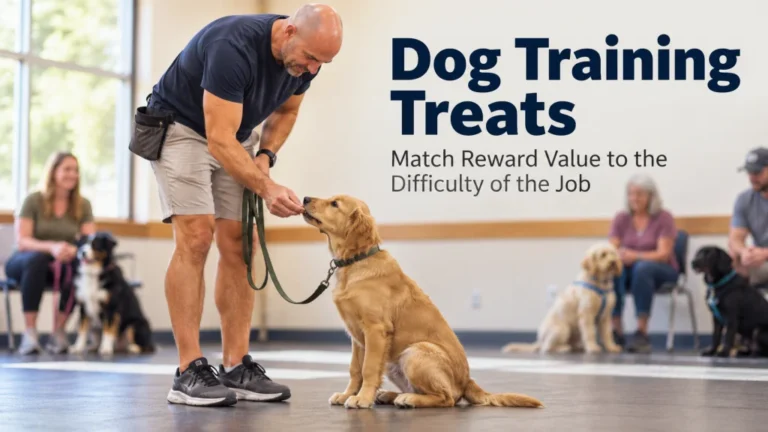
The useful question is not whether a reward is objectively high value, but whether the dog will choose it under the current conditions. If the dog stops taking a familiar reward, do not immediately assume you need a richer treat; the environment may simply be too difficult, distracting, or stressful for productive practice. The article on choosing dog training treats covers food rewards without treating food as the only training currency. Match reward value to the task, then reduce difficulty when even a strong reward cannot restore clear participation.
| Training situation | Reward check | Difficulty check | Useful adjustment |
|---|---|---|---|
| Quiet familiar room | Ordinary reward may be enough | Low competing interest | Teach the first clear version of the behavior |
| New room or yard | Value may need to increase | New smells and movement compete | Lower criteria and rebuild success |
| Busy public setting | Even a favorite reward may lose value | Distraction can overwhelm the task | Add distance or choose an easier environment |
The table is a diagnostic aid, not a reason to make rewards richer every time the dog struggles. If an easier environment restores the response, the challenge was probably too large for the current stage. Adjust the setup before trying to solve every miss with a more elaborate reward.
Keep sessions short enough that clarity survives repetition
Long practice is not automatically better practice. Once the owner becomes sloppy with timing or the dog becomes less engaged, extra repetitions can rehearse confusion instead of improving the skill. A useful session is long enough to produce several clear learning opportunities but short enough that you can still observe the response carefully. Stop while the mechanics remain clean rather than waiting for either side to become frustrated.
Frequency also matters differently from duration. Brief practice can fit naturally into daily routines, such as waiting at a door, settling before access to the yard, or responding to a familiar cue before play. The article on how often to train your dog focuses on building a workable routine without turning every interaction into a formal session. Consistent, understandable repetitions are more useful than occasional marathon sessions that ask for too much at once.
Create new behaviors with luring, capturing, and shaping
Before a cue can become reliable, the dog needs a way to perform the behavior in the first place. Luring uses something the dog will follow to help create the movement, while capturing marks a behavior the dog offers naturally. Shaping reinforces small steps that become progressively closer to the final behavior. None of these methods is automatically best for every skill, so choose the one that makes the next correct response easiest to see and reinforce.
Luring can be simple for a straightforward position, but the lure should not become the only signal the dog understands. Capturing works well when the dog already offers the behavior often enough for you to catch it. Shaping is useful when the final behavior is unlikely to appear all at once or when smaller approximations make the task clearer. The detailed guide to shaping in dog training explains how to split a larger behavior into reachable criteria without rewarding random movement forever.
| Stage | What you reinforce | When to move on | If the dog stalls |
|---|---|---|---|
| Easy first version | A clear approximation | The response appears readily | Make the starting step easier |
| Closer approximation | A more specific version | The dog can repeat it without guessing wildly | Return to the last successful step |
| Finished behavior | The complete response | The dog performs it predictably in the easy setup | Separate the behavior from later proofing work |
A criteria ladder should make the next step clear enough that failure gives you information. If success disappears after a jump in criteria, split the step instead of increasing correction. Smaller changes make the next criterion easier to choose.
Build reliability by changing one difficulty at a time
A behavior learned in one room is not automatically ready for a sidewalk, visitor filled home, class, or park. Dogs can respond differently when distance, duration, distraction, body position, surface, or surrounding activity changes. Proofing means practicing the behavior across those changing conditions until the cue has a more dependable meaning. The safest way to do that is to raise one meaningful challenge while keeping the others manageable.
If you add a new distraction, shorten the duration and stay closer instead of demanding the previous standard in every dimension. When you move to a new place, return to an easier version long enough for the dog to succeed there. The guide to proofing dog training focuses on this transition from learned behavior to practical reliability. A missed response should send you back to the difficulty settings before it sends you toward repeated cues or stronger pressure.
Buy only tools that solve a defined training job
Training equipment should make communication, reinforcement, management, or safe practice easier. A marker can improve timing, a treat pouch can make reinforcement easier to deliver, and a suitable leash can help manage the environment while a skill is still developing. None of those items teaches the behavior on its own. If you cannot name the training job an item solves, it is probably not the next thing you need.
I would start with the smallest setup that lets the owner mark clearly, deliver reinforcement, and prevent the dog from rehearsing unwanted behavior during practice. More gear can add handling complexity, storage, fitting, and extra decisions without improving the lesson. The guide to dog training tools helps separate useful functions from equipment clutter. Skip tools that depend on pain, fear, or physical punishment, and avoid treating any device as a shortcut around criteria, timing, or environment.
Know when a trainer can improve the owner’s training mechanics or plan
Professional instruction can be valuable when the owner understands the goal but cannot identify why progress is inconsistent. Another set of skilled eyes can spot late marking, unclear criteria, poor reward placement, accidental cue changes, or an environment that is too difficult for the dog. A trainer can also help organize practice so the owner is not changing several variables at once. The service is useful when it improves the process, not simply because training feels more official in a class setting.
Method transparency matters as much as format. Ask what the trainer will do when the dog gets something wrong, what equipment they use, how they choose rewards, how they adjust difficulty, and what happens when fear or aggression appears. The guide to choosing a dog trainer covers those screening questions in more detail. A qualified professional should be able to explain the plan without asking you to accept pain, intimidation, or vague claims as necessary.
Use a skills trainer for ordinary teaching and owner training mechanics
For ordinary cue teaching, household manners, and owner timing, look for instruction that is clear, humane, and specific about how progress will be measured. The trainer should be able to demonstrate how to make the task easier and how to reinforce the response you want. They should also be comfortable adapting practice to the dog instead of blaming the dog when the setup is too difficult. Good instruction leaves the owner with mechanics they can repeat outside the lesson.
Use appropriate behavior expertise when fear, aggression, or panic changes the case
Fear, aggression, panic, or a sudden behavior change can move the case beyond ordinary skills coaching. Those signs may require a professional with behavior specific expertise, and sudden changes can also justify veterinary evaluation when a medical cause is possible. Basic training advice should not be stretched into diagnosis or advanced behavior treatment. The important decision is matching the problem to the right level of help rather than assuming every trainer offers the same scope.
| Situation | Reasonable owner step | When outside help adds value |
|---|---|---|
| Cue is inconsistent in an easy setting | Check timing, criteria, reward, and cue clarity | A trainer can observe mechanics you may not notice |
| Skill works at home but not elsewhere | Lower environmental difficulty and proof gradually | Instruction can help stage practice more effectively |
| Owner is unsure how to teach the first version | Choose a clear luring, capturing, or shaping plan | A trainer can demonstrate the method and coach timing |
| Fear, aggression, panic, or sudden change is involved | Stop treating it as a routine skills problem | Seek appropriately qualified behavior or veterinary guidance |
This decision card is about scope, not about labeling the dog. If the problem is ordinary teaching mechanics, a skills trainer may be enough. If welfare, safety, severe emotional distress, or a possible medical cause changes the case, the next professional should match that problem rather than simply offering a more intense version of basic training. Scope matters as much as teaching skill.
Match group or private instruction to the learning environment the dog can handle
Group classes can be useful when the dog can still eat, observe, respond, and recover around the activity in the room. They also give the owner structured practice with controlled distraction once the dog is ready for it. Private instruction can make more sense when the owner needs concentrated coaching, the home setup is part of the problem, or the dog cannot learn effectively in a busy class. The choice is about learning conditions, not about one format being more serious than the other.
A dog that shuts down, cannot engage, or spends the session overwhelmed is not getting the same benefit as a dog that can participate. In that situation, reducing environmental pressure may be more productive than forcing repeated exposure in the name of practice. The comparison of group and private dog training helps match the format to the owner’s coaching needs and the dog’s ability to work in that environment. Whichever format you choose, method quality and professional scope still matter more than the room size.
Apply the training process to everyday cues
Once the system is clear, individual cues become easier to teach because the owner can separate the behavior from the word attached to it. First create a simple version of the response, mark it accurately, reinforce it, and repeat until the pattern is understandable. Then add or refine the cue and practice it under gradually changing conditions. That sequence helps prevent the common mistake of repeating a word that has never been connected cleanly to a behavior.
The next article on basic dog commands applies these mechanics to everyday skills without turning this page into a cue directory. Use the same questions for each skill: What exactly counts as success, what will mark it, what will reinforce it, and what difficulty changes next? If a familiar cue falls apart, revisit those mechanics before inventing a new word or adding equipment. Reliability is built from many clear repetitions across changing contexts, not from the cue label alone.
Stop basic training advice when fear, aggression, panic, or possible medical causes enter the picture
Basic training is useful for teaching skills, but it is not a substitute for assessing severe emotional distress, safety risk, or sudden changes that may have a medical component. If a dog freezes, hides, attempts to escape, shows aggression, panics, or abruptly stops doing familiar behaviors, simply increasing repetition can miss the real problem. Owners should not use a generic training article to diagnose the cause. The correct next step depends on what changed, how severe the response is, and whether health or safety concerns are present.
Keep the boundary simple: ordinary skill building belongs in a basic training process, while serious behavior concerns need appropriately qualified behavior support and possible veterinary involvement. Management may still be necessary to prevent rehearsing unsafe behavior while help is being arranged, but that is different from trying to treat the underlying issue yourself. Do not let the desire for obedience override signs that the dog cannot cope with the current situation. Good training judgment includes knowing when not to keep training the same way.
Final thoughts: reliable training is a process, not a bag of tricks
The most useful beginner training system is simple enough to repeat and specific enough to troubleshoot. Make the first behavior achievable, mark the correct moment, reinforce with something the dog values, and change difficulty gradually. When the response fails, look at timing, criteria, reward value, and environment before assuming the dog is refusing on purpose. That keeps training focused on information you can act on.
Tools, classes, and professional help can improve the process when they solve a defined problem. They should not replace humane methods, clear mechanics, or attention to the dog’s ability to participate. Keep ordinary skills work at owner level, and hand off cases involving serious distress, safety concerns, or possible medical causes. Reliable behavior grows from clear communication under conditions the dog is ready to handle.
Explore related dog training topics
The core process becomes easier when you isolate the current bottleneck. Start with the part that is failing, not the cue name. A timing problem needs different help from a proofing problem. The guides below let you go deeper without mixing those decisions.
| Topic | What you’ll find |
|---|---|
| Positive reinforcement dog training | How reinforcement changes future behavior and why humane method choice matters. |
| Clicker training for dogs | How to teach and use a precise marker without making a clicker mandatory. |
| Dog training treats | How reward value, delivery, and the training environment affect food choice. |
| How often should you train your dog | How to build short, workable practice into an ordinary household routine. |
| Proofing dog training | How to add distance, duration, distractions, and new contexts without overwhelming the skill. |
| Shaping dog training | How to reinforce useful approximations and raise criteria in manageable steps. |
| Dog training tools | How to choose equipment by the training job instead of buying a pile of gadgets. |
| How to choose a dog trainer | How to screen methods, communication, scope, and professional fit. |
| Group vs private dog training | How to match the teaching format to the dog and the owner’s coaching needs. |
Choose the guide that matches the bottleneck you can actually observe. Apply that narrower lesson, then return to the same training process. If the behavior improves, raise only the next relevant criterion. If it still fails, make the setup easier before adding tools or pressure.
Frequently asked questions
🐾 What are the most important dog training basics for beginners?
Start with a behavior the dog can perform, mark the correct moment, reinforce it with something the dog values, and raise difficulty gradually. If the dog struggles, make the setup easier before repeating the cue or adding more equipment.
🔔 Do I need a clicker to train my dog?
No. A clicker can provide a precise, consistent marker, but a short verbal marker can serve the same basic job when it is taught clearly and followed by reinforcement.
🥕 Do I have to use food for every training session?
No. Food is convenient, but reinforcement can also include play, access, movement, praise, or another safe consequence the dog genuinely values in that setting. The right choice depends on the dog and the competing rewards in the environment.
🏠 Why does my dog listen at home but not outside?
The outside environment may add distractions, distance, movement, smells, or other difficulty the dog has not practiced with yet. Lower the challenge and rebuild the behavior in easier versions of the new setting before expecting the same reliability.
🎯 Should I repeat a cue if my dog does not respond?
First check whether the dog can realistically perform the behavior in the current setup. Repeating the cue without changing anything can teach a messy pattern, so reduce difficulty, regain attention, and create a clearer opportunity to succeed.
👥 Is a group class or private lesson better?
Choose the environment in which the dog can still participate and the owner can learn effectively. Group instruction can add controlled distraction, while private instruction can reduce environmental pressure and provide more concentrated coaching.
🧭 When should I get professional training help?
Consider help when you cannot identify why progress is inconsistent, need coaching on mechanics, or want a structured plan. Fear, aggression, panic, sudden behavior change, or possible medical causes call for appropriately qualified behavior or veterinary guidance rather than ordinary skills coaching alone.
References and sources
- AVSAB position statements: Supports reward based methods, humane training boundaries, and trainer selection.
- American Kennel Club clicker training guide: Supports marker timing, rewards, luring, capturing, and shaping.
- American Kennel Club proofing guide: Supports gradual changes in duration, distance, and distraction.
- American Kennel Club shaping guide: Supports smaller approximations and progressive criteria.
- PetMD beginner training guide: Corroborates reward based beginner training at owner level.