A dog crate should match the dog’s measured body, the job it needs to do, the room where it will sit, and the dog’s response to confinement. The right choice gives the dog enough usable space to stand, turn, lie down, and rest while keeping ventilation, cleaning, and household access practical. Wire, plastic, furniture style, and reinforced crates solve different home problems, and a pen, gate, or larger dog safe area can be better when close confinement does not fit the dog. Treat the crate as one management tool, not as a substitute for movement, social contact, training, or professional help when confinement causes distress.
Define the home job before shopping for a crate
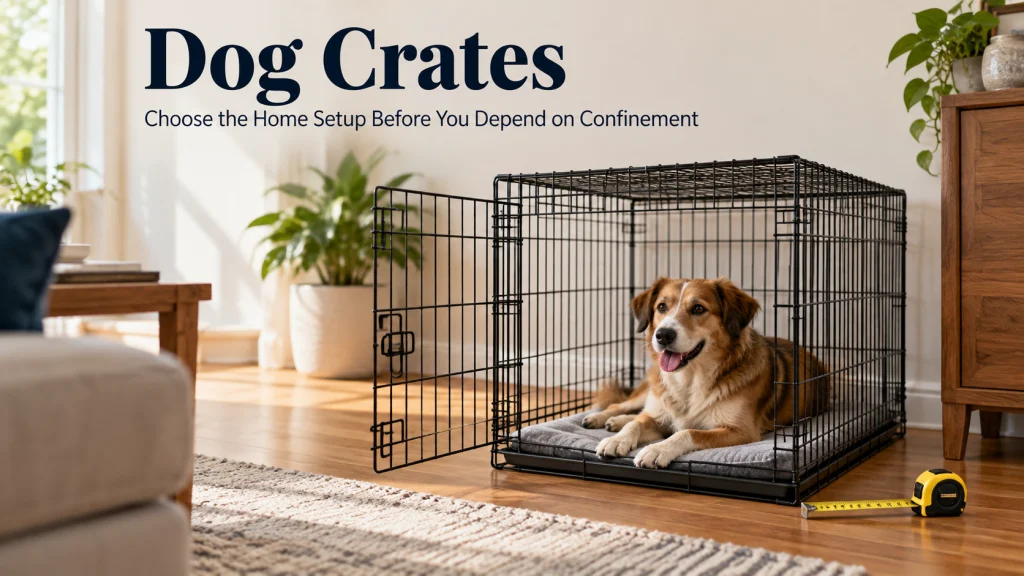
A dog crate is useful only when its job is clear before shopping starts. One home may need a quiet resting place, while another needs brief management when direct supervision is not possible. A growing puppy creates a different fit problem from an adult dog that already settles in confinement. I would define the job, room, body size, and behavior before comparing materials or features.
| Decision step | Check | What to do next |
|---|---|---|
| 1. Define the job | Is the crate for rest, brief management, puppy containment, or another specific home task? | If close containment fits the job, continue. Otherwise compare a pen, gate, or dog safe room. |
| 2. Check the dog | Can the dog settle in close confinement without escalating distress or unsafe escape attempts? | If yes, continue to physical fit. If no, reassess the management plan. |
| 3. Check physical fit | Can the dog enter, stand, turn, lie down, and change position comfortably? | If yes, compare crate families. If no, reject that size. |
| 4. Check the room | Does the crate fit the floor space with workable door swing, airflow, temperature, traffic, and cleaning access? | If yes, continue. If no, change the location, crate format, or containment method. |
| 5. Check construction | Does the material match the dog’s ordinary chewing, pawing, pushing, and the household’s storage and cleaning needs? | Choose the simplest construction that handles the real use. |
| 6. Check the routine | Will the crate be one management tool rather than the default place for large parts of the dog’s day? | If yes, finish the setup. If no, redesign the routine. |
This keeps the crate in the right place within the larger home setup for a dog. A crate can solve a close containment problem, but it does not automatically solve chewing, toileting, separation, or a lack of safe space. If the dog needs more room or becomes distressed behind a closed door, a pen, gate, or dog safe room may fit better. The useful question is whether a crate is the correct tool for the situation at all.
Size the crate from the dog and the job, not from the weight label alone
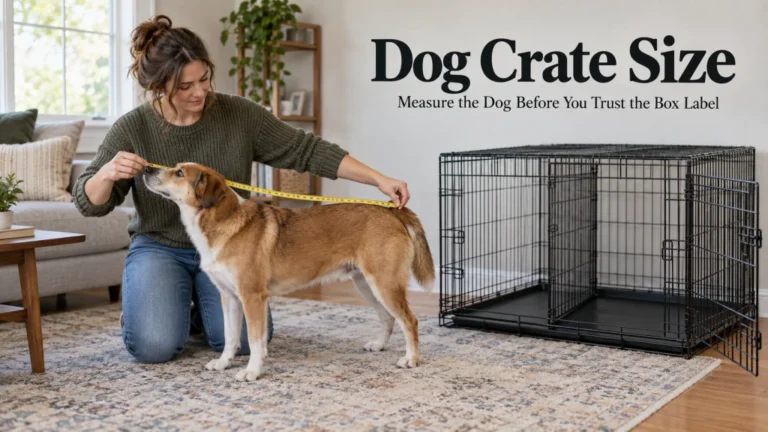
Crate size should begin with the dog’s actual body because dogs at the same weight can differ in height and length. The dog should enter easily, stand naturally, turn around, and lie down in a comfortable position. A weight or breed label can be a starting reference, but it should not replace measuring the individual dog. Bedding also takes up usable interior space, so check fit with the planned setup in mind.
| Worksheet item | Dog measurement or setup | Required usable space | Manufacturer internal dimension | Result |
|---|---|---|---|---|
| Body length | Record nose to base of tail while the dog stands naturally: ______ | Enough internal length for normal standing and lying. | Listed internal length: ______ | Pass or reject: ______ |
| Standing height | Record floor to the highest natural point of the head or ears: ______ | Enough internal height for a normal standing posture. | Listed internal height: ______ | Pass or reject: ______ |
| Turning space | Observe the dog’s normal turn and shoulder width: ______ | Enough usable width for a comfortable full turn. | Listed internal width: ______ | Pass or reject: ______ |
| Door access | Record the dog’s comfortable entry height and width: ______ | A doorway the dog can use without squeezing or twisting. | Listed door opening: ______ | Pass or reject: ______ |
| Interior items | Record planned mat, bed, divider, or other space using item: ______ | Enough room remains for standing, turning, and resting. | Usable space after setup: ______ | Pass or reject: ______ |
| Room footprint | Record the available floor area and door swing space at home: ______ | The crate can sit level, open fully, and remain easy to clean. | Listed exterior dimensions: ______ | Pass or reject: ______ |
A growing puppy may use a larger wire crate with a secure divider rather than changing crates at every growth stage. The divider should create useful space without exposed edges or gaps that invite snagging or chewing. Measure first, then compare those measurements with the manufacturer’s listed internal dimensions. For the full process, use the dedicated dog crate sizing guide.
Compare crate families before comparing brands
Crate families differ in airflow, visibility, storage, cleaning, weight, and resistance to chewing or pushing. Wire crates are open and often fold, plastic crates create more visual enclosure, furniture style crates blend into a room, and reinforced crates use more substantial construction. Soft fabric crates are light but are a poor match for dogs that chew, scratch, or push hard against flexible material. The right family depends on the dog and the home task, not on which material sounds premium.
| Crate family | Useful strength | Main tradeoff |
|---|---|---|
| Wire | Airflow, visibility, folding storage | More exposure and possible bar chewing |
| Plastic | More visual enclosure and rigid walls | Bulkier storage and less open airflow |
| Furniture style | Can integrate into a living space | Fit, cleaning, ventilation, and chewing vary |
| Reinforced | Stronger structure and hardware | More weight, cost, and bulk |
Room layout can eliminate an otherwise good option if the crate blocks a doorway or is hard to clean around. A folding crate may suit limited storage, while a more enclosed shell may suit a dog that settles better with less visual exposure. Extra complexity is useful only when it solves a real constraint. Use the comparison of dog crate types when the remaining decision is which construction family fits the home task.
Compare wire and plastic when those are the two realistic home choices
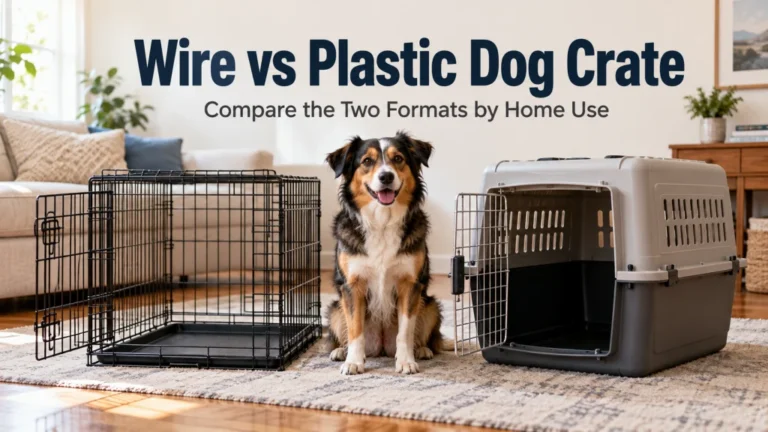
Wire and plastic crates are common home options, but neither is automatically better. Wire usually gives more open airflow and visibility, which can suit a dog that rests calmly while seeing the room. Plastic creates more visual enclosure and has solid surfaces that can make small messes easier to contain. The tradeoff is bulkier storage and less open airflow than a wire design.
The dog’s behavior should break the tie. A dog that paws or mouths wire creates a different problem from a dog that becomes unsettled by seeing every movement in the room. Cleaning matters too because trays, seams, corners, and removable parts change the workload. If the shortlist is down to these two formats, the wire and plastic crate comparison helps resolve the choice from behavior, room conditions, and maintenance.
Choose furniture style crates only after fit, ventilation, cleaning, and durability pass
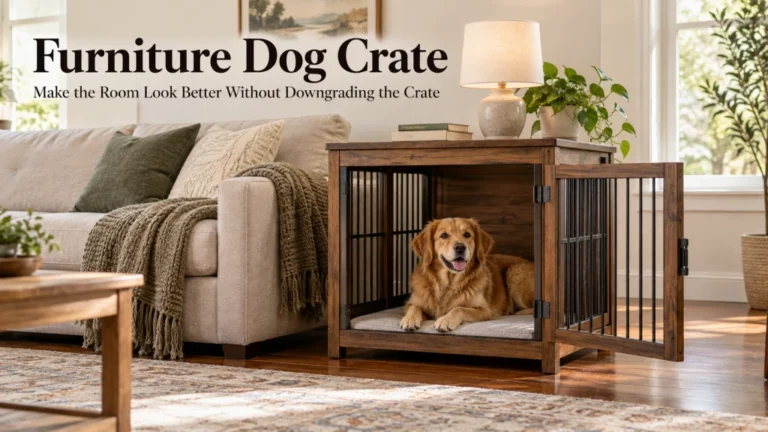
A furniture style crate earns its place only if it works as a crate first. The dog still needs usable interior dimensions, ventilation, safe door geometry, and surfaces that can be cleaned. Decorative panels and table surfaces do not compensate for a cramped doorway or poor interior fit. I would treat appearance as the final filter after the functional checks pass.
Chewing and household use also matter. A dog that gnaws wood or pushes hard at doors may be a poor match for a decorative enclosure, while a calm adult may use the same style without issue. Verify any manufacturer limit for placing objects on top instead of assuming the crate can carry unrestricted furniture loads. Use the furniture style dog crate guide only after the functional checks have passed and appearance is the remaining decision.
Put the crate where the dog can rest without heat, drafts, isolation, or constant traffic
Placement matters even when crate size and construction are correct. A good location lets the dog rest without sitting beside a heat source, in a strong draft, or in a passage where people constantly step around it. The crate should sit level and stable, with enough room for the door to open fully. A location that requires daily dragging or dismantling usually creates more work than expected.
- Keep the crate on a stable, level surface.
- Leave enough clearance for the door and the dog’s entry path.
- Avoid direct heat, strong drafts, and trapped warm air.
- Check whether noise, children, guests, or other pets make the spot too busy.
- Make sure the crate and surrounding floor are easy to clean.
Some dogs rest well near household activity, while others need a quieter location. Compare noise, temperature, foot traffic, supervision, and cleaning access instead of choosing only by convenience. The bedroom, living room, and kitchen can each work under different conditions. For a room by room choice, compare the practical constraints in where to place a dog crate.
Set up the inside around the individual dog’s chewing, toileting, and rest habits
The inside of a crate does not need to be filled with bedding, toys, bowls, and comfort items. Every added item changes usable space and creates a possible chewing, snagging, spilling, or cleaning problem. A calm dog may rest well on a washable mat, while a dog that shreds fabric may need a simpler setup. Keep the interior easy to inspect so wear is noticed early.
Water, food items, chews, and toys require context rather than a universal rule. Age, chewing style, toileting needs, confinement use, and supervision all change the decision. Anything that can break apart, catch on the crate, or reduce comfortable resting space deserves another look. When the crate itself already fits, use the dog crate setup guide to decide which interior items actually belong there.
Cover a crate only when airflow, temperature, and fabric access remain safe
A cover can reduce visual stimulation for some dogs, but it is not required for every dog. The first checks are airflow and room temperature because covering open sides changes the immediate environment. Fabric must also stay out of reach of a dog that pulls material through wire and chews it. A cover that helps one dog settle can make another dog warmer or more interested in grabbing fabric.
Watch the dog’s response instead of assuming a covered crate is automatically better. Leave ventilation open, secure the material, and stop using it if the dog drags, shreds, or swallows fabric. Plastic crates already provide more visual enclosure, so extra covering may solve no real problem. If visual exposure is the remaining issue, use whether to cover a dog crate to check airflow, temperature, and fabric access before adding a cover.
Limit routine confinement by the dog’s needs instead of one universal hourly rule
There is no single crate duration that fits every dog and household. Age, elimination needs, activity, health, routine, and ability to settle all change what is reasonable. The owner must account for bathroom access, movement, social contact, rest, and time outside the crate. Routine confinement should fit around the dog’s day instead of replacing it.
| Audit question | What to reconsider |
|---|---|
| Are bathroom needs being delayed? | Shorter confinement or a different management setup. |
| Is the crate replacing normal movement? | A larger safe area when close confinement is not needed. |
| Is the dog spending much of household life isolated? | More ordinary time near people when appropriate. |
| Is the dog no longer settling? | Whether the crate or the confinement plan is still appropriate. |
Audit what the crate is displacing, not just how long the door stays closed. If crating repeatedly pushes out bathroom breaks, movement, interaction, or access to a larger safe area, change the plan. Restlessness or escalating escape behavior also deserves attention rather than simply extending tolerance. Use how long a dog can stay in a crate when the unresolved question is routine duration rather than crate construction.
Buy heavier construction only when hardware strength is the real problem
A stronger crate can make sense when a calm dog has learned to push a light latch, flex a panel, or damage a weak material. Better joints, doors, bars, or materials may then solve a clear equipment mismatch. The crate still needs correct fit, ventilation, cleaning access, and a workable room location. Extra weight and bulk also affect moving, storage, floor protection, and maintenance.
Stronger construction is not the right response to every escape attempt. Frantic behavior, mouth or paw injury risk, heavy drooling, or escalating distress can point to a problem that hardware strength will not solve. No reinforced crate should be described as escape proof or as treatment for panic. Move to the heavy duty dog crate guide only after weak construction, rather than distress, has been identified as the real constraint.
Use a pen, gate, or larger dog safe zone when a crate is the wrong tool
A crate is only one containment option. An exercise pen gives more room to move, a secured gate can turn a suitable room into a managed area, and a dog safe room can limit access without close confinement. Each alternative still needs checks for stability, climbing, chewing, flooring, and reachable household hazards. More space is useful only when the larger area can actually be managed safely.
| Option | Best fit when |
|---|---|
| Crate | The dog can rest comfortably in close confinement. |
| Exercise pen | The dog needs more movement while remaining contained. |
| Secured gate | A suitable room or hallway can become the managed area. |
| Dog safe room | The dog can handle more freedom but not full home access. |
The alternative should match the reason the crate is failing. More room may solve a simple space problem, but it does not automatically solve distress related to separation or confinement. Watch the dog’s behavior instead of treating square footage as treatment. If the dog needs a different level of freedom, compare the practical options in the dog crate alternatives guide.
Teach crate comfort separately from choosing the crate
Correct size and material do not teach a dog to feel comfortable entering or resting behind a closed door. Selection solves equipment questions such as fit, ventilation, cleaning, and durability. Training solves the learning process around entry, settling, door movement, and separation. Keeping those jobs separate makes troubleshooting clearer.
This article does not reteach the training sequence because that would blur equipment choice with behavior work. Owners who need entry comfort, door comfort, nighttime routines, or alone time progression should use the crate training guide. If training attempts produce escalating distress, forcing more repetitions is not a crate selection strategy. At that point, the dog’s behavior should guide the next step.
Use transport specific guidance when the crate will be used in a vehicle or for travel
A crate that works beside a sofa is not automatically suitable for transportation. Vehicle fit, securement, crash performance, carrier orientation, and transport rules create questions that do not exist in ordinary home placement. Those details depend on the exact crate, vehicle, route, and travel method. Home use guidance should not be stretched into transport claims.
The same boundary applies to regulated travel. Requirements can depend on the carrier, crate, destination, and current rules, so they need transport specific evidence. If travel is driving the purchase, start with the dog travel and transportation guide. That keeps home comfort decisions separate from restraint and compliance questions.
Stop treating equipment as the answer when confinement produces panic or unsafe escape attempts
Repeated escape attempts do not automatically justify stronger hardware. A calm dog may exploit one weak latch, while a distressed dog may bite, paw, vocalize, drool, eliminate, or throw the body against several parts of the crate. Those situations require different responses. First ask whether the dog is calm and persistent or distressed and escalating.
| Observation | Equipment question | Stop and reassess signal |
|---|---|---|
| Latch or panel | Calm manipulation of one weak point | Forceful attacks on multiple points |
| Chewing | Casual damage to a weak material | Biting hard enough to risk injury |
| Vocalizing | Brief sounds followed by settling | Persistent escalation with other distress signs |
When behavior looks distressed or unsafe, stop using equipment strength as the only answer. A larger safe area, a management change, and guidance from a veterinarian or qualified behavior professional may be more appropriate. This distinction does not diagnose a behavior condition. It simply prevents a hardware purchase from being mistaken for a complete solution.
Final Thoughts: a good crate fits the dog, the room, and the amount of confinement being asked
A good home crate starts with a measured dog and a specific household job. It then needs usable space, ventilation, stable placement, practical cleaning, and construction that matches ordinary behavior. Wire, plastic, furniture style, and reinforced crates each make sense under different conditions. There is no reason to pay for extra bulk or strength when a simpler option solves the task.
The final check is the dog’s response to confinement. If the dog settles and the setup does not replace bathroom access, movement, interaction, or larger safe space, the crate is doing a defined job. If the dog needs more room, a pen, gate, or dog safe room may be better. If confinement produces escalating distress or unsafe escape attempts, change the management plan before asking the crate to do more.
Explore the dog crate decisions in more detail
Handle each crate question separately instead of trying to solve size, material, placement, setup, and confinement in one purchase. Start with body fit, then choose the crate family and home location that match the job. After that, work through the interior, covering, confinement, and construction questions that actually apply. This order keeps one problem from being mistaken for another.
| Topic | What you’ll find |
|---|---|
| Choose the right dog crate size | Measure body fit and usable interior space. |
| Compare types of dog crates | Sort crate families by home use. |
| Compare wire and plastic crates | Balance airflow, visibility, enclosure, and cleaning. |
| Evaluate furniture style dog crates | Check function before appearance. |
| Choose where to put a dog crate | Compare rooms by traffic, temperature, and access. |
| Set up the inside of a dog crate | Match the interior to chewing, toileting, and rest. |
| Decide whether to cover a dog crate | Balance privacy with airflow and fabric access. |
| Plan routine crate confinement | Use the dog’s needs instead of one universal number. |
| Decide whether heavier construction is needed | Separate weak hardware from distress. |
| Compare alternatives to a dog crate | Use a pen, gate, or larger safe area when appropriate. |
Use only the topics that match the current setup. A calm dog in a correctly sized crate may never need reinforced construction, while a growing puppy may need repeated fit checks. A small home may make placement and alternatives more important than material. Once the constraint is clear, use the matching topic before changing equipment or adding more confinement.
FAQs
📏 How do I know if my dog’s crate is the right size?
Your dog should enter easily, stand naturally, turn around, and lie down comfortably. Check usable space with any mat or bedding in place, and use the dog’s measurements rather than a weight label alone.
🏠 Is a wire or plastic crate better for home use?
Neither is better for every dog. Wire usually gives more open airflow and visibility, while plastic gives more visual enclosure, so choose from behavior, room conditions, cleaning needs, and storage limits.
🛏️ What should I put inside a dog crate?
Use only items that fit the dog and situation without creating chewing, snagging, spilling, or space problems. A dog that shreds fabric may need a simpler interior than a calm dog that rests on a washable mat.
🌬️ Should I cover my dog’s crate?
A cover can reduce visual stimulation for some dogs, but it is not required. Keep airflow open, watch room temperature, and do not use loose fabric where the dog can pull it through and chew it.
🚪 What can I use instead of a crate?
An exercise pen, secured gate, or dog safe room can provide more freedom while still limiting access. The best choice depends on the dog’s ability to settle, climb, jump, chew, or push barriers.
⚠️ Should I buy a stronger crate if my dog keeps escaping?
Only if the problem is a simple hardware mismatch and the dog is otherwise calm. Frantic escape attempts, injury risk, heavy drooling, or escalating distress are reasons to stop treating crate strength as the whole problem.
References and Sources
- Cornell University College of Veterinary Medicine: Supports crate suitability, fit, type tradeoffs, alternatives, and distress boundaries.
- VCA Animal Hospitals: Supports confinement guidance, placement, alternatives, and distress signals that warrant a change in plan.
- Preventive Vet crate selection guide: Supports individual measurement, intended use, placement, and construction tradeoffs.
- Preventive Vet crate setup guide: Supports cautious interior setup, chewing considerations, covering, and placement checks.