City dog walking works best when the route removes avoidable friction before the owner asks for more control. Crowded sidewalks, building exits, elevators, traffic, litter, unfamiliar surfaces and limited green space can turn an ordinary walk into a chain of tight decisions. A practical city plan chooses easier routes when possible, creates space before close passes, scans the ground, protects decompression opportunities and separates logistics problems from skills that need separate practice.
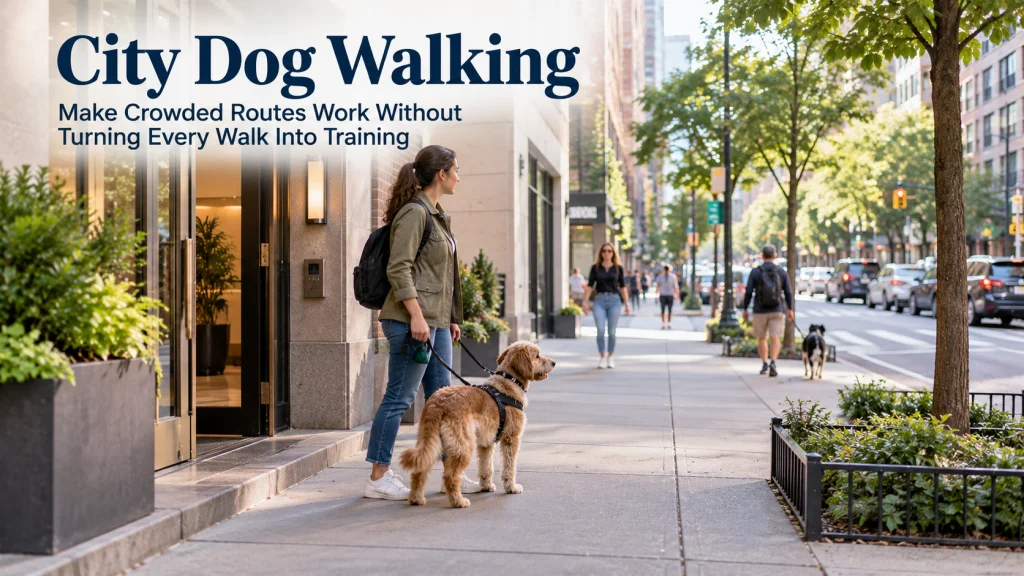
Solve city logistics before adding more cue practice
A city walk can become difficult before the dog has taken ten steps. The elevator opens onto another dog, the lobby door leads straight to a narrow sidewalk, traffic is already moving beside you, and the first patch of grass may be several blocks away. Good city dog walking starts by reducing those predictable pressure points, not by turning every outing into a test of obedience. The broader principles in walking and exercising a dog still apply, but dense streets make route design and timing much more important.
Start with the parts of the walk you can control: which exit you use, which side of the block offers more room, where you can step aside, and where the dog can sniff or toilet without blocking other people. The dog walking tips guide covers the wider everyday walking routine, while this page stays focused on urban logistics. If your dog cannot yet move through basic leash situations, ignore food on the ground, wait at a doorway or recover around distractions, those are skill gaps to practice separately. A route can support training, but it cannot replace training.
Choose quieter periods and lower friction routes when the city gives you that option
The shortest route is not always the easiest route. A direct block with restaurant patios, school traffic, delivery carts and narrow curb space may demand more constant management than a slightly longer street with wider sidewalks and more places to step aside. For routine urban dog walking, compare routes by how many decisions they force into a small amount of space. The better option is usually the one that gives the dog and owner more room to keep moving without repeated close encounters.
Density also changes from one outing to the next, so treat the route as adjustable rather than fixed. If a corner is unusually crowded, construction has removed sidewalk space, or a queue blocks the normal path, rerouting is often more useful than insisting on the original loop. The goal is not to avoid normal city life forever, but to keep everyday walks workable enough that the dog can move, sniff and toilet without being pushed through continuous conflict. Save deliberate exposure practice for a separate session when you can control distance and attention more carefully.
| Route condition | Practical choice |
|---|---|
| Wider sidewalk with several escape points | Usually easier for routine walking because you can create distance without stopping traffic. |
| Narrow sidewalk with frequent doorways and queues | Use only when your dog can pass calmly or when an alternate side of the street is available. |
| Construction, deliveries or temporary crowding | Reroute rather than forcing the planned loop through a compressed space. |
| Small green area off the main flow | Use it as a planned sniff or toilet stop if dogs are allowed there and the space is suitable. |
City route planning checklist:
- Check whether the first building exit or elevator drop puts you directly into a crowd, narrow sidewalk or another common bottleneck.
- Identify at least one place where you can create distance without blocking a doorway, driveway, bike lane or pedestrian flow.
- Scan the route for restaurant frontage, trash collection areas, construction zones, grates and other ground conditions that may need an alternate path.
- Know where the dog can toilet and where a quieter sniff break is realistically available without relying on a large park.
- Keep a shorter or lower density backup route in mind for unexpected crowding or a change in outdoor conditions.
A route does not need to remove every distraction to be useful. It should give you enough room and enough alternate choices that one busy doorway, blocked sidewalk or unsuitable surface does not collapse the entire walk into close handling. If the only workable route repeatedly depends on skills the dog does not yet have, that is the point to separate route management from training practice.
Plan building exits and elevator rides before the dog reaches the sidewalk
Apartment and condo walks often fail at the transition point rather than on the street itself. A closed elevator gives you no information about who is waiting on the other side, and a lobby door may open directly into foot traffic, scooters or another dog. Before moving through a tight doorway, pause long enough to check the space you are about to enter and keep the leash organized so it cannot wrap around legs or door hardware. That small pause gives you a chance to choose another elevator, another exit or a brief delay if the space is already crowded.
Elevators deserve the same planning because the floor moves, the doorway is narrow and passengers can appear with very little room to separate. Stand where you can keep your dog beside you without blocking the controls or trapping the dog against another passenger, then let people exit before you enter when possible. If the car is too crowded for the dog to have reasonable space, skip it and use the next practical option rather than squeezing in. A dog that is frightened by elevators, doors or moving floors needs separate skill building, not repeated forced exposure during a necessary walk.
- Check the hallway or lobby before opening the final door.
- Keep the leash clear of door gaps, feet and elevator thresholds.
- Let exiting passengers clear the doorway before entering.
- Use another elevator or exit when the available space is too tight.
Give other people and dogs room on narrow sidewalks whenever possible
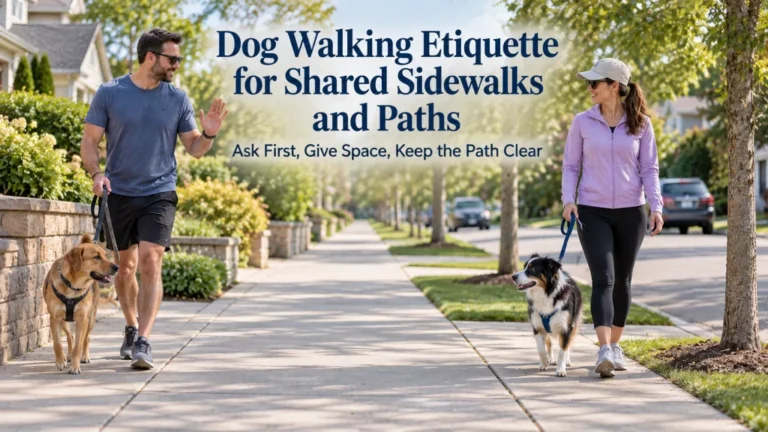
City sidewalks make optional greetings feel unavoidable, but they do not have to become social encounters. When another person or dog is approaching, decide early whether you can pass with comfortable space, cross the street, step into a legal open area or briefly change direction. Waiting until both dogs are nose to nose leaves fewer choices and makes leash handling harder. Creating room is ordinary shared space management, not an admission that either dog is unfriendly.
Keep the dog on the side that gives the most separation from the approaching traffic of people, bikes or dogs, and avoid letting the leash stretch across the walking path. Do not assume another owner wants a greeting simply because their dog looks friendly. The broader dog walking etiquette guide covers greetings, shared space and courtesy in more detail. If your dog is barking, lunging, freezing or unable to recover around normal encounters, route management can create distance, but the underlying behavior problem belongs outside this logistics article.
Watch for sidewalk food, trash, broken glass and other urban ground hazards
Urban sidewalks ask the owner to scan several feet ahead instead of looking only at the dog. Dropped food, food containers, broken glass, sharp metal, spilled liquids, construction debris and overflowing trash can appear with little warning. Move around a hazard before the dog reaches it rather than waiting until the leash is tight and the item is already under the nose. This is especially useful near restaurant fronts, curbside trash, loading areas and places where crowds make the ground harder to see.
Do not treat every unknown substance as harmless just because other people are walking past it. If the safe path narrows, slow down, create a shorter line of travel and choose a cleaner side of the sidewalk or another block when that is practical. A practiced food refusal or leave it cue can be valuable, but this page does not teach that cue because the training mechanics belong elsewhere. The city walking job is to notice the hazard early enough that you do not have to test the cue against every tempting or dangerous object on the street.
- Scan curb edges and the area around trash bags before the dog reaches them.
- Give discarded food and unknown liquids a wider path.
- Look for glass, wire, sharp fragments and unstable debris near construction areas.
- Reroute when crowding prevents you from seeing the ground clearly.
Help the dog navigate grates, slippery surfaces and moving floors without forcing forward movement
Metal grates, wet pavement, polished lobby floors and elevator thresholds can feel very different under a dog’s feet. Some dogs cross them without hesitation, while others slow down, stop or try to move around them. When an alternate path exists, using it during a routine walk is often the simplest choice. Forcing a worried dog across a surface can turn a small logistics problem into a larger confidence problem.
If the surface is unavoidable, give the dog enough room to look, choose footing and move at a pace that does not require dragging or pushing. Sudden reluctance in a dog that previously handled ordinary surfaces comfortably is different from a dog that has always been cautious, so do not assume every hesitation is merely stubbornness. The AKC guidance used for this article notes that unfamiliar or moving surfaces can be challenging and that a new change in surface comfort can also justify veterinary discussion. This article stays at the owner level by focusing on route choice and by handing deliberate surface training back to a separate training context.
Use small green spaces for sniffing and decompression when larger areas are not nearby
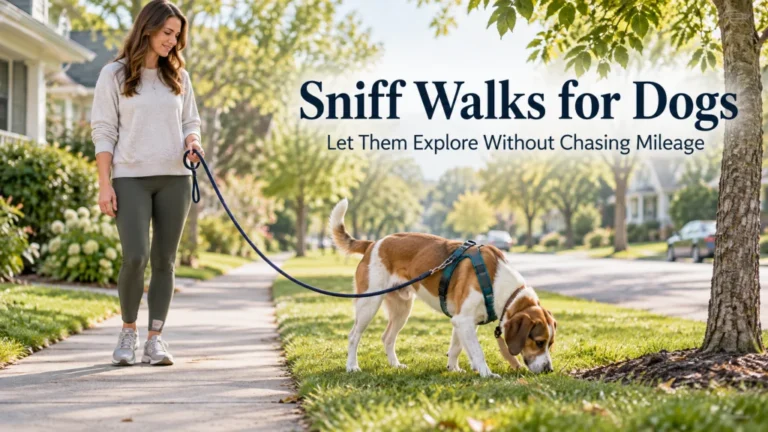
A city dog does not need a large park on every walk to get useful sniffing time. A permitted strip of grass, a quiet planting edge with enough room to stay out of foot traffic, or a small neighborhood green can create a pause between louder sections of the route. The practical question is whether the space lets the dog investigate without blocking a doorway, crowding another dog or trespassing on private landscaping. When the answer is yes, even a modest stop can make the route feel less like one continuous sidewalk transit task.
Use these spots intentionally rather than treating them as a race to cover distance. Let the dog investigate at a manageable pace, then move on before the area becomes crowded or the leash begins tangling around people and objects. The sniff walks for dogs guide explains how sniff focused outings work when sniffing is the main purpose. In dense neighborhoods, the useful compromise may be a regular walk with several protected sniff stops rather than waiting for access to a large open area.
Carry only the city walk items the route actually needs
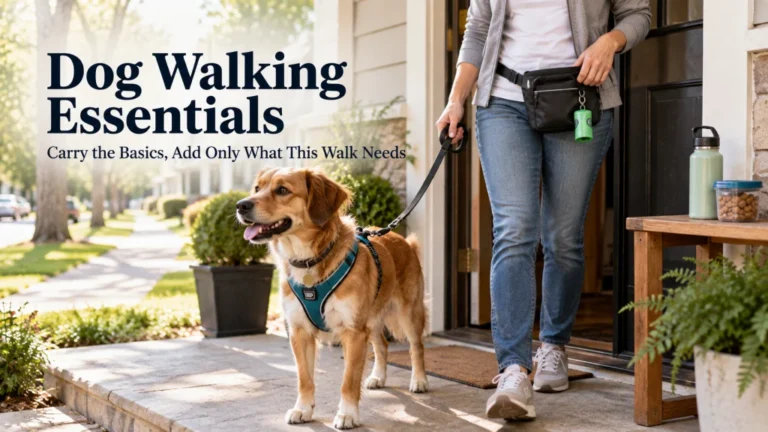
Extra gear does not automatically make a crowded walk easier. The useful load is the set of items that solves the route you are actually taking, such as waste bags, water when conditions and distance call for it, and whatever simple reward or cleanup item your routine already uses. Bulky equipment that needs constant adjustment can become another problem when you are opening doors, sharing an elevator or keeping the leash clear of pedestrians. The goal is a small, repeatable setup that leaves your hands available for the dog and the environment.
Match the carry list to the outing rather than packing for every possible scenario. A short neighborhood toilet walk may need very little, while a longer route with limited water access or fewer disposal points may justify more. The dog walking essentials guide covers the wider decision about what belongs in a walking kit. For city routes, judge each item by whether it solves a recurring need without adding enough bulk, tangles or handling work to make tight spaces harder.
- Carry enough waste bags for the planned outing plus a small backup.
- Keep frequently used items where they can be reached without dropping the leash.
- Avoid dangling accessories that can catch on doors, railings or other gear.
- Leave optional items at home when they do not solve a real need on that route.
| Route condition | Functional requirement | Carry decision |
|---|---|---|
| Short toilet loop with easy disposal access | Fast cleanup with minimal handling | Keep the load small and carry only the cleanup basics the route reliably requires. |
| Longer walk with limited water access | Access to water without relying on an uncertain stop | Bring water when the dog’s needs and conditions make it necessary, while keeping the setup easy to carry. |
| Route with repeated doors, elevators or tight pedestrian flow | Hands stay available and gear does not snag | Skip bulky or dangling extras that make leash and doorway handling harder. |
| Known messy stretch or unreliable disposal points | Enough cleanup capacity to finish the route | Carry the extra cleanup supply that solves that recurring route problem, not a general pile of backup gear. |
This framework keeps the buying decision tied to a function instead of to a feature list. If an item does not solve a repeated route need, improve access or reduce handling friction, it probably does not need to come on that walk.
Identify skills to practice separately before crowded walks
Route planning has a clear limit. If the dog cannot move with you on a basic leash, wait long enough for a doorway to clear, disengage from sidewalk food, or remain functional around ordinary city distractions, the walk may be exposing a training gap rather than a routing problem. Repeating the hardest route does not automatically teach those skills. It can simply make every necessary bathroom or exercise outing harder to manage.
Separate the skill from the commute whenever possible, then practice where the dog has enough room to succeed. The leash training a dog guide is the better place for leash mechanics and cue practice because that work belongs to training, not city route design. This article also does not teach treatment for leash reactivity, severe fear or aggression. When the problem is behavioral rather than logistical, choose a safer route for necessary walks while you address the actual skill or behavior need through the appropriate training or professional support.
Adjust the route when heat, darkness or air quality changes the safety decision
A familiar city loop can stop being the right loop when environmental conditions change. Sun exposure can remove shade from a route, darkness can make ground hazards harder to see, and poor air quality can change whether a longer exercise walk is sensible at all. Treat those conditions as reasons to reconsider distance, surface, visibility and exposure rather than as a challenge to complete the usual route. City convenience should not override a changing safety constraint.
Use the dog walking safety guide when the main question becomes heat, pavement conditions, darkness, visibility or air quality rather than urban navigation. That separation keeps this page from turning into a general outdoor safety manual. The city logistics takeaway is simple: build more than one workable route so you have a shorter, shadier, better lit or otherwise lower exposure option when conditions demand it. If none of the available routes is appropriate, change the outing rather than forcing the normal plan.
Final Thoughts: Reduce city friction before asking for more control
A workable city walk is often the result of small decisions made before a problem is directly in front of the dog. Choose routes with room, check building exits, create distance early, scan the ground and keep useful sniff or toilet stops in the plan. Those choices reduce how often the dog has to solve several difficult things at once. They also give you more options when the sidewalk or building becomes unexpectedly busy.
Then be clear about the boundary between logistics and training. Rerouting can avoid an unnecessary squeeze, but it cannot teach loose leash walking, surface confidence or reliable responses around distractions. Use management to make necessary walks safer and more workable, then practice missing skills separately where the dog has a fair chance to succeed. The best city routine is the one that lowers avoidable friction without pretending that route choice can solve every training need.
FAQs
🏙️ How can I make city walks less stressful for my dog?
Start by lowering route friction: choose wider sidewalks, create distance early, avoid unnecessary crowd bottlenecks and plan reliable sniff or toilet stops. If your dog still cannot function around ordinary city triggers, treat that as a separate skill or behavior issue rather than trying to solve it only by changing the route.
🛗 What should I do if another dog is waiting when the elevator opens?
Keep enough distance to avoid crowding the doorway and let the other dog and handler clear the area before you enter. If the space stays too tight, use another practical option instead of forcing both dogs into a close pass.
🚶 Should my dog greet other dogs on city sidewalks?
No greeting is required just because two dogs meet on the same sidewalk. Create room, ask before allowing contact and keep moving when either owner does not want the interaction.
🧱 What if my dog refuses to walk over a metal grate?
Use an alternate path when one is available and do not drag the dog across. If surface hesitation is new in a dog that previously moved comfortably on ordinary surfaces, discuss the change with your veterinarian rather than assuming it is only a training issue.
🌳 Can a small city green space be enough for a useful walk break?
Yes, when dogs are allowed there and the space gives the dog room to sniff without blocking people or crowding another dog. Several short, calm sniff opportunities can be more practical than treating the whole outing as continuous sidewalk travel.
🎒 What should I carry on a city dog walk?
Carry the items your route reliably requires, including waste bags and any water, reward or cleanup item that fits the conditions. Keep the setup simple enough that you can still manage doors, elevators and the leash without juggling unnecessary gear.
References and Sources
- AKC city life guidance: Supports the city context around crowded sidewalks, elevators, traffic, sidewalk food and common urban distractions.
- AKC different surfaces guidance: Supports the discussion of grates, slippery surfaces, moving floors and the boundary around a new change in surface comfort.
- AKC shared space etiquette: Supports giving people and dogs room, managing sidewalk passes and avoiding unwanted greetings.