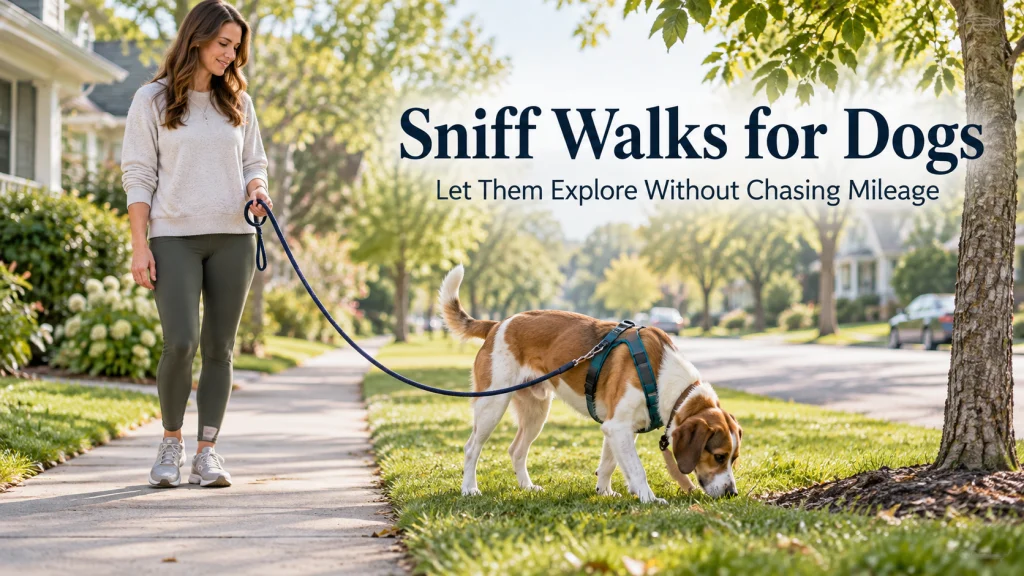
A sniff walk is a walk built around scent exploration rather than distance, pace, or reaching a destination. The dog gets more time to investigate safe smells and make limited choices, while the owner still controls access to traffic, trash, wildlife, private property, and other hazards. A slow scent focused outing can add useful enrichment, but it should not automatically replace whatever physical movement an individual dog needs. The practical goal is to give the dog room to gather information without giving up ordinary leash safety or good judgment.
Stop scoring a sniff walk by distance
Sniff walks for dogs make more sense when distance stops being the scorecard. A dog may cover a short stretch of sidewalk, pause at a hedge, double back to a tree, and spend much of the outing investigating instead of moving steadily forward. That can be frustrating if the owner expected a brisk walk, but it is not a failed outing when the purpose is scent exploration. The better question is whether the dog is exploring in a controlled setting while the owner stays attentive enough to manage what happens next.
I would treat this as one walking format inside a broader routine, not as the new rule for every trip outside. The general framework in practical dog walking tips still matters because location, leash handling, household schedule, and the dog’s behavior change what a useful walk looks like. The same is true for walking and exercising a dog, where enrichment and physical activity have related but separate jobs. Once the purpose is clear, it becomes much easier to decide when slowing down for scent is useful and when the walk needs a different focus.
Define the walk by purpose rather than speed
A scent focused walk is different from a brisk exercise walk because the dog is given more time to investigate smells instead of being asked to maintain steady forward movement. That does not mean the dog controls every part of the outing or that normal leash rules disappear. It means the owner deliberately allows pauses, changes of pace, and some choice when the environment makes those choices reasonable. PetMD and the American Kennel Club both describe this kind of walk as exploration led more by scent than by mileage or destination.
The distinction matters because the same route can support different jobs on different outings. A short bathroom trip before work may need to stay efficient, while another walk can leave room for longer investigation around grass, trees, posts, and other safe scent sources. A more physically active walk may emphasize continuous movement, while a scent focused walk accepts that stopping is part of the task. I would decide the job before leaving home so the owner is not constantly fighting the dog for a pace that does not match the purpose.
| Walk focus | What the dog is mainly doing | What the owner watches |
|---|---|---|
| Scent focused walk | Pausing, investigating, changing pace, and gathering scent information | Safe access, leash connection, body language, and environmental hazards |
| Exercise focused walk | Maintaining more continuous physical movement | Effort, footing, weather, route demands, and the dog’s condition |
| Routine bathroom trip | Going outside for a practical household need | Efficiency, safe elimination area, and return to the household routine |
The table is not a rule that every outing must fit one box perfectly. A walk can include both movement and sniffing, and many ordinary walks naturally shift between the two. The useful distinction is simply that stopping to investigate is not wasted time when exploration is one of the planned jobs. That framing prevents the owner from pulling the dog away from every smell just because the distance number is low.
Choose a location where exploration is actually manageable
The easiest place for a sniff walk is usually an area where the owner can allow pauses without constantly steering the dog away from danger or conflict. A narrow sidewalk beside fast traffic, a crowded event, or a path full of food scraps gives the dog many things to investigate but gives the owner very little room to say yes safely. A quieter residential route, broad path, or other lawful area with good visibility can make exploration easier to manage. The goal is not maximum novelty, but enough environmental room for the dog to investigate without every choice becoming a correction.
Dog size, leash behavior, local rules, wildlife, and the owner’s ability to control access all matter when choosing that setting. A longer leash can create more room in an open low traffic area, but extra length also increases the amount of line the owner must manage and the distance the dog can cover before reaching something unsafe. A standard leash may be the better choice where space is tight or traffic is close. Whatever equipment is used, exploration should stay inside a range the owner can supervise rather than becoming uncontrolled roaming.
Key point: Choice works best inside a safe boundary. The dog can choose which side of a broad path to investigate or how long to examine a safe patch of grass, while the owner can still block access to roads, discarded food, unknown animals, private yards, or anything else that should remain off limits.
That boundary also keeps a scent walk from drifting into off leash advice. This article does not teach recall, long line handling skills, or formal leash training, and it does not assume off leash access is safe or legal. If the dog cannot be given additional range without pulling, tangling, or reaching hazards, keep the setup simpler. More freedom is useful only when the owner can still manage it calmly and consistently.
Run your first sniff walk in five decisions
For a first attempt, keep the sequence simple enough to remember while you are handling the leash and watching the surroundings. Start with an easy route, choose a leash range you can control, allow safe smells to take longer, veto hazards without turning every pause into a correction, and reduce difficulty if the dog’s body language becomes tense. Those five decisions cover most of the practical setup without requiring special equipment or a complicated routine. Once that sequence feels ordinary, you can give the dog more choice where the environment supports it.
- Choose an easy route: favor a place with room to pause and fewer situations that require constant interruption.
- Set a manageable leash range: give only as much range as you can supervise without tangles, pulling, or unsafe access.
- Let safe scents take longer: allow the dog to investigate instead of immediately asking for forward movement.
- Veto hazards calmly: block roads, trash, wildlife, private property, and other unsafe targets, then continue the walk.
- Read the whole dog: if exploration shifts into repeated freezing, frantic scanning, or urgent pulling, make the environment easier rather than adding more freedom.
This sequence is not a training protocol or a fixed recipe for every dog. Its job is to turn the article’s main decisions into one practical first outing while leaving room for dog size, leash behavior, neighborhood layout, and household routine. If one step keeps failing, simplify that step before changing the whole walk. A useful sniff walk should become easier to manage with repetition, not more complicated.
Let safe smells take longer than an ordinary walking pause
On a scent focused outing, the owner can allow the dog to stay with a safe smell longer than they might during a brisk walk. Some dogs sample many spots quickly, while others spend more time on one patch before moving on. Neither style needs to be forced into a fixed number of seconds or a fixed number of stops. The useful owner skill is recognizing when the dog is productively investigating and when the environment is giving a reason to move away.
Stay close enough mentally to notice what the nose is leading toward. A dog investigating a tree trunk is a different situation from a dog trying to reach discarded food, animal waste, broken glass, or something hidden under a parked vehicle. The owner does not need to interrupt every pause, but should be ready to redirect access when the object or location is not safe. That balance allows sniffing without pretending every scent source deserves unrestricted access.
- Allow longer pauses when the area is safe and the dog remains connected to the walk.
- Move on when the scent source is unsafe, inaccessible, or likely to create conflict.
- Keep watching the surroundings instead of using sniffing time as a reason to check out mentally.
- Do not turn every stop into a contest over pace when exploration is the planned purpose.
Patience is especially useful for owners who are used to judging a walk by continuous motion. The dog does not need to be hurried simply because another person could have crossed the same block faster. At the same time, the owner still decides which opportunities are available. A sniff walk is dog led within boundaries, not owner absence from the decision.
Give route and pace choice only inside practical safety limits
Dog choice can be as simple as allowing a pause at one of two grass patches, following a safe curve in the path, or letting the dog decide when an investigated spot is finished. Those small choices are easier to support than giving the dog unrestricted control over direction. The owner can close off any option that creates a traffic, access, conflict, or footing problem without turning the whole outing back into a fixed march. The useful question is not whether the dog has total control, but whether meaningful choices still fit inside the route the owner can manage.
This is also where a clear leash connection matters. If a dog repeatedly reaches the end of the leash at speed, the problem is no longer just whether sniffing should be allowed, because line handling and leash behavior are now affecting safety and comfort. This article does not teach those skills, so the sensible boundary is to reduce freedom until the setup is manageable. A sniff walk should feel slower and more exploratory, not like the owner is being dragged from one scent source to another.
| Dog choice can include | Owner still decides |
|---|---|
| Which safe patch to investigate | Whether the area is safe to enter |
| How long to stay with an ordinary safe scent | When a hazard or conflict requires moving on |
| Whether to move slowly or pause | How much leash range is manageable |
| Which safe direction to take at an optional turn | Road crossings, access rules, and route boundaries |
The useful middle ground is not difficult to recognize once the owner stops treating freedom as all or nothing. The dog can have meaningful choices without choosing every destination, every interaction, or every object to investigate. That makes the outing more workable in ordinary neighborhoods where the environment is shared with people, animals, vehicles, and property boundaries. Safe choice is still choice.
Use familiar routes without assuming the scent picture is identical
A familiar route is not necessarily a boring route from the dog’s perspective. People, dogs, wildlife, weather, landscaping, deliveries, and ordinary neighborhood activity can change what scent information is present even when the sidewalk looks exactly the same to the owner. That makes a repeated route a practical option when it is safe and easy to manage. The owner does not need to chase constant novelty just to make scent exploration worthwhile.
Familiarity can also reduce the setup burden for the household. The owner already knows where traffic is difficult, where trash tends to collect, which corners have poor visibility, and where there is enough room to pause. That knowledge can make it easier to decide where the dog gets more choice and where the walk needs tighter management. A new route can be interesting, but novelty should not be treated as a requirement for a useful sniff focused outing.
Myth check: Repeating the same route does not mean the dog encounters exactly the same scent environment. A familiar physical path can still contain changing information, so route repetition can remain useful when the location is safe and the dog stays engaged.
I would change routes when there is a practical reason, such as avoiding congestion, adding a different walking surface, reducing repeated conflict, or simply giving the household more variety. I would not change them only because the map looks familiar to a person. The dog’s experience of the route includes information people cannot see. That is one reason a short familiar loop can still work well as a scent focused walk.
Separate relaxed investigation from tense or frantic scanning
Not every nose down moment means the dog is calmly enjoying the outing. The owner should look at the whole body rather than using sniffing by itself as proof of relaxation. A dog that pauses, investigates, moves on, and shows generally loose movement presents a different picture from a dog that scans repeatedly, startles, freezes, pulls urgently, or seems unable to disengage from the environment. Those observations can guide an owner to simplify the setting without trying to diagnose why the behavior is happening.
The American Kennel Club specifically distinguishes relaxed investigative sniffing from more frantic sniffing associated with nervous energy, and it recommends paying attention to body language. That supports a practical owner level rule: if the dog looks increasingly tense or overwhelmed, do not assume that adding more freedom or more novelty will improve the walk. Create more distance from the difficult area, shorten the exposure, or choose an easier environment next time. Persistent fear, reactivity, or major behavior change belongs outside the scope of a basic sniff walk article.
| What you observe | Practical reading | Owner response |
|---|---|---|
| Loose movement, voluntary pauses, then easy movement onward | Consistent with ordinary investigation | Allow the safe exploration to continue |
| Frequent scanning, repeated freezing, urgent pulling, or difficulty disengaging | The environment may be too difficult for a relaxed exploration session | Reduce pressure, add distance, or choose an easier setting |
| Sudden behavior change from the dog’s normal pattern | Do not assume sniffing explains the change | Observe the broader context and seek appropriate professional guidance when needed |
This observation card is deliberately descriptive rather than diagnostic. Owners can notice posture, movement, scanning, pulling, and recovery without labeling the dog with a medical or behavior condition. The point is to choose an environment the dog can handle, not to turn a walking article into behavior treatment. If the outing repeatedly looks tense rather than exploratory, the next decision is to reduce difficulty rather than demand more sniffing.
Keep physical exercise as a separate daily decision
A sniff focused walk can be mentally engaging, but that does not create a universal conversion between sniffing time and physical exercise. The plan for movement still depends on the individual dog’s age, body type, activity level, health, environment, and ordinary routine. That is why a slow exploration session should not automatically be counted as the dog’s complete exercise need. The owner should judge physical activity separately instead of using a tired looking dog as proof that every movement need has been met.
If the household is trying to decide how much active movement belongs in the routine, use the broader guidance on how much exercise a dog needs rather than forcing a mileage equivalent onto scent work. One dog may benefit from a slow sniff walk plus another form of movement, while another may have different limits or needs. There is no responsible fixed rule saying a certain amount of sniffing equals a certain amount of brisk walking. Keep enrichment valuable by letting it do its own job.
The research often cited around olfactory activity needs the same restraint. One experimental study comparing nosework with heelwork found a more positive judgment bias after the nosework program, but the task was structured nosework rather than ordinary neighborhood sniff walks. It was also a specific experiment, not evidence that every scent walk treats anxiety, reactivity, or any other condition. I would use that finding as support for the value of olfactory activity and choice, not as a promise about emotional outcomes.
That evidence boundary is useful because it prevents a good idea from becoming an exaggerated claim. Owners do not need to believe that sniffing is a cure in order to give dogs more opportunities to use their noses. A scent focused walk can simply be one form of enrichment that fits alongside physical movement, training, rest, and other parts of daily care. That is a strong enough reason to use it when the setting and dog make it practical.
Add simple scent activities at home when a walk is not the whole answer
Outdoor sniffing is only one way to give a dog opportunities to search and investigate. At home, the owner can use simple scent based activities that match the dog’s size, food routine, supervision needs, and ability to use the activity safely. The purpose is broader enrichment, not a substitute for every walk or every form of exercise. Keeping that distinction clear makes it easier to choose activities because they fit the household rather than because they are marketed as a complete solution.
Food based search games, appropriate puzzle activities, or other simple supervised scent tasks can be useful when weather, schedule, or the environment limits outdoor exploration. The broader guide to keeping a dog mentally stimulated can help place scent activities beside other enrichment formats instead of treating smell as the only channel that matters. Start with a task the dog can understand and supervise it closely enough to prevent chewing, swallowing, guarding, or frustration from turning the activity into a different problem. More complicated equipment is not automatically better than a simple activity the dog can use successfully.
- Use scent activities as one part of enrichment, not as a replacement for every other need.
- Match the setup to the dog’s size, behavior, food routine, and supervision requirements.
- Make the first version easy enough for the dog to understand what action leads to success.
- Stop or simplify the activity if the dog becomes frustrated, destructive, or unsafe with the materials.
I would prioritize repeatable activities the household can actually supervise and maintain. A simple search that works in the living room can be more useful than specialized gear that is difficult to set up, clean, store, or use consistently. The dog still gets an opportunity to investigate with the nose, while the owner keeps control over what is hidden and where. That is the same basic principle that makes a good sniff walk work outdoors.
Final Thoughts: Let exploration matter without making it the only goal
A good sniff walk gives the dog time to investigate without asking the owner to surrender ordinary safety decisions. Choose a manageable setting, allow longer pauses at safe scent sources, offer route or pace choices where they are practical, and keep watching the whole dog rather than only the nose. Familiar routes can still be useful, and a slow outing does not need to cover impressive distance to have a clear purpose. The walk succeeds when exploration is possible and the setup remains controlled.
The important limit is just as practical: sniffing does not erase the separate question of physical exercise, and it should not be promoted as treatment for fear, anxiety, reactivity, or other behavior concerns. Use scent exploration because it gives the dog another way to interact with the environment and make reasonable choices. Then judge movement, training, and broader enrichment on their own terms. That keeps the idea useful without asking it to do more than the evidence supports.
FAQs
🐕 What is a sniff walk for dogs?
It is a walk where scent exploration is one of the main purposes, so the dog gets more time to pause and investigate safe smells. The owner still manages the leash, route, hazards, and access to other people, animals, property, and unsafe objects.
👃 Should I let my dog sniff everything on a walk?
No. Give the dog time with safe scent sources, but block access to trash, animal waste, traffic, unknown objects, private property, or anything else that creates a safety or conflict concern. Exploration stays inside owner managed boundaries.
🌳 Can I use the same route for sniff walks?
Yes. A familiar route can still contain changing scent information from people, animals, weather, and ordinary neighborhood activity. Repetition can also make the environment easier for the owner to manage because known hazards and tight spots are easier to anticipate.
🏃 Does a sniff walk replace physical exercise?
Do not assume that it does. A scent focused walk can provide useful enrichment, but physical activity needs still vary with the individual dog’s age, body type, activity level, health, and routine. Make the exercise decision separately.
🧭 Should my dog choose the route on a sniff walk?
The dog can make limited route and pace choices when those options are safe and manageable. The owner should still control road crossings, property boundaries, unsafe areas, wildlife access, interactions, and any direction that would create a problem.
🐾 How can I tell whether my dog is calmly exploring?
Look at the whole body rather than sniffing alone. Loose movement, voluntary pauses, and easy movement onward are different from repeated freezing, frantic scanning, urgent pulling, or difficulty disengaging. If the outing looks increasingly tense, reduce the difficulty instead of adding more stimulation.
References and Sources
- PetMD scent walk guidance: Supports the distinction between scent focused exploration and walks centered on distance, exercise, or a destination.
- American Kennel Club sniff walk guidance: Supports practical use of safe exploration, dog choice, and whole body observation during scent focused walks.
- Applied Animal Behaviour Science nosework study: Supports the narrow finding that structured nosework was associated with a more positive judgment bias than the comparison activity in that experiment.