Group dog walks can give a dog company, movement and practice staying near other dogs without turning the outing into free play. The useful question is whether the group leaves enough room for each dog to move, recover from excitement and stay connected to its own handler. A good fit depends on the dog’s comfort around other dogs, the group’s spacing, the route, the pace and how optional greetings really are. If the dog becomes increasingly tense, fixated or unable to settle, leaving the group is a better choice than forcing participation.
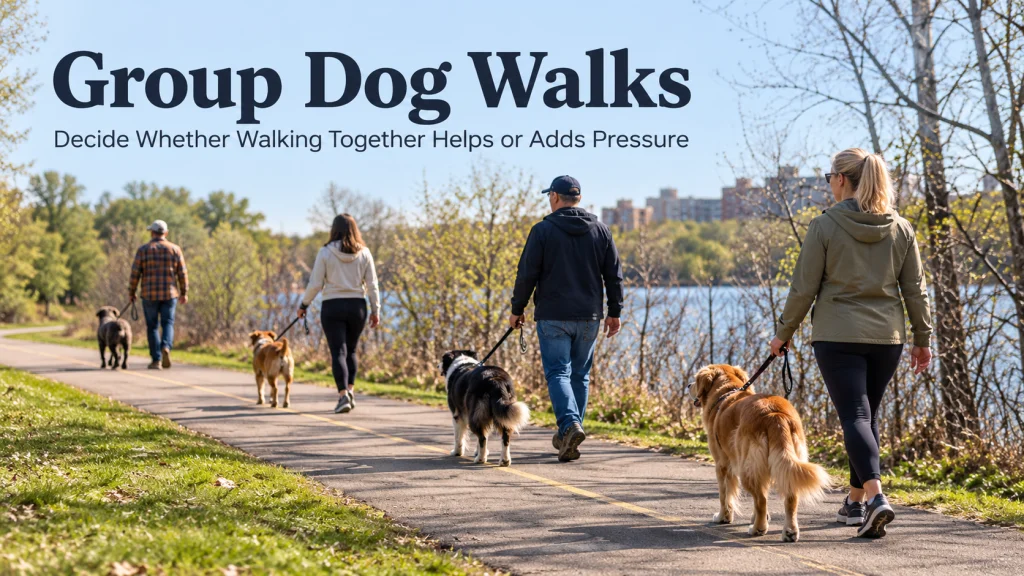
Separate a group walk from one handler walking several household dogs
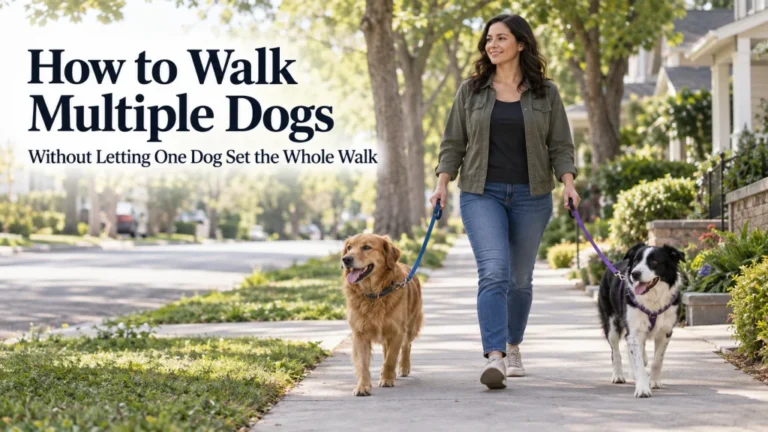
An owner attended group walk usually gives each handler direct responsibility for one dog, so each team can change position, slow down or leave with relatively little disruption. In contrast, walking multiple dogs with one handler concentrates leash management, attention and response decisions in one person’s hands. The dogs may know one another well, but the handler has less freedom when two dogs pull in different directions or react to the same distraction. Those are different control problems, even when both situations look like several dogs moving down the same path.
This difference matters because a group walk can use distance as a pressure release valve. One handler can move a dog farther to the side, fall behind or take a different turn without having to reorganize several leashes at once. In a multi dog household walk, the handler must also consider whether the dogs have compatible pace, positions and leash skills under one set of hands. Do not use advice for one format as proof that the other format will be easy.
| Walking format | Main handling question | Useful pressure release |
|---|---|---|
| One dog per handler in a group | Can each team keep enough space and a workable pace? | Change position, widen the gap or leave the group |
| Several dogs with one handler | Can one person safely manage all leashes and competing responses? | Reduce the number of dogs or simplify the route |
The practical test is therefore not whether the dogs can all walk in the same general area. It is whether the person holding each leash has enough control and space to respond when conditions change. A calm group with several handlers may be easier for one dog than a crowded walk with familiar household dogs under one handler. Keep the format distinction clear before deciding whether group participation itself is suitable.
Choose a group with enough space and predictable handling
Space is useful because it gives a dog options before discomfort becomes a confrontation. A workable group should let handlers spread out, avoid bunching at narrow points and keep moving without forcing dogs into one another’s path. Predictable handling matters too, because sudden leash crossings, repeated rushing forward and constant stops can turn a simple walk into a series of social bottlenecks. I would favor a group whose organizer explains the route and basic expectations clearly enough that handlers can anticipate what happens next.
You do not need every dog to hold the same exact position, but you do need room for different comfort levels. One dog may walk well near the front while another settles better several teams behind, and neither position is inherently superior. Watch whether your dog can look around, sniff, move with a loose body and return attention to you instead of tracking another dog continuously. If increasing distance improves the dog’s ability to walk normally, treat that as useful information rather than a failure to socialize.
- Choose wider paths when the group is large or unfamiliar.
- Avoid formations that repeatedly squeeze dogs together at gates, corners or trail pinch points.
- Keep enough leash control to prevent accidental approaches to another dog’s face or rear.
- Give slower or less comfortable teams room to drop back without being chased by the group.
Before joining, ask how the group handles greetings, how wide or crowded the route usually is, whether the pace can flex for slower teams, how many dog and handler pairs usually attend and whether leaving early is considered normal. Those answers reveal more than a label such as pack walk or social walk. A group that can explain its expectations clearly is easier to evaluate before putting your dog into the middle of it. Use those details to decide whether the format gives your dog enough room to participate without being pushed into contact.
Good organization should make the walk less demanding, not simply more regimented. The goal is a route where each dog can participate without losing every chance to create space. If the group treats close formation as a rule, ask whether that actually suits your dog before joining. Spacing becomes even more important when greetings are part of the group’s culture.
Keep greetings optional instead of making every dog meet
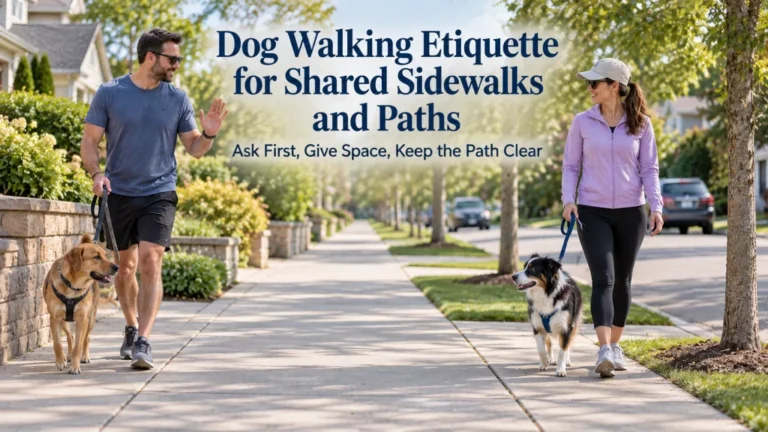
A dog does not need to greet every dog on the route to take part in a social outing. That same principle belongs in ordinary dog walking etiquette: handlers should not assume that another dog wants direct contact simply because both dogs are on a walk. In a group, the pressure can be stronger because repeated greetings may feel like part of the event. A better default is to let dogs walk near one another first and only allow closer interaction when both handlers and both dogs appear comfortable.
Direct face to face approaches can create more pressure than parallel movement, especially when leashes limit how freely dogs can change direction. Look at the whole dog rather than one signal in isolation, because a wagging tail alone does not prove comfort. A dog that stiffens, stares, repeatedly pulls toward another dog or keeps trying to move away is giving you information about the current distance and interaction. Increase space or keep moving rather than using the group as a reason to insist on contact.
This approach preserves the social value of being around other dogs without turning the outing into a sequence of tests. A dog can learn that other dogs are part of the environment while still keeping enough room to function normally. If your dog repeatedly needs more space, honor that pattern rather than trying to make the greeting happen. The next decision is whether the group can also match a pace and route that keep pressure manageable.
Match pace and route to the least comfortable participant
A route that is easy for the fastest dog can still be a poor group choice if another dog is struggling to keep a steady rhythm. Pace should allow handlers to maintain leash control without dragging slower dogs or constantly restraining faster ones. Route difficulty also includes more than distance, because narrow sidewalks, crowded crossings, steep ground, heat, cold and limited exit options can all change how manageable the outing feels. Choose a route that leaves enough margin for the dog that needs the most space or the easiest physical effort.
The group should also have a practical way to handle normal differences between dogs. A younger active dog may be ready to move on while an older dog needs a slower section, and a dog that is comfortable on a quiet path may struggle when the route compresses near traffic or people. I would rather shorten or simplify the shared portion than make one team stay inside a pace it cannot sustain comfortably. The point of walking together is lost when keeping up becomes the main task.
- Check surface, width, shade and escape space before assuming a familiar route suits a group.
- Let teams fall behind or step aside without creating social pressure to catch up immediately.
- Avoid using the most energetic dog as the pace setter for everyone.
- Bring water when route conditions make it sensible, and respond to weather rather than following a fixed routine.
A good group plan leaves room for individual dogs to have different limits on the same outing. When one team’s needs repeatedly conflict with the planned route, changing the route or leaving early is more useful than pushing through. That decision is not a verdict on the dog. It simply tells you that the group format needs more flexibility if it is going to remain low pressure.
Let dogs walk in parallel without demanding direct play
Parallel movement can be useful because dogs share the environment without being required to interact directly. Two teams can walk in the same direction with enough room for each dog to sniff, look away and reconnect with its own handler. If both dogs remain relaxed, the distance can become smaller naturally, but the walk does not need to end in play or a greeting to count as successful. This is especially useful for owners who want calm exposure to other dogs rather than an off leash social session.
The important part is that distance stays responsive to the dogs rather than following a fixed script. If one dog begins staring, pulling, barking, freezing or trying repeatedly to move away, widening the gap is a sensible owner level adjustment. If the dog settles again at greater distance, keep that easier spacing instead of immediately closing the gap. A group should make those adjustments possible without treating them as an inconvenience.
Key point: Shared direction can be the activity. Direct contact is optional, and more distance is a valid choice when it helps the dog move comfortably. The dog does not need to progress toward play for the walk to be worthwhile. Keep the spacing that supports steady movement and handler connection.
This keeps the goal practical and observable. You are not trying to prove that the dog is social enough for the group; you are checking whether the current setup allows normal walking behavior around other dogs. A dog that walks calmly with space may be getting exactly what it can use from the outing. If the dog cannot recover even after distance increases, the next step is to leave rather than keep adding exposure.
Leave when the dog cannot recover from crowding or excitement
One uncomfortable moment does not automatically mean the entire group format is wrong, but repeated inability to settle deserves attention. Look for patterns such as persistent fixation, repeated lunging, frantic pulling, continual attempts to escape the group or a body that stays tense even after you add space. The useful question is whether the dog can recover when the situation becomes easier. If greater distance and a quieter position do not restore workable walking, leaving is the cleaner decision.
Do not wait for the group to agree that your dog has had enough. Each handler is responsible for the dog on their leash, and leaving early is part of that responsibility. A dog that becomes more aroused as the walk continues may need a different route, a smaller group or a different activity altogether. Continuing only to avoid seeming rude turns a recreation choice into unnecessary pressure.
- Move farther away at the first sign that crowding is making the dog less functional.
- Drop behind the group if that creates a calmer walking rhythm.
- Take a different route or end the outing if the dog cannot settle.
- Do not use forced proximity as treatment for fear, reactivity or aggression.
Leaving also gives you better information for the next outing. You can compare whether the problem came from group size, a narrow route, repeated greetings, pace or the presence of particular triggers. That is more useful than reducing the whole experience to a simple success or failure label. Once free play becomes the real goal, however, the decision belongs to a different recreation format.
Choose off leash group recreation only when free play is actually the goal
A walking group and an off leash play space solve different needs. The walk keeps each dog under its own handler’s management while the group moves through a route, while free play deliberately increases direct interaction and reduces leash control. If your real goal is play, evaluate the setting using dog park safety considerations rather than assuming a group walk should gradually become an off leash event. A dog that enjoys parallel walking may still dislike being approached freely by several dogs.
The reverse can also be true, so do not use enthusiasm for play as proof that tight leash walking will feel comfortable. Leashes, path width, handler movement and the inability to move away freely change the social picture. Keep the format aligned with the purpose instead of mixing rules halfway through the outing. That makes expectations clearer for both people and dogs.
Good fit looks different in the two settings. On a walk, success may simply mean moving calmly near other dogs while maintaining space and handler connection. In free play, direct interaction is central, so supervision, entry behavior and the dog’s response to active play become more important. Choosing the correct format prevents owners from using one type of outing to answer a question it was never designed to answer.
If the dog only seems comfortable when other dogs cannot approach freely, a structured walk may be the better recreation choice. If the dog seeks appropriate play and the setting is well managed, an off leash option may fit the goal better. Neither is automatically the more social or more advanced choice. The right choice is the one that matches what the dog can actually handle and what the owner is trying to provide.
Skip group walks when the dog needs more space or professional support
Some dogs are poor candidates for a community walking group at a particular point in time. If the dog cannot remain functional around other dogs even with generous distance, repeatedly escalates when dogs appear or has a known history that makes close group management unsafe, the outing should not become an informal behavior program. The broader topic of dog socialization belongs in a training and behavior context where goals and methods can be chosen more carefully. A recreation group should not be expected to treat fear, reactivity or aggression.
The same caution applies when the owner is not confident reading the dog’s response or controlling the leash in a busy setting. More exposure is not automatically better exposure, especially when the dog spends the entire outing over threshold or trying to create distance. A smaller walking arrangement with one familiar dog may be more useful, or the owner may need qualified professional help before returning to a larger group. Keep the next step proportional to the actual problem instead of using the group as a test the dog must pass.
| Observed pattern | Better next step |
|---|---|
| Dog walks calmly with more distance | Keep the wider spacing and choose a flexible group |
| Dog struggles mainly with greetings | Use a group where greetings are optional |
| Dog cannot recover even after distance increases | Leave the outing and reassess the format |
| Fear, reactivity or aggression is the core issue | Use an appropriate training or behavior support path instead of a recreational group |
A group walk is only useful when the group structure lets the dog succeed at walking. If participation requires constant restraint, repeated forced greetings or enduring a level of arousal the dog cannot recover from, the format is not doing useful work. Choosing to skip it can be a precise decision rather than a permanent label. The strongest group option is one the dog can use without losing individual space.
Final Thoughts: a useful group walk adds company without removing individual space
A good group walk gives dogs and owners company while preserving enough room for each team to make its own decisions. Judge the group by spacing, pace, route, greeting expectations and whether your dog can return to a comfortable walking rhythm after normal excitement. Do not mistake closeness for success or assume every dog needs direct contact with the rest of the group. A dog that participates calmly from farther away may be making excellent use of the outing.
If the dog needs more space, give it more space. If the group cannot accommodate that need, choose a smaller arrangement, a different route or another activity rather than forcing the fit. Group walking is recreation, not behavior treatment and not a social requirement every dog must complete. The best next step is the format that lets your dog move comfortably while you still have enough control to respond when conditions change.
FAQs
🐕 Are group dog walks good for every dog?
No. A dog that is comfortable around other dogs, can keep enough space and can recover from ordinary excitement may enjoy the format, while a dog that remains overwhelmed may need a smaller or quieter setup. Judge the individual dog’s response rather than treating group walking as a requirement.
↔️ How much space should dogs have on a group walk?
Use enough space for each dog to move without crowding and increase the gap when a dog becomes tense, fixated or unable to walk normally. There is no single spacing rule that fits every dog, route and group. The useful distance is the one at which the dog can remain functional and responsive to its handler.
👋 Do dogs need to greet each other before walking together?
No. Dogs can begin by moving in the same direction with comfortable spacing, and direct greetings can remain optional. If either dog appears uncomfortable, keep moving or increase distance rather than insisting on contact.
🐾 Is a pack walk the same as one person walking several dogs?
Not necessarily. An owner attended pack walk can have one handler responsible for each dog, while a multi dog household walk may put several leashes under one person’s control. That changes the handling load and the options available when dogs need different pace or spacing.
🚪 When should I leave a group dog walk early?
Leave when your dog cannot recover after you add space, slow down or move to a quieter position. Persistent fixation, repeated lunging, frantic pulling or continual attempts to escape the group are reasons to stop treating the outing as useful recreation. Leaving early is a management choice, not a failure.
References and Sources
- AKC group dog walk guidance: supports practical group preparation, supervision, water and weather considerations.
- AKC dog greeting guidance: supports keeping dog to dog greetings optional instead of expecting every passing dog to interact.
- PetMD dog introduction guidance: supports parallel walking, reading whole body language and increasing distance when a dog is uncomfortable.