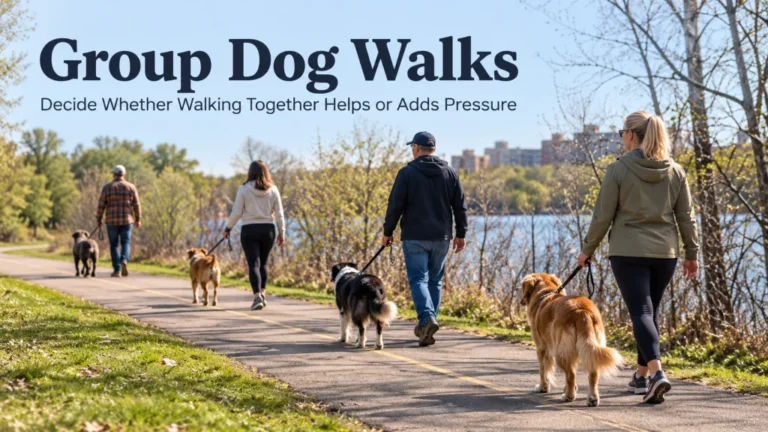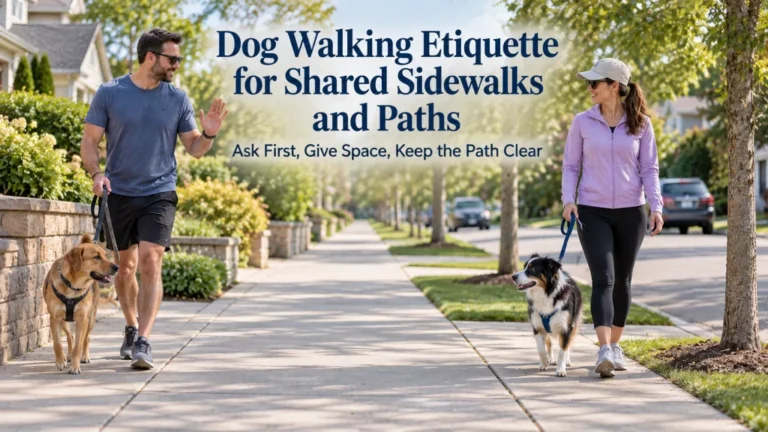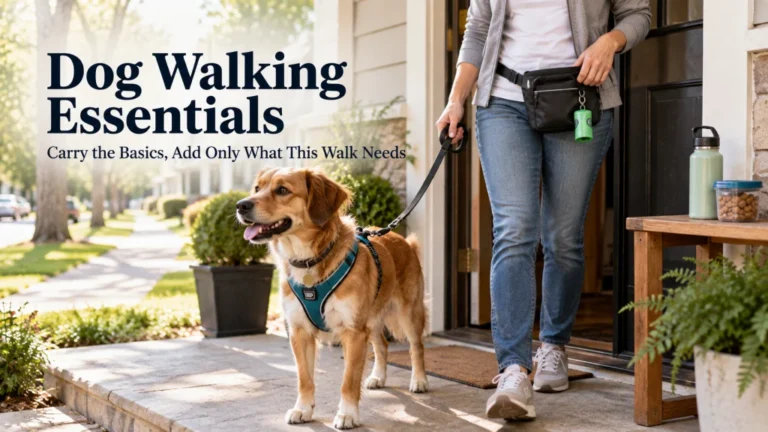
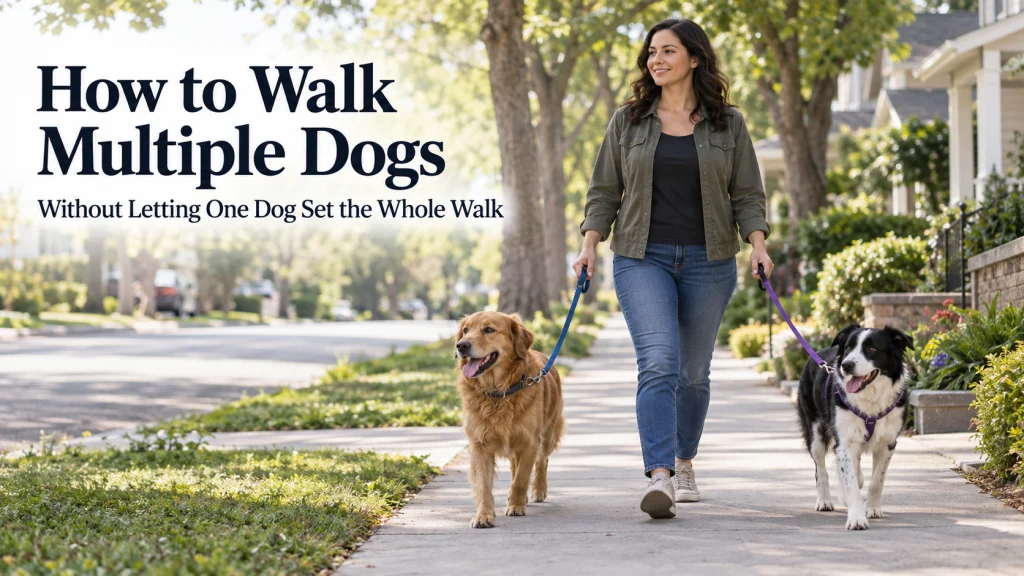
Walking multiple dogs works best when each dog can already handle an ordinary walk alone and the dogs remain comfortable sharing space under leash restraint. The practical goal is not to make two dogs move as one unit, but to keep enough individual control that pace, distractions, leash position, and exercise needs can still be managed. Two separate leashes usually preserve more flexibility, while a coupler makes sense only for well matched dogs that already walk politely together. If one dog needs a different pace, more space, or focused training, separate walks are often the cleaner choice.
Test each dog alone before solving the leash puzzle for two dogs
Learning how to walk multiple dogs starts before both leashes are in the same hand. Two dogs can look manageable on separate outings, then become much harder to handle when one dog’s speed, sniffing, pulling, or excitement immediately changes what the other dog does. That is why I would treat the shared walk as a logistics decision built on individual skills, not as a shortcut for unfinished leash work. The broader goal of walking and exercising a dog still applies, but a shared outing adds another layer of coordination.
Before combining them, think through the route each dog can already complete without turning the whole outing into constant leash management. If one dog routinely needs more distance from distractions, stops often, or changes direction sharply while the other keeps driving forward, putting them together usually magnifies the mismatch. A practical set of dog walking tips should help you reduce friction, not hide it under a new leash setup. The first question is simple: can each dog already handle this route alone well enough that adding the second dog will not remove your ability to make good decisions?
Confirm the dogs are comfortable with each other before sharing a constrained walk
Dogs that live together are not automatically comfortable being physically restricted beside each other for an entire outing. A leash reduces each dog’s freedom to create distance, pause, or choose a different path, so small tensions that are easy to avoid at home can feel more important outside. Watch how the dogs behave when they are close together before the walk begins, while moving through doorways, and when one dog stops to sniff or changes position. If either dog repeatedly crowds, blocks, stiffens, or tries to get away from the other, the shared walk is not the place to force the issue.
The useful standard is not whether the dogs are friends in general, but whether they can stay settled while sharing limited space and handler attention. One dog should be able to slow down without the other climbing into it, and one dog should be able to receive guidance without the second dog turning that moment into competition. If their interactions are already tense or unpredictable, keep the outings separate and deal with the underlying relationship or behavior concern in the appropriate setting. Walking two dogs at once should simplify a routine that is already workable, not become a test of whether the dogs can tolerate being connected to the same person.
- Both dogs can move near each other without repeated crowding or avoidance.
- Each dog can pause while the other pauses without escalating excitement.
- Neither dog depends on pushing ahead of the other to stay comfortable.
- The handler can redirect one dog without immediately losing control of the other.
- The handler can physically control the combined pulling force of both dogs if something unexpected happens.
- A routine distraction does not cause both dogs to become difficult to manage at the same time.
This ready together checklist is meant to expose problems before you leave the easy part of the route. If several items are not true yet, separate walks give each dog more room to succeed and give you clearer information about what needs work. Recheck the list after individual practice rather than assuming the pair will sort itself out once it gets moving. A shared walk should begin from compatibility and control that already exist.
Make sure each dog can complete an ordinary walk individually
A shared walk becomes much easier when neither dog requires constant correction, restraint, or negotiation just to move down the route. Each dog should be able to walk on ordinary equipment, respond to basic handler direction, and recover from normal distractions without turning every few steps into a contest. This does not mean each dog needs a perfect heel or identical walking style. It means you need enough individual control that adding a second leash does not remove your ability to manage either dog.
If one dog is still learning the fundamentals, keep working on leash training for that dog separately before expecting a pair walk to fix the problem. A second dog can add movement, competition, and social excitement, all of which make unfinished skills harder to use. The same logic applies when one dog reacts strongly to common triggers or needs much more distance to stay manageable. That dog needs an individual plan, not a group setup that gives the handler less room to respond.
Key point: A coupler cannot average two unfinished walking skills into one manageable walk. If one dog cannot handle the route alone, connecting that dog to another dog usually adds another variable rather than removing the original problem. Work on the individual limitation where you can see and respond to it clearly. Combine the dogs only after both can give you enough control to manage the added complexity.
Start with two dogs before adding a third
Every additional dog creates another leash path, another pace, another set of decisions, and another possible reaction to the environment. That is why two dogs are the sensible starting point even in a household with more dogs that may eventually share outings. With two, you can still see which dog is creating a tangle, which one is setting the speed, and which one is losing focus. Once three or more dogs are moving together, those causes become harder to separate in real time.
Use the first pair to learn what the combined walk actually changes. You may discover that two dogs who walk beautifully alone both speed up when together, or that one dog becomes more distracted by the other’s sniffing pattern. You may also find that a pair is easy on a quiet route but not when space narrows or distractions increase. Add another dog only when the two dog setup has become predictable enough that a new leash does not erase the control you already have.
I would also avoid treating head count as a goal in itself. There is no practical advantage to walking three dogs together if two of them work well as a pair and the third has a different pace, training need, or tolerance for stimulation. Household efficiency matters, but it should not outrank the quality and manageability of the walk for each dog. A smaller, stable group is more useful than a larger group that repeatedly overwhelms the handler.
Choose a quiet route for the first combined walks
The first shared outings should make the new coordination problem easier to read, not bury it under heavy distraction. A familiar route with enough space to stop, turn, or create distance lets you see how the dogs handle each other’s movement without also dealing with constant surprises. Busy sidewalks, tight paths, crowded entrances, and places where dogs regularly appear at close range remove options quickly. When your hands are already managing two leashes, fewer environmental demands make it much easier to notice small problems early.
Keep the first combined walk simple enough that success is obvious. Give each dog a consistent side or relative position from the start if that helps prevent repeated crossing, without expecting a formal heel. You are watching whether the dogs settle into those workable positions, whether one repeatedly crosses the other’s path, whether both speed up together, and whether ordinary distractions remain manageable. If the pair only works when the route is unusually empty, that is still useful information rather than a failure. It tells you the shared setup has a narrower operating range than the individual walks, so you can choose when it makes sense instead of assuming every outing should now be combined.
Pro Tips: Pick a route with room to pause and reset without blocking other people. The goal is to preserve options whenever the dogs stop moving as a workable pair. Notice where crossings, narrow spaces, or sudden distractions consistently create trouble. Those route features can tell you whether to simplify the next outing before changing equipment.
Match the group pace to the slower or less capable dog
Two dogs do not need identical bodies or walking styles, but they do need a pace that does not force one dog to hurry while the other is constantly held back. Size, age, physical comfort, sniffing style, stamina, and the purpose of the outing can all change what a reasonable pace looks like. When the difference is small, the faster dog may simply need more patience and a little more structure. When the difference is large, separate walks may be more useful because neither dog has to give up the kind of movement that suits it.
Consider a younger dog that naturally wants a brisk walk and an older housemate that prefers a slower route with more pauses. Making the younger dog drag along at the slower pace may leave that dog without enough activity, while pushing the older dog to keep up defeats the point of matching the walk to individual capacity. A shared walk can still work as one part of the routine, but it does not have to replace every individual outing. The combined route should be set by the dog with the lower tolerance, with any extra activity handled separately for the dog that needs more.
This pace matching example is why I would never use household convenience as the only reason to walk two dogs together. A group walk is efficient only when it still produces a sensible outing for both dogs. If one dog spends the entire route being rushed or restrained by the other’s needs, the pairing is not actually solving the walking problem. Separate activity can protect both dogs from being forced into a compromise that works well for neither.
Compare two separate leashes with a coupler based on control, size, and pace
Equipment should preserve the control the dogs already have, not compensate for skills they do not yet have. Two separate leashes let you adjust one dog’s position or distance without automatically moving the other, which is useful when the dogs differ in size, pace, or response to distractions. A coupler reduces the number of handles, but it also physically links the dogs so one dog’s movement affects the other immediately. That tradeoff is why a coupler makes more sense for dogs that know each other well, already walk politely, and tend to move at a similar pace.
Do not assume fewer straps means easier handling in every situation. If one dog stops suddenly while the other keeps going, or one dog needs extra distance from something ahead, independent leashes give you more ways to respond. A coupler can be convenient when the pair is already highly compatible, but it narrows your ability to separate their movement. I would choose the setup that leaves enough control for the less predictable dog, even if that means managing two handles instead of one.
| Setup | Useful when | Main tradeoff | Reason to skip it |
|---|---|---|---|
| Two separate leashes | Dogs differ in pace, size, position, or distraction response | More independent control, but more leash management | Handler cannot comfortably manage both lines without losing leash organization |
| Coupler | Dogs know each other well and already move at a similar, polite pace | Fewer handles, but the dogs directly affect each other’s movement | Either dog pulls, reacts, needs more space, or moves at a clearly different pace |
The table is a decision aid, not a universal ranking. If the dogs change, the route changes, or one dog’s behavior changes, the setup that was convenient on one outing may no longer be the right choice. Reassess control whenever the pair starts creating more management work than it saves. The best setup is the one that lets you respond to each dog without turning the second dog into part of the problem.
Stop and reset when leashes tangle instead of walking through the knot
Tangled leashes are useful feedback because they show that the dogs or the handler have lost a workable position. Continuing forward while the lines cross can tighten the tangle around legs, reduce your ability to shorten the correct leash, and encourage both dogs to keep solving the problem with more movement. Stop before the knot becomes complicated, bring the dogs back into clear positions, and separate the leash paths. A calm reset is usually faster than trying to untwist everything while all three bodies keep moving.
Pay attention to the pattern behind repeated tangles. If the same dog constantly crosses in front, give that dog a more consistent side or position before moving again. If both dogs keep swapping sides because they are chasing smells or reacting to the environment, the route may be too demanding for the current setup. Repeated tangling is not just an equipment nuisance, since it can tell you the pair needs more structure, more space, or separate walks for that situation.
Warning: Do not keep walking through a wrap around a dog or a person’s legs. Stop movement first, restore a clear leash path, and resume only when the lines can move freely again. If the same kind of wrap keeps happening, change positions or separate the dogs rather than repeatedly accepting the same failure pattern. Tangles that recur are a sign to adjust the system, not something the dogs simply have to walk through.
Separate the dogs again when one needs individual training or more space
Combining walks is not a permanent promotion that every dog has to keep once it has happened successfully. A dog can need individual work because leash behavior changes, a new distraction becomes difficult, confidence drops, or the route begins creating repeated overload. Separate walks give you back the ability to change pace, direction, and distance for one dog without making the second dog part of that training problem. They also let you see whether the difficulty belongs to the individual dog or only appears when the pair is together.
This distinction matters most when one dog’s reaction to something immediately affects the other. If one dog begins barking, lunging, freezing, or trying to create more space, do not treat that as a normal group walk inconvenience that should be managed by shortening both leashes and pushing ahead. End the shared setup and give the dog the space and individual handling the situation requires. Reactivity and significant behavior concerns need their own appropriate plan, while this article stays focused on the logistics of combining dogs that are already manageable household walking partners.
The decision flow is straightforward: combine the walk when both dogs are comfortable together, individually manageable, reasonably pace matched, and easy to control on the planned route. Separate them when any one of those conditions stops being true. That keeps the shared walk as an option you use because it works, not a routine you defend after it stops working. Reevaluate the pairing whenever the dogs, route, or walking conditions change enough to affect control.
Keep exercise quantity individualized even when the walk is shared
A shared route does not automatically mean both dogs have received the same useful amount of exercise. One dog may be satisfied by the pace and distance while the other needs more movement, more sniffing opportunity, or a different kind of activity. Age, body size, health status, activity level, and individual tolerance can all change what is appropriate. The fact that two dogs live in the same home does not make their exercise needs interchangeable.
Use the combined walk for the portion of the routine that genuinely suits both dogs, then adjust the rest separately if needed. That might mean one dog finishes after the shared route while the other continues with an additional appropriate activity, or it might mean the dogs share only some outings. For the broader exercise decision, use the guidance on how much exercise a dog needs rather than assuming the group walk settles the question. The walking setup should serve each dog, not force each dog into the same workload because sharing one handler is convenient.
This is also a good reason to review the pairing whenever one dog’s age, mobility, stamina, or behavior changes. A combination that worked smoothly before may become mismatched, and moving back to separate outings can be a practical adjustment rather than a step backward. Watch what each dog can comfortably do now rather than preserving a routine because it used to work. The shared walk should change when the dogs’ needs change.
Final Thoughts: A shared walk is useful only when it still works for each dog
The cleanest way to walk two dogs together is to start with two dogs that already make sense as a pair. They should be comfortable near each other, manageable alone, reasonably compatible in pace, and calm enough that you can still make separate decisions for each leash. Equipment can make a workable pair easier to handle, but it cannot replace those conditions. When the setup starts taking away control, the right adjustment is often to simplify the outing rather than add more gear.
Keep combined walks as one option in the household routine, not as a rule. Use separate walks when one dog needs training, more space, a different pace, or a different amount of exercise, and return to a shared walk only when it again serves both dogs. That approach gives you a clear standard for deciding when to combine, when to reset, and when to split the outing. The best group walk is the one that still lets each dog be managed as an individual.
FAQs
🐕 Can I walk two dogs together if one still pulls?
It is usually better to work with the pulling dog separately first. Adding another dog can make leash control harder and may cause the second dog to speed up or react to the pulling pattern.
🦮 Is a coupler better than two separate leashes?
Not for every pair. A coupler is most practical for dogs that already walk politely, know each other well, and move at a similar pace, while separate leashes preserve more individual control.
🐾 How do I stop two dog leashes from tangling?
Stop before the lines tighten, reset each dog into a clear position, and resume with separate leash paths. If the same crossing pattern keeps returning, give the dogs more consistent positions or use separate walks on that route.
🚶 Should both dogs walk at the same pace?
The shared pace should not force the slower or less capable dog to hurry. If the faster dog needs substantially more movement, use the shared walk for the portion that suits both and handle additional activity separately.
🏡 When should I go back to separate walks?
Separate the dogs when one needs focused leash work, more distance from distractions, a different pace, or a different exercise workload. Also split the walk when repeated tangles or rising arousal make the pair difficult to control.
References and Sources
- American Kennel Club guide to walking multiple dogs: Supports individual leash readiness, compatibility, pace matching, gradual progression, and separating dogs when a shared walk is not workable.
- American Kennel Club guide to double dog leashes: Supports the tradeoffs of couplers and the need for polite individual leash behavior before connecting two dogs to one shared leash setup.