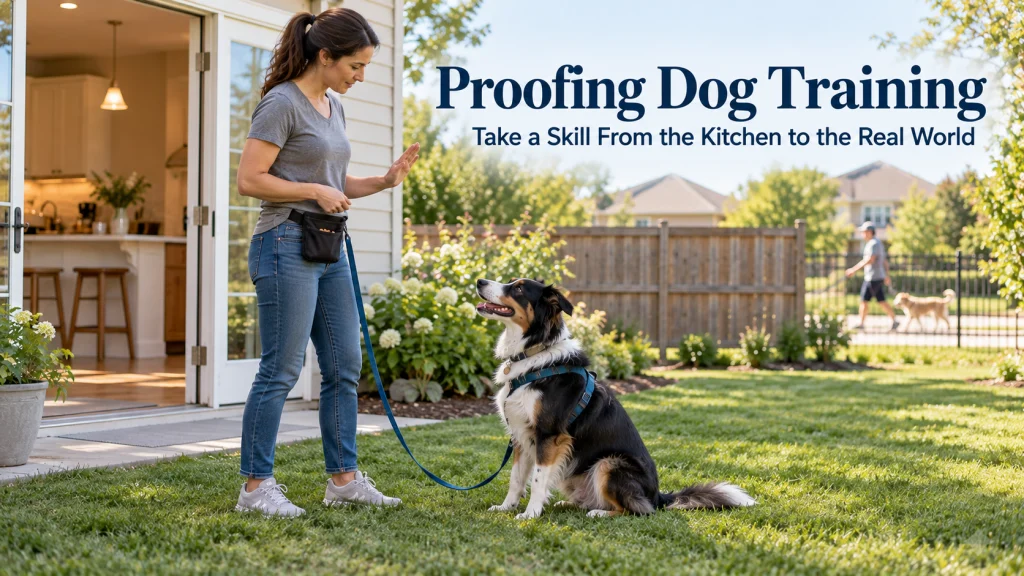
Proofing dog training means helping a dog perform an already learned behavior when the surroundings, handler position, distance, duration, or distractions change. A behavior that looks reliable in the kitchen may still be tied closely to that room, that person, and that easy version of the exercise. Build reliability by changing one difficulty at a time, increasing reinforcement when the work gets harder, and lowering the criteria when performance breaks down. The goal is not to catch the dog failing, but to make the behavior understandable across ordinary situations.
Why a dog can know a skill at home and lose it outside
Proofing dog training starts with a common mismatch: your dog listens at home but not outside, yet the problem is not automatically stubbornness or defiance. Dogs can learn a cue together with the setting around it, so a sit practiced beside the kitchen counter may be easier than the same sit near a sidewalk, another dog, or a person walking past. That is why dog training basics need practice beyond the first easy setup. The wider how to train a dog guide also matters because proofing only makes sense after the dog understands the behavior itself.
Treat the first successful version as a starting point, not a final exam result. When the location changes, briefly make the exercise easier so the dog can recognize what still earns reinforcement. If performance drops, look first at what became harder instead of repeating the cue or adding pressure. That mindset turns proofing dog training into a progression you can adjust rather than a test the dog either passes or fails.
Understand why dogs do not generalize automatically
Generalization is the process of learning that the same cue applies across different surroundings and versions of a task. A dog may notice details that feel irrelevant to a person, such as where you are standing, whether you are holding treats, which room you are in, or what is moving nearby. Changing several of those details at once can make a familiar behavior feel much less familiar. The practical response is to rebuild clarity in the new context instead of assuming the original lesson transferred perfectly.
This is also why household consistency needs more than everyone saying the same cue. Different people may stand differently, move their hands differently, reward at different moments, or expect different levels of precision. Once the skill is stable with one person, let other household members practice an easier version before asking for the same standard. The dog is then learning that the cue predicts the same job even when ordinary context changes.
Change duration, distance, and distraction one at a time
Duration, distance, and distraction are three common ways a familiar behavior becomes harder. Duration asks the dog to maintain the behavior longer, distance changes how far the handler is from the dog, and distraction adds competing sights, sounds, smells, movement, or access to something interesting. Work on one of these variables while keeping the other two easy. When one variable is stable, return the others to an easy level before raising a different challenge.
This matters because difficulty stacks quickly. A stay beside you in a quiet room is not the same task as a longer stay while you move away and someone walks past. If you change all three conditions together, a failure tells you very little about which part was too difficult. A simple progression makes the next adjustment obvious and keeps the dog practicing successful repetitions instead of rehearsing confusion.
| Variable | Make it easier | Make it harder | Keep steady while changing it |
|---|---|---|---|
| Duration | Ask for a brief response | Ask the dog to maintain the behavior longer | Stay close and keep the setting quiet |
| Distance | Work near the dog | Move farther away gradually | Keep duration short and distractions low |
| Distraction | Use a calm familiar setting | Add one manageable distraction | Stay close and ask for an easy version |
Use the table as a planning tool rather than a fixed ladder. What counts as easy or difficult depends on the individual dog, the behavior, and the environment. A quiet front yard may be a small step for one dog and a major distraction for another. Progress should follow the dog in front of you, not a preset idea of what the next location ought to be.
Reteach the behavior in new locations instead of testing it cold
A new location is a good place to lower your expectations temporarily. Ask for an easier version of the known behavior, reinforce it promptly, and let the dog discover that the cue still has the same meaning in this setting. If you are working on sits, downs, stays, or recalls, the underlying mechanics belong with the relevant basic dog commands instruction. Proofing starts after those mechanics are already understood in an easier context.
Think of the move from kitchen to yard to a public setting as several teaching steps, not one leap. In the kitchen, the dog may work with little competition for attention, while the yard adds smells and movement and a public area can add people, dogs, traffic, and unfamiliar surfaces. At each new stage, make the first repetitions simpler than the strongest version the dog can do at home. Once the response becomes easy again, you can begin adding one difficulty at a time.
| Setting | Starting approach | What to watch |
|---|---|---|
| Kitchen or quiet room | Confirm the dog understands the behavior with low distraction | Clear response to the cue without repeated prompting |
| Yard or another familiar area | Return to an easier version and reinforce generously | New smells, movement, doors, family activity, or outdoor sounds |
| Calm public area | Create space from distractions and keep the task simple | Whether the dog can still notice the handler and take reinforcement |
The public stage should still be controlled enough for learning. Going straight from a quiet home to the busiest environment available does not prove whether the dog knows the cue well. It mostly proves that the new environment is harder. Choose settings where you can adjust distance and leave before the dog becomes overwhelmed.
Raise reward value when the environment becomes harder
Reinforcement has to compete with what the environment offers. A reward that matters in the living room may be much less useful around interesting smells, moving dogs, visitors, or a favorite outdoor activity. When you increase difficulty, consider using something the dog values more and rewarding successful responses more often. The point is not to bribe the dog through every challenge, but to make the correct response worth practicing while the skill is still being built.
Reward preference is individual, so do not assume one food, toy, or game has the same value for every dog. If you use food during training, the practical choices and tradeoffs belong in the separate guide to dog training treats. For proofing, the important question is whether the chosen reinforcement is meaningful enough for the current environment. If the dog cannot engage with a normally valued reward, lowering the environmental difficulty may be more useful than simply searching for something richer.
Use a rollback rule when performance drops
When a dog misses a cue that was reliable in an easier setup, treat the miss as information. Identify the variable that changed most recently, reduce that difficulty, and rebuild successful repetitions before trying the harder version again. You can also improve reinforcement while you lower the criteria, especially if the environment became more competitive. This is more useful than repeating the cue several times or deciding the dog has chosen not to listen.
A good rollback is specific enough that you know what to change next. If the dog breaks a stay after you move farther away, step closer rather than also shortening the session, changing the location, and adding a new reward at the same moment. If the problem appeared when another dog entered the area, create more distance from that distraction and ask for an easier response. Once the dog is succeeding again, advance in smaller steps so the same jump is not repeated.
| What changed before the miss | Rollback | Next step after success returns |
|---|---|---|
| The behavior lasted longer | Return to a shorter successful version | Add duration in smaller increments |
| You moved farther away | Move closer again | Increase distance gradually while duration stays easy |
| A distraction became stronger | Create more space or reduce the distraction | Reintroduce the distraction at a manageable level |
| The location changed | Reteach an easier version in the new place | Build difficulty only after the cue is clear there |
The rollback rule keeps failure from becoming the main training pattern. It also gives you a simple troubleshooting question: what became harder immediately before the response fell apart? That answer usually points to the next adjustment more clearly than adding pressure or repeating instructions. If you cannot identify a manageable level where the dog can work comfortably, the situation may not be a routine proofing problem.
Vary handler position and ordinary context after the skill is stable
Once a behavior is reliable under one easy setup, change the ordinary details that may have become part of the picture. Practice with the handler standing in a slightly different place, facing a different direction, or using the cue in another familiar room. Let another household member practice after the dog understands the behavior clearly with the first person. Keep the task easy while you change these details so the dog is learning what matters and what does not.
This does not mean you need to invent endless variations. Focus on context the dog will actually encounter, such as a different doorway, another room, a family member holding the leash, or the handler sitting instead of standing. The goal is useful flexibility, not novelty for its own sake. When one ordinary change causes a sharp drop in performance, treat that change as a new training variable and simplify the rest of the exercise.
- Change location before adding strong distractions.
- Vary handler position while keeping the cue and expected behavior clear.
- Let different household members practice with the same cue and reinforcement logic.
- Practice on ordinary surfaces and near routine household activity that the dog can handle comfortably.
- Return to an easier version whenever a context change causes repeated misses.
This checklist is most useful after the original skill is stable. If the dog is still guessing what the cue means in the easiest setting, adding more context will not solve that uncertainty. Strengthen the basic behavior first, then use variation to widen where and how it works. That sequence keeps proofing separate from initial teaching.
Combine difficulties only after each one works separately
Real life eventually combines duration, distance, distraction, location, and handler changes, but training does not have to begin there. First make sure the dog can handle each important variable at a manageable level on its own. Then combine two easy versions instead of stacking the hardest version of everything at once. If the dog struggles, separate the variables again and find which one needs more work.
For example, a dog that can stay while you move away in a quiet room and can stay near a mild distraction while you remain close is not automatically ready for both challenges at full difficulty together. Start with a modest distance and an easy distraction, reinforce success, and build from there. A clean response at a lower combined difficulty is more useful than repeated failures at the final goal. Reliability grows from many understandable repetitions across contexts, not from repeatedly testing the hardest scenario.
Stop calling fear, panic, or reactivity a proofing failure
Proofing assumes the dog is able to learn and perform in the current situation. A dog showing fear, panic, intense avoidance, lunging, or other serious distress is not simply facing a normal increase in training difficulty. Increasing exposure to prove the cue can make the situation less safe and can push the exercise beyond ordinary skill practice. Create distance, use management to reduce the immediate challenge, and stop treating the behavior as a simple reliability problem.
This article does not diagnose fear, anxiety, aggression, or reactivity, and it does not provide a treatment plan for those concerns. If the behavior creates a safety concern, causes marked distress, or repeatedly prevents ordinary training even after the environment is simplified, seek qualified professional guidance appropriate to the problem. Training based on rewards and careful management are consistent with current animal behavior guidance, but serious behavior cases need more individualized assessment than a proofing progression can provide. Knowing that boundary protects both the dog and the people around them.
Final thoughts: reliability is built across contexts, not discovered in one test
A dog that performs beautifully in one room has learned something useful, but that success may still be tied to a narrow set of conditions. Build outward by changing one difficulty at a time, making the first repetitions in new places easier, and matching reinforcement to the challenge. When performance drops, roll back the variable that changed instead of repeating the cue or labeling the dog stubborn. That gives you a clear path forward without turning training into a contest.
The practical standard is not perfection in every environment. It is a behavior that becomes understandable and dependable across the situations that matter in your household while the dog remains able to learn. Keep notes on which contexts are easy, which changes cause mistakes, and which rollback restores success. That information tells you what to practice next and when a problem no longer belongs in ordinary proofing.
FAQs
Proofing questions usually come up after a dog can perform a behavior in at least one familiar setting. The useful answer depends on what changes when the behavior stops working, such as location, handler distance, duration, or distractions. Start by identifying that change before adjusting the training plan. The questions below focus on the most common owner decisions in that process.
Keep the distinction between a training challenge and an emotional or safety problem clear. A manageable distraction can be part of proofing, while fear, panic, or dangerous behavior needs a different response. Reward value also depends on the individual dog and the setting, so there is no universal item that works everywhere. Use these answers as troubleshooting prompts rather than fixed rules for every dog.
🐕 What does proofing mean in dog training?
Proofing means practicing an already learned behavior under varied conditions so the dog can perform it beyond the original teaching setup. Change duration, distance, distraction, location, or handler context gradually rather than making everything harder at once.
🏠 Why does my dog listen at home but not outside?
The outside environment may add smells, movement, people, animals, and other competing information that was not present during the original training. Make the behavior easier again, create enough distance from distractions, and rebuild reinforcement in that setting before expecting the home level of performance.
📏 Which should I increase first, distance, duration, or distraction?
Work on one variable while keeping the other two easy. The best starting variable depends on the behavior and your real life goal, but distraction is often easier to manage after the dog understands the behavior under simpler distance and duration changes.
🌳 How do I know when to add a harder distraction?
Add difficulty when the dog can respond clearly and repeatedly at the current level without repeated cues or visible struggle. If performance drops as soon as the distraction changes, increase distance from it or return to an easier version before building again.
👥 Should different family members practice the same behavior?
Yes, once the dog understands the behavior with the original handler, other household members can help generalize it. Keep the cue, expected response, and reinforcement logic consistent, and make the first repetitions easier when a new person begins practicing.
🛑 When should I stop proofing and get professional help?
Stop treating the issue as ordinary proofing if the dog shows serious fear, panic, aggression, or behavior that creates a safety concern. Management and qualified professional guidance are more appropriate when the dog cannot work comfortably even after the environment and criteria are simplified.
References and sources
These references support the learning principles used in the article rather than serving as a general reading list. The AKC material covers generalization, the three Ds, consistency, and matching reinforcement to training difficulty. AVSAB provides the welfare boundary for training based on rewards and more serious behavior concerns. Only sources used for those factual points are included here.
The practical progression in this article translates those principles into an owner level workflow for known skills. It does not replace individualized behavior assessment, and it does not treat fear or aggression as a routine proofing problem. Product claims are not part of this article, so manufacturer or retailer references are unnecessary. Keeping the source list narrow helps each reference have a clear job.
- AKC three Ds of dog training: supports changing duration, distance, and distraction separately before combining them.
- AKC consistency in dog training: supports varying training locations and handler consistency to help behaviors generalize.
- AKC training rewards: supports matching reward value and reinforcement frequency to harder training conditions.
- AVSAB position statements: supports reward based training and the distinction between routine training and more serious behavior concerns.