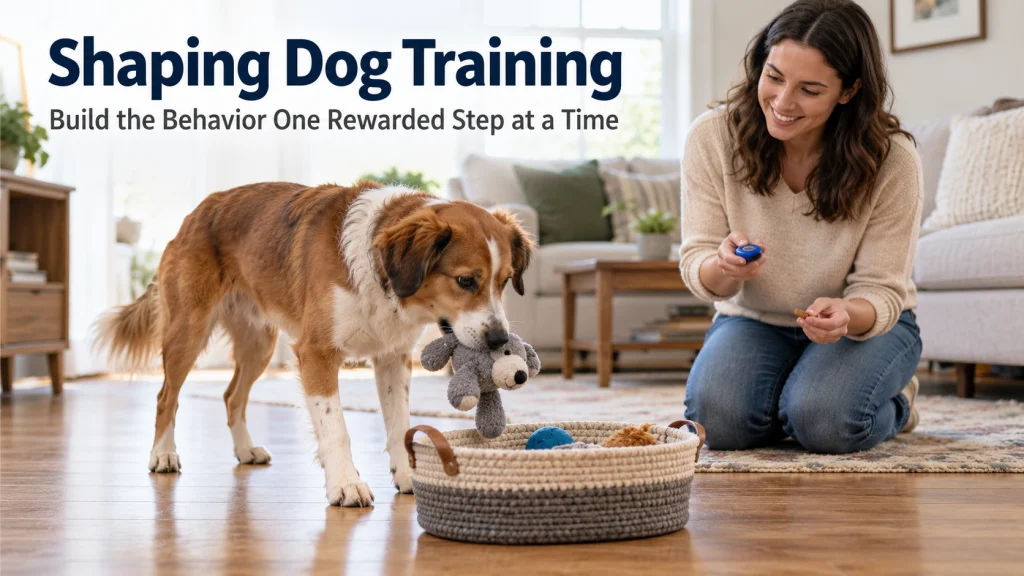
Shaping dog training builds a finished behavior by rewarding small actions that move in the right direction. It is most useful when the complete behavior is unlikely to happen at once or is awkward to guide with a lure. The practical skill is not simply rewarding effort, but choosing a clear criterion, marking the right moment, and changing that criterion when the dog is ready. A simple plan also makes it easier to see when luring or capturing would be the cleaner choice instead.
Use shaping when the finished behavior is too large to reward at once
Shaping dog training can look slow if the only thing you watch for is the finished behavior. The method becomes much clearer when you reward a small action that points toward the goal, then ask for a slightly closer version after that action becomes predictable. That fits the broader logic of how to train a dog, because the dog needs a clear path to reinforcement rather than a mystery to solve. The owner also needs a plan that can change when the dog shows what is easy, difficult, or unclear.
Start with a behavior that cannot be produced cleanly by simply moving food in front of the dog’s nose, such as carrying a toy to an open basket and releasing it inside. The task contains several pieces, so waiting for the complete sequence can leave the dog with no useful information about what earns the reward. A shaping plan lets you reward progress from looking toward the toy, to approaching it, to picking it up, to moving toward the basket, and finally to dropping it inside. For the surrounding foundation of cues, reinforcement, and everyday practice, the dog training basics guide keeps this technique in the right context.
Define shaping as rewarding successive approximations
Shaping means reinforcing a series of increasingly close versions of the behavior you ultimately want. The first version can be very small, provided it is observable and genuinely moves toward the final action. Once that version is easy for the dog to offer, the criterion changes so the next reward requires a little more. This is one practical application of positive reinforcement dog training, because the consequence that follows the behavior helps make that behavior more likely to occur again.
The important word is successive, because the steps are connected rather than random. If the goal is putting a toy in a basket, rewarding a glance at the toy can make sense at the beginning, but rewarding that same glance forever will not build the rest of the sequence. The owner has to notice when the current approximation has become easy enough that the next useful variation is ready to reinforce. Shaping therefore depends as much on observation and criterion setting as it does on handing over a reward.
Decide whether luring, capturing, or shaping fits the behavior
Shaping is not automatically the best method just because it can produce detailed behavior. A lure is often simpler when the dog can comfortably follow a hand or reward into an easy position, while capturing is efficient when the dog already performs the behavior naturally and you can mark it when it appears. Shaping becomes especially useful when the final action has several components, happens rarely, or is difficult to guide directly. The decision should follow the behavior in front of you rather than a rule that one technique is always superior.
Method choice also affects how much timing and planning the owner must manage. Luring can create a clear first repetition quickly, capturing asks you to be ready when the behavior occurs on its own, and shaping asks you to define what counts now and what will count next. A dog that readily follows a lure does not need extra complexity just to prove that shaping works. A dog that becomes confused by a large final request may benefit from the smaller earning opportunities that shaping creates.
| Method | Best fit | Main owner task | Reason to choose another method |
|---|---|---|---|
| Luring | The dog can comfortably follow a hand or reward into the position. | Guide clearly, mark the correct behavior, and fade the lure as the behavior becomes understood. | The behavior cannot be guided cleanly or the lure produces the wrong movement. |
| Capturing | The dog already offers the behavior naturally often enough to notice and reward. | Watch for the behavior and mark it when it happens without prompting. | The behavior is too rare to wait for or has several pieces that need to be built. |
| Shaping | The final behavior can be broken into observable steps that the dog can earn. | Set criteria, mark useful approximations, and adjust the next step based on the dog’s progress. | A lure or captured behavior would reach the goal with less complexity. |
Use the table as a decision check, not as a ranking. The simplest method that gives the dog clear information is usually easier to repeat consistently at home. If two methods could work, choose the one that lets you define success and deliver reinforcement with less confusion. You can change methods later if the dog’s response shows that your first choice is creating unnecessary difficulty.
Write the final behavior before choosing the first step
A shaping session becomes vague when the owner has not defined what the finished behavior should look like. Write the goal in observable terms so another person could recognize success without guessing about the dog’s intention. For the toy and basket example, a useful final description is that the dog picks up the chosen toy, carries it to the open basket, and releases it inside. That description gives you something concrete to split instead of rewarding whatever happens to look interesting.
The plan should also name the starting setup, the current criterion, the reward, and the next likely criterion. Keep the environment simple enough that you can see the behavior you are trying to reinforce rather than sorting through several unrelated actions. If the dog surprises you with a useful step that is further along than expected, you can revise the plan rather than ignoring good information. Planning gives the session direction, but the dog’s actual behavior tells you whether the plan needs to become easier or can move forward.
| Shaping plan field | Example for toy to basket |
|---|---|
| Finished behavior | Pick up the chosen toy, carry it to the open basket, and release it inside. |
| Starting setup | Toy and basket are visible in a quiet practice area with enough room to move naturally. |
| Current criterion | Orient toward the toy. |
| Marker | A consistent marker word or a conditioned clicker. |
| Reward | Something the dog values in that setting. |
| Next likely criterion | Move toward the toy. |
This worksheet is most useful when every field describes something you can actually observe. If you cannot tell whether the criterion happened, rewrite it before adding more difficulty. Keep the next likely step close enough to the current behavior that you can recognize progress without guessing. A clear written plan also makes rollback easier because you can see which earlier approximation was working.
Split the first criterion small enough to create success
The first criterion should be easy enough that the dog can discover a workable route to reinforcement. That does not mean rewarding every movement in the room, because random reinforcement makes the path less clear. It means choosing the smallest useful action that is likely to occur from the starting setup. For a dog that has never interacted with the toy on cue, turning the head toward it may be a better first criterion than demanding a pickup immediately.
Small criteria matter most when the gap between what the dog can do now and what you want next is large. If the dog repeatedly offers the current step but never produces the next one, the gap may still be too wide. Add an intermediate approximation that preserves the same direction of travel instead of waiting for a lucky leap. A good criteria ladder creates enough success to keep information flowing while still moving toward the finished behavior.
| Stage | Possible criterion | What changes next |
|---|---|---|
| Start | Look toward the toy. | Require a small movement toward it. |
| Approach | Move to the toy. | Require nose or mouth contact. |
| Pickup | Lift the toy from the floor. | Require movement while holding it. |
| Carry | Move toward the basket while holding the toy. | Require arrival at the basket. |
| Finish | Release the toy inside the basket. | Build consistency before adding a cue. |
The exact ladder will vary with the dog, the object, the room, and what the dog already knows. Treat it as a draft that can be split further rather than a fixed sequence every dog must follow. A dog that already picks up toys may begin later in the ladder, while another dog may need several steps just to build comfortable interaction with the object. Adjust the ladder to the behavior you actually see instead of forcing the dog through steps that are either unnecessary or too large.
Mark and reinforce the exact approximation you want
A marker is useful in shaping because it identifies the precise action that earned reinforcement. The reward may arrive after the marked moment, but the marker tells the dog which movement mattered. A clicker can serve this function after it has been properly associated with reinforcement, and a consistent marker word can also be used. If that foundation is unfamiliar, the separate guide to clicker training for dogs covers marker setup without turning this article into a clicker lesson.
Timing gets harder when several actions happen close together, so decide what you are watching before the dog starts moving. If the criterion is lifting the toy, mark the lift rather than the later step toward you, the accidental paw movement, or the moment you reach for the reward. Then deliver the reward in a way that lets the dog reset for another clear attempt. Precise marking reduces guesswork, but it cannot rescue a criterion that is too vague or too difficult.
- Choose one observable criterion before the attempt begins.
- Mark the action you intend to reinforce, not the behavior that happens after it.
- Follow the marker with the promised reward consistently.
- Reset the setup so the next repetition gives the dog another fair opportunity.
The list is a practical timing check rather than a separate training method. If your marks keep landing on different behaviors, simplify the criterion before asking the dog for more. You may also need to reposition yourself or the training objects so the target action is easier to see. Better observation usually improves shaping more than adding extra cues or talking through every attempt.
Raise one criterion when the current step is predictable
Move forward when the dog is offering the current approximation readily enough that it no longer looks like an accidental event. The next criterion should change one meaningful part of the behavior rather than several parts at once. If the dog reliably lifts the toy, for example, the next step might require a small movement while holding it rather than a longer carry plus a turn plus a release into the basket. Keeping the change narrow makes it easier to see whether the dog understands what now earns reinforcement.
When you raise the criterion, the old approximation may stop earning the reward because it no longer represents progress toward the current goal. That transition needs judgment, because advancing too early can make the dog stop offering behavior while advancing too late can make the old step feel like the complete answer. Watch what happens after the change instead of defending the plan simply because you wrote it down. If success collapses, the next decision is not to pressure the dog but to make the path clearer.
Lower the criterion when the dog gets stuck
A stuck session often means the current step is too large, the setup changed, or the dog is no longer sure which behavior is being reinforced. Repeating the same difficult criterion more insistently does not add information. Lower the requirement to a version the dog can earn, restore a clear pattern of reinforcement, and then rebuild the missing step with a smaller gap. This keeps the problem in the training plan instead of labeling the dog as stubborn.
For example, suppose the dog is lifting the toy reliably but stops progressing when you suddenly require carrying it all the way to the basket. Roll back to reinforcing a tiny movement while holding the toy, then a little more movement, then orientation toward the basket, and only later ask for arrival. If even the pickup disappears, return to contact with the toy and rebuild from there. The rollback point should be the last approximation that is still clear enough for the dog to succeed and close enough to support the next step.
| What you see | Likely training issue | Practical adjustment |
|---|---|---|
| The dog repeatedly offers the old step but not the new one. | The jump in criteria may be too large. | Add an intermediate approximation between the two. |
| The dog offers many unrelated actions. | The current criterion or marker timing may be unclear. | Simplify what counts and mark only that action. |
| A behavior that was easy disappears after the setup changes. | The environment may have added difficulty. | Restore the easier setup and rebuild the changed condition separately. |
Rollback is part of shaping, not evidence that the whole method has failed. A smaller successful step gives you information you can use to design the next attempt. Once the dog is succeeding again, increase difficulty through a narrower gap than the one that caused the stall. That keeps the session moving forward without turning persistence into repeated confusion.
Avoid reinforcing the same approximation until progress stalls
Shaping can stall in the opposite direction when the owner keeps rewarding an easy approximation after it has already become predictable. The dog is learning from the reinforcement history you create, so a heavily rewarded early step can begin to look like the complete answer. If looking at the toy has been rewarded over and over, the dog may reasonably continue looking instead of trying a new action. Progress requires the criterion to move once the current step is clearly established.
The solution is not to withhold all reinforcement and wait for a dramatic leap. Raise the criterion by a small amount that invites variation in the same direction, then mark the first useful version of that new action. If the dog stops participating or returns only to the old step, the increase was probably too ambitious or not clear enough. Good shaping alternates between stability and change rather than staying permanently easy or becoming abruptly difficult.
Add the verbal cue after the behavior is reliably offered
A cue is most useful after the dog can already perform the behavior you intend the cue to predict. Adding a word while the behavior is still changing can attach that word to several incomplete versions rather than to one clear action. Finish the shaping path first, then introduce the verbal cue or hand signal as the behavior becomes consistent in the training setup. The cue should identify a known behavior, not replace the work of teaching the behavior itself.
After adding the cue, watch whether the dog can respond without needing the earlier setup to do all the prompting. If the dog performs only when the toy, basket, your body position, and the reward arrangement look exactly the same, the surrounding context may still be doing much of the work. Change one condition at a time so you can see what the dog actually understands. If reliability drops, return to an easier version rather than repeating the cue until it loses meaning.
Keep shaping inside ordinary skill training
Shaping is a useful teaching technique, but this page is about ordinary skills and household training rather than treatment for severe fear, aggression, panic, or other serious behavior problems. Do not turn a difficult emotional response into a do it yourself shaping project simply because small steps are part of the method. The same outward action can have very different meaning depending on the dog’s emotional state, environment, and history. When the concern moves beyond ordinary skill learning, the owner needs guidance appropriate to that behavior problem rather than a more complicated criteria ladder.
That boundary also keeps the method practical. For everyday skills, you can observe what the dog does, define the next approximation, reinforce useful progress, and adjust the task when the dog gets stuck. You do not need to claim that shaping is gentler, faster, or better than every alternative for every dog. The useful question is whether it gives this dog a clearer path to this specific behavior than luring or capturing would.
Final thoughts: shape the path, not just the finished behavior
Shaping works best when the owner can describe both the destination and the next earnable step. Write the finished behavior, choose one observable criterion, mark it precisely, and move forward only far enough that the dog still has a realistic way to succeed. When progress disappears, lower the criterion instead of repeating a confusing request. That turns a stalled session into information you can use.
The method is valuable because it gives structure to behaviors that are too large or awkward to teach all at once, not because it replaces every other training option. Use luring when direct guidance is simple, capturing when the dog already offers the behavior naturally, and shaping when a sequence of approximations makes the route clearer. Add the cue after the behavior itself is dependable, and keep serious fear or aggression outside the scope of an ordinary shaping plan. The best plan is the one that makes the next correct choice obvious enough for both the dog and the owner.
Frequently asked questions
🐾 What is shaping in dog training?
Shaping teaches a finished behavior by reinforcing smaller approximations that move toward it. The owner changes the criterion as each step becomes predictable, so the dog earns reinforcement for progressively closer versions of the goal.
🎯 When should I use shaping instead of luring?
Use shaping when the behavior is difficult to guide directly, has several components, or is unlikely to happen all at once. If the dog can comfortably follow a lure into the behavior, luring may be simpler.
👀 What should I do if my dog stops offering behavior?
Lower the criterion to the last approximation the dog could perform clearly, then rebuild the missing step in smaller increments. Also check whether the setup or your marker timing changed.
🔔 Do I need a clicker to use shaping?
No. A conditioned clicker is useful for precise marking, but a consistent marker word can also identify the behavior you intend to reinforce.
🧩 How do I know when to raise the criterion?
Raise it when the current approximation is being offered readily enough that it looks established rather than accidental. Increase one meaningful part of the behavior, then watch whether the dog can still find a clear path to reinforcement.
🗣️ When should I add the verbal cue?
Add the cue after the finished behavior is being offered reliably in the training setup. A cue works best when it names a behavior the dog already understands instead of trying to create the behavior by itself.
References and sources
- AKC shaping guide: Supports successive approximations, planning criteria, adjusting steps, and adding a cue after the behavior is established.
- AKC dog training terms: Supports the practical distinction between shaping and other common training terms.
- AKC clicker training guide: Supports the role of a marker in identifying the behavior that earns reinforcement.