
Positive reinforcement dog training is a method for making useful behavior more likely by arranging consequences the dog actually values. The practical work is more than handing out treats: you need clear criteria, accurate timing, rewards that matter in the moment, and management that prevents unwanted behavior from repeatedly paying off. Reward based training can include boundaries and removal of access to a reward, but it should not rely on pain, fear, intimidation, or physical correction. The goal is to judge the method by what happens to the dog and what consequences are being used, not by a marketing label.
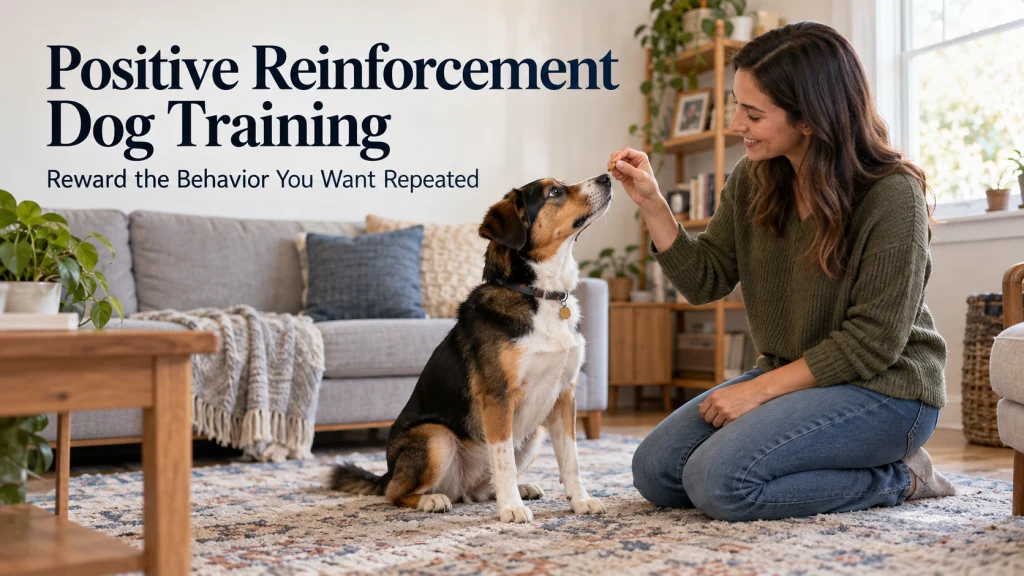
Positive reinforcement is not the same as giving treats whenever your dog is nice
Positive reinforcement dog training becomes much clearer when your dog does something you do not want. The method is not defined by whether you approve of the behavior, and it is not a promise to hand over food for every polite moment. It is one part of how to train a dog with clear criteria and humane consequences, where the owner decides which behavior should earn access to something valuable. For the larger everyday framework, dog training basics helps place this method alongside cues, practice, management, and realistic household expectations.
The useful question is simple: what happened immediately after the behavior, and did that consequence make the behavior more likely to happen again in a similar situation? A dog may sit because sitting makes the door open, bring a toy because play begins, or settle on a mat because calm behavior earns attention and access to the family. The same dog may ignore food outdoors if sniffing, movement, or another environmental opportunity is more valuable at that moment. Once you look at consequences this way, reward based training stops looking like a bag of treats and starts looking like a system for making good choices worth repeating.
Define reinforcement by whether behavior becomes more likely
In learning terms, reinforcement is identified by its effect on future behavior, not by the owner’s intention. If you give something after a behavior and that behavior becomes more likely in the same kind of situation, the consequence functioned as reinforcement. If the behavior does not strengthen, the item may have been pleasant without being useful as a reinforcer. This distinction matters because owners often assume praise, petting, or a treat must be rewarding simply because people usually think of them as rewards.
| Situation | What happens | What to watch next |
|---|---|---|
| Dog sits before the door opens | The door opens after the sit | Does sitting happen more readily at the door? |
| Dog jumps and receives attention | Talking, touching, or eye contact follows jumping | Does jumping become more persistent? |
| Dog lies on a mat and gets a chew | Calm mat behavior produces access to the chew | Does the dog return to the mat more often? |
A common mistake is to judge a consequence by what it was called instead of what it did. Saying “good dog” is not automatically reinforcement if your dog is focused on leaving the room, while opening the door may be extremely powerful because access is what the dog wanted. The cleanest way to check your training is to watch the next few opportunities and see whether the target behavior becomes easier to obtain. That feedback keeps positive reinforcement practical and prevents you from blaming the dog when the supposed reward was never valuable enough to change behavior.
Let the dog determine what actually counts as reinforcing
Owners choose what they can offer, but the dog determines what has reinforcing value. Food is convenient because it is easy to deliver in small amounts, yet some dogs will work harder for play, movement, sniffing, access to the yard, or social interaction in a particular context. Value also changes with the environment, the difficulty of the task, and what the dog has recently had access to. A reward that works in a quiet kitchen may lose out completely when the same dog is standing near an interesting trail or watching another dog pass.
I would treat reward selection as an observation problem rather than a loyalty test for one favorite treat. Offer choices that are safe and practical, then notice which consequence makes the behavior more likely without disrupting the session or creating a new problem. If food is not practical for a specific dog because of dietary instructions, allergies, or another health consideration, do not improvise around medical guidance just to preserve a training routine. Change the reinforcement plan or ask the appropriate professional for guidance, because the method depends on value to the dog, not on a rule that every dog must work for food.
Mark the behavior before you deliver the reward
A marker helps separate the exact behavior you want from the practical delay involved in delivering the reward. The marker can be a short consistent word or another conditioned signal, and it should occur when the target behavior is happening rather than after the dog has already moved on to something else. This is especially useful when the reward cannot appear at the exact location and instant of the behavior. If you want a deeper look at marker mechanics, clicker training for dogs covers how a clicker can serve that job without making the clicker itself the reward.
Think of the marker as information and the reward as the consequence that gives the information value. If you mark a sit and then the dog jumps before the food arrives, the mark can still identify the sit, provided your marker has been taught clearly and your delivery pattern stays consistent. Poor timing creates muddy feedback because the dog may connect the reward with whatever happened closest to delivery rather than with the behavior you intended to strengthen. Cleaner timing is usually a better fix than increasing the amount of food, repeating the cue more loudly, or assuming the dog is being stubborn.
Use food, play, access, and social interaction as rewards
Reward based dog training works best when rewards match the dog and the situation instead of following a rigid hierarchy. Food is useful for rapid repetitions, play can support energetic engagement, access can reward self control, and social interaction can matter when the dog genuinely seeks it. Environmental rewards are often overlooked even though they are already present during walks, doorway routines, yard time, and greeting situations. If food is part of the plan, choosing practical dog training treats is a separate decision from deciding whether positive reinforcement is the right method.
| Context | Possible reward | Useful check |
|---|---|---|
| Quiet indoor practice | Food, brief play, praise, or access to a favorite spot | Does the dog stay engaged without becoming overexcited? |
| Doorway routine | Door opening and permission to move through | Does calm waiting make access more likely? |
| Walk near interesting smells | Permission to sniff after the requested behavior | Is sniffing more valuable than food in that location? |
| Play session | Restarting the game after a simple behavior | Can play resume without losing control of the routine? |
The reward should support the behavior you are teaching rather than compete with it. A highly exciting game may be a poor choice when you are trying to reinforce quiet settling, while calm access to a comfortable spot may fit that job much better. Likewise, petting is only useful when the dog actually wants touch in that moment, not because human affection sounds positive to us. Match reward type, intensity, and delivery to the goal, then watch whether the target behavior becomes more reliable.
Prevent unwanted behavior from rehearsing while you teach the alternative
Positive reinforcement is easier when the unwanted behavior is not repeatedly collecting its own reward between training attempts. A dog that practices rushing through an open door may be reinforced by reaching the yard, while a dog that jumps on visitors may be reinforced by attention even when the visitor is trying to push the dog away. Management changes the setup so those rewards are harder to obtain while you teach a behavior that can succeed instead. Gates, distance, closed doors, leashes used without correction, and changes to the environment can all reduce rehearsal without trying to frighten the dog out of acting.
- Block access to the trigger when you cannot train the situation safely.
- Set up enough distance for the dog to notice you and respond.
- Teach a clear alternative such as going to a mat, waiting, or moving with you.
- Arrange the environment so the alternative can earn the outcome the dog wants when practical.
Management is not a substitute for teaching, but teaching often fails when management is missing. If the dog can earn a powerful payoff from the unwanted behavior all day, a short practice session has to compete with a long history of successful rehearsal. I would make the desired behavior easier to perform, make the unwanted behavior harder to profit from, and then reinforce the alternative clearly. That combination gives the dog a workable path instead of waiting for mistakes and reacting after they happen.
Reward based does not mean boundary free
Boundaries can be clear without relying on pain, fear, or intimidation. A dog can lose access to attention when jumping, wait before a door opens, pause play when teeth contact skin, or remain behind a gate while a situation is being set up more safely. What matters is how the boundary is taught and what procedure is doing the behavior change. Removing or delaying access to something the dog wants can be part of a reward based plan when it is predictable, humane, and paired with a clear alternative that the dog can perform.
| What you see | Reinforcement | Bribe or visible lure problem |
|---|---|---|
| When the reward appears | After the target behavior or marker | Before the response, so the dog waits to see the payoff |
| What tells the dog what to do | The cue, situation, and learned criteria | The visible food, toy, or other payoff becomes the prompt |
| What should happen as learning improves | The dog can respond before seeing the reward | The dog may hesitate when the visible payoff disappears |
This comparison is also why a lure and a reinforcer are not the same job. A lure can help guide a new movement, but it should be faded so the dog learns to respond to the cue and situation rather than waiting to inspect your hand first. Reinforcement comes after the behavior and keeps that behavior worth repeating, while a visible payoff that must appear before every response can become part of the prompt. Clear cues, clear criteria, and rewards delivered after the behavior let you keep boundaries without turning every request into a negotiation with visible food in your hand.
Separate humane management from aversive correction
Management changes access, distance, or opportunity so the dog is less likely to rehearse a problem, while aversive correction attempts to suppress behavior through something the dog experiences as painful, frightening, or intimidating. Those are not interchangeable just because both can stop a behavior in the moment. A closed gate that prevents a dog from reaching the front door changes the environment, while a leash jerk delivered after lunging adds an unpleasant consequence to the dog’s behavior. The first can create room for teaching; the second depends on aversive pressure and carries different welfare concerns.
Veterinary behavior guidance from AVSAB recommends reward based methods and advises against aversive methods for dog training and behavior modification. Comparative companion dog research has also found poorer welfare indicators in dogs trained with greater use of aversive methods, although that work was observational in real training schools rather than a randomized experiment. I would use that evidence as a reason to choose procedures that teach and manage without adding pain or fear, not as a claim that one study predicts every individual outcome. Humane method selection is strongest when the procedure is understandable, the dog has a learnable alternative, and the owner can describe exactly what consequence follows each behavior.
Evaluate the procedure, not the training label
Labels such as positive, balanced, force free, relationship based, or practical can sound reassuring without telling you what happens during training. Two trainers can use the same label while relying on very different consequences, tools, and responses to mistakes. Ask what happens when the dog gets the behavior right, what happens when the dog gets it wrong, how unwanted behavior is prevented, and whether the method adds pain, fear, startle, or physical pressure. Those questions reveal more than branding because they describe the actual learning environment the dog will experience.
| Label or claim | Procedure question to ask | What you are trying to verify |
|---|---|---|
| Positive training | What happens after the dog makes a mistake? | Whether correction methods match the label |
| Balanced training | Which tools and consequences are used, and when? | Whether aversive pressure is part of the plan |
| Force free training | How are unwanted behaviors managed and alternatives taught? | Whether the trainer can explain the process clearly |
| Relationship based training | What specific procedure changes the behavior? | Whether a vague philosophy is hiding the mechanics |
If you are comparing professional help, use the same procedure questions rather than relying on testimonials or a polished label. The separate guide to how to choose a dog trainer can help you evaluate transparency, methods, scope, and professional fit. A trainer should be able to explain what the dog will experience and why a method is being used without hiding behind jargon. If the explanation becomes vague exactly where pain, fear, or physical correction enters the process, that is useful information for your decision.
Know when a behavior concern needs qualified professional help
Positive reinforcement is a broad method, not a home treatment plan for every behavior problem. Severe aggression, panic, intense fear, sudden behavior change, repeated escape attempts, or behavior that creates a meaningful safety risk can require assessment beyond basic owner level training. Do not turn a general training article into a diagnosis, and do not assume a stronger reward will solve a problem whose cause has not been evaluated. The practical next step is to reduce preventable risk, avoid rehearsing unsafe setups, and seek qualified help appropriate to the concern.
A veterinarian may need to rule out medical contributors when behavior changes suddenly or appears connected with pain, illness, sensory change, or another health issue. For behavior work, look for a professional who can explain humane procedures, stay within their scope, and coordinate with veterinary care when needed. Reward based principles still matter, but complex cases often require more careful assessment, setup, and follow through than a beginner lesson can provide. Knowing when to stop improvising is part of good training judgment, not a failure of the method.
Final Thoughts: reward what should grow and manage what should not keep paying off
Positive reinforcement works when the behavior is clear, the timing is useful, and the consequence matters to the dog. Start by deciding what you want the dog to do in a real household situation, then arrange the setup so that behavior can succeed and earn something valuable. If the behavior does not become easier to obtain, check the reward, the timing, the difficulty, and the competing rewards in the environment before adding more pressure. Training becomes more understandable when you can explain what the dog did, what happened next, and why that consequence should change future behavior.
The method also leaves room for practical boundaries. You can prevent access, pause a reward, use gates or distance, and teach an alternative without making fear or discomfort the engine of the lesson. Judge any training approach by the procedures actually used rather than the label attached to it, and keep difficult or safety sensitive behavior within the scope of qualified professional help. The useful standard is not whether training looks strict or permissive, but whether it gives the dog clear information and humane consequences that support the behavior you want to see again.
FAQs
🐾 Does positive reinforcement mean I have to use treats forever?
No. Food can be convenient while a behavior is being taught, but rewards can also include play, access, sniffing, social interaction, and other outcomes your dog values. As a behavior becomes reliable, the reinforcement plan can change without pretending the behavior no longer needs any worthwhile consequence.
🍖 Is using food in training just bribing my dog?
Not when the reward follows the behavior you want to reinforce. Showing food before every response can turn the food into a visible prompt, so lures should be faded as the dog learns the cue. The goal is for the cue and situation to predict what to do, with reinforcement delivered afterward.
🎾 What if my dog is not motivated by treats?
Look for other rewards your dog values in that context, such as play, access to sniffing, movement, or social interaction. Also check whether the environment is too difficult for the reward you are offering. If food use is limited by a health or dietary issue, follow the relevant veterinary guidance rather than improvising around it.
🚪 Can I say no or set boundaries with reward based training?
Yes, but a boundary works best when the dog also has a clear behavior that can succeed. You can block access, pause an activity, use a gate, or wait for calm behavior without adding pain or intimidation. Consistent setup and reinforcement make the boundary easier to understand.
🧠 How do I know whether something is actually reinforcing my dog?
Watch what happens to the behavior over repeated opportunities in a similar context. If the behavior becomes more likely after that consequence, the consequence is functioning as reinforcement. If nothing changes, reassess the reward, timing, difficulty, or competing distractions.
🛑 Is ignoring unwanted behavior always enough?
No. Some unwanted behaviors are rewarded by the environment, are unsafe to ignore, or need active management so they are not rehearsed. Prevent access to the payoff when practical, then teach and reinforce an alternative behavior the dog can use instead.
References and Sources
- AVSAB humane dog training position: Supports the welfare boundary favoring reward based methods and advising against aversive training procedures.
- AVSAB reward based training explainer: Supports the distinction between reward based procedures, humane management, and aversive methods.
- PLOS ONE companion dog welfare study: Provides comparative evidence on welfare indicators in dogs attending training schools that used different proportions of aversive methods.
- AKC positive reinforcement overview: Supports owner level examples of markers and different reward types used in everyday training.