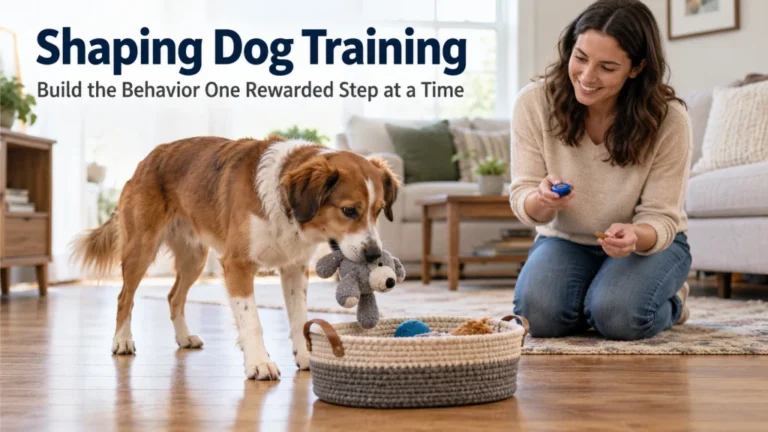
Clicker training for dogs works by marking the exact behavior you want, then following that marker with a reward the dog values. The click is not a cue and it is not the reward itself; its job is to make your timing clearer when the reward arrives a moment later. A short verbal marker can do the same job when it is distinct and used consistently. The practical goal is not lifelong dependence on a plastic device, but cleaner communication while a behavior is being learned.

Start with the timing gap, not the clicker
Clicker training for dogs is most useful when the behavior you want happens before you can deliver the reward. A dog may sit, touch a target, settle on a mat, or glance toward you, and the meaningful moment can be over before food reaches the mouth. The marker solves that communication gap by telling the dog which instant earned reinforcement. If you keep that purpose clear, the clicker stays a teaching tool instead of becoming another object the dog must stare at.
This fits inside the broader process of training a dog with clear, repeatable communication and the everyday foundation covered in basic dog training decisions. The important sequence is behavior, marker, then reward, not clicker, command, repeated clicking, and finally a treat after the dog has moved on. I would focus first on whether the marker tells the dog exactly what was correct. Once that is clean, the choice between a mechanical click and a word becomes much easier.
Decide whether to use a clicker or a verbal marker
A clicker has one practical advantage: the sound is brief, consistent, and unusual in ordinary household conversation. That can make precise timing easier for an owner who tends to stretch a word into praise or change tone from one repetition to the next. A verbal marker can still work very well when it is short, clear, and delivered the same way each time. The better choice is the one you can produce accurately without fumbling, delaying, or adding extra signals.
Household consistency matters too. If several people train the same dog, they should agree on what the chosen marker means and avoid turning every approving word into a training marker. A clicker can help because the sound is standardized, while a verbal marker is easier when your hands are occupied or the device is not nearby. Neither option has special power by itself. The useful test is whether the dog can reliably hear or perceive the marker and whether the humans can use it with clean timing.
If you do choose a clicker, prioritize handling over extra features. It should be easy to press with one hand, easy to hold without slipping, and quick to reach so the device does not slow your marker timing. The sound should be distinct enough for the dog to notice without being unnecessarily sharp for the setting. A simpler tool that stays ready in your hand is more useful than one that makes you look down, reposition your grip, or miss the behavior you meant to mark.
| Marker option | Practical strength | When it can get messy |
|---|---|---|
| Mechanical clicker | Very consistent sound and easy to separate from ordinary speech | Can slow the handler down if it is hard to hold or reach |
| Verbal marker | Always available and easy to use during daily life | Tone, length, and wording can drift between people |
The table is not a ranking. Choose the format that gives your dog the clearest signal in the situation you are actually training, then keep that meaning stable. If timing becomes clumsy with a handheld device, a clear word may be the better practical choice. If household speech makes the word inconsistent, the clicker may create a cleaner signal.
Pair the marker with reinforcement before asking it to carry meaning
A new click or marker word starts as noise until the dog learns that it predicts something worthwhile. Build that association in a quiet setting by marking and then delivering a reward the dog actually wants. At this stage, you are not testing obedience or asking for a polished behavior. You are teaching one simple communication rule: that sound means reinforcement is coming.
Keep the order clean so the reward does not become the thing that prompts the behavior before the marker has meaning. If your hand dives into the treat pouch first, the dog may focus on that movement rather than the sound you are trying to establish. I would prepare rewards so they are easy to deliver, keep the marker hand quiet, and avoid extra chatter between the marker and the reward. The association becomes useful when the marker can stand out from everything else you are doing.
- Choose one marker for the training task.
- Mark first, then deliver the reward.
- Use a reward the dog values in that context.
- Keep unrelated words and gestures out of the sequence.
You do not need to turn this into a long ritual. Once the dog clearly treats the marker as useful information, start applying it to real behavior instead of endlessly pairing sound and food. Keep the setup easy enough that you can still deliver the reward calmly and consistently. The point is to establish meaning, then use that meaning when an actual training decision appears.
Mark the exact moment the desired behavior occurs
The marker should land on the behavior you want repeated, not on whatever the dog happens to be doing when the reward arrives. If you are teaching a sit, mark when the rear reaches the floor rather than after the dog has stood up and stepped toward your hand. If you are capturing calm behavior, mark the quiet posture itself rather than waiting until the dog gets excited by your movement. Precision matters because the dog can only learn from the information you consistently provide.
Owners often think the solution to poor timing is to move the reward faster, but that is exactly the problem a marker is designed to solve. The reward can arrive after the marked instant as long as the marker has a reliable history of predicting reinforcement. This lets you reinforce actions that are brief, occur at a distance, or would disappear if you moved toward the dog too soon. Your job is to watch the body closely enough to mark the right frame of the behavior.
A simple handler drill can sharpen that timing before you involve the dog. Have another person drop a soft object from a low height and press the clicker at the exact instant the object touches the floor, or use another harmless visual event with a clear start and finish. Repeat until your click reliably lands on the event instead of before or after it. The drill is not dog training by itself, but it exposes slow hands and anticipatory clicking before those mistakes become part of a real session.
Keep the marker separate from the cue
A cue asks for a behavior; a marker tells the dog that a behavior just earned reinforcement. Mixing those jobs can make training harder to read because the dog no longer knows whether a sound means act now or reinforcement is on the way. The clicker should not be waved like a remote control to make the dog sit, come, or look at you. A marker word should not gradually become a repeated command either.
This distinction becomes especially useful when you add a cue after a behavior is already happening predictably. Say or show the cue before the behavior, then mark the correct response after it occurs. If the dog does not respond, avoid spraying the cue and marker together in hopes that one of them works. Reset the situation, make the requested behavior easier to understand, and preserve the marker for successful moments.
Follow the marker with the promised reward
During marker training, the marker should remain trustworthy. If you click and then sometimes decide the behavior was not good enough, the sound stops being a clear promise and starts becoming uncertain background noise. That does not mean every training reward must be identical, but the marked event should lead to reinforcement. The marker identifies the behavior, while the reinforcer is what makes that behavior more likely to be worth repeating.
The larger learning method belongs to positive reinforcement dog training, while reward choice and delivery deserve separate attention in choosing dog training treats. Food is convenient for many dogs, but a useful reinforcer can also be another outcome the dog genuinely values in that situation. What matters here is the communication contract between marker and reward. Do not weaken that contract by clicking casually when you have no intention of reinforcing what you marked.
Use the marker with luring, capturing, or shaping
The same marker can support several ways of teaching without becoming the teaching method itself. With luring, the marker tells the dog which part of following the lure earned reinforcement. With capturing, you wait for a useful behavior to happen naturally and mark it when it appears. With shaping, you mark small steps that move toward a more complete behavior rather than waiting for the final version all at once.
The marker therefore stays in the same role even when the teaching setup changes. If you want to build behavior through successive steps, shaping in dog training needs its own criteria plan so you know which approximation earns the next mark. If you are luring, the practical goal is to avoid making the visible reward hand the permanent cue. If you are capturing, be ready before the behavior happens so your marker does not arrive after the dog has already switched to something else.
Fix common timing and double marker mistakes
The most common marker problems are usually human communication problems, not proof that the dog is incapable of learning the system. Clicking late, saying the marker after reaching for food, repeating the cue, or stacking a click and a verbal marker can blur the exact event you meant to reinforce. If you use both a clicker and a word, give each one a clear purpose instead of automatically firing both for the same moment. Simpler communication is usually easier for everyone to maintain.
When a training session feels messy, stop increasing difficulty and inspect the sequence. Ask what the cue was, what behavior happened, exactly when you marked, and what reinforcement followed. That small audit often reveals that the dog was marked for standing after a sit, looking at the food pouch, or moving toward the handler rather than for the intended action. Clean up the sequence before changing tools or assuming the marker itself has failed.
| Mistake | What the dog may experience | Cleaner approach |
|---|---|---|
| Clicking after the behavior has ended | The marker may point to the next movement instead | Watch for the exact body position or action you want to reinforce |
| Reaching for food before marking | The food movement can become the most noticeable signal | Mark first, then move to deliver the reward |
| Clicking and saying the same marker together every time | Two signals compete to do one job | Use one clear marker at a time unless you have a defined reason for separate signals |
| Clicking with no reward afterward | The marker becomes less dependable as a predictor | Reinforce each marked event while using the teaching marker |
If you see one of these patterns, change the handler routine before changing the dog training goal. A cleaner marker sequence often fixes confusion faster than adding more words, gestures, or equipment. Practice the human sequence without asking for a harder behavior until the order feels predictable. Then return to training with one cue, one clear marker, and one planned reinforcement path.
Transition away from the teaching marker after the behavior is learned
A clicker is most valuable while you are teaching or sharpening a behavior, not as a permanent requirement for every successful response. Once the dog reliably understands the cue and can perform the behavior in the conditions you have trained, you can stop marking every ordinary repetition. The cue should become the information that starts the behavior, while reinforcement continues in ways that make sense for the task and the stage of learning. This is how the dog becomes responsive to the cue rather than dependent on seeing a clicker.
Fade the teaching marker because the behavior is becoming reliable, not because rewards suddenly stop mattering. New environments, harder distractions, or a more demanding version of the behavior can make the task feel new again, and a clear marker may become useful during that learning step. I would bring the marker back when precision needs rebuilding, then reduce it again as the response becomes stable. The device is allowed to come and go because the communication system is what matters.
- Teach the behavior with a clear marker and reliable reinforcement.
- Add the cue when the behavior is predictable enough to connect cue and action.
- Practice until the cue reliably produces the behavior in the trained setting.
- Use the teaching marker less often for routine repetitions that are already understood.
- Bring the marker back when teaching a harder version or rebuilding precision.
That sequence keeps the clicker in its proper place. It is a precision tool for learning, not proof that the dog can only perform when the plastic device is present. A reliable cue should eventually make the expected behavior clear without the dog waiting to see the clicker first. Use the marker again when it adds useful information, not simply because it was part of the earliest training sessions.
Final Thoughts: precision matters more than the plastic device
A good marker makes one moment easy for the dog to identify. Whether you use a clicker or a short word, clean timing and consistent follow through matter more than the device itself. Keep the cue and marker in separate jobs, avoid double marking out of habit, and make each marked event worth trusting. Those habits make the system easier for the dog to read and easier for the household to repeat.
As the behavior becomes reliable, let the teaching marker fade into the background instead of turning it into a permanent prop. Keep reinforcing behavior appropriately, and bring the marker back when you need to teach a new detail or sharpen timing again. If a session starts falling apart, inspect the sequence before adding more commands or equipment. Clear communication usually starts with a cleaner moment, not a louder click.
FAQs
🐾 Can I use a word instead of a clicker?
Yes. Use a short, distinct word consistently, then follow it with reinforcement just as you would after a click. A clicker can be easier for very precise timing, while a verbal marker is easier when your hands are busy.
🎯 Should I click and say yes at the same time?
Usually there is no practical need to stack two markers for the same job. Pick one clear marker for that repetition so the dog gets one precise signal. If you teach multiple markers, give them deliberate meanings rather than using them automatically together.
🍗 Does every click need a reward?
While you are using the click as a teaching marker, follow it with reinforcement so the sound remains dependable. You can reduce use of the marker as the behavior becomes learned instead of clicking and then withholding the promised outcome.
🗣️ Is the clicker a command?
No. A cue asks for behavior, while the click marks behavior that just earned reinforcement. Keep those roles separate so the dog knows what starts the action and what confirms success.
🧠 Will my dog become dependent on the clicker?
Not if you use it as a teaching tool and fade it after the cue and behavior are reliable. Bring it back when teaching a new detail, working in a harder setting, or rebuilding precise timing.
References and Sources
- American Kennel Club clicker training guide: Supports marker function, timing, pairing the marker with reinforcement, verbal marker alternatives, use with luring, capturing and shaping, and fading the marker after learning.
- Purina beginner clicker training guide: Corroborates the distinction between the click and the reward, consistent marker use, cue development, generalization, and continued reinforcement after a marked behavior.