A vacuum for dog hair should match the home’s floor mix, furniture, shedding load, and cleaning routine instead of relying on the word pet on the box. Independent testing can show fur pickup, but ownership also depends on brushroll access, emptying, tools, runtime, and maintenance. Upright, canister, stick, and handheld capable designs solve different problems, so choose the format that performs well on the surfaces you actually clean without creating a routine you will avoid.
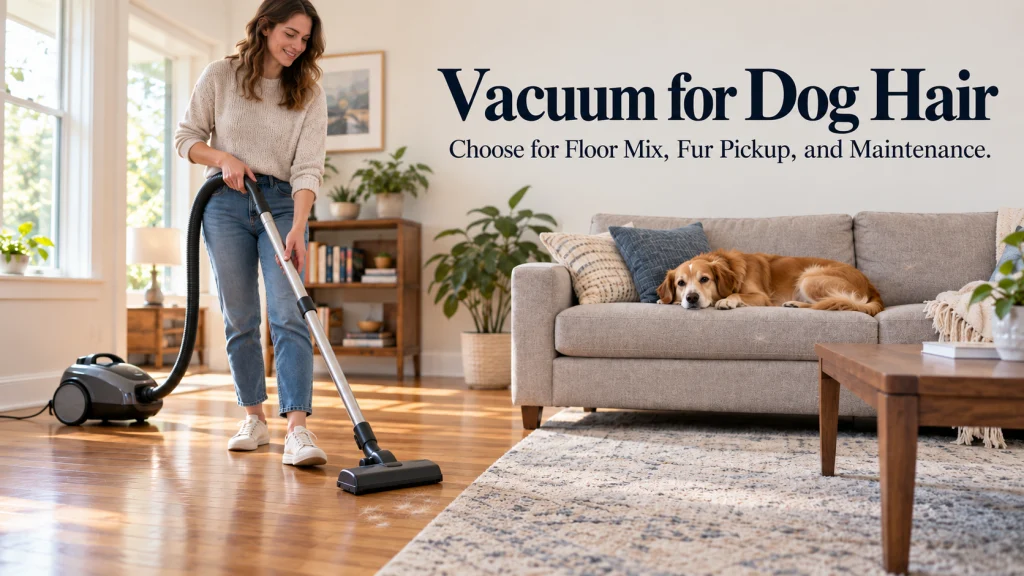
Choose for surfaces and maintenance, not the pet label
A vacuum for dog hair can look excellent on paper and still be a poor fit for the home using it. Thick carpet asks more from a floorhead than hard flooring, stairs make weight and hose reach matter, and a couch can expose weaknesses that never appear during floor cleaning. Start with the surfaces that collect the most fur and the amount of cleanup you are willing to do after each session. The word pet is useful only when the machine’s actual design and tested performance support the job.
For the broader household routine, keeping a home clean with dogs starts with where hair, dirt, and other messes actually collect. When loose fur is the main problem, the dog hair removal guide helps separate vacuuming from manual tools and automated floor cleanup. That distinction matters because no single vacuum format is equally convenient on carpet, hard floors, stairs, upholstery, and tight spaces. A useful buying decision begins with the home’s cleaning pattern and works backward to the machine.
Start with independent pet hair tests instead of suction marketing
Suction figures can describe part of a vacuum system, but they do not tell you how the floorhead, brushroll, seals, airflow path, and surface settings work together on fur. Independent pet hair tests are more useful because they put the machine on a defined surface and evaluate what remains after controlled cleaning. The test conditions still matter, so a strong result on one carpet type should not be treated as a guarantee for every rug or floor in a home. Read the method before treating a score or rank as a verdict.
RTINGS separates pet hair pickup from hard floor pickup, furniture performance, filtration, emptying behavior, and form factor, while Consumer Reports uses its own lab testing to identify vacuums that stand out on pet hair. Those sources are most useful when they agree on a broad strength or when their different methods expose a tradeoff. Neither source replaces exact model verification for attachments, battery configuration, bags, filters, warranty, or support. Use independent testing to narrow the field, then use manufacturer documentation to confirm the machine you are actually considering.
| Test source | Most useful for | What to extract | What not to assume |
|---|---|---|---|
| RTINGS | Cross surface tradeoffs | Pickup, furniture, hard floors, brushroll, filtration, emptying, form factor, availability | One score does not prove household fit |
| Consumer Reports | Pet hair lab testing | Fur pickup and category context | A lab pick does not verify the exact current variant |
Compare like with like. A cordless stick should not win by convenience if your hardest job is deep carpet, and a corded machine should not win by carpet strength if most cleaning is a short daily pass across hard floors.
Choose an upright or canister when deep carpet cleaning and long sessions matter most
Upright and canister vacuums make the most sense when the main job includes substantial carpet, larger rooms, or cleaning sessions that would be annoying to interrupt for charging. A powered brushroll or powerhead can help work fur out of carpet fibers, but the useful feature is the tested result on the carpet type, not the presence of a motor by itself. An upright keeps the main machine in one body, which can simplify straight runs across open carpet. A canister moves the main body separately, which can make the cleaning head easier to position around furniture even though storage can take more planning.
Weight and reach should be judged against the home’s layout rather than against a spec sheet in isolation. A strong full size machine may be easy on one level but frustrating if it must be carried between floors, and a long hose can matter more than raw capacity when stairs are part of every cleaning session. A cordless stick reduces setup effort, but battery limits and smaller bins can become more important as carpet area and shedding load increase. Compare the formats by the job you repeat most often instead of treating one design as the universal premium choice.
| Format | Best fit | Main strengths | Main ownership tradeoff |
|---|---|---|---|
| Upright | Large carpeted areas | Unlimited runtime and direct carpet cleaning | Bulk on stairs and above floor work |
| Canister | Carpet, furniture, and stairs | Unlimited runtime and flexible hose reach | More storage and possible bag costs |
| Cordless stick | Frequent mixed floor cleanup | Fast setup and easy movement | Battery and smaller bin limits |
Use the table to eliminate the wrong format before comparing features. If two formats still fit, let tested pickup on your hardest surface, furniture access, storage, and maintenance burden break the tie.
Choose a cordless stick when frequent grab and go cleanup matters more than unlimited runtime
A cordless stick can be a strong fit for homes where dog hair appears every day in small amounts and the vacuum needs to be easy to reach. The advantage is not simply that it has no cord; it is that low setup effort can make short cleaning sessions more practical around feeding areas, hallways, rugs, and the sofa. That convenience matters only if pickup is strong enough for the surfaces it sees most often. A light vacuum that leaves embedded fur behind on the main carpet may still force you to use a second machine.
Runtime claims also need context because battery life changes with power level, floorhead use, surface resistance, and battery condition. Think in terms of the cleaning route: the rooms you actually cover before the machine returns to storage. If your routine is several short sessions, a cordless design may fit even when maximum runtime looks modest. If you regularly clean a large carpeted home in one continuous pass, charging and battery management become part of the ownership burden rather than a minor specification.
Treat handheld capability and upholstery tools as a separate furniture decision
Furniture changes the vacuum decision because fur on upholstery is not the same task as fur on an open floor. The tool has to stay in contact with fabric, reach cushion seams, and move hair without becoming awkward at the wrist or hose. A vacuum that converts to handheld use can be convenient, but conversion alone does not prove that the included furniture tool works well on embedded hair. Look for independent furniture testing when it exists and inspect the actual tool shape, brush action, width, and cleaning access.
Also consider where the dog spends time rather than assuming every attachment needs to do everything. A narrow tool may be useful for stair edges and seat seams, while a wider powered tool may suit a large couch but feel excessive for a small chair. Check whether wrapped hair can be removed from the tool without dismantling half the accessory, and confirm that replacement parts remain available for components that wear. The best furniture setup is the one you can move, clean, and store without turning a quick couch pass into a separate project.
Compare carpet and hard floor pickup across the home’s real floor mix
A mixed floor home needs more than one strong headline score. Carpet rewards agitation that helps release embedded hair, while hard floors can expose a different problem if a spinning brush scatters light debris or if the head does not seal well around edges. Area rugs add another variable because a floorhead that moves easily on one carpet can grab or bunch a lighter rug. Write down the surfaces that cover the largest areas and the surfaces where dog hair is most visible before comparing machines.
A simple floor mix check keeps the decision practical. If most fur lands on hard flooring with only a few low rugs, smooth movement, edge pickup, and brush control may matter more than maximum carpet aggression. If the dog spends much of the day on carpet, pet hair pickup on carpet and brushroll behavior should carry more weight. For a balanced home, choose the machine that avoids a serious weakness on either surface rather than chasing the highest score in only one test.
| Home condition | What to check first | Common tradeoff |
|---|---|---|
| Mostly hard floors | Hard floor pickup, brush control, edges | Carpet focused agitation may be unnecessary |
| Mostly carpet | Pet hair pickup, floorhead, brushroll access | Powered heads can add bulk |
| Mixed floors and rugs | Surface changes and rug behavior | One setting may not suit every surface |
| Stairs and furniture | Reach and upholstery tools | Capacity can add bulk |
The table is a starting point, not a ranking. Give the hardest recurring surface enough weight to prevent buyer regret, then make sure the rest of the home does not become unnecessarily difficult to clean.
Check brushroll access and how much hair removal the machine requires
Long dog hair can turn brushroll maintenance into a recurring ownership task even when pickup is strong. Designs intended to reduce tangles may reduce wrapping, but the practical question is how much hair remains around the roller after the kind of cleaning you do and how easily you can remove it. A removable brushroll can make access easier, while a fixed design may still be acceptable if the housing opens clearly and the roller is easy to reach. Do not assume the words automatic hair clearing mean the brushroll will never need manual attention.
Inspect the cleaning path before buying: floorhead, roller, intake, hose bends, filters, and the point where debris enters the bin or bag. Hair that collects in one hidden bend can create more frustration than a visible strand around the roller because it is harder to diagnose and clear. Check the manual for the intended cleaning procedure rather than using blades or improvised tools near belts, wiring, or soft components. A machine that performs well but is unpleasant to clear after every session may be the wrong match for a heavy shedding household.
- Can you reach the brushroll without a complicated teardown?
- Does the manual explain how to clear wrapped hair safely?
- Are filters, belts, bags, or rollers easy to identify and replace?
- Can you inspect common clog points without special repair work?
Use this checklist before comparing convenience features. Maintenance that is simple on the first day is more likely to stay simple after repeated exposure to fur, dust, and debris.
Compare bagged and bagless emptying by capacity, debris contact, and recurring consumables
Bagged and bagless vacuums handle the same fur very differently after it leaves the floor. A bagged design contains debris in a replaceable bag, which can reduce how much loose hair you handle during emptying, but it creates an ongoing need to keep compatible bags on hand. A bagless bin avoids that consumable, yet the bin, shroud, screens, and seals may need more direct cleaning. Capacity matters in both cases because heavy shedding can fill a small container surprisingly quickly.
Choose the ownership pattern you are more likely to maintain consistently. A household that dislikes washing or brushing dust from bin components may prefer the simpler disposal routine of a bag, while someone who wants to avoid recurring bag purchases may accept more direct bin maintenance. Check the manufacturer’s replacement schedule for filters and other consumables because bagless does not automatically mean zero recurring parts. The better choice is the system whose emptying and maintenance routine fits the household, not a universal winner.
| Ownership question | Bagged | Bagless |
|---|---|---|
| Debris disposal | Remove and replace the bag | Empty and clean the bin as directed |
| Recurring supplies | Bags plus any required filters | Filters or other parts as specified |
| Direct contact with fur | Usually less during disposal | Often more during bin cleaning |
| Capacity check | Bag size and fill indicator if provided | Bin size and practical emptying frequency |
Compare the whole maintenance cycle rather than just the purchase price. Consumables, cleaning time, storage for spare parts, and how often you empty the machine all contribute to long term fit.
Check battery runtime, charging behavior, and the replacement path for cordless models
For a cordless vacuum, the battery is part of the cleaning system rather than a convenience detail. Published runtime can be useful, but the number only matters when you know the power mode, floorhead, and test conditions behind it. Carpet and powered tools can demand more energy than lighter hard floor work, so the maximum claim may not describe your normal route. Estimate how long your usual cleanup takes and compare that with realistic operating conditions, not the most favorable number on the box.
Then look past the first charge cycle. Check whether the battery is removable, whether replacements are sold through a clear support path, and whether charging requires the entire vacuum to stay near an outlet. A replaceable battery can extend practical service life, but only if the exact compatible battery remains identifiable and obtainable. If battery replacement is unclear, treat that uncertainty as part of the ownership cost before choosing cordless convenience.
Treat filtration as a machine feature, not an allergy treatment claim
Filtration matters because a vacuum does more than collect visible hair; it also moves air through filters, seals, joints, and the exhaust path. Independent particle or emissions testing can help show whether a machine contains fine material effectively under the test conditions. A filter label by itself does not prove that the entire vacuum is sealed equally well, and it does not justify a medical promise. Compare whole machine test results when available and keep the conclusion limited to containment performance.
Maintenance still matters because filters work only as part of a complete system. Check whether filters are washable or replaceable, how the manufacturer says to clean them, and whether the machine must be fully dry before reassembly when washing is allowed. Do not invent a replacement interval if the manufacturer does not give one for the exact model. If a household member has a medical concern related to allergens, vacuum selection should not be presented as treatment or a substitute for appropriate health guidance.
Build a current shortlist around the job before checking exact models
Current independent testing keeps upright, canister, cordless stick, and handheld capable systems in play for pet hair for different reasons. The useful shortlist is therefore not a pile of machines with the word pet in the name. It is a small set of form factors tied to the hardest recurring job in the home, with exact models added only after pickup, tool, maintenance, and support details are verified. This keeps the buying decision current without pretending one model should fit every household.
Start with the row that best matches the home, then verify the exact machine against current independent results and manufacturer documentation. Remove any candidate whose main strength solves a problem you do not have, or whose battery, bag, filter, floorhead, upholstery tool, or replacement path cannot be confirmed. If two candidates survive, prefer the one with fewer compromises on the surfaces and tasks you repeat most often. A shortlist is finished when every remaining option has a clear job and a clear reason to skip it.
| Primary household job | Shortlist first | Verify before keeping it | Skip when |
|---|---|---|---|
| Deep carpet and long sessions | Upright or powered canister | Pickup, carpet behavior, brushroll, capacity | Weight or storage hurts routine use |
| Mixed floors and daily shedding | Cordless stick | Pickup, runtime, bin, battery support | The route exceeds practical runtime |
| Carpet, couches, and stairs | Canister or handheld capable system | Furniture pickup, tool, reach, storage | The setup is too bulky |
| Small furniture and spot pickup | Handheld capable system | Furniture pickup, battery, bin | You need full floor cleaning |
This is intentionally a job based shortlist rather than a model ranking. Exact products change, but the household constraints that make one format sensible and another frustrating are more stable and easier to verify before purchase.
Choose a robot instead when daily autonomous floor pickup is the primary job
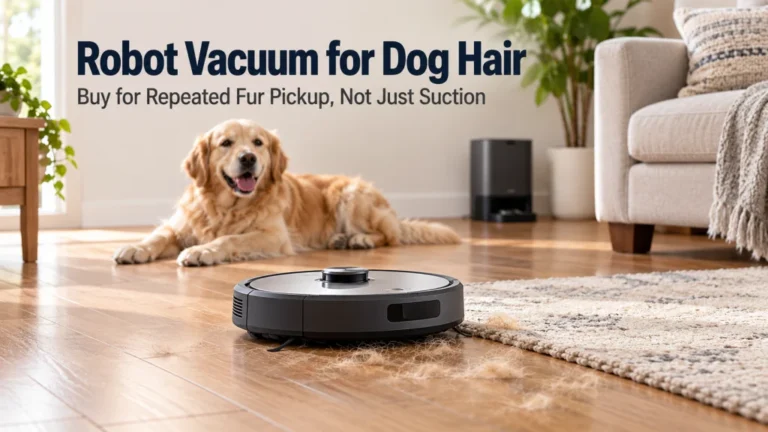
A conventional vacuum is not always the most useful answer when the main problem is loose fur appearing across open floors every day. A robot vacuum trades manual control and deep spot work for scheduled autonomous pickup, which can reduce how much loose hair accumulates between full cleaning sessions. That is a different job from choosing an upright, canister, or stick for deliberate floor and furniture cleaning. Homes with clutter, cords, pet bowls, thresholds, or complex rugs also need to account for navigation and setup burden.
If scheduled floor cleanup is the priority, use the separate guide to choosing a robot vacuum for dog hair rather than forcing a conventional machine to solve an automation problem. A robot can complement a deeper cleaning vacuum, but that does not mean every home needs two machines. Decide whether autonomous maintenance actually changes the workload enough to justify charging space, bin care, brush cleaning, and floor preparation. If not, a conventional vacuum used consistently may be the simpler system.
Use a manual remover when the problem is one couch, garment, or small embedded patch
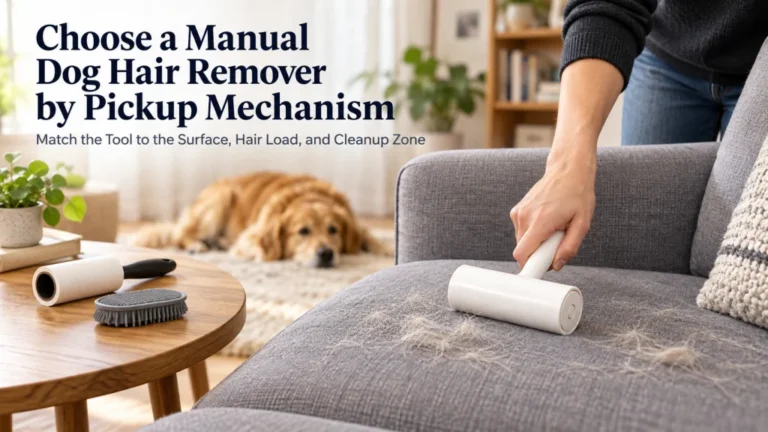
Buying another powered machine can be excessive when the real problem is a narrow patch of stubborn fur. A couch cushion, fabric chair, car seat, or garment may respond better to a manual tool that gives direct contact and control over a small area. Manual removal can also avoid dragging out a full vacuum for a task that takes only a minute. The tradeoff is effort, especially when the surface is large or fur is spread through several rooms.
For those small jobs, the dog hair remover guide focuses on nonpowered methods and surface fit. Use it when the area is limited enough that manual passes are realistic and when the material can tolerate the chosen tool. If you are repeatedly clearing whole rooms, several rugs, and upholstered furniture, a vacuum remains the more scalable choice. The goal is to match the tool to the size and location of the hair problem instead of buying power for its own sake.
Final Thoughts: choose the tested machine that fits the home’s surfaces and maintenance tolerance
The right dog hair vacuum is not defined by a pet label, the highest suction claim, or a single overall score. Start with the home’s hardest recurring surface, then compare independent pet hair pickup, floorhead behavior, furniture access, brushroll cleaning, capacity, emptying, runtime, and recurring parts. Give extra weight to the tasks you perform most often, because a strong machine that is awkward to use can become the one that stays in the closet. A simpler format can be the better choice when it handles the real workload with less friction.
Before buying, verify the exact model and included tools against current manufacturer information, then check whether replacement bags, filters, batteries, and other routine parts have a clear support path. Skip any feature that sounds impressive but does not solve a surface, access, maintenance, or workload problem in your home. If the primary need is autonomous floor pickup, consider a robot; if the problem is one small fabric area, consider a manual remover. The best fit is the tested machine, or simpler tool, that you can use and maintain consistently.
FAQs
🐕 What type of vacuum is best for dog hair?
There is no universal winner. Upright and canister designs suit many longer carpet sessions, while cordless sticks favor frequent cleanup, so choose by floor mix, furniture, stairs, and maintenance tolerance.
🧹 Does more suction always mean better pet hair pickup?
No. Pickup also depends on the floorhead, brushroll, surface settings, airflow path, and actual floor, so independent testing is more useful than a suction claim alone.
🛋️ What should I look for if my dog sheds on the couch?
Check furniture performance and the upholstery tool, including brush action, seam access, and cleaning. A vacuum that is strong on floors can still be awkward on cushions.
🔋 Is a cordless vacuum enough for a dog hair household?
It can be when short cleanups are the main job and tested pickup fits your floors. For large carpeted homes, runtime may make a corded design more practical.
🧺 Is bagged or bagless better for dog hair?
Choose by the emptying routine you prefer. Bags add consumables but can reduce debris handling, while bagless bins usually require more direct bin and filter maintenance.
🪮 How important is a tangle reducing brushroll?
It can reduce maintenance, but no label promises zero wrapping. Confirm that the brushroll is easy to access when manual cleaning is still needed.
References and Sources
- RTINGS pet hair vacuum testing: Supports pet hair pickup, floorhead, brushroll, form factor, filtration, furniture, emptying, and availability.
- Consumer Reports pet hair vacuum testing: Supports independent lab comparison of pet hair pickup across vacuum categories.
- RTINGS cordless pet hair vacuum testing: Supports cordless pickup, runtime, tools, and availability.