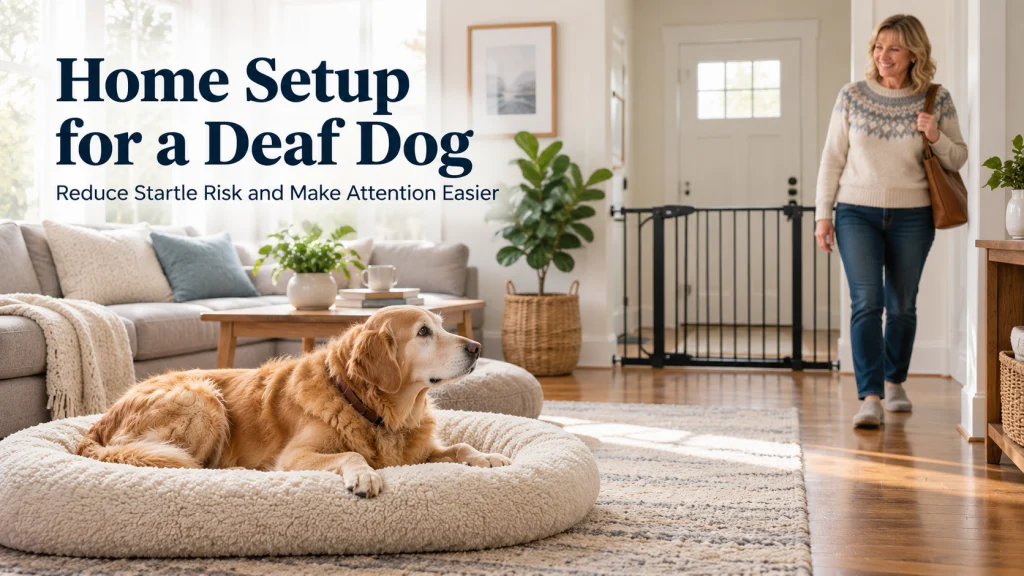
A practical home setup for a deaf dog should make people and household changes easier to notice before touch, movement, or an open door creates a surprise. The priorities are clear sight lines, predictable approach routines, simple light or floor vibration cues, secure exits, and a layout that stays familiar. New hearing loss still needs veterinary assessment because the home can reduce daily risk but cannot determine why hearing changed. If vision is also reduced, the setup should support both senses instead of assuming a visual cue will always work.
Make people noticeable before expecting a response
A useful home setup for a deaf dog starts with one change in household thinking: get the dog’s attention before expecting a response. A dog that cannot hear footsteps, a door opening, or a familiar voice may sleep through an arrival or become surprised when someone suddenly appears at close range. That does not mean the house needs to become silent or complicated. It means the setup should give the dog another way to notice that a person is approaching, moving through an exit, or asking for attention.
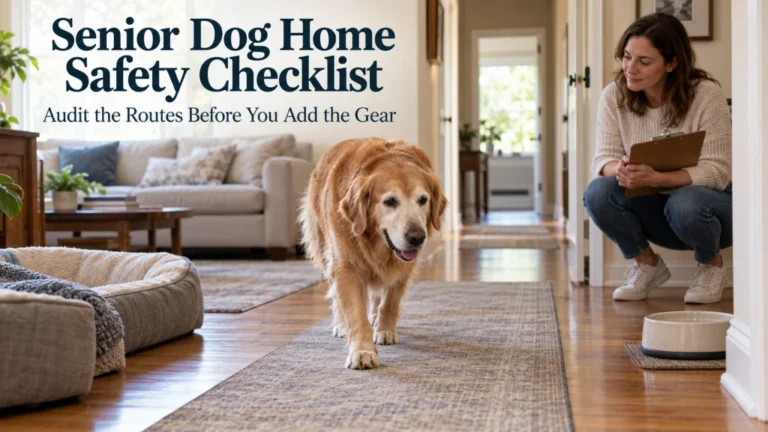
That approach fits the broader decisions involved in caring for an older dog as daily abilities change, while the physical layout belongs with other senior dog home modifications that reduce avoidable friction. In practice, the useful cues are often ordinary: seeing a person enter the room, feeling a footstep through a solid floor, noticing a room light change, or following a familiar doorway routine. The goal is not to make every moment perfectly predictable. The goal is to reduce situations where touch or movement happens before the dog has any chance to notice it.
Have new hearing loss assessed instead of assuming the dog is ignoring the household
A dog that stops responding to a name, sleeps through arrivals, or no longer reacts to familiar household sounds may have hearing loss, but those observations do not identify the cause. Age related change is one possibility, and veterinary sources also describe other causes of acquired deafness. A home noise check can tell you that the response has changed, but it cannot replace a veterinary examination or diagnostic testing. That boundary matters because the right household setup begins with knowing that a sensory change is real, not with labeling every missed cue as stubbornness.
While the assessment is being handled, manage the environment around what the dog can reliably perceive now. Avoid escalating volume, clapping close to the ears, or repeatedly testing the dog with startling sounds in an attempt to prove the hearing loss. Write down the situations in which the dog no longer responds, such as arrivals, verbal cues, or activity in another room, because patterns can be useful to discuss with the veterinarian. Once hearing loss is confirmed or strongly established, the home can shift from sound dependent routines toward visible, tactile, and environmental cues without pretending those changes are medical treatment.
Approach and wake the dog in a way that reduces surprise contact
Unexpected touch is most likely to be startling when the dog is asleep, facing away, or focused on something else. Whenever possible, enter the dog’s field of view first and give a moment for recognition before reaching in. On a floor that carries vibration, a deliberate step nearby may make your approach noticeable without touching the dog. If the dog is sleeping deeply, use the same calm waking routine consistently rather than switching among sudden touch, loud sound, and unpredictable handling.
- Move into the dog’s field of view when the room layout allows it.
- If the dog is not looking toward you, use a mild floor vibration or another familiar environmental cue that has produced a calm response before.
- Wait for the dog to orient toward you before closing the distance.
- Reach in or touch only after the dog is awake and aware of your presence.
Use that sequence as a household routine rather than a test the dog has to pass. A dog that does not notice the first cue may simply be sleeping deeply, facing away, or standing on a surface that carries little vibration, so change your position instead of making the cue harsher. Children and visitors should follow the same rule: make yourself noticeable before petting, hugging, stepping over, or reaching toward a resting dog. Formal work on changing a startle response belongs in a training plan, while the home setup should first reduce how often surprise contact is created in the first place.
Keep sight lines useful in the rooms where family members approach most often
A deaf dog does not need an empty room, but visual access becomes more useful when people can enter without repeatedly appearing from behind furniture. Look at the places where the dog commonly rests and notice whether a sofa back, tall storage unit, kitchen island, or narrow hallway hides the usual approach path. Small placement changes can help, such as turning a bed so the dog can see the main doorway or keeping the favored resting spot out of a blind corner. The best arrangement depends on where the dog naturally chooses to rest, not on forcing every room into the same layout.
Useful sight lines also need to coexist with a stable, comfortable routine. Moving furniture every few days to improve visibility can create a different problem, especially for a senior dog that relies on familiar paths. Instead, prioritize the rooms where approach conflicts actually happen and make the fewest changes needed to improve awareness. The examples below show what that can look like without redesigning the whole house.
| Room or resting area | Common visibility problem | Simple arrangement change |
|---|---|---|
| Living room dog bed | A sofa back blocks the main doorway from the dog’s resting position. | Turn or shift the bed so the dog can see the doorway while keeping the usual resting zone familiar. |
| Kitchen resting spot | People appear suddenly from behind an island or tall cabinet. | Move the resting spot far enough to the side that the normal walking path enters the dog’s field of view sooner. |
| Bedroom sleeping area | A person must approach from behind the bed or step across the dog’s space. | Place the bed where one consistent approach path remains open and visible. |
Use the same logic as a quick room check: can the dog see the doorway or main walking path, can a person move into view before reaching down, and can the layout stay consistent afterward? If those answers are mostly yes, the room is already doing much of the work. If not, adjust the resting position or approach path before adding more equipment. The purpose is to make ordinary household movement easier to read, not to build a special room that separates the dog from normal family life.
Use light or floor vibration as an attention signal without making it aversive
Light changes and floor vibration can be useful because they can reach a dog that is not looking directly at a person. A brief room light flick or a deliberate footstep on a floor that carries vibration may prompt the dog to look up, at which point normal visual communication can continue. These cues should be mild, predictable, and used to invite attention rather than to frighten the dog into responding. Do not flash a bright beam into the dog’s eyes, pound the floor aggressively, or assume every dog will perceive the same vibration in the same way.
Start with the least intrusive environmental signal that reliably gets a calm orientation response. If a dog ignores a light change but notices a nearby floor vibration, use the cue that works in that room instead of escalating intensity. A powered vibration device should not be treated as automatically appropriate just because the dog is deaf, and an aversive device is not an acceptable shortcut for getting attention. The household job is simply to create a gentle signal that means, in effect, look toward the person now.
Add a second barrier where an open exterior door creates an escape risk
An exterior door is a higher risk point when a dog cannot hear someone entering, a delivery arriving, or a verbal warning to stay back. The strongest home change is often not another cue but a second physical layer between the dog and the outside opening. Depending on the room, that may be a closed interior door, a properly fitted gate, or another secure separation point that keeps the dog from reaching the exterior threshold while people come and go. The barrier should suit the dog’s size, mobility, jumping ability, and household traffic rather than relying on a decorative divider that the dog can push through.
Door safety works best when the human routine is as predictable as the hardware. Decide which barrier closes before the exterior door opens, make sure every regular household member follows that order, and avoid leaving the system dependent on someone remembering a verbal cue the dog cannot hear. For guests, service visits, or busy entries, place the dog behind the secure inner boundary before the main door is used. That turns a moment of distraction into a contained setup problem rather than a recall test.
Keep the yard securely enclosed and maintain predictable exit routines
A deaf dog may not hear traffic, a person calling from behind, or another sound that would normally interrupt movement toward an unsafe area. For that reason, an unfenced outdoor space should not be treated as secure simply because the dog usually stays near the house. Veterinary guidance consistently emphasizes containment and leash use when a deaf dog is not in a safely enclosed area. At home, inspect the yard boundary, gate closure, and route from the door to the outdoor space as one connected system.
Predictable exits make that system easier for both dog and household. Use the same door when practical, pause at the same interior point while the exit is prepared, and confirm that the outer area is secure before the dog crosses the threshold. If a gate is used, check that it actually latches and cannot be pushed open by normal contact. The goal is not to create a formal recall exercise at the doorway; it is to remove the need for hearing based recall at the exact moment containment matters most.
Use the bedroom setup to make nighttime approaches and exits predictable
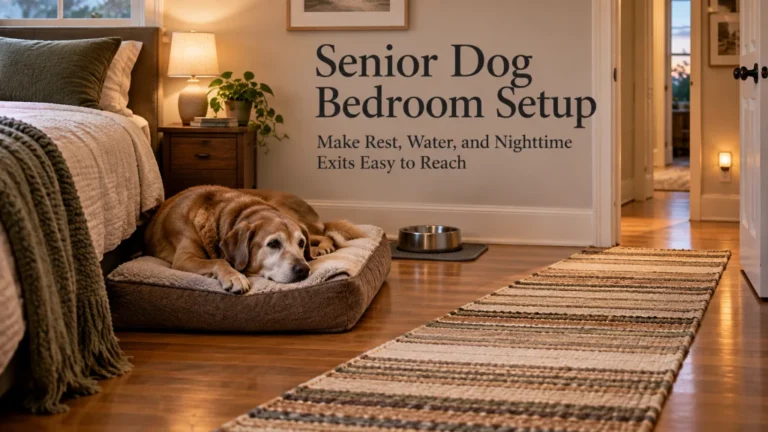
Nighttime can magnify the same communication problem because the dog may be asleep, the room may be dark, and people may move around without being seen. Place the sleeping area where a person can approach from a consistent direction instead of reaching over the dog from behind or stepping across the bed. Keep the path to the door clear, and avoid turning the sleeping spot into a traffic choke point. A low level room light may help a dog with useful vision notice movement, but it should not be assumed to solve the problem if vision is also declining.
The bedroom should also fit the dog’s mobility and comfort needs, not just hearing loss. If getting up, crossing a slippery surface, or reaching the exit is difficult, those constraints need their own setup decisions. The broader senior dog bedroom setup can help organize sleeping location, access, and overnight movement without turning every issue into a hearing problem. For the deaf dog specifically, keep the waking routine and exit route familiar so the first interaction after sleep is not a surprise.
Keep home arrangement separate from formal hand signal and startle training
The house can make communication easier, but it cannot teach every behavior the dog may need. Better sight lines, light cues, floor vibration, gates, and predictable approach patterns belong to environmental management because they change what happens around the dog. Teaching a visual recall, building a complete hand signal vocabulary, or deliberately changing a startle response requires a training process with timing, reinforcement, and progression. Keeping those jobs separate prevents a useful home article from quietly becoming a behavior program.
If the dog needs structured cue training, use a consistent system and move that work into basic dog training guidance or an appropriate professional plan. The table below is a practical boundary check for deciding whether a problem can be improved by the room itself or needs active training. Some households will use both at the same time, but they are still different jobs. Start with management when the immediate risk comes from an open door, hidden approach, or confusing layout.
| Household problem | Home arrangement job | Training job |
|---|---|---|
| The dog is surprised when someone enters behind the resting area. | Improve sight lines or change the approach path. | Build a calm response to planned attention cues if needed. |
| The dog can reach an exterior door while it is open. | Add a secure second barrier and change the entry routine. | Teach door manners or visual recall separately. |
| The dog cannot hear a verbal cue from across the room. | Use a mild visual or floor vibration signal to gain attention. | Teach the meaning of specific hand signals after attention is gained. |
| The dog startles during unexpected touch. | Reduce surprise approaches and make contact more predictable. | Use a structured behavior plan if startle conditioning is needed. |
This distinction also keeps expectations realistic. A gate does not teach recall, and a light flick does not teach a stay cue. Likewise, training does not make an unsecured exterior door physically secure when someone is distracted. Match the solution to the job instead of asking one tool or one skill to solve both problems.
Combine the setup with visual navigation changes when hearing and vision are both reduced
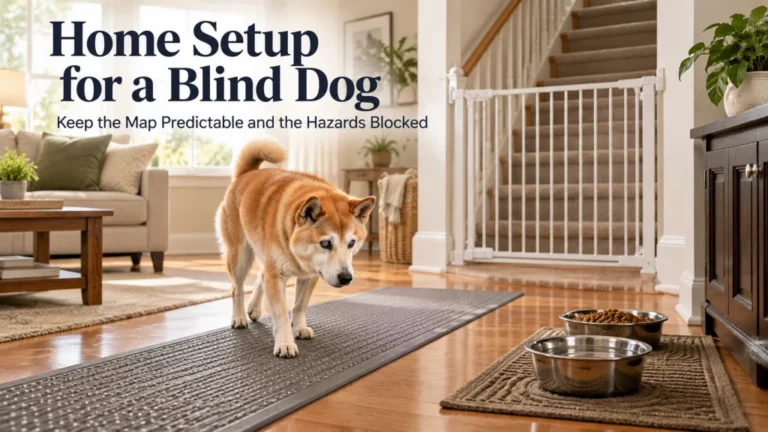
Visual communication becomes less dependable when a senior dog is also losing vision. A hand signal across the room, a person entering through a doorway, or a brief light change may not be useful if the dog cannot see it clearly. In that situation, do not keep making visual signals larger or brighter without considering the second sensory limitation. The home needs a combined plan that protects predictable routes, reduces obstacles, uses touch or vibration thoughtfully, and keeps important locations consistent.
The home setup for a blind dog covers navigation changes that belong to reduced vision rather than hearing loss alone. When both senses are affected, choose cues based on what the dog can still perceive reliably and keep the environment simple enough that those cues remain meaningful. Veterinary assessment matters here as well because a new change in vision or hearing should not be treated as a normal aging assumption without evaluation. The practical test is whether the dog can move through familiar spaces and notice household contact without being forced to depend on a sense that is no longer reliable.
Final Thoughts: make attention possible before contact happens
A good deaf dog home setup does not try to replace hearing with one perfect gadget or cue. It gives the dog several ordinary ways to notice what the household is doing, then removes the highest risk moments with secure doors, clear approaches, and familiar routines. Start with the places where surprise or escape risk actually happens instead of changing the entire house at once. The result should feel easier to live with, not more complicated.
Keep diagnosis and formal behavior work in the right hands while using the home to solve the environmental part of the problem. Verify new hearing loss with a veterinarian, make sleeping and doorway routines predictable, and use visual or vibration cues only when the dog responds to them calmly. If vision is also reduced, shift the setup again rather than expecting visual communication to carry the full load. The best arrangement is the one that lets the dog notice people before touch, movement, or an open exit becomes a surprise.
FAQs
🐾 How can I get a deaf dog’s attention inside the house?
Use a calm cue the dog can perceive, such as moving into view, a brief room light change, or a deliberate floor vibration. Once the dog looks toward you, continue with the visual cue or household routine you normally use.
😴 How should I wake a deaf dog without startling them?
Approach from a visible direction when possible and use the same gentle waking routine each time. Avoid sudden grabbing or repeated loud noise, and change the setup if the dog regularly wakes in alarm.
🚪 Should I use a gate near the front door for a deaf dog?
A secure second barrier can be useful when the dog can reach an exterior door during arrivals or departures. The barrier still has to fit the dog’s size, mobility, and ability to push, climb, or jump, so it should be chosen for the actual household setup.
💡 Is a flashing light a good signal for every deaf dog?
No. A mild light change can help some dogs orient toward you, but it should not be bright, startling, or directed into the eyes. If vision is reduced or the dog does not respond calmly, use another environmental cue.
🩺 Can I confirm hearing loss at home with sound tests?
At home observations can show that a dog’s response to sound has changed, but they do not identify the cause or replace veterinary assessment. New hearing loss should be evaluated rather than treated as proof that the dog is ignoring cues.
👀 What if my senior dog is losing both hearing and vision?
Do not rely on hand signals or light cues alone if the dog cannot see them reliably. Keep routes and important locations consistent, reduce surprise contact, and combine the hearing setup with appropriate visual navigation changes.
References and Sources
- American Animal Hospital Association: Supports veterinary assessment, predictable routines, light or floor vibration cues, secure yards, and door barriers for pets with sensory loss.
- American Kennel Club senior dog hearing loss guidance: Supports veterinary evaluation, visual communication, careful approaches, and outdoor safety for senior dogs with hearing loss.
- VCA Animal Hospitals: Supports acquired hearing loss context, avoiding surprise approaches, floor vibration cues, and containment in unsafe outdoor settings.