
Renting with a dog works best when written housing rules are checked before the dog is chosen, promised, purchased, or adopted. A listing that says pets are welcome may still have limits on dog size, type, number, documentation, charges, insurance, or future unit changes. The practical goal is to confirm that the current home permits the dog, understand the housing costs, and decide whether the same choice will leave enough flexibility when the next move comes. Questions about local law or assistance animals need separate official guidance rather than assumptions based on an ordinary pet policy.
Pet friendly is not specific enough
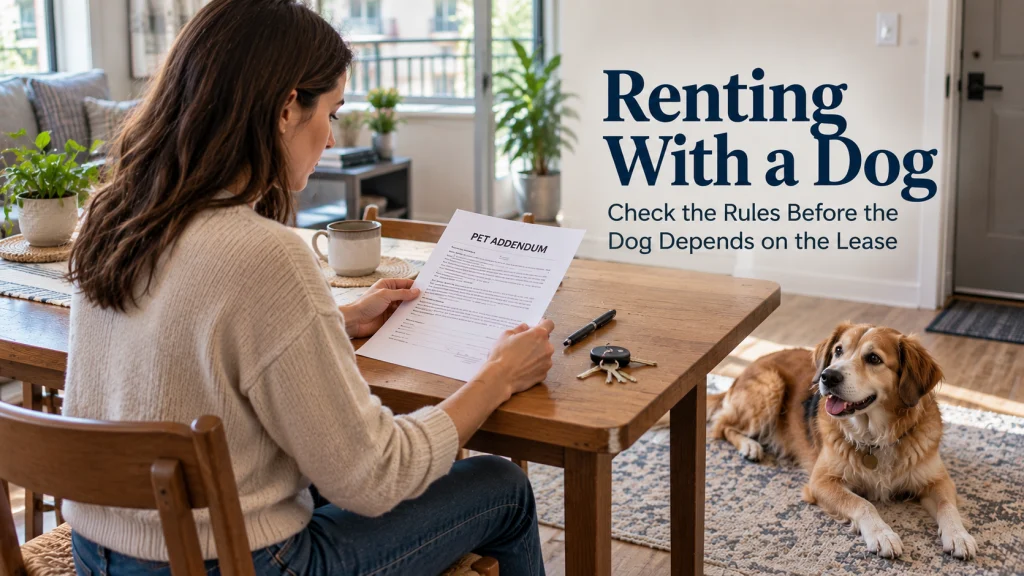
Renting with a dog starts with the written agreement, not the lobby sign, listing filter, or a casual yes from a leasing agent. Before a dog depends on the lease, compare the actual pet language with the broader decisions in what to check before getting a dog. A dog can fit your routine and still be a poor housing choice if the property does not allow that size, type, number of pets, or required documentation. The goal is not to find a building that likes dogs in general, but to verify that your expected dog fits the rules that apply to your unit.
That housing check also belongs inside the larger commitment described in practical dog care and ownership. A lease lasts for a limited period, while responsibility for the dog continues through renewals, job changes, moves, and changes in household budget. Written restrictions can therefore shape which dog is realistic before breed preference, appearance, or impulse takes over the decision. If the housing answer is vague, treat it as unresolved rather than translating it into permission.
Read the current lease before contacting a breeder or rescue
Start with every document that governs the tenancy, including the lease, any pet addendum, building rules, and notices that are incorporated into the agreement. Look for language about whether dogs are allowed, whether approval is required, and whether the rule applies to a specific animal rather than pets as a general category. Do not assume an old conversation controls if the current written documents say something different. When wording is unclear, ask the landlord or property manager which document controls and what process resolves the uncertainty.
A simple verification pass is more useful than reading the lease once and remembering only the word pet. Mark each rule that could affect acquisition, cost, or continued occupancy, then keep the relevant documents where you can compare them with the dog you are considering. If a shelter, rescue, or breeder asks whether the dog is allowed where you live, you should be able to answer from the current paperwork rather than from memory. This is a housing readiness check, not legal interpretation, so unclear legal language should go to an appropriate official or qualified source.
- Confirm whether dogs are allowed and whether approval must be completed before the dog moves in.
- Check for pet number, size, type, or other selection limits.
- Find every pet charge and note whether it is listed as recurring or one time.
- Check required forms, records, registration, or pet addendum language.
- Look for rules that apply to renewal, transfer, common areas, or a move to another unit.
- Flag any insurance requirement that needs a separate conversation with the property or insurer.
Once the checklist is complete, the useful result is not simply yes or no. You should know which conditions are already satisfied, which ones limit dog selection, and which ones still need a written answer before you commit. That distinction prevents a broad pet friendly label from hiding a rule that matters later. It also makes the next step, matching the dog to the restrictions, much more concrete.
List every written restriction that can change dog selection
Housing restrictions matter before acquisition because some of them change the set of dogs that can realistically stay with you. A size limit, pet count limit, or type restriction is not just a paperwork detail if it excludes the dog you are about to choose. Write each restriction in plain language and compare it with the actual dog or the range of dogs you are considering. For broader fit questions such as size, activity, age, and household match, move that part of the decision to choosing a dog for your life and home.
The table below is a handoff tool, not a recommendation to prefer one kind of dog over another. Its purpose is to show when a rental rule must be settled before the dog decision can continue. If a restriction is ambiguous, do not guess how a mixed breed, future adult size, or second pet will be classified. Ask the property how it applies the written rule, then keep that answer with the lease records if it affects your choice.
| Written restriction | What to verify before choosing a dog | Decision effect |
|---|---|---|
| Number of pets | Whether current animals already use part or all of the allowed total | May rule out adding a dog now |
| Dog size or weight rule | How the property applies the limit and what information it requires | May narrow the realistic size range |
| Dog type rule | The exact written wording and how the property applies it | May exclude a dog that otherwise fits the household |
| Approval or registration | What must be submitted and when approval is complete | May require clearance before acquisition or move in |
| Unit or building limits | Whether the rule changes by unit, building, or common area | May affect where you can live within the property |
Use the most restrictive unresolved item as the stop sign. If the property clearly allows one dog but you have not confirmed whether the size rule applies to the adult dog you want, the housing question is not finished. That approach keeps housing constraints from being discovered after an emotional commitment has already formed. It also avoids turning a dog selection problem into a later lease conflict.
Separate one time pet charges from recurring housing costs
Pet related housing costs are easier to evaluate when they are separated by frequency instead of combined into one vague number. A lease may describe an upfront charge, a deposit, recurring pet rent, screening cost, registration cost, or another property specific item, and the terms are not uniform across the country. Record the label exactly as the property uses it rather than assuming that two buildings mean the same thing by fee or deposit. If a charge or refund rule has legal implications, use the lease and appropriate local guidance instead of relying on a national rule of thumb.
Then place the recurring amount inside your wider ownership budget rather than treating it as a small housing footnote. The dog still brings normal food, veterinary, care, training, travel, and replacement costs, while pet rent or similar housing charges can continue as long as the tenancy does. A complete budget belongs with planning dog ownership costs, but this page should identify the housing line items that need to be carried into that calculation. The important question is whether the lease cost is affordable alongside the rest of the dog commitment, not whether the first payment alone is manageable.
| Housing line item | Frequency to record | What to verify |
|---|---|---|
| Pet deposit or similar security amount | As written in the lease | Amount, conditions, and applicable written terms |
| Pet fee or registration charge | One time or as stated | Whether it is per pet and when it is due |
| Pet rent | Recurring | Amount, billing schedule, and whether it changes by pet count |
| Screening or administration cost | As stated | Whether it is required before approval or at renewal |
After you fill in the table, convert the recurring items into the same monthly household budget you already use for rent and utilities. Keep one time charges separate so they do not disappear inside the monthly estimate or get counted twice. If the current property is affordable only because you ignore the dog related housing charge, the constraint is financial even if the animal itself is permitted. That is useful information before acquisition, when delaying or choosing a different housing plan is still possible.
Ask how rules apply at renewal, transfer, or unit changes
Permission for the current unit does not automatically answer what happens when the lease renews, you transfer to another unit, or management changes a building policy. Ask which current documents govern those situations and whether a new pet review or addendum would be required. The point is not to predict every future rule, because rental policies and local law can change. The point is to identify whether your housing plan depends on an assumption that has never been confirmed.
This matters most when you expect a move inside the same property, a roommate change, or another transition that could alter the lease. A dog that is acceptable in one unit may still create a paperwork question if the tenancy changes, so verify the process before you depend on continuity. Keep the relevant record with the lease documents and review the new paperwork when a renewal or transfer is actually offered. A prior approval is useful history, but the current agreement remains the document you need to read.
Check whether renters insurance or building insurance creates an additional question
Some rental arrangements may include insurance requirements that deserve a separate check before you acquire a dog. Do not assume the lease, property policy, and your own renters insurance treat every dog or household in the same way. Ask the property what proof or coverage it actually requires, then ask the insurer whether the policy you are considering satisfies that requirement. If the answer depends on the dog, describe the dog accurately rather than asking only whether dogs are generally covered.
Keep the insurance question at verification depth instead of turning it into an insurance buying guide. You need to know whether insurance creates another condition for keeping the dog in that rental and whether the cost changes your budget. Coverage language, exclusions, and eligibility can vary by insurer and jurisdiction, so read the actual policy documents or speak with the provider about the specific case. If insurance becomes the limiting factor, resolve it before treating housing permission as complete.
Get important permission or clarification in writing when appropriate
Verbal conversations are useful for asking questions, but important permission is easier to verify later when it appears in the lease, pet addendum, approved application, or another written record. If the property has a formal pet approval process, follow that process rather than relying on an informal message from someone who may not control the lease. Make sure the written description of the approved dog matches the dog you are actually bringing home. If a restriction was clarified for your case, keep that clarification with the rest of the tenancy documents.
Written records also help you notice mismatches before money or emotion makes them harder to solve. For example, a conversation may describe one recurring charge while the final addendum shows another, or an application may list a different pet limit than the lease. Resolve those conflicts before signing or acquiring the dog rather than assuming the friendlier answer will prevail. When the disagreement becomes a legal question, stop at the document boundary and use an official or qualified source for the jurisdiction.
Do not hide a dog from the landlord or building rules
Hiding an unauthorized dog converts a known housing problem into a risk carried by both the renter and the animal. If the lease requires approval, the responsible next step is to seek approval, choose a different dog that fits the rules, find different housing, or delay acquisition. The exact consequences of violating a lease depend on the agreement and applicable law, so this is not a place for blanket claims about fines or eviction. The practical point is simpler: do not build a long term care commitment on a plan that requires the dog to remain undiscovered.
This rule also protects decision quality before the dog arrives. Once a dog is living with you, the pressure to keep the animal can make housing choices more expensive, rushed, or emotionally difficult. Solving the permission question first leaves more options and reduces the chance that the dog later depends on an arrangement that was never allowed. If the current home cannot approve the dog, treat that as a real constraint rather than a problem to conceal.
Treat future moves as part of the ownership commitment
The current lease matters first, but a renter should also ask whether the dog choice leaves realistic housing flexibility later. No worksheet can guarantee future availability, prices, or landlord policies, and the goal is not to predict the rental market. Instead, identify the features that could make the next move harder, such as a large required space, a restriction that appears in many properties you would realistically consider, or pet charges that would strain your budget. The more your dog choice narrows housing, the more financial and geographic flexibility you may need.
Use the worksheet below as a stress test rather than a promise that the next move will be easy. Compare what is solved today with what could become a search constraint if your job, household, neighborhood, or building changes. If you already know that you may relocate often, housing flexibility deserves more weight before acquisition than it might for someone with a stable long term arrangement. A dog is not a short lease decision, so the next address belongs in the pre ownership thinking even when it is not yet known.
| Question | Current home | Next move stress test |
|---|---|---|
| Is the specific dog permitted? | Confirm from current documents | Would the same dog materially narrow likely rental options? |
| Can the household absorb pet housing costs? | Record current charges | Could a higher future housing cost force an unrealistic budget? |
| Does the dog need a particular home setup? | Check access and routine now | Would that requirement be hard to reproduce after a move? |
| Is relocation likely? | Note known household plans | Would frequent moves make restricted housing especially risky? |
If the next move column exposes several weak points, do not treat that as an automatic no. It means the ownership plan needs more margin, which may involve savings, a broader housing search, a different timing decision, or a dog choice that fits more of the places you can realistically rent. The value of the worksheet is that it surfaces the tradeoff before the dog depends on your housing. That is much easier to manage than discovering the same constraint during a rushed move.
Recognize when assistance animal questions need separate official guidance
An ordinary pet policy is not the right framework for answering every housing question involving an assistance animal. Federal housing guidance distinguishes assistance animals from ordinary pets in important ways, and individual situations can involve facts and rules that this ownership article should not interpret. If your question concerns disability related accommodation, documentation, fees, a denied request, or whether a housing rule applies to an assistance animal, use current official housing guidance. Do not rely on a general dog renting article to decide legal rights or obligations.
This boundary also prevents two opposite mistakes. A renter should not assume that ordinary pet restrictions automatically decide an assistance animal request, and should not assume that calling a pet an assistance animal bypasses the required process. Use the relevant official guidance and, when needed, qualified legal help for the specific jurisdiction and situation. For the rest of this article, the word dog refers to an ordinary pet covered by the rental arrangement being evaluated.
Decide whether the housing constraint is solved, selection limiting, or a reason to delay
At the end of the housing check, place your situation into one of three practical categories. Solved means the written rules permit the dog you intend to get, required approvals are complete or clearly defined, and the costs fit the household budget. Selection limiting means the rental allows a dog but restricts the realistic choices, so those limits must shape the dog search. Delay means a critical permission, cost, insurance, or future housing issue is unresolved enough that acquiring the dog now would create avoidable risk.
This classification is more useful than a generic yes or no because it tells you what to do next. If the problem is selection limiting, carry the exact restriction into the dog choice instead of hoping it disappears later. If the problem is unresolved permission or affordability, finish that work before contacting a source for a dog. A delay can be disappointing, but it is still a better ownership decision than asking the dog to absorb a housing problem you already knew existed.
Final Thoughts: secure the housing permission before the dog depends on it
Renting with a dog is less about finding a listing with a pet icon and more about confirming the exact rules that will govern your household. Read the lease, list the restrictions, price the housing costs, verify any insurance question, and keep important approval in writing when appropriate. Then carry those constraints into dog selection instead of trying to negotiate with reality after the commitment is made. If a rule is unclear, leave it unresolved until the controlling document or responsible source answers it.
The strongest plan also looks one move beyond the current unit. You cannot guarantee future housing, but you can avoid choosing a dog under assumptions that make the next rental unnecessarily fragile. When the current home works and the future move still looks manageable, the housing side of the decision is much more stable. When it does not, changing timing or selection before acquisition protects both the renter and the dog from a preventable housing crisis.
FAQs
🏠 Is a pet friendly apartment enough to know my dog is allowed?
No. Check the lease and pet policy for limits on the specific dog, pet count, size, type, approval, charges, and other requirements that apply to your unit.
📄 Should I get landlord permission before getting a dog?
If your lease or property process requires approval, complete that step before the dog moves in and preferably before you commit to acquiring the dog. Keep important approval or clarification in writing when appropriate.
💵 What dog related rental costs should I check?
Look for every charge stated in the lease or pet addendum, then separate recurring housing costs from one time charges. Do not assume that fees, deposits, refund rules, or pet rent are the same across properties or jurisdictions.
🐕 What if the rental has a size or type restriction?
Treat the restriction as a dog selection constraint until the property clarifies how it applies. Do not guess how a mixed breed, future adult size, or specific dog will be classified if the written rule is unclear.
🧾 Does renters insurance matter when renting with a dog?
It can if the property requires particular coverage or if the insurer has conditions that affect your household. Verify the lease requirement with the property and the actual policy terms with the insurer.
🚚 Why should I think about the next move before getting a dog?
Because the dog remains your responsibility after the current lease ends. If the dog choice would greatly narrow future housing or raise recurring costs, you need enough budget and search flexibility to absorb that constraint.
⚖️ Do ordinary pet rules decide assistance animal housing questions?
Not necessarily. Assistance animal questions involve separate housing guidance, so use current official sources for disability related accommodation, documentation, fees, and other legal questions.
References and Sources
- American Veterinary Medical Association: supports checking whether rental housing has limits on the number or types of pets and considering future living changes before choosing a dog.
- American Kennel Club: supports the practical warning that keeping an unauthorized dog can create serious lease and housing consequences and that important permission should be documented.
- U.S. Department of Housing and Urban Development: provides official federal guidance distinguishing assistance animals from ordinary pets in housing.