Senior dog home modifications work best when they fix the routes an older dog actually uses, not when they add gear to every room. Start with the paths between rest, water, food, the bathroom area, the yard door, and the places where the family spends time, then look for slipping, awkward steps, darkness, clutter, or unnecessary distance. Changes should match what the dog can currently navigate, while new or worsening mobility, vision, or hearing changes still belong with a veterinarian. This route based approach helps you decide what to move, block, light, shorten, or hand off to a more specific mobility setup.
Start with the route, not the room
A house can look familiar and comfortable while one ordinary trip has quietly become difficult. The useful starting point for senior dog home modifications is to follow the path from bed to water, bed to food, bed to the door, and bed to the places where the family spends time. That fits the broader goal of caring for an older dog without assuming that every older dog has the same mobility problem. I would change the smallest part of the route that is actually failing before redesigning the entire room.
Watch what happens at transitions because that is where small problems often become obvious. A dog may cross carpet comfortably, pause at tile, hesitate at one step, avoid a dark hallway, or take a much longer route because furniture narrows the direct path. The home setup should respond to that observed friction rather than to age alone. If the change in movement, balance, sight, hearing, or toileting is new or worsening, a household modification can improve access but cannot explain the medical cause.
- Trace the routes between rest, water, food, bathroom access, and family areas.
- Mark where the dog slows, slips, stops, turns around, or chooses another path.
- Check whether the obstacle is traction, height, lighting, clutter, distance, or access.
- Change one route problem at a time so you can see whether the setup is easier to use.
| Daily route | What to observe | Home decision |
|---|---|---|
| Rest area to water | Distance, slick flooring, turning space, and bowl approach | Shorten the trip or stabilize the path before changing the bowl |
| Rest area to door | Thresholds, steps, lighting, and the outdoor landing | Fix the first barrier that interrupts bathroom access |
| Rest area to family space | Clutter, narrow turns, floor changes, and furniture access | Preserve a clear route and remove unnecessary height changes |
That short route audit keeps the project practical. It also prevents a common mistake: buying a ramp, bed, bowl stand, or support harness before you know which movement is difficult. Once the route is clear, each change has a specific job and a clear place in the house.
Audit the routes the dog uses every day before changing the house
Start with repeated movement rather than a room by room shopping list. A route from the sleeping area to the yard might cross a smooth hall, turn sharply around a table, pass a narrow doorway, and end at a step that was once easy. Any one of those points can become the reason the whole trip feels harder. A useful audit records the route, the obstacle, what the dog does there, and the simplest change that could remove the obstacle.
Do not assume that the most obvious looking hazard is the one causing trouble. A staircase may look dramatic, while the real failure point is the slick landing before the first step or the dark doorway at the bottom. Likewise, a bed may be easy to enter but poorly placed if reaching it requires crossing a long smooth floor. Follow the dog through the full sequence so the fix supports the whole route instead of one isolated object.
Run a repeatable room by room safety check to find the failing route
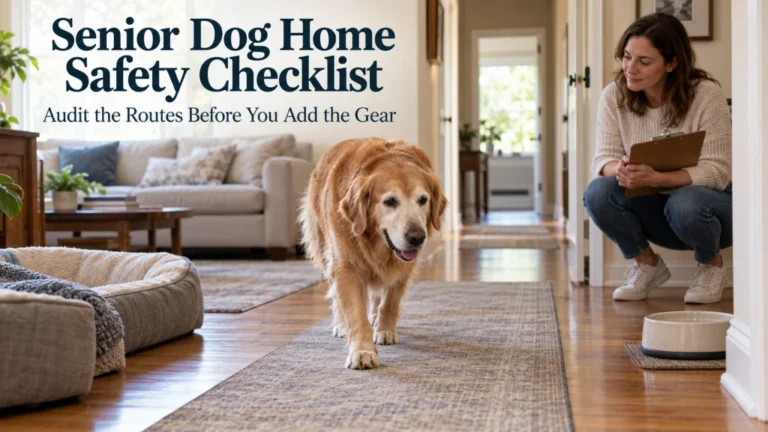
The senior dog home safety checklist is the right place for a deeper room by room pass, but the home modification decision should stay route focused. Check the surface underfoot, the width of the path, the lighting, the direction changes, the thresholds, and whether loose objects appear in a path the dog uses often. Then note whether the dog moves through normally, slows down, braces, backs away, or chooses a detour. Those observations give you a better starting point than age based assumptions.
| Area | Route check | What can make access harder |
|---|---|---|
| Bedroom | Bed to doorway and water | Tight turns, sliding bedding, clutter, or a long trip to water |
| Hallway | Continuous path between key rooms | Slick flooring, poor lighting, or temporary objects |
| Kitchen | Approach to food and water | Slippery surfaces, moving mats, or limited turning space |
| Living area | Access to family and rest spots | Furniture jumps, narrow passages, or unstable rugs |
| Entry | Indoor path through the door | Threshold height, steps, wet flooring, or an awkward landing |
A room check is useful only if it reconnects to the routes the dog actually travels. A problem in an unused corner matters less than a small obstacle between the bed and water. Keep the audit focused on repeated access, then rank the barriers by how often they interrupt an essential trip. That ranking tells you what to change first without turning the whole house into a renovation project.
| What interrupts the route | What to check first | First home response |
|---|---|---|
| Slipping or bracing | Surface continuity and secure footing | Create a stable traction path through the full problem area |
| Hesitation at a step | Height change, landing space, traction, and supervision | Reduce access or route the decision to a ramp or stair setup |
| Difficulty after dark | Lighting and whether the layout stays predictable | Improve route visibility without rearranging familiar landmarks |
| Bumping into clutter | Objects placed in repeated walking lines | Clear and preserve the familiar path |
| Avoiding a distant resource | Distance, floor changes, stairs, and turning space | Relocate or duplicate access where appropriate |
The table is a triage tool, not a diagnosis. It helps separate household friction from the reason the dog has changed, which may still need veterinary evaluation. Use it to choose the next home decision, then watch the same route again instead of assuming the problem is solved.
Build the bedroom and rest area around easy entry, clear movement, and reachable water
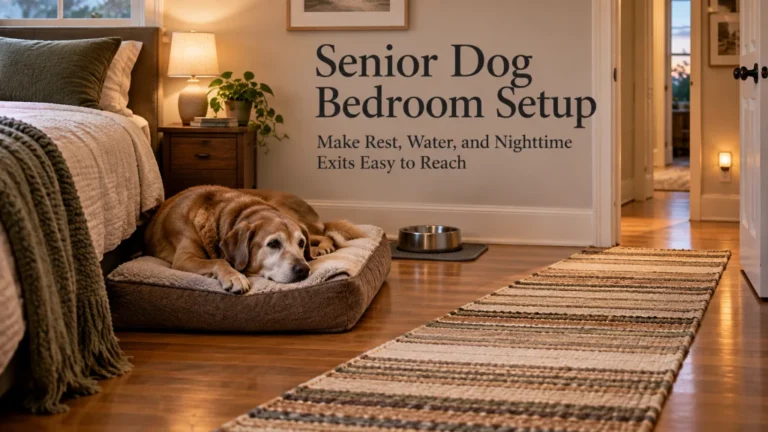
The senior dog bedroom setup should make getting in, settling, standing up, and leaving straightforward. Keep the approach clear enough that the dog does not have to make a tight turn immediately after rising, and avoid placing the rest area behind furniture that narrows the exit. Water should be reachable without requiring a difficult stair trip or a long crossing over a surface the dog avoids. The bed itself should stay stable when the dog steps onto or off it, but detailed bed construction and product choice belong in the dog bed system.
Shorten difficult daily routes before adding specialized equipment
Distance is easy to overlook because it does not look like a hazard. A dog may be able to walk across the house, yet repeated trips to water, the yard door, or a favorite resting place can become the hardest part of the routine when those trips include smooth floors, turns, or stairs. Before buying specialized equipment, see whether the route can be shortened by moving a resource or creating access on the level the dog already uses. A simpler route often reduces several barriers at once.
Resource relocation should still preserve household stability. Move the thing that creates unnecessary travel, not every object in the room, and make sure the new location has enough space for the dog to approach, turn, stand, and leave without slipping. If the dog has known vision loss, changes should be introduced deliberately so the mental map stays understandable. When the difficult task is a height transition or loss of footing rather than distance, hand that problem to the more specific mobility system instead.
For example, imagine a dog that sleeps in a back bedroom, crosses a slick hallway to reach water in the kitchen, then returns through the same dark threshold before going to the yard door at night. Before the change, that single routine combines unnecessary distance, low light, and a slippery surface even though each room looks acceptable on its own. After the change, a stable water station can be placed closer to the sleeping area, the repeated walking path can be kept clear and securely gripped, and the threshold can be easier to see without moving the rest of the familiar furniture. The useful change is not a new collection of senior gear; it is a shorter, more predictable bed to water to yard path with fewer failure points.
Redesign bathroom access when getting outside is the difficult task
The indoor potty setup for a senior dog becomes relevant when the route to the usual bathroom area is itself the barrier. First check the entire path to the door, including surface changes, thresholds, stairs, lighting, turning space, and the outdoor landing. Shortening the route or moving the resting area closer to the exit may solve more than adding equipment at the door. If toileting changes are new, frequent, or otherwise unusual, the home setup should not be used to explain the cause.
Keep dog bed choice in the dog bed system
If the home check shows that the resting area is difficult to enter or leave, location and access belong here, but detailed shopping does not. Use the dog bed selection guide for bed size, construction, cleaning, and fit decisions. In this home plan, check whether the bed stays in place, whether the dog can approach it without a tight turn, and whether it sits on a route that requires unnecessary stairs or slippery flooring. A suitable bed in the wrong location can still create a difficult daily journey.
Keep raised bowl decisions in the feeding system
Food and water access belong in the whole home review, but the equipment decision belongs elsewhere. If the dog has difficulty reaching a feeding station, first make the path stable, clear, and close enough to use comfortably. Then use the elevated dog bowl guide if bowl height itself appears relevant to the setup. This keeps a general home article from turning one feeding adjustment into a rule for every older dog.
Hand each physical barrier to the mobility setup that owns it
Once you identify a specific physical barrier, avoid solving every problem with the same piece of equipment. A height transition, repeated steps, a slick floor, and a route that requires caregiver lifting are different tasks. The right handoff depends on what the dog can currently do, the space available, and whether the setup can be used consistently. This is where a whole home plan becomes more useful than a generic list of senior accessories.
Measure the route before choosing equipment. Check the available floor space, approach angle, landing area, surface traction, door clearance, and whether the dog can enter and leave the setup without an awkward turn. Also consider the household burden because a device that blocks a hallway, must be moved constantly, or cannot stay secure may not work in daily use. The specialized guides can handle fit and selection once the home audit identifies the correct task.
Use a ramp for a continuous height transition
A dog ramp is the appropriate next decision when the route problem is a height change that would be easier as one continuous surface. The important home questions are where the ramp starts, where it lands, whether the approach stays clear, and whether the space allows a practical slope without blocking another route. Do not assume that adding a ramp helps if the dog cannot confidently enter it or if the landing is still slick. Ramp dimensions, surface design, weight limits, and exact product fit belong in the dedicated guide.
Use pet stairs when repeated stepping still fits the dog and the space
Dog stairs fit a different movement pattern because the dog still has to lift and place the feet repeatedly. That can be appropriate when the dog handles stepping well and the household needs a compact way to break one height into smaller rises. Check the landing, tread traction, stair stability, and whether the dog can approach straight enough to use the steps without twisting around furniture. The dedicated stair guide should handle dimensions and fit rather than turning this home article into a product comparison.
Build a continuous traction route when slick floors are the failure point
If the dog moves well until the floor changes, focus on the walking surface rather than a height device. The guide to a dog slipping on hardwood floors can handle traction options and floor specific choices. In the whole home plan, the important point is continuity: one secure mat at the bed is not enough if the dog must cross a wide slick gap to reach water or the door. Create a route the dog can enter, follow, turn on, and leave without jumping between isolated patches of grip.
Add assisted lifting only when the route needs caregiver support
A dog mobility harness belongs in the decision when the route cannot be completed safely without hands on support. The whole home question is where help is needed, such as standing from a resting area, crossing a threshold, or moving through a short transition. That location determines whether the helper has enough room to stand, support, and move without pulling the dog sideways or colliding with furniture. Harness fit, support coverage, handle design, and exact product choice belong in the dedicated guide.
| Barrier found in the route | Best next decision | What stays outside this article |
|---|---|---|
| One continuous height change | Ramp setup | Ramp dimensions, materials, and product comparison |
| Repeated stepping to a raised surface | Pet stair setup | Step geometry and product selection |
| Slick flooring along a repeated path | Continuous traction route | Traction product comparison |
| Route requires physical assistance | Mobility support setup | Harness fit and product selection |
| Rest or feeding resource is poorly located | Relocate the resource first | Bed or bowl product choice |
Use the handoff table to keep one problem from turning into a full home shopping project. A route may need more than one change, but each change should solve a visible constraint. When the obstacle type is clear, the specialist guide can take over without duplicating the rest of the home plan.
Final thoughts: modify the route that is failing before changing everything else
The most useful aging dog home setup is not the one with the most equipment. It is the one that lets the dog reach rest, water, food, family space, and the bathroom route with fewer avoidable obstacles. Follow the repeated paths, identify the exact friction point, and make the smallest change that solves that task. Then watch the same route again before adding another layer of gear.
Keep medical and household questions separate as you do that. A clearer path, better traction, shorter distance, or more predictable layout can improve access, but it cannot diagnose why a dog’s movement or senses changed. Use the home audit to make daily life easier and to produce clearer observations for the veterinarian when something is new or worsening. That keeps senior dog accessibility practical, specific, and centered on what the dog actually needs to do at home.
Senior dog home modification guides
The whole home audit becomes easier when each recurring problem has a focused next step. Use these guides after you identify which route, room, or access point is creating difficulty. They cover the detailed setup decisions that would otherwise make this page too broad. Start with the problem you can observe rather than opening every guide at once.
| Guide | What it helps you decide |
|---|---|
| Senior dog home safety checklist | Run a detailed room by room safety review and identify household hazards. |
| Senior dog bedroom setup | Arrange rest, nighttime movement, water access, and clear entry around the sleeping area. |
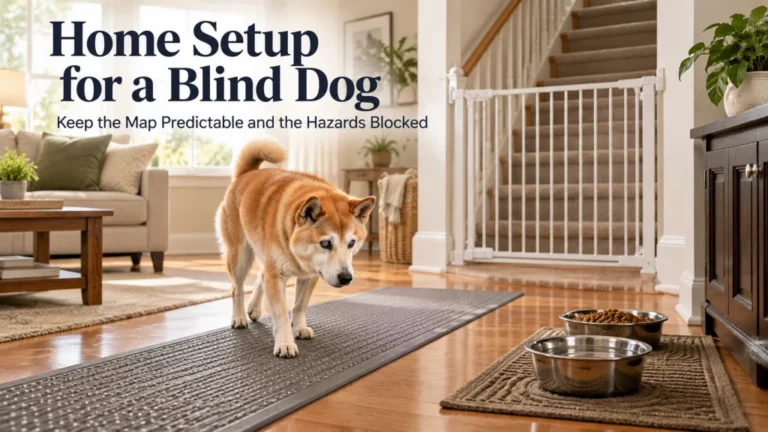
| Home setup for a blind dog | Preserve route consistency and use safe environmental cues for reduced vision. |
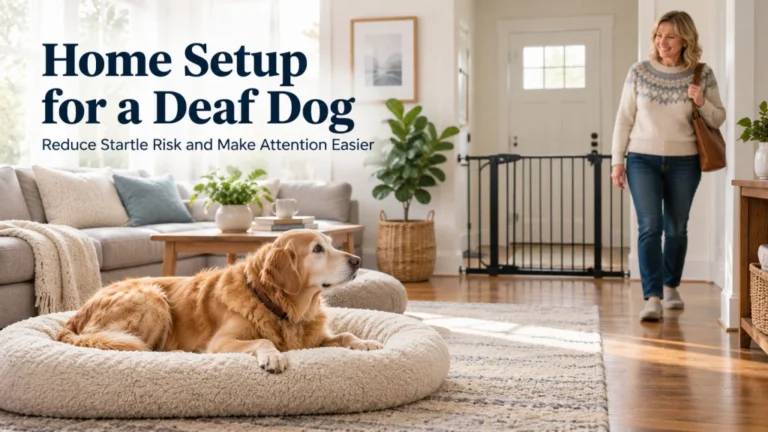
| Home setup for a deaf dog | Build visual, vibration, communication, and barrier cues around reduced hearing. |
| Indoor potty for a senior dog | Decide when an indoor bathroom option fits a difficult or overly long bathroom route. |
These pages are extensions of the same route based decision process. The home audit tells you where the problem happens, and the focused guide handles the setup details for that problem. If several routes fail at once, prioritize the path that affects essential access such as water, rest, or the bathroom area. Keep the changes understandable enough that the dog can still navigate a familiar home.
Frequently asked questions
🐾 What should I change first for an older dog at home?
Follow the dog’s most important daily routes and find the first place where movement becomes difficult. Fix that specific problem, such as slipping, clutter, poor lighting, unnecessary distance, or a height transition, before buying extra equipment.
🏠 Should I rearrange the whole house for a senior dog?
Usually no. Preserve familiar routes where possible and change only the areas that create a clear access problem, especially if the dog has reduced vision and relies on a stable layout.
💡 Can better lighting help an older dog move around the house?
It can help when dim areas, shadows, steps, or doorways are harder to navigate, especially if some vision remains. New or worsening vision changes still need veterinary assessment rather than being treated as a lighting problem alone.
🪜 Is a ramp always better than pet stairs for an older dog?
No. The better choice depends on the dog’s current movement, the height transition, the available floor space, the landing area, and whether repeated stepping is still comfortable and reliable.
🧭 How do I make routes easier for a dog with reduced vision?
Keep major furniture and essential resources in predictable places, clear temporary obstacles from repeated paths, and use secure cues at important transitions. Avoid frequent layout changes that make the dog’s existing mental map less useful.
🔔 What home changes help a dog with reduced hearing?
Use consistent visual or vibration cues, approach in ways that reduce surprise, and use secure barriers where missing a spoken warning could create a hazard. Keep the system simple enough that everyone in the household uses the same cues.
References and sources
- VCA Animal Hospitals: Supports owner level home adjustments for mobility, flooring, stairs, rest areas, water access, and bathroom access.
- American Animal Hospital Association: Supports predictable home layouts, safe barriers, and communication adjustments for dogs with reduced vision or hearing.
- American Kennel Club: Supports senior home accessibility decisions involving traction, ramps, stairs, and route consistency for dogs with reduced vision.