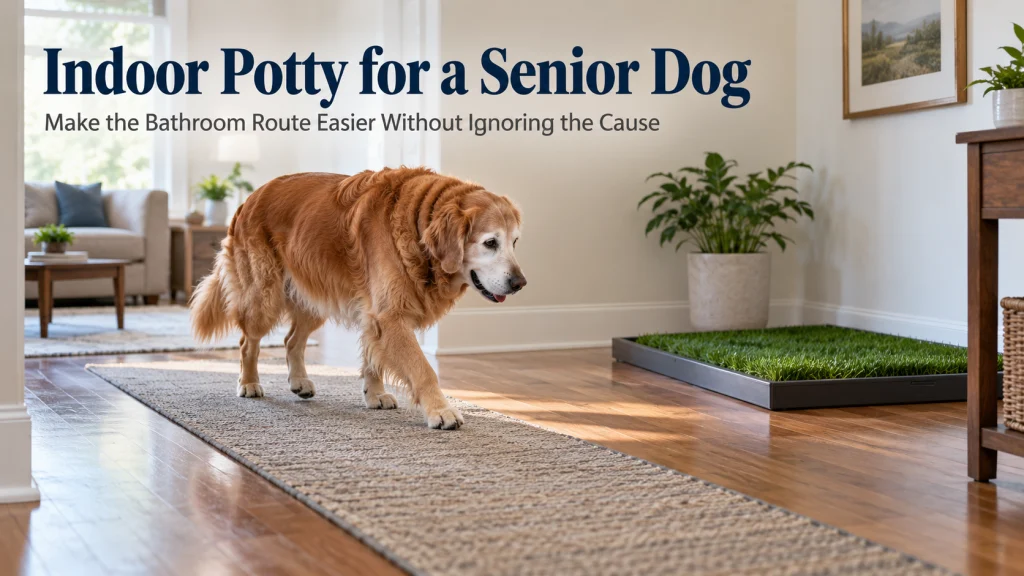
An indoor potty for a senior dog can be a useful accessibility change when the normal bathroom route has become too long, slippery, steep, or difficult to enter. A new accident pattern still needs medical assessment first because changing the toilet location does not explain why a previously reliable dog is struggling. The practical goal is to shorten the route, reduce physical barriers, choose a surface the dog can enter and stand on comfortably, and keep the setup easy for the household to maintain. Training the new location is a separate task from deciding whether the location and physical setup are appropriate.
Start by separating a new health change from an access problem
When an indoor potty for a senior dog starts sounding necessary, first ask what changed about the trip to the usual bathroom area. A dog that once crossed the house, handled a threshold, waited for an elevator, or used steps may now find that same route harder even when the destination itself is familiar. Broader daily care for an older dog should account for changing mobility, comfort, senses, and routine rather than assuming every new problem is behavioral. The practical setup ideas in senior dog home modifications are useful for the same reason: the home may need to change when the dog can no longer move through it the same way.
The first decision is therefore not which pad or tray to buy. It is whether the dog is facing a new medical problem, a physical access problem, or both at the same time. If the route is the obstacle, moving the toilet closer can reduce distance and difficult transitions without pretending that the new location is a treatment. If the pattern is sudden, frequent, painful, uncontrolled, or otherwise unusual for that dog, the setup question should follow veterinary assessment rather than replace it.
Treat sudden accidents, urgency, pain, or loss of control as veterinary questions first
A previously reliable older dog that suddenly starts having indoor accidents deserves more than a house training explanation. Changes in urination or defecation can be associated with medical, physical, sensory, or cognitive problems, and the pattern alone does not tell an owner which cause is present. A veterinarian can evaluate the dog in context and decide what needs investigation. Until that assessment is made, avoid labeling the problem as stubbornness, forgetting, or normal aging.
Medical first checkpoint: If the bathroom change is new, sudden, painful, uncontrolled, unusually frequent, or accompanied by a broader change in thirst, movement, awareness, or behavior, treat the cause as a veterinary question before treating the problem as a location or training issue.
| What you notice | What it means for the indoor potty decision |
|---|---|
| The dog has a new or sudden accident pattern | Arrange veterinary assessment first, then use an indoor setup only as access management if appropriate |
| The dog appears painful, strains, leaks, or cannot control elimination | Do not treat the problem as a house training failure or try to solve it with a different surface |
| The dog still signals normally but struggles with the route | Assess distance, flooring, thresholds, stairs, and delays as possible access barriers |
| The dog can reach the new area comfortably but does not understand its purpose | Move from accessibility setup to the separate location training process |
The same boundary applies when the dog appears unable to wait, leaks while resting, strains, seems painful, becomes unusually thirsty, or acts confused around the normal bathroom routine. Those signs are not reasons to diagnose the dog at home, and an indoor toilet should not be presented as a cure. A closer potty area can still be useful as household management while the cause is being addressed, but it should be framed as an access option. That distinction protects the dog from having a potentially important health change hidden behind a convenient new setup.
Decide whether the outdoor bathroom route has become physically unrealistic
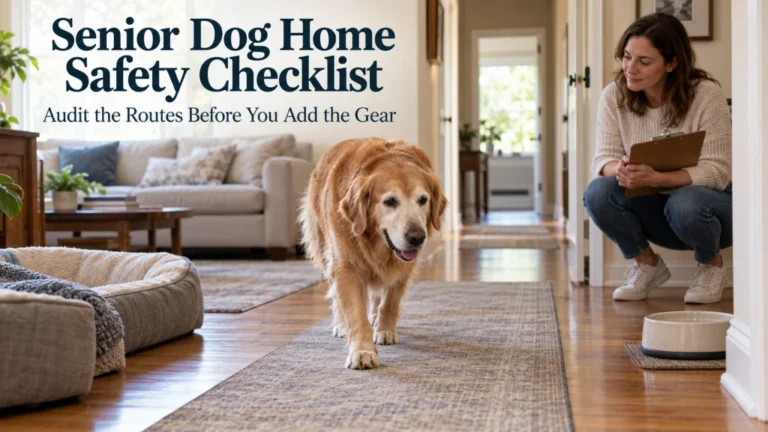
Look at the full trip from the place where the dog usually rests to the place where elimination happens. Distance is only one part of the burden because slick flooring, stairs, a tall threshold, tight turns, a slow elevator, or a heavy door can make a short route much harder than it appears. Watch whether the dog hesitates, loses footing, stops before a transition, or arrives too late despite starting toward the door. The useful question is whether the route still matches the dog that is using it now, not whether the route worked comfortably in the past.
| Decision step | If the answer is yes | If the answer is no |
|---|---|---|
| Can the dog still reach the outdoor toilet comfortably and consistently? | Keep the outdoor route and fix smaller barriers that are easy to remove safely | Check which part of the route is failing before moving the toilet indoors |
| Is one correctable barrier causing most of the difficulty? | Improve traction, simplify the turn, or remove the access obstacle, then reassess the route | Continue to the next step because several barriers may be adding up |
| Do distance, stairs, thresholds, slick flooring, or access delays still make the trip unrealistic? | Consider a nearer indoor toilet as an accessibility option | Keep the normal bathroom location and avoid adding a new toilet without a clear access reason |
| Can the dog reach, enter, turn on, and leave the proposed indoor setup comfortably? | Move on to surface choice and location training | Change the location, entry, traction, or usable area before asking the dog to use it |
Use observations like these as a route audit, not as a diagnosis. If one barrier can be removed safely, such as adding stable traction across a slick hallway, the old bathroom location may remain workable. If the route includes several difficult steps that cannot reasonably be removed, a nearer indoor toilet becomes more practical. The best choice is the one that reduces avoidable physical demand while preserving the dog’s normal outdoor routine whenever outside trips are still comfortable and appropriate.
Choose a quiet location the dog can reach without stairs, slick flooring, or tight turns
An indoor bathroom area should be easy to find and easy to approach from the dog’s normal living space. A quiet corner of a utility area, bathroom, mudroom, or other low traffic space can work if the dog can reach it without crossing a route that already causes hesitation. Avoid making the dog weave around furniture or squeeze through a narrow opening just to reach the toilet. The closer location only helps when the final approach is simpler than the route it is replacing.
Household practicality matters too because a toilet area that blocks a doorway or sits in the middle of a busy walkway will be hard to keep consistent. Choose a place where the surface can stay flat, the dog can turn without bumping walls or furniture, and the household can clean the area without moving it every day. A stable location is easier for the dog to learn than a pad that shifts from room to room. Before settling on the spot, check the route at the times when the dog usually needs it and confirm that doors, gates, or normal household traffic do not create a new barrier.
| Layout zone | What the setup should provide | What to avoid |
|---|---|---|
| Route from the resting area | A short, predictable path on secure footing | Stairs, long detours, loose rugs, or slick stretches |
| Final approach | Enough width for the dog to approach without a sharp turn | Furniture pinch points, narrow doorways, or clutter |
| Entry edge | A low, stable transition that matches current mobility | A tall rim or raised base that recreates the threshold problem |
| Usable toilet area | Enough flat space to enter, stand, turn, and eliminate | A surface so small that the dog must balance partly off it |
| Separation from daily living zones | A distinct location near enough for access but away from food and rest | Placing the toilet beside the bed, bowls, or in a busy walkway |
| Household access | A location that can stay available and return to the same position after cleaning | Daily relocation, blocked doors, or a setup that disrupts normal traffic |
- Keep the approach short and predictable.
- Avoid stairs when a level route is available.
- Keep the final turn wide enough for the dog’s current mobility.
- Use a surface that stays flat and does not slide underfoot.
- Choose a location the household can keep available consistently.
Keep the entry low enough for the dog’s current mobility
The edge of a tray can be a bigger obstacle than its overall size. A dog may have enough room to stand inside a toilet area yet still avoid it because stepping over the rim requires more joint flexion, balance, or confidence than the dog has available. Watch the entry movement from the side and notice whether the dog lifts each foot cleanly, clips the edge, pauses, or turns away. A low entry becomes especially important when the dog already struggles with thresholds elsewhere in the home.
Size still matters because the dog needs enough usable surface to enter, position the body, and eliminate without standing half on the floor and half on the toilet area. Do not solve one access problem by choosing a tiny tray simply because its rim is low. For a larger dog, a broader flat surface may be more workable than a compact framed unit, while a smaller dog may manage a contained tray comfortably if the entry is easy. Check the actual step over height, usable standing area, surface stability, and turning space rather than relying on a package label that only says the product is suitable for senior pets.
Compare pads, low entry trays, and grass style surfaces by access and cleaning
There is no universal indoor toilet surface for every older dog. A flat absorbent pad has almost no entry barrier, but it can bunch or shift if it is not held securely. A low entry tray can keep the bathroom area more defined, yet the rim and standing surface have to match the dog’s mobility. Grass style surfaces may feel familiar to some dogs, but they add a cleaning and drainage task that the household must be willing to handle consistently.
| Format | Access advantage | Watch for | Household burden |
|---|---|---|---|
| Flat absorbent pad | Very low entry | Sliding, folding, edge lift, or insufficient area | Frequent replacement and stable placement |
| Low entry tray | Defined target with some containment | Rim height, rigid grid texture, and usable floor area | Washing the tray and any removable parts |
| Grass style surface | May resemble a familiar outdoor texture | Base height, drainage, stability, and surface maintenance | Regular rinsing, drying, or surface replacement |
Choose from the dog’s physical approach first, then consider cleaning and household fit. A surface that contains mess well is still a poor choice if the dog cannot step onto it safely, and a nearly flat option is not useful if it slides across the floor. Avoid medical claims about one surface being healthier or therapeutic unless a veterinarian has recommended something specific for that dog. The best format is the one the dog can reach, enter, stand on, and leave without adding another obstacle to the bathroom routine.
Add traction on the route when the floor itself is part of the problem
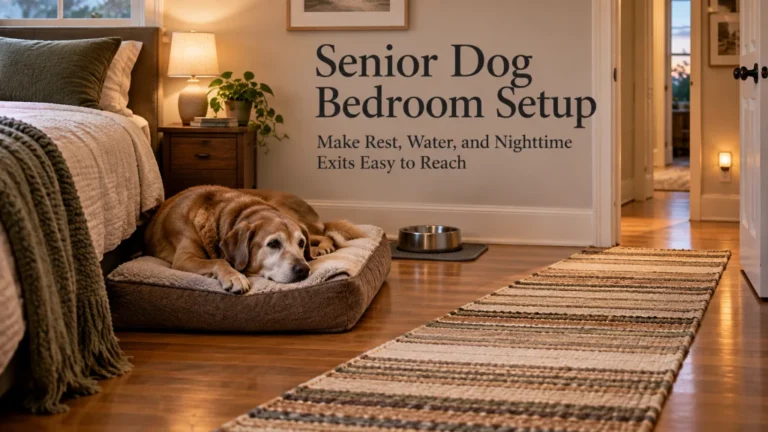
A nearby indoor toilet does not solve much if the dog still has to cross a slick floor to reach it. Hardwood, laminate, and tile can be difficult for dogs with reduced mobility because secure footing matters during starts, stops, and turns. Stable runners or rugs can create a more predictable path when they lie flat and do not slide or curl at the edges. The goal is to reduce slipping risk on the approach, not to create a patchwork route full of loose mats.
If the dog is already hesitating or losing footing around the house, the broader issue deserves its own check rather than being buried inside the potty setup. The guide to helping a dog that slips on hardwood floors covers the flooring problem in more detail. For this bathroom decision, focus on making the path continuous from the resting area to the toilet location. A short route with reliable traction is usually more accessible than a slightly shorter route that still requires the dog to cross a polished floor or make a sharp turn on a loose mat.
Keep the toilet area separate from resting and feeding zones
Shortening the bathroom route does not mean placing the toilet directly beside the dog’s bed or bowls. The dog should be able to rest, eat, and drink without having to stand in or step across the elimination area. A nearby but distinct location usually gives a better balance between accessibility and normal household organization. This matters even more when the dog spends much of the day in one room and the available floor space is limited.
Think in terms of a simple path with separate destinations. The resting area can remain comfortable and easy to rise from, while the toilet sits far enough away to feel like a different functional zone but close enough to avoid a difficult trip. Keep food and water on their own clean route so reaching them does not require crossing the potty surface. If the only available spot forces the toilet into the middle of the dog’s sleeping or feeding area, reconsider the room or adjust the layout before expecting the dog to use it consistently.
Teach the location through the existing pee pad training system
Physical access and location choice are only part of the job. A dog that has spent years eliminating outdoors may not automatically understand that a new indoor surface is now an acceptable bathroom area. The teaching sequence belongs in the existing guide on how to train a dog to use pee pads, where cues, supervision, reinforcement, and location learning can be handled as a training task. Keeping that work separate prevents this accessibility page from turning into a second house training article.
| Accessibility decision | Training decision |
|---|---|
| Is the route short and physically manageable? | How will the dog learn that this is an approved toilet location? |
| Can the dog step onto the surface safely? | What cue and reinforcement routine will be used? |
| Is the location quiet, stable, and always available? | How will successful use be reinforced consistently? |
| Does the setup stay separate from food and rest? | How will mistakes be handled without punishment? |
The distinction also helps when progress is slow. If the dog understands the location but physically struggles to enter the tray, the setup needs revision rather than more repetition. If the dog moves comfortably to the area but does not understand its purpose, the training system deserves attention. Separating those two questions makes troubleshooting clearer and reduces the chance of asking an older dog to practice around a physical barrier that should have been removed first.
Keep accident cleanup and floor protection outside the accessibility decision
An indoor toilet will create a new cleaning task, but cleanup should not become the reason for choosing a surface the dog cannot use comfortably. First decide whether the location, entry, traction, and usable area work for the dog. Then choose a maintenance routine that the household can perform consistently without moving the toilet every time it needs attention. A setup that is easy to disinfect but hard for the dog to enter has solved the wrong problem.
Likewise, this page does not need to become a guide to stain removal, odor control, waterproof flooring, or accident products. Those are different household tasks with different material and safety questions. Here, cleaning matters only as a practical ownership burden: the surface should be removable or serviceable, the surrounding floor should remain manageable, and the setup should return to the same location after cleaning. Keeping that boundary clear lets the accessibility decision stay centered on the dog’s route instead of drifting into a general home cleanup article.
Final Thoughts: an indoor toilet can shorten a difficult route without explaining why
An indoor toilet can be a sensible accessibility change when an older dog can no longer manage the old bathroom route comfortably or consistently. The strongest setup is usually the one with a short level approach, dependable traction, a low entry, enough standing room, and a quiet location that stays separate from food and rest. It should reduce physical demand rather than simply move the mess closer. If the dog can still enjoy comfortable outdoor trips, the indoor option does not need to replace them.
The change in bathroom behavior still deserves its own explanation, especially when it is new, sudden, painful, uncontrolled, or otherwise unusual. Veterinary assessment addresses the cause, accessibility changes address the route, and training teaches the new location. Keeping those jobs separate makes the plan easier to adjust when one part is not working. That is a more useful approach than assuming every accident is a training failure or treating a closer toilet as a medical answer.
Frequently asked questions
🐾 Should I use an indoor potty if my senior dog suddenly starts having accidents?
A sudden change should be discussed with a veterinarian before it is treated as a simple training problem. An indoor toilet may still help with access, but it does not explain the cause of the new accidents.
🏠 Where should an indoor bathroom for an older dog go?
Choose a quiet, consistently available place that the dog can reach without stairs, slick flooring, narrow turns, or a long wait at a door. Keep it separate from the dog’s main resting, feeding, and drinking areas.
📏 How low should the entry be for a senior dog potty area?
There is no single entry height that fits every dog. Watch the dog step over normal thresholds and choose a setup that does not require a higher or harder movement than the dog can make comfortably and safely.
🧼 Are pads, trays, or grass style toilets better for senior dogs?
Choose by access, stability, usable area, and cleaning burden rather than by format alone. A flat pad may minimize the step, a tray may define the area, and a grass style surface may feel familiar, but each option can create its own traction or maintenance problem.
🚪 Should an indoor potty replace outdoor bathroom trips?
Not automatically. If the dog can still go outside comfortably and safely, an indoor toilet can serve as a shorter option when the normal route is difficult rather than replacing all outdoor activity.
🦴 What if my dog can reach the indoor potty but will not use it?
First confirm that the surface is stable, the entry is easy, and the location is quiet and accessible. If the physical setup works, use a consistent pee pad training process rather than repeatedly changing the toilet location.
References and Sources
- American Kennel Club senior indoor potty guidance: Supports using a quiet accessible indoor toilet area when mobility makes outdoor bathroom trips difficult and keeping outdoor activity when it remains appropriate.
- American Kennel Club senior house training guidance: Supports the medical first boundary for new accidents in a previously house trained older dog.
- VCA mobility compromised home guidance: Supports reducing difficult home routes and improving secure footing for dogs with mobility limitations.