A blind dog often navigates a familiar home by relying on a stable layout, repeated routes, floor texture, sound, smell, and memory rather than constant physical guidance. A practical home setup for a blind dog keeps major furniture and daily resources in predictable places, clears routine paths, and blocks stairs, pools, balconies, and other serious fall hazards. Tactile landmarks and useful lighting can help when they solve a specific navigation problem, but they should not turn the floor into a new obstacle course. New or unexplained vision change belongs with a veterinarian, while the home changes here focus on safer everyday access.
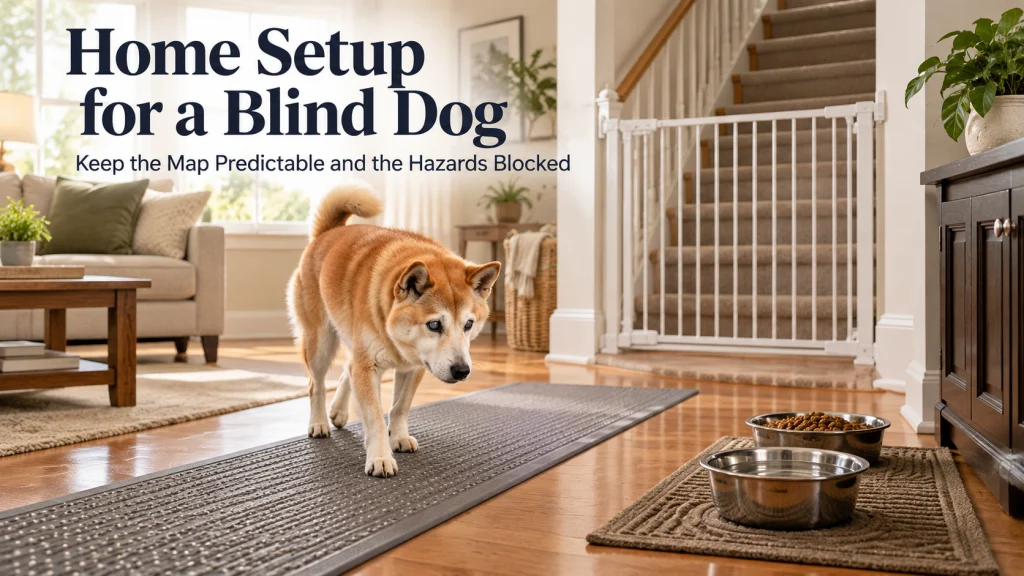
Protect the home map before adding more tools
A blind dog can often move through a familiar home more confidently when the layout stops changing. The most useful home setup for a blind dog is therefore a predictable one: fixed furniture, fixed resources, clear routes, and barriers where one wrong step could matter. If you are adjusting the house as part of broader aging changes, start with caring for an older dog and use senior dog home modifications to keep the vision changes connected to the rest of the home setup. The goal is not to direct every step, but to make the route itself easier to remember.
That means resisting the urge to solve vision loss by filling the house with new equipment all at once. A dog that already knows where the water bowl, bed, door, hallway, and sofa are may benefit more from consistency than from a complicated collection of markers. Change the environment when a real hazard or access problem exists, then let the dog learn that change without simultaneously moving several other landmarks. A simpler setup is easier for the dog to map and easier for the household to keep consistent.
Get new or sudden vision change assessed before redesigning the house
Bumping into furniture, hesitating in dim areas, missing familiar objects, or seeming uncertain at thresholds can happen with reduced vision, but those observations do not identify the cause. Vision change can have different medical explanations, and some problems may need prompt veterinary attention rather than a home design solution. Before treating the behavior as an ordinary part of aging, arrange a veterinary assessment and describe what changed, where the dog struggles, and whether the change seems gradual or abrupt. The household can still make obvious safety improvements while diagnosis remains with the veterinarian.
That boundary matters because the right environmental support depends partly on what the dog can still perceive. A dog with useful remaining vision may benefit from stronger contrast and better lighting in troublesome areas, while a fully blind dog may rely much more on stable routes and tactile landmarks. Eye discomfort, other health changes, or mobility problems can also alter how confidently a dog moves through the same room. Home modifications should respond to the dog’s actual navigation pattern without pretending to explain the medical reason for it.
Keep major furniture, bed, food, water, and door locations consistent
Large furniture and daily resources become landmarks when they stay where the dog expects them to be. Keep the bed, food area, water station, main exit route, and large pieces of furniture in stable locations unless there is a clear safety reason to move them. Small household habits matter too, because a dining chair left in the walkway or a laundry basket placed in the hall can become an unexpected collision point. Predictability works best when every person in the home follows the same basic layout rules.
| Keep fixed when practical | Change when there is a clear reason |
|---|---|
| Bed, food, water, main door route, large furniture, routine resting areas | Unstable furniture, sharp collision points, blocked walkways, unsafe access to drops |
| Common hallway widths and familiar room entrances | Loose clutter, cords, temporary storage, objects left across the dog’s usual path |
If something important must move, treat the change as a new landmark rather than assuming the dog will immediately understand it. Guide the dog through the altered route calmly, keep the rest of the room as stable as possible, and avoid stacking several layout changes together. Watch where hesitation or collisions appear after the change, because those spots tell you whether the new arrangement is actually easier to navigate. The best layout is the one the dog can use consistently, not the one that looks most symmetrical to people.
Clear memorized routes instead of carrying the dog from place to place
When it is safe for the dog to move independently, preserve the routes the dog already uses rather than automatically carrying them between every destination. Regular movement helps the dog keep learning where the bed, water, door, resting area, and household members are in relation to one another. Carrying can be appropriate when a route is unsafe or the dog also has a mobility limitation, but it should not become the default response to every moment of uncertainty. The environment should do more of the guiding so the dog does not have to wait for a person to relocate them.
- Keep hallways and doorway approaches free of bags, shoes, boxes, and temporary clutter.
- Push chairs back to their normal positions after use so they do not narrow a familiar path.
- Secure cords and unstable objects that could shift into the dog’s route.
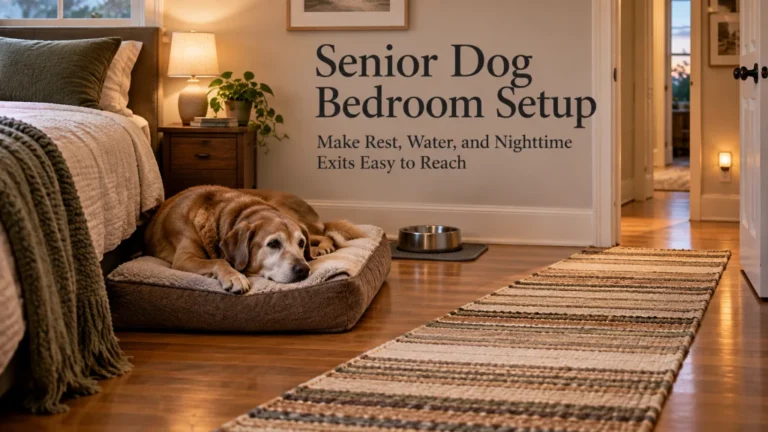
- Keep access to water and the main resting area direct rather than forcing detours around new furniture.
Think of these routes as dependable corridors rather than perfectly empty rooms. The dog still needs normal household life around them, but the important paths should not change shape several times a day. If the dog repeatedly bumps the same object, reconsider that object’s placement instead of assuming more verbal guidance will solve the problem. A clear route is especially valuable when nobody is close enough to give a cue at the exact moment the dog needs it.
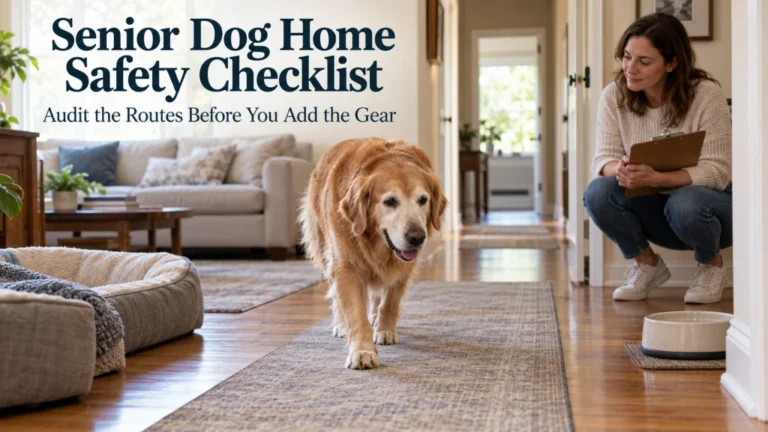
Mental map home check: Trace the dog’s ordinary path from the main resting area to water, the exit door, the feeding area, and another frequently used resting spot. At each turn, check whether the route depends on a stable wall, doorway, floor texture, or large piece of furniture that stays in the same place. Remove temporary obstacles from that route and avoid adding new markers unless they solve a specific point of confusion. If the dog repeatedly hesitates at the same location, change that one location instead of redesigning the whole route.
| Route point | Stable landmark to preserve | What to check |
|---|---|---|
| Resting area to water | Wall line, doorway, fixed bowl station | No chairs, bags, or storage narrowing the usual path |
| Resting area to exit door | Hallway edge, floor texture, fixed door location | No loose mats, cords, or temporary objects crossing the route |
| Room entrance to favorite resting spot | Large furniture edge or stable tactile landmark | The landmark stays flat, secure, and in the same position |
Block stairs, pools, balconies, and other serious drop hazards
Some parts of the home deserve a physical barrier because a mistake there can have much greater consequences than bumping a table leg. Open stairways, elevated decks, balconies, pools, and abrupt drops should not depend on the dog remembering where the edge is every single time. Use secure barriers that fit the opening and household traffic pattern, and make sure they remain closed when the dog has unsupervised access nearby. Familiarity with a route is useful, but it is not a substitute for a barrier at a serious fall hazard.
Sharp corners and unstable objects deserve a different response because they may be better handled by changing the obstacle itself. Move or stabilize furniture that can tip, pad a corner when repeated face contact is a realistic risk, and remove objects that project unexpectedly into a route. Do not clutter the room with protective gear where simple rearrangement solves the problem more cleanly. Safety changes should reduce surprises without destroying the larger layout the dog already knows.
High risk hazard checklist: Before giving the dog independent access to an area, confirm that open stairs and abrupt drops are blocked, pool access is physically restricted, balcony or deck edges cannot be reached through an open route, exterior doors do not lead directly into an unsafe drop or traffic path, unstable furniture cannot tip into a familiar route, and temporary household items are not defeating a barrier. Recheck these points after furniture moves, guests, cleaning, or other household changes that can alter the route.
Use tactile floor changes as landmarks without creating loose trip hazards
A texture change under the paws can mark an important location such as a door, feeding area, resting spot, or the approach to a blocked stairway. A stable mat or runner can work because the dog feels a predictable transition before reaching the landmark. The key is consistency: one texture should signal the same type of location instead of appearing randomly throughout the house. Choose low profile materials that lie flat and do not curl, slide, bunch, or narrow the route.
Traction and navigation are related but not identical problems, especially for an older dog that also slips on smooth floors. If footing is part of the difficulty, use the more detailed checks in helping a dog that slips on hardwood floors rather than assuming every rug is automatically helpful. A loose runner can become a new hazard even if its texture is easy to detect. The useful landmark is one the dog can feel and cross securely without having to step around raised edges or shifting fabric.
Use useful lighting when the dog retains some vision
Blind dog setup is not always all or nothing because some dogs retain partial vision that works better under certain conditions. If the dog navigates familiar rooms well in brighter areas but hesitates when spaces become dim, steadier lighting may make thresholds, stairs, doors, and furniture edges easier to detect. Focus first on the locations where the dog actually slows down or misjudges a change in level. Adding more light everywhere is less useful than solving the specific low light problem the dog repeatedly encounters.
Keep lighting practical and stable rather than turning it into another moving variable. Avoid creating a route that alternates between glare and deep shadow when a more even level of illumination is possible. If better lighting does not change the dog’s hesitation, do not keep escalating bulbs as though brightness alone must be the answer. That pattern is useful information to share with the veterinarian and a reason to rely more heavily on layout, barriers, and tactile landmarks.
Partial vision lighting check: Use lighting only when the dog appears to use remaining vision. Compare the same familiar route in brighter and dimmer conditions, then look for repeated hesitation at thresholds, changes in floor level, furniture edges, or shadowed corners. Favor steady illumination and useful contrast at the problem area rather than adding bright lights throughout the house. If the dog’s navigation does not improve, keep the environmental support focused on predictable layout, barriers, and tactile landmarks instead.
Use a ramp or pet stairs only when the dog can use that system safely
Furniture access becomes more complicated when reduced vision overlaps with age related changes in strength, balance, or confidence. A ramp or a set of pet stairs can provide a repeatable route to a bed or sofa, but only if the dog can find the approach, stay centered, and move across the surface without slipping. Do not add access equipment merely because the dog is blind, and do not assume the steeper or more compact option is automatically easier. The equipment has to fit the height, available floor space, dog size, body control, and way the dog approaches the furniture.
For the equipment decision itself, compare the setup requirements in choosing a dog ramp and choosing dog stairs rather than stretching this page into a product guide. Keep the chosen access point in one consistent location so the dog does not have to search for it each time. If the dog cannot use the system reliably, block the furniture or assist access instead of leaving an uncertain route available without supervision. Vision support should never require a dog to negotiate equipment that their mobility does not support.
Combine vision and hearing changes without making the setup more complicated
A dog with both reduced vision and reduced hearing may not benefit from the same sound based landmarks that help a dog who can hear well. In that situation, stable layout, clear routes, secure barriers, predictable touch, and floor texture become more important because they do not depend on seeing or hearing from a distance. The household also needs to avoid surprising the dog with sudden contact when the dog cannot easily detect someone approaching. Keep the environment calm and repeatable before adding extra signaling systems.
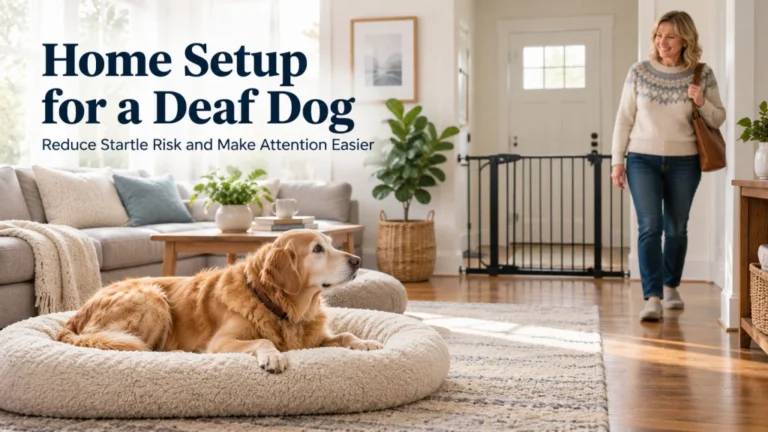
If hearing loss is also changing the dog’s daily navigation, use home setup for a deaf dog to adjust the environment without duplicating or contradicting the vision setup. The shared principle is predictability, but the useful landmarks differ depending on which senses remain reliable. Do not assume a single cue format works for every dog with sensory loss. Build the home around the dog’s usable senses, physical ability, and familiar routine rather than around a generic list of disability gear.
Final Thoughts: Predictability is the foundation of a blind dog’s home setup
A safer home for a blind dog usually comes from making fewer, better changes rather than redesigning every room. Keep major landmarks where the dog expects them, remove temporary obstacles from familiar routes, and use secure barriers where a navigation mistake could lead to a fall or other serious hazard. Add tactile flooring or lighting only when each change solves a specific problem you can observe. Then keep that change stable long enough for it to become part of the dog’s map.
When vision loss is new, unexplained, or changing, keep the medical questions with the veterinarian and use home changes to support daily access rather than diagnose the cause. If mobility, hearing, or formal navigation cues also become part of the problem, route those decisions to the more specific setup or training guidance instead of forcing one page to solve everything. The practical test is simple: the dog should be able to find essential resources and move through familiar areas with fewer surprises. A predictable environment gives that independence a safer structure.
FAQs
🐾 Should I rearrange furniture after my dog loses vision?
Avoid unnecessary rearranging because familiar furniture positions help the dog navigate from memory. If something is unsafe and must move, change as little else as possible and calmly reintroduce the route.
🚪 How can I help my blind dog find important places in the house?
Keep the bed, water, food area, and main door in stable locations and maintain clear paths between them. A secure textured mat can mark a key location if it lies flat and remains in the same place.
🪜 Can a blind dog use stairs safely?
Some dogs can learn familiar steps, but open stair access still carries fall risk when vision is poor. Use secure barriers where needed, especially when the dog is unsupervised or also has balance or mobility limitations.
💡 Does better lighting help every blind dog?
No. Lighting is most useful when the dog retains enough vision to use it and shows more difficulty in dim areas, so watch the dog’s actual response rather than assuming brighter is always better.
🧭 Are tactile mats useful for blind dogs?
They can be useful as consistent landmarks at doors, feeding areas, or other important locations. Choose stable, low profile surfaces that do not slide, curl, or create a new tripping problem.
👂 What changes if my dog is losing both vision and hearing?
Sound based guidance becomes less dependable, so stable layout, tactile landmarks, clear routes, barriers, and predictable touch matter more. Adjust the setup to the senses the dog can still use rather than adding more signals indiscriminately.
References and Sources
- AAHA guidance for blind and deaf pets: Supports veterinary assessment, consistent home layout, predictable routines, safe containment, and using other senses for navigation.
- AKC guidance on helping a blind dog: Supports keeping furniture stable, blocking stairs and pool access, protecting sharp edges, and using tactile floor cues.
- AKC guidance on age related vision and hearing loss: Supports keeping routines stable, using gates at stairs, and using useful lighting when a dog retains partial vision.
- Colorado State University guidance on caring for a blind dog: Supports consistent layout, hazard control, tactile signals, lighting, and nonslip flooring.