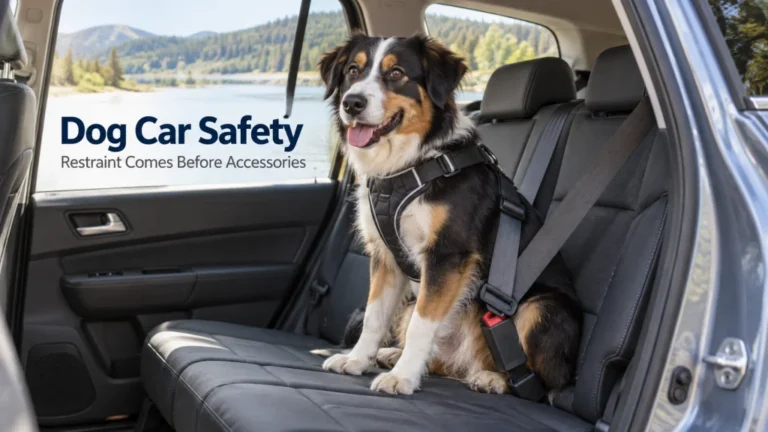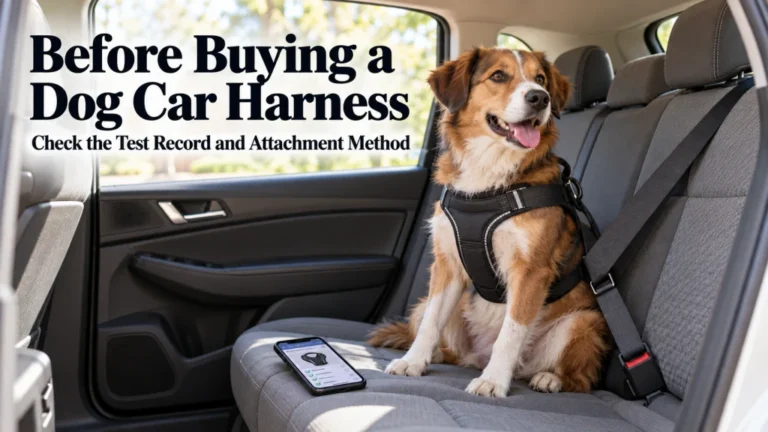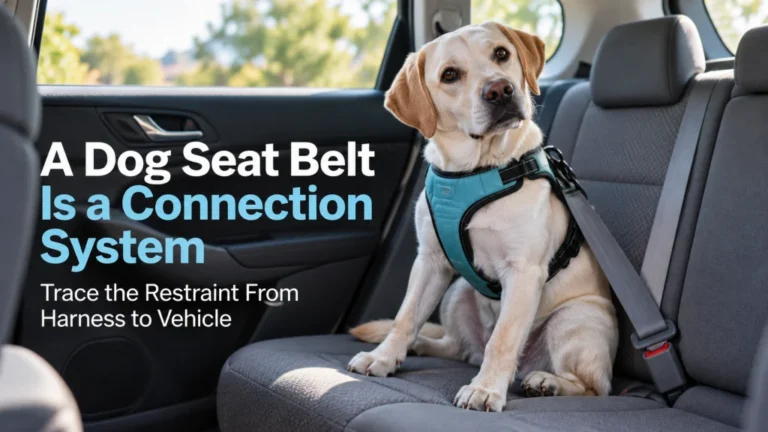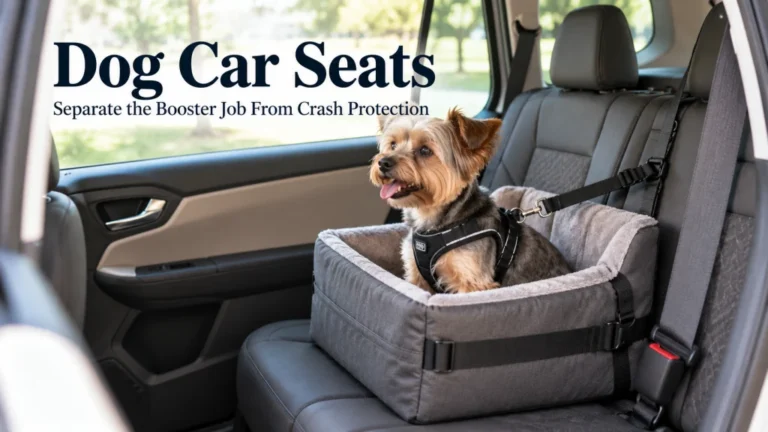
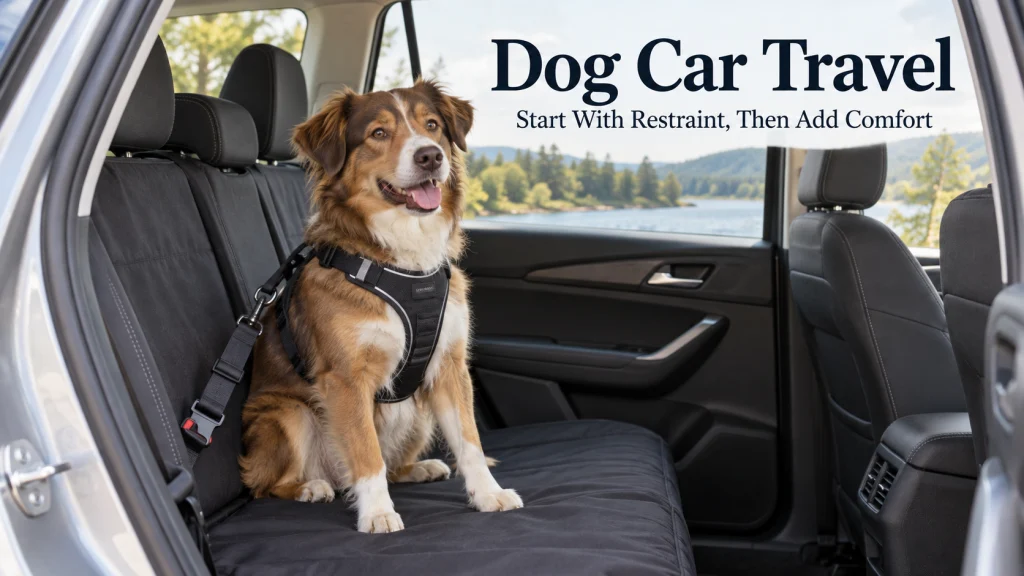
Dog car travel works best when you solve restraint or containment before adding comfort, cleanliness, or cabin control accessories. A harness, carrier, or travel crate may be part of the safety system, while a barrier, cover, hammock, or rear platform usually solves another job. Check what touches the dog, what connects to the vehicle, what evidence supports that connection, and whether the setup fits both. Then judge comfort upgrades without confusing them with crash protection.
Choose the restraint job before the accessory
Dog car travel can look organized and still have a weak safety setup. A calm dog may still be loose, connected through unsuitable hardware, or sitting in an accessory with no demonstrated crash protection. I would first decide whether the dog will use a body worn restraint, a carrier, or a travel crate, then verify how that system connects to the vehicle. That keeps the decision aligned with the broader traveling with a dog framework instead of letting comfort accessories drive the setup.
Next, decide where the dog can ride. Prefer a suitable rear seating or cargo position over the front passenger seat when an active front airbag could put the dog in the deployment zone, and check the vehicle manual for exact seating and airbag restrictions. AKC guidance favors the back seat over the front because of airbag risk. Vehicle layout, dog size, passenger needs, anchor locations, and the restraint instructions all change what is workable.
| Job | What it should do | What not to assume |
|---|---|---|
| Restrain the dog | Limit body movement through a supported automotive restraint system | A leash style connector or generic tether is not automatically crash protective |
| Contain the dog | Keep the dog inside a carrier or crate that is appropriately fitted and secured | Rigid walls alone do not prove crash performance |
| Control cabin access | Keep the dog away from the driver or divide usable vehicle space | A barrier is not automatically a restraint |
| Protect the interior | Manage hair, mud, upholstery wear, or the rear footwell | A cover or platform is not automatically part of the restraint system |
The distinction matters because an accessory can make the cabin feel controlled without changing how the dog would move during a sudden stop. Name the job each item performs before treating it as part of the safety system. If an item only manages space, dirt, or comfort, keep its claim at that level. Build the setup from the dog and vehicle outward, not from a catalog inward.
Build the car setup around a safety decision, not a product category
A useful dog car safety check separates restraint parts from items that only make the ride easier to manage. Words such as safety, tested, or seat belt compatible do not identify the test protocol, connection method, tested size, or result. Match the evidence to the product class and exact fitting instructions. Changing required routing or attachment creates a different setup from the one the evidence covered.
This is where simple can be better than improvised. Extra clips, long straps, or unofficial adapters can change how far the dog moves before the restraint loads. Center for Pet Safety advises against extension tethers and zipline style products. If the supported connection cannot fit the vehicle as intended, choose another supported route instead of modifying the system.
Crash evidence checklist: verify the exact model and product class, confirm that independent evidence applies to that model and size, match the vehicle connection to the tested or instructed configuration, check that the full installation can be followed in your vehicle, and reject added tethers, adapters, or routing changes that are not part of the supported setup.
Use a body worn automotive harness only with the attachment method supported by its evidence
A dog car harness is a complete restraint system, not simply a padded walking harness with a loop. It must fit the dog as designed, and the vehicle connection must follow the supported routing or attachment method. Check the exact size range, fitting instructions, connection points, and evidence for the current model. If the dog falls between sizes or the harness shifts substantially, resolve fit before relying on it for transport.
Treat the seat belt connection as part of the restraint system
The dog seat belt connection is part of the restraint system when the harness depends on it. A buckle adapter, strap, loop, or belt routing method changes the geometry between the dog and the vehicle. Use only the connection supported by the product instructions and relevant evidence, rather than assuming every compatible looking connector is interchangeable. Ask whether the entire dog to vehicle path is supported, not merely whether two pieces can clip together.
Treat booster style car seats as their own product class rather than a synonym for restraint
A dog car seat may raise a small dog, create a defined sitting area, or reduce roaming, but those benefits do not establish crash protection. Center for Pet Safety testing shows why elevated travel seats should not be treated as proven restraints without specific evidence for the exact product and connection. If the seat is for comfort or visibility, solve the restraint or containment route first and confirm the seat does not change that supported connection. Do not connect a travel seat to a collar or ordinary walking harness and assume elevation makes the setup protective.
Control cabin movement without overstating crash protection
A dog car barrier can solve a real problem when the goal is keeping the dog out of the front seating area or dividing an SUV cargo space. That can reduce driver interference and make the cabin easier to manage, especially with a dog that repeatedly tries to move forward. The barrier still needs to fit the specific vehicle and be installed as its manufacturer directs, because loose or poorly fitted hardware creates its own problem. Its job, however, is cabin access control unless independent evidence for the exact product says more.
This distinction prevents a common setup mistake: using a barrier as the only safety measure because the dog remains behind it during normal driving. Normal position does not tell you how the dog or barrier will behave during abrupt deceleration. If the dog is riding behind a barrier, decide separately whether a supported crate, carrier, or restraint system is also required for the chosen position. Think of the barrier as a space management layer, not as proof that the dog is crash restrained.
Warning: An accessory that keeps a dog away from the driver during ordinary driving should not be described as crash protective unless exact independent evidence supports that claim.
Add comfort and interior protection after restraint is solved
Once the dog has an appropriate transport setup, comfort and cleanup accessories can be judged on their own merits. A dog car seat cover can protect upholstery from hair, dirt, moisture, and claw wear, while a hammock style layout may also help define the rear seating area. Choose one that does not block the connection points or belt routing needed by the restraint system. A neat rear bench is useful, but it should not require moving or burying the hardware that actually secures the dog.
Material and fit matter here for practical reasons rather than crash claims. Check whether the cover lies flat, stays clear of door latches, preserves the required seat belt openings, and can be removed for cleaning without dismantling the restraint every time. For a muddy dog, easy cleanup may matter more than extra pockets or decorative padding. If a washable cover protects the seat without interfering with restraint, there is no reason to complicate the cabin.
Bridge the rear footwell only when a platform solves the actual space problem
A dog back seat extender can flatten the rear area when an open footwell makes settling awkward. Treat it as a cabin surface, not a restraint, and check dimensions, support method, load instructions, door clearance, and restraint compatibility. Confirm that the platform does not force the dog into a poor belt angle or block needed anchors. If the dog already settles comfortably on the bench, the extender may add bulk without solving a real problem.
Use a portable carrier when the dog and vehicle fit that route
A carrier can suit a smaller dog when the dog fits comfortably and the carrier can be secured according to supported instructions. Start with dog fit, then vehicle placement, then the connection method. Soft or rigid construction alone does not prove crash performance, and a carrier that fits the dog may still fit the vehicle poorly. Use the dedicated dog travel carrier guide for broader fit and portability decisions.
Keep the car specific check focused on the complete setup. Verify secure closures, open ventilation, driver clearance, and the exact vehicle attachment supported for that model. Cornell advises against loose vehicle travel and points owners toward crash tested harnesses, carriers, or travel crates. If a carrier needs improvised straps or conflicting placement, choose another supported arrangement.
| What fits the dog and vehicle? | Start with | What must be true |
|---|---|---|
| The dog can wear a supported automotive harness and the rear seat provides the required belt path or attachment. | Harness route | Dog fit, restraint model, and vehicle connection all match the supported setup. |
| A smaller dog fits a carrier and the carrier has a supported position and securing method in the vehicle. | Carrier route | Dog fit, carrier fit, placement, and attachment instructions can all be followed. |
| The vehicle has enough space and suitable connection points for rigid containment. | Travel crate route | Crate fit, orientation, anchoring, and access work without improvised hardware. |
| None of those routes can be installed as supported. | Stop and reassess | Change the restraint class or vehicle position rather than combining unsupported parts. |
Use this routing table to narrow the first system to verify, not to declare a universal winner. The dog still has to fit the equipment, and the equipment still has to fit the vehicle exactly as supported. Reject any route that blocks required hardware or depends on improvised attachment. The complete system matters more than the product label.
Choose a travel crate when rigid containment and anchoring fit the vehicle better
A travel crate can make sense when the vehicle has enough room for rigid containment and appropriate anchoring. Crate construction, door integrity, dog fit, orientation, and the vehicle connection all matter, so this is not simply a question of choosing the heaviest enclosure that fits through the hatch. Center for Pet Safety crate research and cargo area guidance emphasize the role of appropriate anchoring and the need to consider the combined mass of the dog and crate when evaluating connection strength. The dedicated dog travel crate guide handles crate construction and anchoring in greater depth.
Before choosing this route, measure the usable vehicle space and check how the crate can be secured without blocking doors, crushing seat backs, or relying on weak or unsuitable cargo points. If the manufacturer specifies strength rated anchor straps or a particular anchor arrangement, follow those instructions rather than substituting a casual tie down. A crate that consumes the entire cargo area may also create a household tradeoff if luggage, passengers, or mobility equipment still need to fit. The best setup is the one that meets the dog, vehicle, and connection requirements together, not the one that merely looks most rugged.
- Check the dog fit inside the crate before evaluating the vehicle fit.
- Measure the actual cargo or rear seating space with doors and seats in their travel positions.
- Identify the vehicle connection points and verify their intended use before selecting anchor hardware.
- Follow the exact crate and anchor instructions instead of adding unsanctioned extension hardware.
- Leave enough practical access to load, unload, inspect, and clean the setup.
A rigid enclosure can solve containment well, but the installation still has to fit the vehicle. Check that the chosen anchors and straps match the supported setup. Keep loading access and necessary passenger space in the decision. If the crate only works after improvised attachment, choose another route.
Plan long drives as a separate journey once the vehicle setup is solved
A safe restraint or containment system answers how the dog rides, not how the whole trip operates. Longer drives add water, bathroom stops, feeding decisions, rest, identification, cleanup, lodging, route access, and the question of how the dog handles repeated entry and exit from the vehicle. Those issues deserve their own planning because even an excellent car setup can become difficult if the trip schedule ignores the dog and household routine. Use the road trip with a dog guide when the problem has shifted from equipment selection to journey management.
Keep the handoff clear in the other direction as well. Do not buy more comfort gear to solve a route problem, and do not change the restraint system casually just because a longer drive creates more packing pressure. If luggage forces the carrier or crate into a different location, reassess the full connection and placement rather than squeezing everything around it. Long distance convenience should adapt to the safety setup, not quietly dismantle it.
Keep car fear and acclimation as training when the transport equipment itself is not the problem
A dog can have a suitable restraint system and still struggle with the car. Refusing to approach the vehicle, frantic movement before the engine starts, escalating vocalization, or difficulty settling can point to an acclimation or behavior problem rather than a reason to keep changing hardware. AKC guidance recommends gradual familiarization with the restraint equipment and vehicle, while Cornell also emphasizes slow acclimation based on the dog’s response. When the main task is teaching comfort and predictable car behavior, move to the broader basic dog training framework instead of treating every reaction as a product failure.
That does not mean equipment fit should be ignored. Check for pinching, restricted movement beyond the intended restraint, unstable carrier placement, excessive heat, noise from loose hardware, or another obvious setup issue before deciding the problem is purely training. Once the physical setup is appropriate, keep exposure gradual and avoid forcing the dog through escalating distress just to complete a trip. If the response is severe or persistent, the next step may need qualified behavior or veterinary input rather than another accessory.
Stop the equipment comparison when vomiting or significant distress needs veterinary input
Vomiting, repeated drooling, marked lethargy, or other significant changes during travel should not be diagnosed from the restraint setup alone. Puppies and adult dogs can respond differently to motion, stress, heat, confinement, or underlying health factors, and an owner cannot reliably separate those causes by swapping car accessories. Cornell advises veterinary discussion when a dog shows travel related nausea or vomiting, which keeps medication and medical assessment where they belong. This article stays with physical car setup and does not prescribe motion sickness treatment.
The same boundary applies when distress is intense enough that normal acclimation is not progressing. Check that the dog is not being pinched, overheated, crowded, or placed in an unstable carrier or crate, then stop using equipment changes as a substitute for professional assessment. A veterinarian can evaluate medical contributors, while an appropriate behavior professional may be needed when fear or confinement distress is substantial. The owner level decision is knowing when the setup is checked and the remaining problem belongs elsewhere.
Final thoughts: restraint first, cabin control second, comfort accessories third
Start with the job that determines how the dog is physically restrained or contained, then verify the exact dog fit, vehicle placement, connection method, and evidence that supports the setup. After that, add a barrier only for cabin control, a cover for upholstery protection, or a rear platform for a genuine space problem. Keeping those layers separate prevents a tidy looking back seat from being mistaken for a proven safety system. It also makes shopping simpler because every accessory has to solve a named problem.
I would rather use a simpler supported setup than a complicated one built from incompatible parts. If a harness, carrier, or crate cannot be installed the way its instructions and evidence require, treat that as a reason to choose another route instead of improvising. Recheck the complete setup whenever the dog, vehicle, seating arrangement, or travel routine changes in a way that affects fit or connection. Comfort matters, but it should be added around the transport system rather than used to define it.
Dog car travel guides
Use these guides when one part of the car setup needs a deeper decision than this overview can reasonably hold. Each one isolates a different job, so you can compare evidence, fit, connection, or cabin function without turning every rear seat accessory into the same kind of safety product. Start with the guide that matches the unresolved part of your setup. Then return to the complete vehicle arrangement and check that the pieces still work together.
| Topic | What you will find |
|---|---|
| Dog car safety | How to separate restraint evidence, vehicle placement, and general safety claims. |
| Dog car harnesses | How to evaluate body worn automotive restraint fit and supported attachment methods. |
| Dog seat belt connections | How the dog to vehicle connection changes the restraint system. |
| Dog car seats | How to distinguish booster style comfort products from demonstrated restraint evidence. |
| Dog car barriers | How to control cabin access without overstating crash protection. |
| Dog car seat covers | How to protect upholstery while preserving restraint access and usable seating. |
| Dog back seat extenders | How to judge whether bridging the rear footwell solves a real space problem. |
Keep each product class tied to its real function. Use the carrier or crate guide when enclosure fit and connection are the unresolved issues. Use the road trip or training guide when the problem has shifted to journey management or acclimation. That prevents one accessory from being stretched beyond the job its evidence actually supports.
Frequently asked questions
🚗 What is the safest way for a dog to ride in a car?
Use an evidence supported restraint or containment system, fit it to the dog, and install it correctly for the vehicle position. Do not let the dog ride loose or treat cabin accessories as crash protection.
🐕 Is a dog car harness the same as a walking harness?
No. An automotive harness needs evidence and vehicle restraint instructions, while a walking harness may only be designed for leash control. Check the exact model, fit, and supported connection.
🔗 Can I use a long tether so my dog can move around the back seat?
Do not add an extension tether or zipline style connector to a safety setup just to create more movement. Center for Pet Safety advises against these products because extra travel can increase risk and can undermine the restraint system.
🪑 Does a dog booster seat count as a restraint?
Not automatically. A booster style seat may provide comfort, elevation, or a defined sitting area, but only exact evidence for the product and connection can support a crash protection claim. Solve the restraint or containment decision separately.
🧱 Is a cargo barrier enough for a dog in an SUV?
A barrier can keep the dog out of the passenger area, but cabin control is not the same as crash restraint. Decide separately whether a supported crate, carrier, or automotive harness is appropriate for the dog and the vehicle position.
🧼 Can I use a hammock seat cover with a dog restraint?
Yes, if the cover fits without blocking or altering the supported restraint connection. Keep required belt paths, buckles, anchors, and hardware accessible, and treat the hammock as upholstery protection rather than as the restraint itself.
📦 When does a travel crate make more sense than a harness?
A crate can make sense when the dog fits and the vehicle has room and suitable anchoring. Compare dog fit, vehicle layout, construction, and anchor requirements rather than choosing by size alone.
🤢 What should I do if my dog vomits during car rides?
Check that the physical setup is stable and comfortable, but do not diagnose vomiting as an equipment problem. Discuss recurring nausea, vomiting, or significant distress with a veterinarian rather than trying to solve it by repeatedly changing accessories.
References and sources
- Center for Pet Safety certified products: supports independent testing and certification checks for harnesses, carriers, and travel crates.
- Center for Pet Safety extension tether advisory: supports the warning against extension tethers and zipline style products.
- Center for Pet Safety cargo area connection guidance: supports cargo anchor checks and strength rated crate anchoring.
- Center for Pet Safety pet travel seat pilot: supports treating booster style travel seats as a separate class from demonstrated crash restraint.
- Cornell dog travel safety guidance: supports vehicle restraint guidance and veterinary handoff for travel related nausea or vomiting.
- American Kennel Club car ride guidance: supports preferring the rear seat over the front passenger seat because of airbag risk.
- American Kennel Club car safety training guidance: supports the training handoff for gradual acclimation to restraint equipment and vehicle travel.