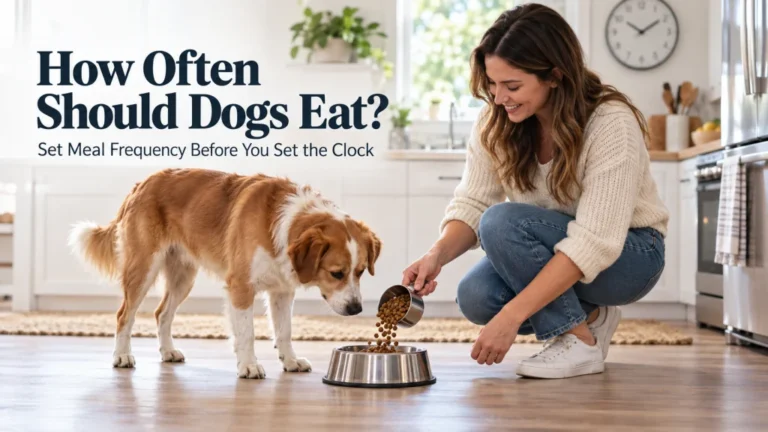
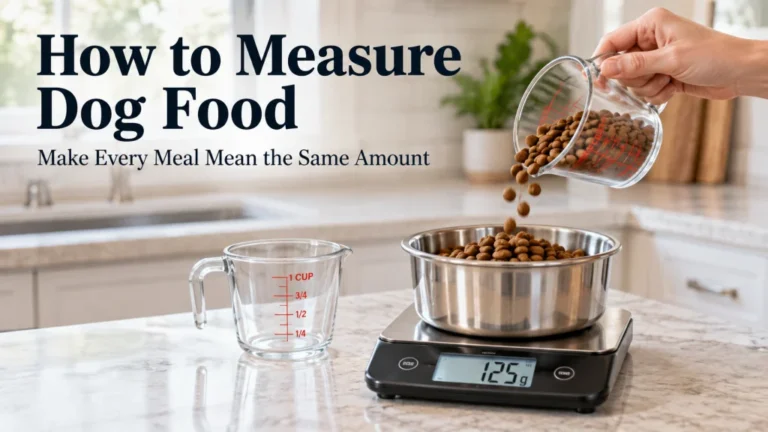
A practical puppy feeding schedule starts with the daily amount your puppy should receive, then divides that amount into several measured meals that fit growth and household logistics. Young puppies commonly need more frequent meals than adult dogs, but published age bands should be treated as starting points rather than deadlines that every puppy must follow. Keep the first routine close to the puppy’s current safe schedule when practical, measure consistently, and reduce meal frequency gradually as growth, size, appetite pattern, and veterinary guidance support the change. Repeated vomiting, diarrhea, lethargy, refusal to eat, poor growth, or another concerning change belongs with a veterinarian, not a schedule adjustment alone.
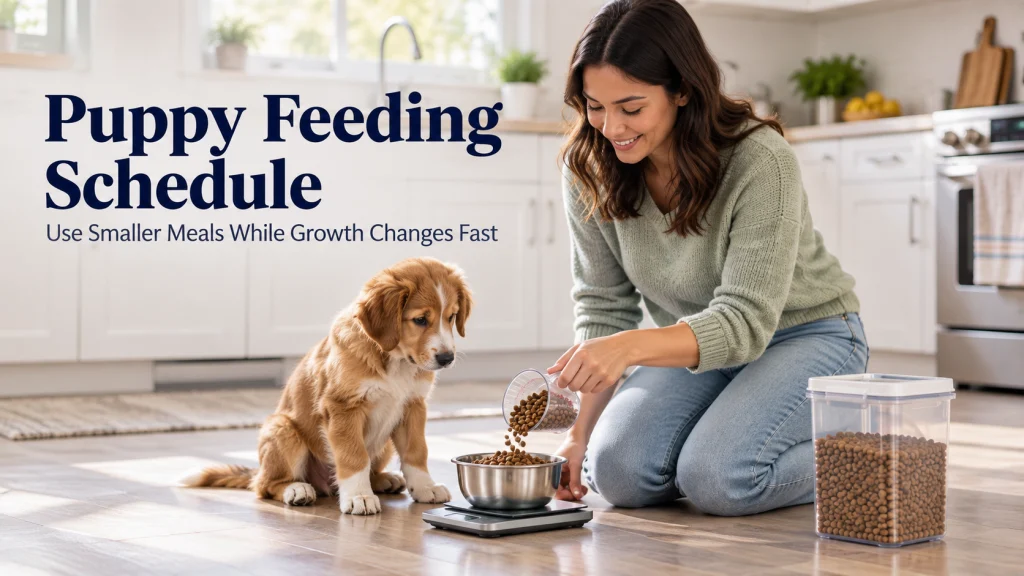
Keep the first puppy feeding schedule simple before changing it
A puppy feeding schedule changes faster than an adult schedule because growth, stomach capacity, appetite, and the household routine are all changing at once. If your puppy arrived eating a measured routine that has been working safely, the easiest first move is usually to preserve that pattern long enough to learn what the puppy is actually eating and how the day fits together. The broader principles in our guide to feeding a dog still apply, but a growing puppy usually needs the daily amount divided more often. That is why the first goal is consistency, not immediately forcing the puppy into an adult pattern.
Once the first few days feel predictable, compare the puppy’s current routine with the practical framework in our dog feeding schedule guide. Write down the food being offered, the known daily amount, how many meals are being served, who handles each meal, and whether a midday handoff is needed. Do not change food type, total daily amount, meal count, and household timing all at once unless veterinary guidance gives you a reason to do so. A schedule is useful when it makes feeding more repeatable, not when it turns every bowl into a rigid clock test.
Confirm the food is appropriate for growth before building the schedule around it
Meal timing cannot fix a food that is not appropriate for the puppy’s life stage. Before you build a detailed routine, read the nutritional adequacy statement and confirm that the food is labeled for growth, for all life stages when appropriate, or is otherwise being used under veterinary guidance. AAFCO identifies growth as a distinct life stage because nutritional needs change across life stages, and feeding directions on complete and balanced foods are meant to match the intended stage. This article stays with schedule execution, so it does not prescribe nutrient ratios, calcium targets, or a homemade puppy diet.
Large breed puppies deserve extra attention because growth rate and adult size can change what the veterinarian wants you to feed and how long growth food remains appropriate. The safest household move is to verify the label and any veterinary instructions before changing the meal count around a new food. If the package amount is meant for a puppy’s current weight or expected adult size, use that information as a starting point rather than copying another owner’s bowl size. Once the daily amount is known, the schedule can divide it without pretending meal timing determines the puppy’s nutritional requirements.
Use several small measured meals for young puppies
Young puppies often do better with the known daily amount divided into several smaller meals instead of one or two oversized servings. VCA notes that puppies have high energy needs while growing and relatively small stomachs, which is why several small meals are commonly used. PetMD also recommends measured meals and notes that puppies younger than about three months may need three or four feedings in a day. The useful takeaway is the pattern, not a universal meal count for every puppy of the same age.
If you are trying to decide how often to feed a puppy, first look at whether the current meals are small enough to be practical, measured consistently, and spaced so the puppy is not being asked to handle one or two oversized servings. A toy breed puppy with a specific medical risk should not be managed from a generic household routine, and a large breed puppy may have growth considerations that change the nutrition plan. Avoid making a young puppy skip a needed midday meal merely because an adult dog in the home eats twice. The immediate goal is a workable meal pattern that fits the puppy now, while the next section deals with when published age bands should or should not influence a transition.
| Puppy stage | Common starting pattern from published guidance | How to use it |
|---|---|---|
| Very young puppy | Several small meals, often three or four | Keep the current safe routine when practical and verify the plan for the individual puppy. |
| Growing puppy moving through the middle months | Many puppies transition toward fewer meals | Reduce frequency gradually rather than changing only because a chart says the puppy reached a cutoff. |
| Older puppy approaching an adult pattern | Two meals may become practical for many puppies | Confirm that growth, size, appetite, and veterinary guidance support the change. |
The table is a planning tool, not a prescription. Different reputable sources use slightly different examples, which is exactly why the puppy’s condition and veterinary guidance matter more than matching one chart perfectly. Use the pattern to know what question to ask next: should this puppy still have the same number of meals, or is it time to reduce one gradually? That keeps the schedule flexible without making it vague.
Treat published age bands as examples, not exact deadlines
Age charts are most useful as comparison points, not as instructions to change a meal on a particular birthday. AKC publishes one commonly used progression by age, while PetMD and VCA frame puppy feeding with more room for individual needs and veterinary adjustment. The practical value is in seeing where the sources broadly agree and where they leave flexibility. When two reputable guides use slightly different age bands, that is a reason to reassess the individual puppy rather than force the sources into one rigid timetable.
Size, growth rate, body condition, appetite pattern, food choice, and veterinary advice can all change when the next transition makes sense. Small and large dogs do not finish growing on the same timetable, and a medical concern can make generic meal charts especially inappropriate. If the puppy is thriving on the current number of measured meals, there is rarely a practical reason to force a sudden change just to hit an age cutoff. Use age as a prompt to reassess the routine, not as an alarm that says one meal must disappear immediately.
Divide the known daily amount across the current meals
The meal schedule should organize the daily amount, not create a new total on its own. Start with the amount supported by the food label and any veterinary adjustment, then divide that amount across the current number of meals. If you still need to establish that daily total, use our guide on how much to feed a dog before trying to solve the problem with meal timing. This separation matters because feeding frequency and feeding quantity answer different questions.
For example, if the established daily amount is divided across four meals, each bowl should represent one part of that total rather than four independent serving decisions. When the puppy later moves to three meals, the daily amount does not automatically increase simply because each meal looks larger. Training food and edible enrichment also come from the puppy’s overall intake, so they should not become invisible extras. Keeping one daily total makes handoffs clearer and reduces the chance that two people both assume the other person has not fed the puppy.
- Write down the established daily amount before dividing it.
- Record how many meals are currently being served.
- Assign each meal to a person or a clear household routine.
- Count food used for training or enrichment toward the overall intake when appropriate.
- Recheck the daily amount as the puppy grows instead of keeping the same serving forever.
A simple record is more useful than a complicated feeding spreadsheet that nobody updates. The point is to make every caregiver work from the same daily total and the same meal count. When growth changes the daily amount, update the total first and then recalculate the portions. That keeps quantity decisions from getting mixed up with schedule decisions.
Measure each meal the same way as the puppy grows
Consistency matters more when several people share feeding duties. Use the same measuring method for every meal so that breakfast, midday food, and evening food are all portions of the same plan rather than guesses from different bowls or scoops. Our guide to measuring dog food consistently explains why a familiar scoop is not automatically an accurate serving unless its capacity is known. The feeding routine becomes easier to adjust when the starting measurements are repeatable.
Recheck the label as the puppy gains weight and as the food changes, because feeding directions can differ between products and life stages. Do not assume a cup of one food carries the same energy as a cup of another food, and do not keep increasing the bowl just because the puppy finishes quickly. Body condition, growth, appetite, activity, and veterinary guidance should inform adjustments to the daily amount. The schedule only works if the measurement underneath it still matches the puppy.
Reduce meal frequency gradually when growth supports it
Moving from more meals to fewer meals should be a deliberate transition, not a skipped lunch that becomes permanent by accident. If the puppy is ready, shift the daily amount so that the remaining meals absorb the portion that is being removed instead of simply deleting food. Our broader guide to how often dogs should eat explains how meal frequency changes once the dog is no longer in the most rapid part of puppy growth. For this decision, the puppy’s age is only one part of the check.
Watch whether the new pattern fits appetite, stool quality, body condition, activity, and the household routine without treating any one observation as a diagnosis. Small dogs, large dogs, and puppies with veterinary concerns may need different timing or a slower transition. If the puppy consistently leaves a middle meal, that can be information worth discussing, but it is not proof that every puppy of that age should lose the meal. Gradual changes make it easier to tell whether the schedule itself is working before another variable changes.
Coordinate feeding with the puppy’s first days without changing everything at once
A new home already changes sleeping, potty trips, people, sounds, confinement, and access to the yard. Feeding is easier to evaluate when it is not transformed at the same time without a reason. If a breeder, rescue, or previous caregiver has provided a safe routine and food information, keep that schedule close at first while you learn the puppy’s normal appetite and elimination pattern. Our broader guide to bringing home a new dog covers the rest of the transition so feeding can stay one manageable part of the first days at home.
Build the puppy meal schedule around repeatable parts of the day such as waking, a midday caregiver handoff, and the evening household routine rather than chasing perfect clock times. That makes the schedule easier to follow on workdays and days off without creating a different system every morning. A written handoff can be as simple as a note showing the meal served, the amount, and whether the puppy ate normally. Once the household can execute the routine consistently, you have a much cleaner baseline for deciding whether anything actually needs to change.
| Household situation | Practical option | What to verify |
|---|---|---|
| Someone is home midday | Keep the planned midday meal and record it | Portion, caregiver handoff, potty access, and supervision |
| Work creates a midday gap | Use a trusted caregiver or an appropriate feeder setup when safe | The puppy still receives needed care beyond the food itself |
| Household members alternate days | Use one written meal plan | Everyone uses the same daily amount and measuring method |
The midday problem is often a logistics problem rather than proof that the puppy should immediately eat fewer meals. Solve the care gap first, then reassess whether the puppy is actually ready for a different meal pattern. That distinction protects the puppy’s routine from being changed only because the human schedule became inconvenient. It also makes later transitions easier because everyone knows what the current plan is.
Use an automatic feeder only for a safe timing gap
An automatic feeder can be useful when the puppy still needs a measured meal and the household cannot reliably deliver that portion by hand. It should solve a narrow timing problem, not become a reason to leave a young puppy without the supervision, potty access, social contact, or other care the puppy still needs. Our guide to choosing an automatic dog feeder covers the equipment decision separately. The puppy feeding routine should be settled first so the device is serving an existing plan rather than inventing one.
Before relying on a feeder, verify that the food type works with the device, the portioning is repeatable, the puppy cannot tip or damage the setup, and a failed meal would be noticed. A feeder also does not tell you whether the puppy actually ate, vomited, developed diarrhea, or showed another concerning change unless someone is checking the puppy. For a very young puppy or a puppy with a medical concern, veterinary guidance and direct care may matter more than the convenience of automated timing. Use automation only where it reduces a safe household gap without hiding the puppy’s condition.
Treat concerning changes as a veterinary question, not a schedule problem
A feeding schedule can organize normal meals, but it cannot diagnose why a puppy suddenly stops eating or becomes unwell. Repeated vomiting, diarrhea, lethargy, refusal to eat, poor growth, or another concerning change should prompt veterinary contact rather than a sequence of internet schedule experiments. The same boundary applies when a toy breed puppy has a specific hypoglycemia concern, a large breed puppy needs individualized growth guidance, or a puppy has another condition that changes feeding. Those decisions need information about the actual puppy, not a generic age chart.
Keep useful observations for the veterinarian, including what food was offered, how much was offered, how much was eaten, whether the meal pattern recently changed, and what other signs appeared. Do not respond to repeated problems by forcing a puppy to skip meals, adding supplements, or changing multiple diet variables without guidance. The practical job of this article ends at organizing measured meals for an otherwise stable puppy. When the puppy’s health or growth becomes the question, the next step is individualized veterinary guidance.
Warning: Repeated vomiting, diarrhea, lethargy, refusal to eat, poor growth, or another concerning change should not be treated as a routine feeding schedule issue.
That stop condition is intentionally simple. A clear boundary is more useful than giving owners a long list of possible causes that this article cannot diagnose. Bring the feeding record and the food label when you ask for help so the veterinarian can see the schedule in context. That makes the household routine useful evidence without pretending it is a medical assessment.
Final Thoughts: let the puppy schedule change with growth
The best puppy feeding routine is not the one that matches a single internet chart most precisely. It is the one that starts with an appropriate growth food, a known daily amount, repeatable measurement, and enough meals for the puppy’s current stage and individual needs. Keep the first routine steady enough to learn from it, then change one part at a time when growth, appetite, size, and veterinary guidance support the change. That gives the household structure without turning age bands into rigid deadlines.
As the puppy matures, revisit both the daily amount and the meal count instead of assuming one can change safely without the other. Make midday care a logistics decision, use automation only for a narrow safe gap, and keep every caregiver on the same written plan. If the puppy becomes unwell, grows poorly, or stops eating normally, move the question out of schedule management and into veterinary care. A useful feeding routine should become simpler as the puppy grows, not more rigid.
Frequently asked questions
🐶 How many times a day should a young puppy eat?
Young puppies commonly eat several small measured meals, often three or four depending on age, size, growth, food, and veterinary guidance. Use published age ranges as starting examples, then confirm what fits the individual puppy rather than forcing every puppy onto the same cutoff.
🍽️ Should I keep the breeder or rescue feeding schedule at first?
If the existing routine is safe and the puppy is doing well on it, keeping it close at first can reduce the number of changes happening at once. Record the food, daily amount, meal count, and timing pattern before you decide what needs to change.
📏 Do I change the total daily food when I reduce the number of meals?
Not automatically. Meal frequency and daily quantity are separate decisions, so redistribute the established daily amount across the remaining meals unless the label, body condition, growth, or veterinary guidance also supports changing the total.
🕒 Does a puppy need meals at exact clock times?
A repeatable household pattern is usually more practical than treating an exact minute as mandatory. Aim for a routine caregivers can follow consistently while still giving the puppy the number of meals and supervision appropriate for the puppy’s current needs.
🏠 What if nobody is home for the midday meal?
First decide whether the puppy still needs that meal rather than dropping it only because work makes it inconvenient. A trusted caregiver or a safe feeder setup may solve the timing gap, but a young puppy may still need potty access, supervision, and other care that a feeder cannot provide.
🩺 When should I call the veterinarian about feeding?
Contact the veterinarian for repeated vomiting, diarrhea, lethargy, refusal to eat, poor growth, or another concerning change. Also ask for individualized guidance when size, medical history, growth pattern, or another condition makes a generic puppy schedule unreliable.
References and Sources
- AAFCO pet food label guidance: Supports checking the nutritional adequacy statement, growth life stage, and feeding directions before building a schedule.
- VCA general feeding guidance for dogs: Supports several small meals for growing puppies and individualized feeding based on life stage and the dog.
- PetMD puppy feeding guide: Supports measured meals, frequent feeding for young puppies, and aligning the schedule with the household routine while consulting the veterinarian for the individual puppy.
- AKC puppy feeding fundamentals: Provides common age band examples for moving from more frequent meals toward fewer meals as puppies mature.