A new puppy checklist is most useful when it separates true arrival needs from purchases and plans that can wait. Before pickup, the important jobs are confirming the puppy’s information, making the accessible home safer, covering food, water, rest, cleanup and transport, and making sure the household knows who is responsible for what. Gear should be chosen only far enough to make those immediate functions work, with fit and details specific to the puppy confirmed instead of guessed. The goal is to be ready enough for a calm handoff, not to solve every future puppy decision in advance.
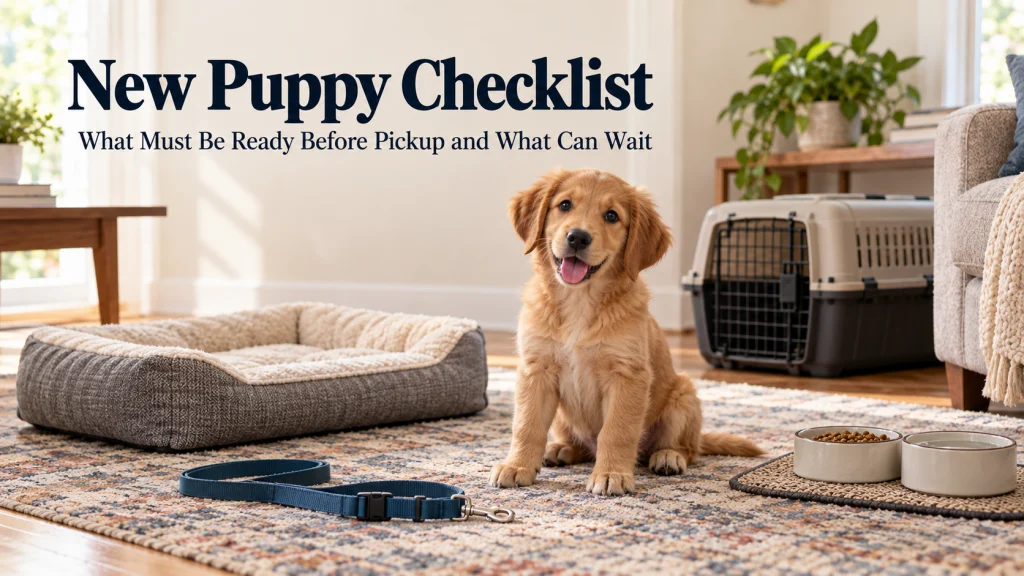
Start with readiness, not a giant shopping list
A useful new puppy checklist starts with what must function when the puppy arrives, not with every product a puppy might eventually use. That means separating food, water, safe access, rest, cleanup, pickup and household coverage from decisions that become easier once you know the puppy better. If you are still organizing the broader household setup, the guide to preparing for a new dog gives that work a wider frame. For the complete transition from selection through arrival, bringing home a new dog keeps the puppy checklist connected to the larger process.
| Checklist item | Ready | Confirm first | Can wait |
|---|---|---|---|
| Current food and feeding information | □ | □ | □ |
| Records and identification information | □ | □ | □ |
| Veterinary contact and first visit plan | □ | □ | □ |
| Safe access and resting area | □ | □ | □ |
| Cleanup supplies | □ | □ | □ |
| Pickup and transport setup | □ | □ | □ |
| Household and work coverage | □ | □ | □ |
| Optional supplies and upgrades | □ | □ | □ |
I would treat every item on the list as one of three statuses: ready, confirm first or can wait. Ready means the function is understood and the household can carry it out, not merely that an item has been purchased. Confirm first covers details such as current food, body measurements, records, transport setup, household access or which veterinary practice will receive the puppy’s records and questions. Can wait is for a real decision that does not need to be solved before pickup.
Confirm information specific to the puppy before shopping around assumptions
Several purchases depend on facts you should not guess, especially current food, approximate body size, identification information, existing records and any instructions that come with the puppy. Ask the breeder, shelter or rescue what the puppy is currently eating, what documents will be transferred, whether identification information needs an ownership update and what equipment the puppy already uses comfortably. The point is not to lock the household into every existing routine. It is to prevent avoidable changes caused by buying first and learning the puppy’s actual starting point later.
- Current food and feeding instructions supplied with the puppy
- Identification, registration or microchip transfer information when applicable
- Medical, vaccination and deworming records that are available
- Known equipment sizes or measurements that affect immediate fit
- Pickup contact details and any handoff instructions
Write down the information that affects immediate setup and keep it with the pickup paperwork rather than scattering it across messages, screenshots and shopping notes. If a collar, harness, carrier or crate decision depends on measurements or a particular transport setup, mark it confirm first until the relevant fit can be checked. For health records, collect what exists and let the veterinarian interpret what care is due rather than building a medical schedule from a generic checklist. This is where a short, accurate handoff record is more useful than a long list of assumptions.
Prepare immediate food, water, rest, access and cleanup functions
The household needs a few functions to work immediately: the puppy must be able to eat and drink from a stable setup, rest in an appropriate area, move only through spaces you intend to allow, and have accidents cleaned without improvising. Those functions do not require a premium version of every item. A basic bowl setup, the puppy’s current food, an intentionally chosen rest area, waste supplies and a suitable cleaner can cover more real needs than a cart full of accessories. Start with the function, then choose the simplest equipment that makes it reliable in your home.
| Function needed now | What must be settled | What can usually wait |
|---|---|---|
| Food and water | Current food is known and bowls have stable locations. | Specialized feeding accessories unless a real need appears. |
| Rest | A quiet, manageable rest area is chosen. | Upgraded beds or multiple sleep stations. |
| Access | Unsafe areas or rooms the puppy cannot enter can be blocked or closed. | Permanent room changes that are not yet necessary. |
| Cleanup | Waste bags, absorbent materials and suitable cleaning supplies are accessible. | Large collections of specialty cleaning tools. |
Think about placement as carefully as the objects themselves. Water that is constantly kicked in a narrow walkway, bedding placed beside a busy doorway or cleanup supplies stored far from the areas most likely to need them create unnecessary work even if the products are fine. A small home may need compact storage and clear gates, while a larger home may need duplicate cleanup supplies near different access points. Readiness comes from a workable setup, not from the number of puppy products in the room.
Complete the home safety pass before the puppy gets access
A puppy sees reachable cords, trash, small objects, open storage and tempting household items differently from an adult who already knows the rules. Before pickup, inspect only the spaces the puppy will actually be allowed to enter and remove, secure or block obvious hazards there. This keeps the job manageable and makes access control part of the plan instead of assuming supervision will catch everything. For a process that checks each room, use the full guide to dog proofing your home rather than trying to duplicate that entire task inside this checklist.
Warning: Home preparation does not replace supervision, and a generic checklist cannot identify every household hazard. A barrier only helps when it fits the opening and is used as intended. A cleaner should be used according to its current label and surface directions. Do not improvise a different use because a product happens to be nearby.
Pay attention to the puppy’s reachable level, not just what looks tidy from standing height. Electrical cords, medications, household chemicals, trash, small chewable objects and unsecured areas can become problems simply because they are accessible. Gates, closed doors and intentional confinement can reduce how much space must be prepared at once, but the equipment still has to match the opening and be used as intended. If a space cannot be made reasonably manageable before pickup, keeping the puppy out of it is a valid preparation decision.
Choose only the supplies that must work when the puppy arrives
The phrase new puppy essentials can make every category sound urgent, but a supply belongs on the ready list only when it supports an immediate function you have identified. Before buying, check the criteria that can make the item succeed or fail in your setup: correct size or fit, stable placement, fit through the intended access point, practical cleanability and vehicle compatibility when transport is involved. Food, bowls, cleanup supplies, identification, transport equipment and planned rest or access control may qualify once those details are clear. Extra toys, duplicate beds, specialized grooming tools and upgrades can wait until the puppy’s size, chewing style, preferences and household routine are easier to judge.
Key point: A supply earns its place on the ready list because it solves a known arrival task. “Puppies usually need one” is not enough when fit, placement, cleaning, access or transport compatibility can change the choice. Confirm those practical constraints before comparing optional features. If the basic function is already covered, an upgrade does not become urgent just because it is marketed for puppies.
For a deeper supply decision, the separate guide to new dog supplies handles the product side without turning this checklist into a catalog. A crate, harness, bed or food choice can still change with body size, current diet, transport method, home layout and behavior context. When those inputs are unknown, mark the purchase confirm first instead of guessing from a generic puppy label. The aim is to buy what can be verified for the immediate setup, not the most feature rich version of every category.
Agree on household rules and responsibilities before pickup
A home can be fully stocked and still be unprepared if family members disagree about access, feeding responsibilities, resting areas or who handles the puppy when routines collide. Decide which rooms are available, where food and water belong, where the puppy rests and who owns each recurring care task. Keep those decisions simple enough that everyone can follow them without a meeting every time the puppy moves rooms. The detailed guide to house rules for a new puppy is the better place for building the full household rule set.
| Household decision | Ready when |
|---|---|
| Allowed spaces | Everyone knows which areas are open and which are blocked. |
| Food and water | Storage, bowl location and responsible person are clear. |
| Rest area | The location is chosen and family traffic will not constantly disrupt it. |
| Care responsibilities | Primary and backup coverage are assigned for essential tasks. |
The checklist only needs to confirm that major responsibilities are assigned and obvious conflicts are resolved before pickup. If one person expects free access while another expects gated access, or if everyone assumes someone else will handle a care task, the problem is operational rather than a product problem. Put the assignment where household members can see it and keep backup coverage clear when the primary person is unavailable. Consistency at this stage means the humans have a shared plan, not that the puppy is expected to understand every rule immediately.
Decide how the first workdays will be covered
Work coverage belongs on a getting a puppy checklist because the puppy’s needs continue when the owner’s normal schedule resumes. Before pickup, identify who can provide the required supervision, access, feeding and bathroom opportunities under the plan you receive from the breeder, rescue and veterinarian. Do not build this around a universal interval copied from someone else’s puppy because age, routine, travel distance and individual needs change what is workable. The immediate task is making sure there is no uncovered block that the household has simply not planned for.
Note: If the puppy’s health, elimination, feeding or behavior needs create uncertainty about appropriate care, ask the veterinarian or other qualified professional who owns that question. This checklist should route the decision, not invent a universal schedule. Keep the unanswered point visible until the right source resolves it. Do not turn a household coverage gap into a medical guess.
If work scheduling is the main constraint, use the guide to planning work coverage for a new puppy for the deeper decision. The answer may involve adjusting who is home, arranging trusted help or changing the household routine, but it should be decided before the gap occurs. Avoid treating a crate, pen or other containment setup as a substitute for a realistic care plan. Equipment can support management, but it cannot create coverage that does not exist.
Confirm the information the breeder should provide
If the puppy is coming from a breeder, prepare the handoff questions before pickup so important information is not lost in an exciting conversation. Focus on the puppy’s current food, records, identification or registration details when applicable, known routine information and any documents or items the breeder has said will transfer with the puppy. Do not use this checklist to judge medical meaning from a record or to create your own care schedule. The separate guide to questions to ask a breeder before pickup is where the full handoff conversation belongs.
- Collect the records and documents that are actually available.
- Confirm the puppy’s current food and any immediate transition instructions.
- Confirm identification or registration transfer steps when relevant.
- Record contact information for later questions.
- Mark unknown details as unknown instead of filling them in from a generic checklist.
If the puppy comes from a shelter or rescue instead, apply the same handoff principle to the organization actually transferring the dog. Ask what records and identification information exist, what food or routine information is known and what later instructions are being provided. Some details may be unknown, and that is useful information too because it tells you what must be verified after arrival rather than assumed. Keep the handoff factual and written where possible so it can be shared accurately with the veterinarian and household members.
Prepare pickup logistics as a transport and handoff task
Pickup is easier when the route, people, paperwork and puppy transport setup have already been decided. Confirm who is traveling, where the puppy will be secured, what records or supplies need to come home and how you will keep essential handoff information together. The transport equipment must suit the puppy and vehicle rather than being chosen because a generic checklist calls it an essential. If the pickup involves a carrier, crate or restraint, follow the relevant product instructions and vehicle setup requirements instead of improvising a connection.
Pro tips: Keep the puppy’s records, contact details and any transfer instructions together in one place that is easy to reach. Assign one person to paperwork and another to puppy handling when more than one adult is available. Keep the transport area clear before the handoff starts. That prevents essential information from disappearing into bags while the puppy is being managed.
Use the complete puppy pickup checklist for the detailed handoff and travel sequence. This article only needs to confirm that pickup is not being treated as “drive there and figure it out.” Keep loose objects out of the planned dog area, bring the required paperwork and assign responsibility for the puppy during the handoff. Make sure the chosen transport setup is ready before the puppy is placed in the vehicle. Once those logistics are settled, there is little value in adding unrelated future tasks to pickup day.
Know which decisions need a separate plan
A puppy preparation checklist should not swallow every topic that becomes relevant after arrival. Crate selection and home containment, feeding, transport equipment, training, records and health questions each have their own evidence and fit requirements. Keeping them separate prevents one line such as “buy a crate” or “start training” from standing in for a real decision. The checklist should identify what blocks pickup and route the rest to the source that can handle its actual constraints.
| Decision area | What this checklist should do | What it should not do |
|---|---|---|
| Crates and containment | Confirm whether a safe management setup is needed for arrival. | Choose one universal crate or teach full crate training. |
| Feeding | Confirm current food and immediate feeding information. | Prescribe a diet or feeding schedule. |
| Training | Make sure household expectations are aligned. | Turn preparation into a complete training program. |
| Health records | Collect records and establish veterinary contact. | Interpret records as a diagnosis or treatment plan. |
Use the readiness status to route these decisions. A transport setup needed for pickup belongs in ready or confirm first, while an unrelated training accessory does not. If a medical record raises a question, collect it and bring that question to the veterinarian rather than interpreting it here. A question can be urgent without becoming a pre pickup shopping decision. This keeps the checklist focused on preparation while preserving the boundary around specialist decisions.
Move from checklist mode to puppy homecoming mode
Once puppy specific information is collected, essential functions are covered, accessible areas are prepared, responsibilities are assigned and pickup is workable, stop expanding the before arrival list. The next decisions can use what you observe about comfort, appetite, elimination, sleep, play, handling and household fit. Some preferences only become clear after arrival, so advance purchases cannot resolve them reliably. At that point, the checklist should hand the household into the homecoming stage.
Key point: Pickup readiness means the handoff can work with verified information, prepared access, assigned responsibilities and suitable immediate equipment. It does not require finishing the puppy’s first month in advance. Choices that depend on preference or behavior can use direct observation after arrival. That gives the household better inputs than a speculative purchase list.
The guide to bringing home a puppy picks up that next stage. Use it for the homecoming transition instead of forcing after arrival routines into this checklist. Keep the records and readiness notes together so the household starts from the same information. Preparation is complete when the handoff is supported and the next decision has a clear place to go.
Final Thoughts: ready enough beats buying for every future problem
A strong puppy checklist is a sequencing tool, not a measure of how much you bought. Before pickup, confirm the puppy’s starting information, prepare planned access, cover food, water, rest, cleanup and transport, establish the veterinary contact plan, and assign essential household responsibilities. Mark uncertain fit, compatibility or record questions as confirm first instead of filling gaps with assumptions. Judge everything else by whether it truly has to work at the handoff.
When those items are covered, move forward and let later decisions use better information from the puppy and the appropriate source. This keeps the setup practical without turning preparation into a catalog. Complete preparation does not mean every future task is finished. It means the puppy can arrive into a household that has solved the immediate jobs and knows where the next decisions belong.
FAQs
🐶 What are the most important new puppy essentials before pickup?
Prioritize functions: known food, stable water access, a manageable rest area, safe transport, cleanup supplies, planned access control and the records or handoff information that are available. Exact gear depends on the puppy’s size, fit, current routine and your home or vehicle setup.
🛒 Should I buy all puppy supplies before bringing the puppy home?
No. Buy what must work immediately, and confirm size, fit, placement, cleanability or transport compatibility before committing to items that depend on them. Optional upgrades can wait until the puppy’s actual needs are clearer.
📋 What records should I ask for when I pick up a puppy?
Collect the medical, vaccination, deworming, identification, registration or transfer records that actually exist for that puppy. Keep them together and let your veterinarian interpret health records and decide the appropriate care plan.
🏠 Do I need to prepare every room before the puppy comes home?
Not necessarily. Prepare the areas the puppy will be allowed to access and use doors, gates or other appropriate management to keep the puppy out of unprepared spaces until they can be checked.
🚗 What should I confirm for puppy pickup?
Confirm who is traveling, how the puppy will be secured, which paperwork and handoff items must come home and who is responsible for the puppy during the transfer. Any carrier, crate or restraint should fit the puppy and vehicle and be used according to its current instructions.
🧾 What can wait until after the puppy arrives?
Optional upgrades, extra toys, duplicate beds, specialized accessories and other choices that depend on observed preferences can often wait. If an item is not needed for food, water, rest, access, cleanup, transport or another known arrival function, ask whether better information later would improve the decision.
References and Sources
- PetMD new puppy checklist: Supports supplies, home safety, identification and veterinary routing.
- AKC preparing for a new puppy: Supports home safety, access management and basic supply preparation.
- VCA first veterinary visit preparation: Supports gathering available records for the veterinarian.