House rules work best when the people in the home agree on them before a new puppy arrives. The useful decisions are simple ones: where the puppy may go, where the puppy will sleep, who handles recurring care, what happens around meals, and which words everyone will use for basic cues. A short written rule sheet also makes it easier to spot decisions that change the physical setup of the home. The goal is not to train every behavior in advance, but to make sure the humans are not giving opposite answers to the same everyday question.
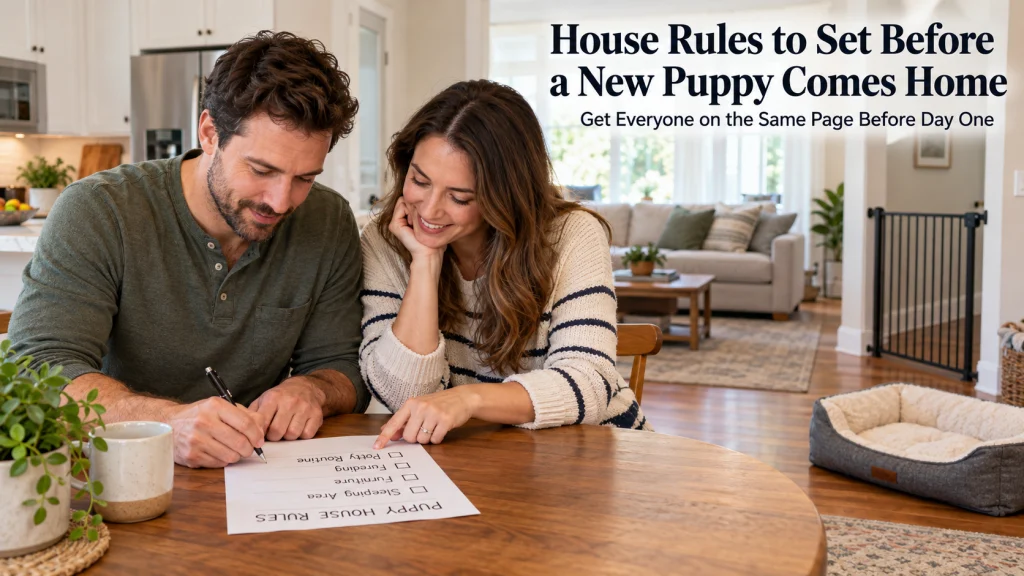
The first consistency problem usually belongs to the humans
One person says the puppy can sit on the couch, while another person says the couch is always off limits. That is the kind of conflict worth solving before anyone worries about perfect puppy behavior. When setting house rules for a new puppy, start with the choices the people in the home can actually control. That planning fits into the larger process of bringing home a new dog and the more focused work of preparing for a new dog.
The point is not to make the home rigid or to predict every situation that might occur. It is to remove obvious contradictions before the puppy encounters them, especially around access, furniture, sleep, food, visitors, and recurring care. A workable rule should tell a household member what decision has already been made without forcing that person to interpret a long behavior manual. If two people still disagree, settle the household decision first and leave the teaching method for the appropriate training guidance.
Keep the rule sheet short enough that everyone will follow it
A useful rule sheet should fit the real household, not an imaginary home where everyone remembers twenty small instructions. Start with decisions that affect daily access, care, safety, or setup, then leave minor preferences off the first version. The easiest test is whether a person can glance at the sheet and know what to do without calling a family meeting. If the list keeps expanding, move optional details to a later discussion instead of making the core rules harder to follow.
This is also where a new puppy checklist can help separate items you need to prepare from rules you need people to follow. The checklist answers whether a space, supply, contact, or task has been prepared, while the rule sheet answers how the household will use that setup. Keeping those jobs separate prevents the planning document from becoming a shopping list or a training curriculum. A short sheet is easier to revise when the puppy’s actual size, temperament, energy, and household fit become clearer.
- Rooms the puppy may enter without special permission
- Furniture that is allowed or not allowed
- Chosen sleeping area
- Who owns feeding, bathroom, supervision, and cleanup tasks
- Household rules for treats and table food
- Shared words for a small set of basic cues
- How household members handle guests, doors, meals, and rest periods
| Rule area | Household decision |
|---|---|
| Room access | Write the rooms that are normally allowed and restricted |
| Furniture | Write which furniture is allowed, restricted, or conditional |
| Sleeping location | Write the agreed starting location |
| Care ownership | Name the primary person and backup for recurring tasks |
| Meals and treats | Write who gives them and the household rule for table food |
| Shared cues | List the small set of words everyone will use consistently |
| Guests and doors | Write who manages the puppy when people arrive or leave |
| Rest and meals | Write the human rule for giving the puppy space |
That list is a starting framework, not a demand that every home make the same choices. A small apartment, a multilevel house, a home with children, and a quiet adult household can need different boundaries. Keep only the rules that remove a real point of confusion or change how the home must be prepared. Everything else can wait until it becomes a real decision.
Decide which rooms and furniture are allowed before setting up the space
Room and furniture rules matter before arrival because they can change where gates, beds, bowls, storage, and supervision zones need to go. Decide whether the puppy will have broad access, access to selected rooms, or a smaller starting area, then make the home support that decision. The same logic applies to couches, beds, and other furniture: allowed, not allowed, or allowed only in a defined way. For the physical side of those choices, use the broader guidance on setting up a home for a dog rather than turning this page into a containment guide.
A household rule should be clear enough that two people would give the same answer when the puppy approaches the same place. For example, “living room couch is allowed, guest bed is not” is more usable than “furniture depends on the situation.” If someone wants the puppy on the couch and someone else does not, choose the household rule now instead of letting each person enforce a different preference later. The decision can change in the future, but it should change deliberately for everyone, not person by person.
| Decision | Household rule to write down | Setup consequence to check |
|---|---|---|
| Room access | List rooms that are normally open and rooms that stay restricted | Doors, gates, supervision zones, and puppy safe storage |
| Furniture access | State which furniture is allowed, restricted, or conditional | Alternative resting spot and consistent household response |
| Freedom level | Define the starting area rather than assuming full home access | Where daily care and supervision will actually happen |
Use the setup column as a reality check before finalizing a rule. A boundary that nobody can maintain with the current layout is not yet a finished plan. Either change the environment or simplify the rule until the household can follow it consistently. The puppy should not be the first member of the home to discover that the rule does not work.
Choose the puppy’s sleeping location
The household should agree on where the puppy is expected to sleep before deciding how to teach that routine. There is no universal answer that fits every home, because room layout, household sleep, supervision needs, other animals, and the puppy’s adjustment can all change the practical choice. The planning question is simply whether the intended sleeping area is in a bedroom, nearby common area, separate quiet space, or another suitable location. Once that location is chosen, the household can prepare it without debating the rule after the puppy is already home.
A sleep rule should also clarify who can change the arrangement and under what circumstances. If one person intends to invite the puppy onto a bed while another expects the puppy to remain in a separate sleep space, the conflict is not really about the puppy yet. It is a household decision that needs one shared answer before training begins. Keep this section at the location and responsibility level, and handle crate use, containment choices, or sleep setup details in the guidance that owns those topics.
Assign feeding, bathroom, and supervision responsibilities
“Everyone will help” sounds cooperative but does not tell anyone who owns a recurring task. Assign a primary person for feeding, bathroom trips, active supervision, cleanup, and any handoff that must happen when the primary person is unavailable. The point is not to create a rigid family chart, but to prevent a task from being missed because each person assumed someone else had it. If work or school schedules make early coverage difficult, review the practical planning around time off work for a new puppy before the puppy arrives.
Responsibilities should match who is actually present, capable, and willing to do the task, not who volunteered most enthusiastically during planning. A backup person matters for recurring care because household schedules change and a puppy cannot rely on a vague promise that somebody will notice. Write the handoff rule beside the task, especially if different adults cover different routine windows. That makes the plan usable without prescribing a detailed bathroom or feeding schedule here.
| Recurring task | Primary owner | Backup rule |
|---|---|---|
| Meals | Named household member | Backup confirms before taking over |
| Bathroom access | Named household member for each routine window | Handoff is explicit, not assumed |
| Supervision | Person currently responsible | Responsibility is transferred directly before leaving |
| Cleanup and reset | Named household member | Supplies return to the agreed storage location |
Keep names or roles specific enough that the table means something in your home. “Parent” or “roommate” can work if that label identifies one person clearly, while “someone” does not. Review the table against the real household schedule and change assignments that depend on wishful thinking. A simple ownership map is more useful than a detailed routine nobody can maintain.
Agree on meal and table food rules without prescribing a diet
Meal rules on this page are about household consistency, not nutrition planning. Decide who gives meals, whether treats can come from more than one person, whether food from the table is part of the household routine, and how family members avoid duplicating what someone else already gave. The goal is to stop one person from following a rule that another person quietly cancels at the next meal. Questions about what, how much, or how often to feed belong in the broader guidance on feeding a dog.
Keep the wording practical and observable, such as “only the assigned person serves the meal” or “table food is not offered during household meals.” Avoid turning the rule sheet into a list of ingredients, calorie targets, or dietary claims. If the puppy has individual feeding needs, follow the appropriate veterinary or feeding guidance rather than inventing a household rule to override them. What this page needs is one shared human practice, not a universal feeding prescription.
Agree on how guests and doorways will be managed
Visitors often reveal household disagreements quickly because one person may want immediate greetings while another wants the puppy kept away from the entry. Decide who handles the puppy when the door opens, whether guests are asked to wait before interacting, and which areas remain available during a visit. Those are management choices that can be written before anyone tries to teach greeting behavior. Keep the rule focused on what the humans do at the doorway rather than promising a particular puppy response.
The same principle applies to delivery doors, shared entrances, and households where several people come and go. A good rule identifies who has responsibility when the door opens and what setup supports that responsibility. If a visitor ignores the household plan, the household member should return to the agreed management choice rather than improvising a new rule in front of the puppy. Detailed greeting skills, jumping work, or behavior modification belong in training guidance, not in this planning page.
Write human rules for leaving the puppy alone while eating or resting
Some of the most important rules are for people rather than for the puppy. Decide that household members will not crowd, grab, tease, or repeatedly disturb the puppy while the puppy is eating or settled in a designated rest area. Children and guests need the same simple boundary, and an adult should be responsible for enforcing it when necessary. This is easier to follow when the rule describes human behavior directly instead of expecting the puppy to manage an intrusive situation.
The wording should stay simple: give space during meals, respect the chosen rest area, and ask the responsible adult before interrupting the puppy. That does not replace supervision, child and dog introduction planning, or professional help if concerning behavior appears. It simply establishes that rest and meals are not moments for testing the puppy’s tolerance. If the household cannot follow that boundary reliably, the setup should create more separation rather than placing the burden on the puppy.
Separate household decisions from teaching techniques
A rule sheet answers what the household has decided, while training guidance answers how the puppy learns a behavior. Mixing those jobs is how a simple planning page turns into an incomplete obedience manual. “Guest bedroom stays closed” is a household decision, while teaching the puppy to wait at an open doorway is a training task. “No table food during household meals” is a household decision, while teaching a settle behavior near the dining area is a training task.
Use that distinction whenever a rule starts accumulating step by step instructions. If the household can state the desired boundary in one sentence, keep it on the rule sheet and route the teaching question elsewhere. If the issue involves fear, aggression, resource guarding, severe distress, or another behavior concern, do not expand the household rule into a treatment plan. A planning document should make responsibilities clearer, not encourage people to improvise beyond owner level care.
The puppy is not invited into the guest bedroom.
How the puppy learns to remain outside that room belongs in appropriate training guidance.
Apply the same split to furniture, greetings, doorways, and quiet areas. Decide the household boundary here, then use the correct guidance for teaching or behavior support. That keeps the rule sheet short and stops conflicting techniques from creeping into a document meant for planning. It also makes later changes easier because the household can revise the decision without rewriting an entire training method.
Post the rules where household members can actually use them
A finished rule sheet should live somewhere people will see it during the adjustment period, not in a forgotten note thread. Put the short version in a shared, visible place and keep the language direct enough to scan quickly. Include responsibilities beside the relevant rules so nobody has to check a second document for who owns a task. If the household uses a shared digital note instead, make sure everyone knows where it is and can read the current version.
Revisit the sheet when a rule proves impractical, the home setup changes, or the puppy’s real needs make a different arrangement more sensible. Changing a rule is not a failure, but changing it silently for one person creates the same inconsistency the sheet was meant to remove. When a change is made, update the written version and tell the people who share care responsibilities. The best rule sheet is not the strictest one, but the one the household can actually follow together.
Final thoughts: consistent humans make the new routine easier to learn
Before the puppy arrives, settle the small number of household choices that will affect daily life from the start. Decide access, furniture, sleep location, recurring responsibilities, meal boundaries, shared cue language, visitor management, and human rules around rest. Write those choices in plain language and make sure each recurring task has a real owner. That preparation removes contradictions without pretending the puppy can be fully trained on paper.
Then let each specialized topic stay in its proper lane. Home setup, feeding, and training all need their own decisions and may change with the puppy and household. The rule sheet only needs to give the people in the home one shared starting point. When the humans know what they agreed to, the puppy is not being asked to navigate a different household every time a different person walks into the room.
FAQs
🐶 What house rules should we decide before a puppy comes home?
Start with room and furniture access, sleeping location, care responsibilities, meal boundaries, shared cue words, guest management, and rules for leaving the puppy alone while eating or resting. Keep the list short enough that everyone in the home can follow it.
🏠 Should a new puppy have access to the whole house?
There is no single access rule for every home. Choose an area that fits your layout, supervision plan, other household members, and the puppy, then make sure everyone follows the same boundary.
🛋️ Is it okay to let a puppy on the furniture?
That is a household preference rather than a universal rule. What matters here is deciding the boundary before arrival and making sure different household members are not giving opposite answers.
🗣️ Does everyone need to use the same cue words?
Using one shared word for one intended meaning reduces avoidable household inconsistency. Keep the vocabulary small, and use appropriate training guidance for how each cue is actually taught.
🍽️ Should children be allowed to feed the puppy from the table?
Decide one household rule for table food and make sure adults and children follow it. Dietary decisions and individual feeding needs should come from appropriate feeding or veterinary guidance, not from an informal house rule.
🚪 What should we decide about guests before the puppy arrives?
Choose who manages the puppy when the door opens, whether guests wait before interacting, and which areas remain available during visits. Keep this as a human management plan rather than a promise that the puppy will greet everyone in a certain way.
References and sources
These references support the planning principle that household members should agree on core rules before a puppy arrives. They cover access, furniture, responsibilities, sleeping location, cue consistency, and human expectations around the puppy. They do not require every household to choose the same boundaries, and detailed teaching steps remain outside this article’s scope. The links are included because those specific planning points are central to the decisions explained above.
Use the sources as support for consistency, not as a template that every household must copy. Home layout, household routines, supervision needs, and the individual puppy can change the practical decision. Different homes can choose different boundaries while still giving everyone one shared plan. The useful standard is whether the people responsible for the puppy understand and follow the same decision.
- American Kennel Club house rules guidance: Supports deciding household access, furniture, responsibilities, sleeping location, cue consistency, and human rules before a puppy arrives.
- Adopt a Pet house rules guidance: Supports early household consistency, realistic boundaries, and clear human expectations around a new puppy.