The most useful breeder questions at pickup are the ones that capture information specific to this puppy before routines change in a new home. Focus on current food, daily patterns, sleep and toilet habits, handling and exposure, health records, microchip details, paperwork, familiar items, and a reliable contact path. Record what the breeder tells you rather than trying to interpret medical records or reopen the entire breeder selection process. A simple written handoff gives you a cleaner starting point for the puppy’s transition and a better record to share with your veterinarian when needed.
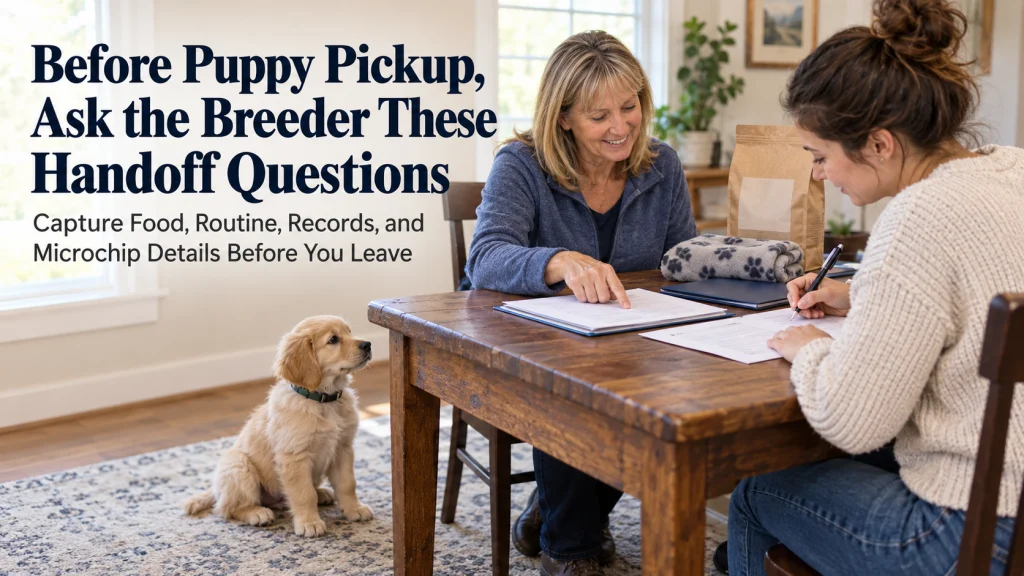
Ask for puppy specific handoff information, not another breeder interview
The most useful questions to ask breeder before picking up a puppy are different from the questions used to decide whether that breeder was a good source in the first place. At this stage, the job is to capture details that may be difficult to reconstruct after the puppy leaves, including what the puppy currently eats, how the daily routine works, what records come home, and what the puppy has already experienced. That information supports the practical transition described in our guide to bringing home a new dog. It also keeps the conversation focused on the puppy in front of you instead of repeating broad screening questions.
A useful pickup conversation should leave you with written answers, not just a reassuring impression. The preparing for a new dog guide covers the wider setup work, while this page stays focused on the breeder handoff itself. Ask for factual descriptions of the puppy’s current routine and copies of records that are being transferred, then save questions about medical meaning for your veterinarian and questions about contract meaning for an appropriate legal source. That boundary keeps the handoff practical without pretending every document can be interpreted at the kitchen table.
Confirm the puppy’s exact current food and feeding pattern
Start by writing down the exact food name, formula, form, usual amount offered, and the breeder’s current meal sequence. Ask how the breeder measures the food and whether anything is routinely mixed into it, because a scoop size or casual description can be hard to reproduce. If the breeder is sending food home, note how much is included so you know whether you need more of the same food before making any future change. For broader owner level feeding decisions, use our dog feeding guide rather than turning the pickup conversation into a nutrition consultation.
Also ask what the puppy actually does at meals, not just what is offered. A puppy that usually finishes quickly, eats slowly, leaves part of a meal, or eats better in a quieter spot gives you a more useful baseline than a simple statement that the puppy eats well. Record those observations without treating them as a diagnosis or a reason to invent a new feeding plan on the spot. The goal is continuity and a clear starting record, not an immediate diet overhaul.
Ask what the puppy’s current day actually looks like
Ask the breeder to describe the puppy’s ordinary sequence of waking, eating, play, rest, outdoor or toilet opportunities, quiet time, and interaction with people. You do not need a minute by minute schedule, but you do need enough detail to understand what the puppy is used to before the home environment changes. Ask which parts of the routine are consistent and which parts vary with the litter, household activity, or individual puppy. That distinction helps you avoid treating a rough pattern as a rigid rule.
Pay attention to transitions inside the routine as well as the activities themselves. Ask what usually happens before the puppy settles, what tends to happen after a meal, and whether the puppy is accustomed to short periods away from littermates or people. These answers are descriptive background, not promises that the same behavior will continue in a new home. A change in environment can change behavior, so use the breeder’s description as a baseline rather than a prediction.
| Routine point | What to write down |
|---|---|
| Wake | What usually happens first and where the puppy starts the day |
| Meal | When food is normally offered and what the puppy typically does at the bowl |
| Toilet | Usual location, surface, and any signs the breeder notices beforehand |
| Play | Typical play context, interaction with littermates or people, and common activity level |
| Rest | Where the puppy normally naps and what the resting setup is like |
| Settle | What usually happens before the puppy becomes quiet or goes to sleep |
Use this as a short current routine note, not as a schedule you must reproduce exactly. The sequence gives you a compact way to preserve what the breeder reports while leaving room for the puppy’s routine to change in a new home. If one step varies a lot, write that down instead of forcing a neat pattern that is not really there. The value of the note is accuracy, not symmetry.
Ask about current sleep, toilet, and handling patterns
For sleep, ask where the puppy currently settles, what the sleeping area is like, whether littermates are nearby, and what usually helps the puppy settle. For toilet habits, ask what surface and location the puppy has been using and what signs the breeder notices before elimination. These details tell you what is familiar without pretending the puppy is fully trained for your home. They also give you a more realistic starting point than a broad claim such as the puppy is doing great with house training.
Handling questions should stay equally concrete. Ask whether the puppy has been gently handled around paws, ears, mouth, collar area, grooming tools, and routine lifting, and ask how the puppy generally responds. Do not turn that answer into a guarantee about future grooming, veterinary visits, or restraint tolerance. What matters is knowing what contact is familiar and what may still feel new once the puppy is in a different place with different people.
Ask what the puppy has already experienced
Ask for a factual list of environments, household sounds, surfaces, people, animals, containment setups, and routine care experiences the puppy has encountered. Useful answers sound like descriptions of exposure, not claims that the puppy is permanently confident, socialized, or trained. A puppy may have heard a vacuum, walked on several surfaces, or met visitors and still react differently after moving to a new home. Recording exposure gives you context without converting limited experiences into a behavior guarantee.
It is also useful to ask whether the breeder noticed any situations the puppy approached readily, hesitated around, or needed more time to investigate. Keep the wording neutral so the breeder can describe behavior instead of defending the puppy or assigning a personality label. A single reaction in one setting does not establish a diagnosis or a permanent trait. The practical value is knowing which experiences are familiar and which will likely be newer after the handoff.
Confirm which health and treatment records will be handed over
Ask which veterinary, vaccination, deworming, examination, and other treatment records are being transferred with the puppy. AKC puppy kit guidance specifically includes vaccination and deworming history among the information commonly sent home, which makes these records a reasonable part of a handoff checklist. Your job at pickup is to receive the records and make sure the puppy they describe is identifiable from the paperwork. Medical interpretation, future treatment decisions, and any question about what should happen next belong with your veterinarian.
Do not rely on memory if the breeder can provide a written record. Check that the documents are legible, that names or identifiers are consistent where applicable, and that you can tell which document came from which source. If the breeder says a record will follow later, write down exactly what is still outstanding so it does not disappear into a vague promise. The point is document control, not deciding whether a medical entry is normal or sufficient.
| Record category | What to capture | What you do with it |
|---|---|---|
| Veterinary and treatment records | Copies provided, puppy identifiers, issuing clinic or source | Keep the originals or copies together and share them with your veterinarian |
| Vaccination and deworming history | Written history exactly as provided | Do not calculate or prescribe the next step yourself |
| Other health related documents | Document name, puppy or parent reference, source | Ask the appropriate professional if you need interpretation |
A records checklist is useful because paperwork can look complete while still leaving one promised document unaccounted for. Mark an item as received only when you actually have it, and mark anything pending with a plain description of what is missing. Avoid converting the checklist into a score for breeder quality, because that is a different decision. Here, the checklist exists to preserve what changed hands.
Confirm the microchip and identification information
If the puppy has a microchip, ask for the chip number and any paperwork or enrollment information that accompanies it. Confirm that the number on the handoff paperwork is the number the breeder says belongs to this puppy, and ask what registry or transfer process applies to that chip. Do not assume every registry uses the same transfer steps or account process. Keep the answer with the rest of the puppy’s identification records so it can be checked later.
If you receive several documents, it helps to keep the microchip record, registration material when applicable, and other identifying paperwork together rather than scattered across emails and folders. Our guide to dog identification and records covers the broader organization job after the handoff. At pickup, your narrower task is to capture the identifiers accurately and know which information still needs action. A correct number written down is more useful than a confident memory of seeing a chip document somewhere.
Confirm which paperwork and contact information will come home
Ask the breeder to name the paperwork that will be provided and separate what is already in hand from what is expected later. Depending on the situation, that may include registration material, pedigree information, a sales agreement or contract, health related records, and other documents specific to the puppy. Do not assume every puppy will come with the same package or that every registration system applies. The useful question is simple: what exactly is being transferred for this puppy, and what is still pending?
Also confirm the breeder’s preferred contact method for factual follow up after pickup. AKC guidance on puppy kits recommends making breeder contact information available to new owners, which supports treating contact details as part of the handoff rather than an afterthought. Save the contact information in the same note as the records so you know where to ask if a factual detail was missed. Keep that contact path for factual follow up rather than treating it as a substitute for professional interpretation.
Ask what food, familiar bedding, or other items are coming home
Ask what the breeder plans to send with the puppy and distinguish useful continuity items from extras. Current food, a familiar towel or blanket, a toy, written instructions, and records can all serve different purposes, so note what is actually included rather than assuming a standard puppy kit. AKC breeder guidance commonly mentions current food and familiar items among possible go home materials. That does not mean every breeder must provide the same objects, but it does make the question worth asking before you buy duplicates or arrive expecting something that is not included.
For familiar soft items, ask whether the item has been used around the puppy or litter rather than assuming a new blanket carries a familiar scent. For food, record the exact product information rather than relying on the color of a bag or a photo. For toys or other gear, treat them as handoff items, not proof that you have everything needed for the trip or home setup. The practical goal is to know what is coming with the puppy and what you still need to prepare separately.
Separate breeder quality concerns from ordinary handoff questions
If you still have unresolved concerns about parent health testing, breeding practices, the litter environment, or whether the source is responsible, do not bury those concerns inside a routine pickup checklist. Those are selection stage questions, and they deserve a separate evaluation rather than a quick answer while you are collecting food and paperwork. Our guide to finding a responsible dog breeder owns that decision. This article assumes the selection has already been made and focuses on preserving puppy specific information.
The distinction matters because a handoff question and a source quality question can sound similar while asking for different decisions. Asking what vaccination record comes home is a handoff question, while deciding whether the breeder’s overall health practices were responsible is an evaluation question. Asking what the puppy has experienced is a handoff question, while deciding whether the litter was raised appropriately is a broader breeder assessment. Keeping those jobs separate prevents a documentation checklist from becoming an accidental certification of the breeder.
| If you are asking about | The question belongs to |
|---|---|
| The puppy’s current food, routine, records, identification, and familiar items | Pickup handoff |
| Parent health testing, breeding choices, breeder practices, or source quality | Breeder evaluation |
| The medical meaning of a record or what treatment should happen next | Your veterinarian |
| The legal meaning of a contract term or dispute | Appropriate legal guidance |
Use the table as a routing check when a question starts to drift. If the answer would change whether you should have selected the breeder, move it back to the breeder evaluation process. If the answer requires medical or legal interpretation, do not force it into this handoff page. That leaves the pickup conversation free to do one job well: capture facts you may need later.
Put the answers into one handoff note before pickup
A single handoff note is easier to use than scattered screenshots, text messages, and verbal answers. Keep the note factual and leave a blank beside anything that still needs confirmation rather than filling the gap from memory. If the breeder gives you a document that already answers a question, record the document name instead of copying every detail. That keeps your note compact while preserving a clear trail back to the original record.
The note should cover the puppy’s current routine, the records received, the identification details, the items coming home, and the breeder’s contact path. It should also separate facts from your own questions so you do not later confuse an assumption with something the breeder actually said. When a detail is uncertain, label it uncertain and verify it rather than smoothing over the gap. A useful handoff note is a working record, not a polished souvenir.
- Exact current food and the breeder’s normal feeding pattern
- Typical waking, play, rest, toilet, and settling sequence
- Current sleep setup and familiar handling experiences
- Environments, sounds, surfaces, people, and animals already encountered
- Health and treatment records actually received
- Microchip number and related registry or transfer information when applicable
- Registration, pedigree, contract, and other paperwork being transferred when applicable
- Food, bedding, toys, or other familiar items coming home
- Breeder contact information for factual follow up
- Anything promised later but not yet received
Before you finish the conversation, scan the note for blanks that matter to the transition. Ask for clarification while the breeder still has the puppy’s current routine and records in front of them. Do not add extra questions simply to make the sheet look comprehensive. The best one page handoff note is the one you can actually use once you get home.
Use a separate pickup checklist for what to bring and trip logistics
The breeder handoff note should not become a packing list. Questions about what carrier, cleanup supplies, water setup, vehicle protection, or other trip items you need belong to the puppy pickup checklist. Keeping logistics separate makes it easier to see whether you have captured the puppy specific information before you leave. It also prevents a long gear list from hiding a missing record or unanswered routine question.
Think of the two pages as complementary tools with different jobs. The handoff questions preserve information that comes from the breeder, while the pickup checklist helps you prepare your own transport and arrival setup. If a question is about what the breeder knows about this puppy, it belongs here. If it is about what you need to pack, carry, or arrange for the trip, route it to the separate checklist.
Final Thoughts: leave with information you cannot reconstruct from a shopping receipt
The most valuable thing to bring home is not an oversized folder or a bag full of extras. It is a clear record of what this puppy currently eats and does, what documents and identifiers were transferred, what experiences are known, and how to reach the breeder for factual follow up. Those details can become harder to recover once the puppy’s routine changes in your home. Write them down while the information is still close to its source.
Keep the handoff narrow enough to stay useful. Do not use it to certify the breeder, interpret health records, resolve contract disputes, prescribe a feeding change, or replace your veterinarian. Do use it to capture facts, mark missing items, and organize what was actually received. That gives the puppy’s transition a cleaner starting point and gives you a record you can refer back to instead of guessing.
Frequently asked questions
🐶 What should I ask the breeder about food before pickup?
Ask for the exact food, formula, amount offered, measuring method, normal meal pattern, and anything routinely mixed in. Record what the puppy actually does at meals as well, because that gives you a useful baseline without prescribing a diet change.
📄 Which puppy records should I receive from the breeder?
Ask which veterinary, vaccination, deworming, registration, identification, and other relevant records are being transferred for this puppy. Keep the documents together and take medical questions about their meaning to your veterinarian.
🔎 Should I ask breeder screening questions again at pickup?
Only if a real unresolved concern remains. Routine pickup questions should focus on the puppy’s current routine and records, while source quality questions belong to a separate breeder evaluation.
🧾 What if the breeder says some paperwork will come later?
Write down exactly what is still pending and keep that note with the documents you already received. A specific missing item is easier to follow up on than a general memory that more paperwork was promised.
📱 Should I keep the breeder’s contact information after pickup?
Yes, keep the breeder’s preferred contact method with the puppy’s handoff records so factual questions can be traced back to the source. Use a veterinarian for medical interpretation and appropriate legal guidance for contract disputes or legal meaning.
References and Sources
- American Kennel Club puppy kit guidance: Supports the handoff categories of feeding information, vaccination and deworming history, microchip information, registration material, familiar items, and breeder contact information.
- American Kennel Club puppy kit packing guidance: Supports sending current food, daily routine information, medical records, contract material, and breeder contact details with a puppy.
- Royal Kennel Club breeder paperwork guidance: Supports common paperwork categories such as pedigree, microchip, vaccination, and deworming information; these categories are used as supporting context, not as United States legal requirements.