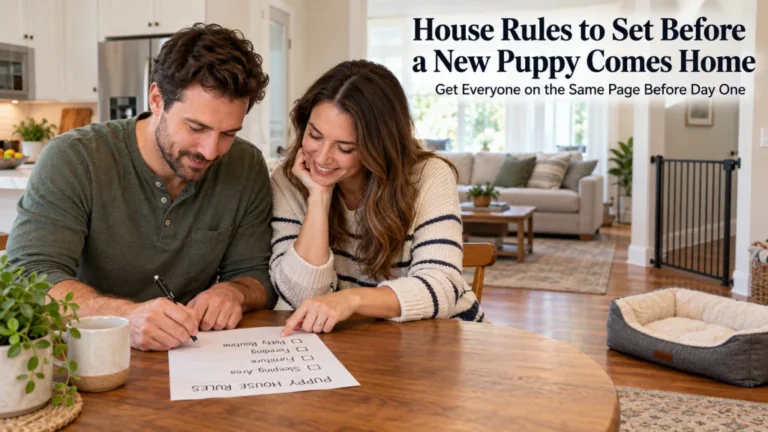
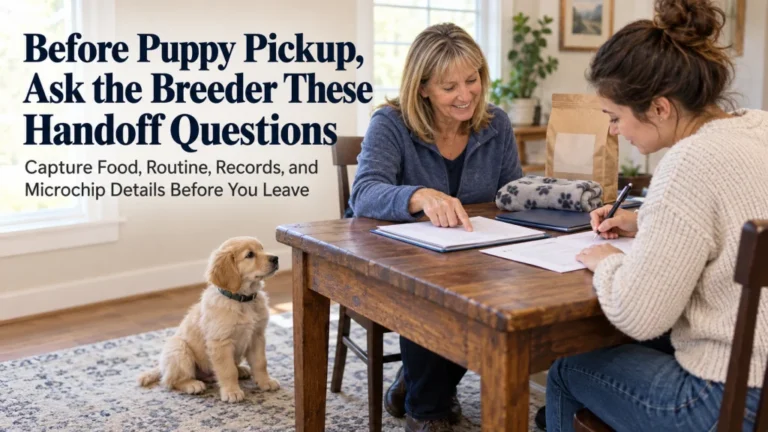
Taking time off when a new puppy comes home can make early routines easier to manage, but the useful question is not how many days every owner should take. The better plan is to identify which puppy care tasks collide with work, decide who can cover those tasks, and prepare for the point when normal work resumes. Leave, remote work, staggered schedules, and outside help can all work when they actually close the household’s coverage gaps. Puppy age, individual adjustment, commute demands, meetings, and available helpers can change what a workable plan looks like.
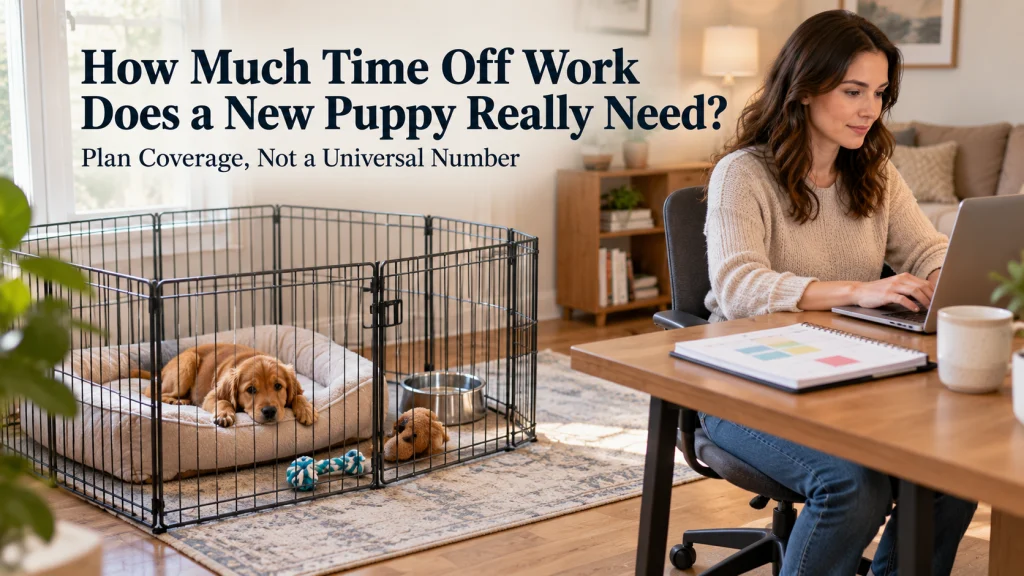
Replace the day count with a coverage question
Owners trying to decide how much time to take off when a new puppy arrives often get wildly different answers because the households behind those answers are different. One person may have a flexible remote job, another may commute, and a third may share care with someone whose schedule overlaps only part of the day. That is why a useful new dog homecoming plan starts with the actual care load instead of copying another owner’s leave request. The goal is to know which parts of the day need active coverage and which parts can fit around work without pretending that being physically home means being continuously available.
The same logic applies when you move from general preparation into preparing for a new dog in your own household. Extra time at home can help you establish routines, observe how the puppy is settling in, attend necessary appointments, and handle the practical interruptions that come with a new arrival. It does not create a guarantee that adjustment will be smooth, and it does not remove the need for a plan after leave ends. Think of leave as one coverage tool among several, not as a magic number that determines whether the transition succeeds.
Start with the arrival date and the household’s actual work calendar
Put the puppy’s arrival on the same calendar as commutes, meetings, shifts, school runs, appointments, and any other obligations that reduce who is actually available. Then mark which work blocks are fixed and which can be moved, shortened, or handled by another person. This exposes the difference between a household that has people at home and a household that has usable care coverage. If you are also planning the broader transition, the first puppy homecoming setup should fit the same calendar rather than living on a separate wish list.
Map the normal work pattern as carefully as the arrival period. Mark who will be available after temporary flexibility ends and which responsibilities will still collide with fixed work blocks. That makes it easier to choose temporary coverage that supports the household’s real routine instead of creating a plan that only works under unusual conditions. Any gap that remains in the normal schedule needs its own solution.
List early care tasks that interrupt a work block
A new puppy creates short, repeated tasks that can conflict with focused work even when none of those tasks is complicated by itself. Supervision, trips to the elimination area, meals, cleanup, settling after activity, brief interaction, and noticing whether the puppy is becoming overtired or overwhelmed all interrupt a normal work rhythm. Veterinary or breeder instructions may add other tasks that are specific to that puppy. The useful step is to list what requires a person to stop working instead of building an overly precise schedule that falls apart as soon as the puppy’s needs shift.
Use that list to separate true care obligations from things that can wait until a work block ends. A water spill, an unsafe object within reach, or a puppy that needs to be moved to a secure area can require immediate attention, while reorganizing supplies or researching a future purchase usually does not. This distinction keeps the work plan practical and reduces the temptation to treat every puppy related task as urgent. It also shows where your schedule needs a real backup person rather than a reminder on a calendar.
| Coverage check | What to write down |
|---|---|
| Fixed work block | Meetings, commuting, customer calls, physical work tasks, or any period that cannot be paused easily |
| Puppy care conflict | Supervision, elimination trip, meal, cleanup, settling, appointment, or another task that needs a person |
| Primary coverage | The household member or helper who is genuinely available during that block |
| Backup coverage | The person or arrangement that takes over if the primary plan changes |
Once the worksheet is filled in, look for any row where the care conflict has no named person or workable arrangement. That row is the problem to solve before the puppy comes home. You may discover that you need less leave than expected because the household already has coverage, or more support because remote work was doing less work than you assumed. The worksheet is useful because it turns a vague leave question into specific uncovered responsibilities.
Separate working from home from being available
Remote work can reduce commuting and make some transitions easier, but it does not automatically create free attention. A person presenting in a meeting, handling customer calls, operating equipment, or working to a tight deadline may be home and still be unavailable for puppy care. The opposite can also be true: a flexible remote role may allow brief interruptions that an on site job cannot absorb. Judge the job by how interruptible it is, not by the location of the laptop.
This is where many new puppy and work plans become unrealistic. The owner assumes the puppy can simply stay nearby, then discovers that supervision and work compete for the same attention at the same moment. If a work block cannot be interrupted, treat it exactly like a period when you are not available and assign coverage accordingly. That approach is less optimistic, but it is much more useful than labeling the whole day as covered because someone is in the house.
Compare leave, flexible hours, staggered schedules, and outside help
Paid or unpaid leave is one way to create a larger block of availability, but it is not the only workable option. Flexible hours can move demanding work away from the puppy’s busiest periods, staggered household schedules can reduce overlap in unavailable time, and outside help can cover a specific gap that no household member can cover. For ongoing absences, the broader question of dog care when you are away becomes more important than stretching a short leave period. The right option is the one that closes the actual gap without creating a new problem in the household’s work or finances.
Each option also has a different burden. Leave may be simple but limited, flexible work may still involve protected meeting blocks, staggered schedules may reduce shared rest time, and outside help requires reliable access and clear instructions. Combining options is often more realistic than expecting one arrangement to carry the entire transition. A household can use leave to absorb the busiest adjustment period, then shift to flexible hours or shared coverage as normal work resumes.
| Coverage option | Useful when | Main limitation to check |
|---|---|---|
| Leave from work | You need a larger block of flexible attention around arrival and setup | Coverage still needs a plan for the return to normal work |
| Remote or flexible work | The job can tolerate brief interruptions and tasks can move around care needs | Being home does not mean every work block is interruptible |
| Staggered household schedules | Two or more people can cover different unavailable periods | Handoffs need to be explicit so each person knows who is responsible |
| Outside help | A recurring gap remains when household members are unavailable | The helper must be reliable, informed, and suited to the puppy’s current needs |
Choose based on the weak point in the schedule, not on which arrangement sounds most generous. If the only uncovered period is a fixed commute block, a targeted helper may solve more than extending leave. If the whole workday is unpredictable, temporary leave may buy time to learn the puppy’s pattern before designing the longer term arrangement. The comparison should lead to a coverage decision, not a ranking of which household is doing puppy ownership the “right” way.
Use puppy age and individual adjustment as variables, not guarantees
Age matters because a very young puppy generally creates a different supervision and routine burden from an older puppy, but age alone cannot tell you how much leave your household needs. Individual puppies also differ in confidence, sleep pattern, appetite, response to a new environment, and how quickly they settle into a predictable routine. Health guidance from your veterinarian or information from the breeder or rescue may change what needs attention after arrival. Use those details to adjust coverage rather than assuming two puppies of the same age create the same work plan.
The same restraint applies when a puppy seems easy during the first part of the transition. A quiet puppy may be resting after a major change, and a busy puppy may settle differently once the environment becomes familiar. Do not convert one easy or difficult day into a guarantee about the next stage of the schedule. Keep enough flexibility in the plan to respond to what the puppy actually needs without turning normal variation into a diagnosis.
Plan the return to the normal work pattern before leave begins
Before the puppy arrives, write down what the normal work pattern will look like, including who is present, who is unavailable, and which blocks are difficult to interrupt. Use any temporary flexibility to practice the handoffs, home setup, and backup arrangements that will still matter later. The goal is to make the regular routine workable rather than keeping the puppy in an artificial all day attention bubble. That gives the household a clearer transition when ordinary work demands return.
This does not mean forcing independence on a fixed timetable or using a universal alone time target. It means making the household aware of the coming schedule so the return to work is not a surprise to the people responsible for care. If a future work block has no safe, practical coverage plan, solve that before leave expires. A strong return plan is defined by a clean handoff from temporary availability to normal responsibility.
Decide when time alone requires a separate training plan
Work coverage and alone time training are related, but they are not the same problem. This article can help you identify when the workday will create periods without a person available, but it should not prescribe how long a puppy should be left alone or claim that taking leave prevents separation problems. If the question has shifted from household logistics to teaching the puppy how to be comfortable when people are absent, move to the site’s basic dog training guidance and keep the training question separate. That boundary prevents a scheduling article from making behavior claims it cannot support.
The distinction also helps when the puppy shows distress, persistent difficulty settling, or another behavior that concerns you. Do not diagnose the cause from a work schedule alone, and do not assume that adding more leave automatically fixes the problem. Note what is happening, reduce obvious management gaps where you can, and seek appropriate professional guidance if the concern moves beyond basic training and everyday management. The work plan should support care, not substitute for behavior assessment.
Decide what home setup must function while the owner is occupied
A work plan fails quickly if the physical setup requires constant correction. Before arrival, identify the secure area, water access, resting area, cleanup supplies, and route to the elimination area that the household expects to use while someone is occupied. The exact setup should match the puppy, the home, and the instructions you are following rather than relying on a generic “puppy zone” picture from the internet. For the equipment and containment side of that decision, use the site’s home setup guidance for dogs instead of improvising unsafe modifications.
Make sure the setup can work during the least flexible part of the day, not only when someone is actively supervising every second. Cords, small objects, household chemicals, unstable barriers, and other accessible hazards should not become a recurring emergency because the owner is in a meeting. At the same time, a secure area is not permission to ignore the puppy for an arbitrary duration. The setup and the coverage plan must work together, with each one reducing the burden on the other without pretending to replace it.
Build coverage for meetings, commuting, nights, and unexpected schedule changes
The plan should survive one ordinary disruption. A meeting can run long, traffic can delay a commute, a household member can become unavailable, or a poor night of sleep can make the next workday harder to manage than expected. If every task depends on one person remaining perfectly on schedule, there is no real backup. Name the second person, helper, or alternative arrangement before you need it, and make sure that option is genuinely available.
Keep the backup specific enough that another person can use it without guessing. They should know where the puppy can safely be, what care tasks they are covering, what household rules matter, and who to contact if something falls outside the agreed plan. This is especially important when coverage changes hands between household members because vague statements such as “you have the puppy” create missed responsibilities. Good backup planning is boring on paper and extremely useful when the day stops being boring.
Two worked schedules show why the same leave can function differently
Consider two households that can create the same amount of temporary time away from work. Household A has one flexible remote worker and a second adult whose workday begins later, so responsibility can move between them as work demands change. Household B has one owner, a fixed commute, and protected work blocks that cannot be interrupted. The difference is not the amount of leave itself, but what coverage exists around each work block once that leave is no longer carrying the schedule.
A worked schedule makes that difference visible because each block has a named handoff instead of a vague assumption that someone will manage. The examples below are not recommended puppy timetables and do not set an alone time limit. They simply show how a household can map work obligations against care coverage without pretending that every puppy or job follows the same pattern. The useful test is whether each block has a realistic person or arrangement responsible for it.
| Work block | Household A: flexible remote work plus shared coverage | Household B: solo owner with a fixed commute |
|---|---|---|
| Before the first work block | Remote worker handles the puppy’s immediate routine while the second adult prepares for work. Responsibility is explicitly with the remote worker until the first protected meeting begins. | Owner handles the puppy’s immediate routine before leaving. The backup plan must already be ready because no second household member can take the next handoff. |
| First protected work block | Second adult takes over puppy coverage while the remote worker is unavailable for a meeting. The handoff ends when that protected block is finished. | Owner is commuting or unavailable at work. A helper or other planned care arrangement must own this block if the puppy needs coverage during it. |
| Middle of the workday | Remote worker resumes coverage during an interruptible period, then passes responsibility back before another fixed work commitment. | The same outside arrangement continues or a second planned handoff occurs. The owner cannot count the block as covered simply because work may be quieter than expected. |
| Later protected work block | Second adult or another named household member covers again if the remote worker cannot step away. The plan identifies the handoff before the work block starts. | Coverage must still come from the named helper or another reliable arrangement until the owner is genuinely available again. |
| After work obligations end | Responsibility returns to the household member assigned for the next part of the day, with any notes about meals, cleanup, or behavior passed along. | Owner takes over after the commute and receives any relevant update from the helper. Any repeated gap noticed during the day goes back onto the coverage worksheet for adjustment. |
Household A can solve several conflicts through handoffs because another person is available when the remote worker reaches a protected block. Household B needs a recurring solution for blocks that the owner cannot cover, so extra leave by itself does not create that ongoing handoff. The example does not tell either household how many days to take off. It shows which work blocks still need a responsible person after the temporary schedule changes.
Know when the current work plan simply leaves a care gap uncovered
Sometimes the worksheet reveals a problem that cannot be fixed by better organization. If the puppy needs care during a block when every household member is unavailable and no helper or alternative arrangement exists, that is an uncovered gap. Moving tasks around the calendar does not make the gap disappear. The responsible next step is to change the coverage plan rather than hoping the puppy will fit an adult dog’s routine immediately.
That change might involve different leave, a work adjustment, shared household coverage, outside help, or a reconsidered arrival arrangement. Which option is practical depends on the job, household, puppy, finances, and support network, so there is no single correct solution. The important point is to identify the gap before it becomes a repeated daily problem that everyone assumes someone else will cover. A realistic plan can be modest, but it cannot depend on necessary care appearing from nowhere.
Final thoughts: solve coverage instead of copying another owner’s PTO number
The best answer to the leave question is a coverage map, not a universal number. Identify the tasks that interrupt work, mark the blocks that are genuinely unavailable, and assign a person or arrangement to each gap. Then decide whether leave, remote flexibility, staggered schedules, outside help, or a combination gives the household enough room to manage the transition. That process respects both the puppy’s needs and the reality of the owner’s job.
Before the puppy comes home, review the normal work pattern one more time and ask what changes when temporary flexibility ends. If a gap remains, solve it directly rather than stretching an anecdote from another household into a rule for yours. Keep training questions, behavior concerns, and equipment decisions routed to the guidance that actually owns those topics. A workable plan is one the household can still follow after the special arrival period is over.
FAQs
🐶 Should I take time off work when I bring home a puppy?
Time off can be useful when it gives you real coverage for arrival, supervision, appointments, setup, and routine changes. Whether you need leave depends on how interruptible your job is, who else can help, and what gaps remain when normal work resumes.
💻 Is working from home enough for a new puppy?
Not automatically. Remote work helps only when your actual work blocks can accommodate the puppy’s care needs or another person can cover the blocks that cannot be interrupted.
📋 How do I plan work coverage before the puppy arrives?
List fixed work blocks, likely puppy care conflicts, the person responsible for each conflict, and a backup. Any row without a real person or arrangement is a gap to solve before arrival.
🏠 Can two household members stagger their schedules instead of taking leave?
Yes, if the staggered schedule creates genuine coverage and each handoff is clear. Check that meetings, commutes, sleep, and other fixed obligations do not leave hidden periods when neither person is available.
🧑🤝🧑 When should I arrange outside help?
Outside help becomes relevant when a recurring care need falls inside a work block that no household member can cover. Choose the arrangement around the actual gap and make sure the helper has clear instructions and reliable access.
🎓 Does taking leave prevent separation anxiety?
No scheduling choice should be treated as a guarantee against a behavior problem. If the concern is teaching comfortable alone time or addressing persistent distress, use appropriate training or professional behavior guidance rather than relying on leave length.
References and Sources
- American Kennel Club on taking time off for a new dog: supports the practical value of temporary availability for routines, appointments, and adjustment while also showing that leave advice is not a universal household rule.
- American Kennel Club puppy routine guidance: supports the need to plan recurring care tasks and build a consistent household routine around a new puppy.
- American Animal Hospital Association puppy homecoming guidance: supports supervision, management, routine, home safety, and adapting the plan to the individual puppy and household.