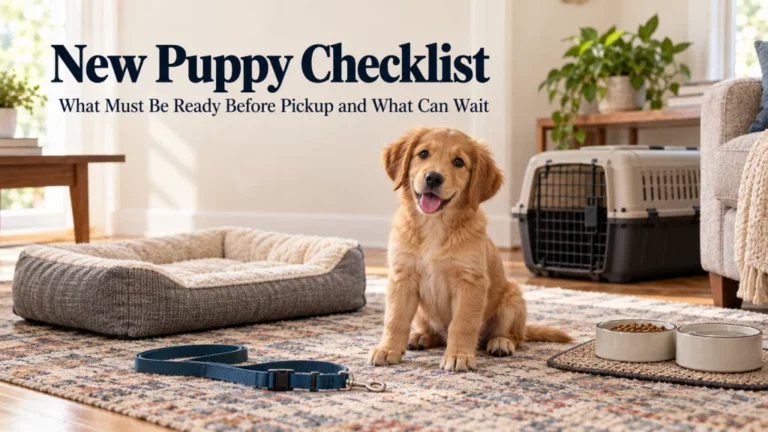
New dog supplies are easier to choose when every purchase has a job instead of a place on a giant checklist. Cover food and water access, identification, controlled movement, rest, managed access, cleanup, and a small amount of suitable enrichment before arrival, then delay choices that depend on fit, coat, chewing style, home layout, or the dog’s actual preferences. A puppy and an adult dog may need the same broad functions covered but very different sizes, materials, and management setups. The goal is a working first week, not a full pet store at home.

Make the first week function before you fill the cart
An empty cart can feel like a risk when a dog is about to arrive, but a long list of new dog supplies can create a different problem: buying before you know what actually fits the dog or the household. Start with the jobs that cannot wait, then make each item earn its place by solving one of those jobs. If you are still working through the broader setup, the guide to preparing for a new dog helps organize the arrival process beyond shopping. For the larger transition into the home, bringing a new dog home covers the wider ownership decisions around that first adjustment period.
The useful question is not whether an item appears on a dog supplies checklist. Ask what function would fail if you did not have it, whether the dog must be measured before you choose it, and whether the source sending the dog home is already providing something usable. That filter quickly separates basic access and management needs from purchases that can wait until you see the dog’s size, habits, comfort, coat, and play style in your own home. It also keeps a starter list small enough to revise without wasting money on duplicates or poor fits.
Start with functions every incoming dog needs covered
The first shopping pass should cover ordinary daily functions rather than every possible activity. A dog needs access to food and water, a way to be identified and moved under control, a place to rest, a plan for limiting access where needed, and a practical cleanup setup. Those functions are broad enough to apply to many incoming dogs without pretending that one product type is mandatory for every household. The exact item can still change with dog size, age, behavior, home layout, and what the dog already uses comfortably.
Think of these as coverage questions, not product commands. Can the dog eat and drink from a stable setup, move from the door to the yard or vehicle under control, settle in a suitable resting area, and be kept away from spaces that are not ready for access? Can you clean ordinary messes without improvising with supplies you do not want to use on pet areas? When those answers are yes, you have covered the core functions and can make slower choices about the rest.
Food and water access
Have a practical way to serve the food the dog is already expected to eat and provide regular access to clean water. Before buying specialized feeding equipment, confirm the dog’s size, current routine, and any instructions that come from the shelter, rescue, breeder, veterinarian, or previous caregiver. A basic bowl setup may be enough until you know whether the dog actually needs a different format. Detailed feeding equipment choices belong with the household’s broader feeding setup and mealtime routine.
Identification and controlled movement
Plan how the dog will be identified and how you will move the dog safely through doors, sidewalks, parking areas, and other everyday transitions. Fit matters more than buying multiple versions of collars, harnesses, or leads before the dog arrives. Use measurements or reliable information from the current caregiver before assuming a labeled size will fit. A simple setup that fits correctly is more useful than a drawer of gear bought from guesses.
Rest and managed access
The dog needs a reasonable place to rest and a household plan for where access should be limited, but that does not make any single containment product universally required. Some homes may use doors, gates, pens, crates, room layout, or a combination, depending on the dog and the routine. Confirm the intended job before buying anything large or fit sensitive. If the decision turns into crate, gate, pen, bed, or home zone selection, use the dedicated guidance for setting up a home for a dog.
Cleanup
Cleanup is easy to overlook because it is less exciting than beds, toys, or walking gear. Have washable cloths or towels, waste bags where relevant, and cleaning supplies appropriate for the surfaces you expect to manage. Do not buy a shelf of specialized cleaners before you know what surfaces, messes, and routines you are actually dealing with. The function is simple: make ordinary cleanup possible without turning every small mess into an emergency shopping trip.
Separate universal categories from dog specific product choices
Most new dog essentials fall into one of three buying states: buy before arrival, confirm fit or compatibility first, or wait until the dog gives you more information. The category can be universal while the product choice is not. Nearly every dog needs food and water access, but not the same bowl size, shape, or feeding accessory. The same logic applies to walking, resting, containment, grooming, toys, and travel.
This is where a short list becomes more useful than a long one. Buy early when a function must work immediately and the choice is unlikely to be wasted, confirm first when size or setup controls success, and wait when preference or behavior is the main unknown. The table is a starting framework rather than a rule that every household must follow identically. Move an item when reliable information or suitable gear from the current caregiver changes the decision.
| Buy before arrival | Confirm fit first | Can wait |
|---|---|---|
| Food and water access, basic cleanup supplies, waste bags when relevant, and a simple rest setup | Collar or harness, containment gear, bed size, travel gear, and tools that depend on body size or coat | Large toy collections, upgraded beds, specialized feeding accessories, extra grooming tools, and convenience technology |
| Items needed to receive the dog and complete the first household routine | Items where measurements, home dimensions, vehicle setup, or current routine determine compatibility | Items whose value depends mostly on preference, chewing style, routine, or a problem that has not appeared |
Use the columns as a filter every time something new enters the cart. If you cannot explain which immediate function it covers, which measurement supports the fit, or which observed preference justifies it, it probably belongs later. That does not mean the item is useless. It means the timing of the purchase is not yet supported by what you know.
Buy only after confirming size, age, coat, and source provided gear
Before buying fit sensitive or task specific supplies, collect the information that can change the decision. Size affects wearable gear, sleeping space, containment, and transport, while age can change expected growth, chewing behavior, and how quickly an item may be outgrown. Coat type changes grooming needs, and the home’s doors, rooms, floors, yard access, and vehicle can change which management gear makes sense. The current caregiver may also be sending food, a familiar blanket, identification information, or other useful items that remove an immediate purchase.
Do not turn estimates into pretend measurements. If you have a specific dog, ask for current measurements or measure when practical, then compare those details with the instructions for the type of gear you are considering. If the dog is still growing or you do not yet know the final routine, favor a minimal setup instead of trying to buy the permanent version of everything at once. For a puppy specific arrival list, the new puppy checklist handles the life stage details that should not be forced onto every incoming adult dog.
| Variable to confirm | What it can change | What to ask or check |
|---|---|---|
| Body size and measurements | Wearable fit, bed space, containment dimensions, and transport fit | Current measurements, not only breed or weight labels |
| Age and growth | How long a size may remain useful and what level of management is practical | Current age, expected growth, and whether an adjustable option actually covers the needed range |
| Coat and grooming needs | Brush, comb, bathing, drying, and maintenance choices | Coat length, density, texture, and the current grooming routine |
| Current routine | Food, walking, rest, containment, and transition needs | What the dog already eats, wears, sleeps on, and uses successfully |
| Home and vehicle setup | Gate fit, travel gear, storage, cleanup, and movement routes | Doorways, rooms, surfaces, vehicle space, storage, and where the dog will actually spend time |
| Gear coming with the dog | Duplicates and unnecessary immediate purchases | What the source provides and whether it is suitable to keep using during transition |
This worksheet is most useful before the shopping list gets long. A single answer, such as learning that the dog already has a well fitting walking setup, can remove several purchases at once. The same is true when a doorway, vehicle, or coat creates a specific constraint. Good preparation is often less about adding items and more about removing guesses.
Decide what can safely wait until you know the dog
Preference dependent purchases are where overbuying grows fastest. A dog may ignore the bed style you expected to be perfect, dislike the texture of a toy, chew through something you thought would last, or prefer a simpler resting spot already available in the home. Buying one workable option is different from buying a full collection before the dog has shown you anything. Leave room for observation to change the list.
The same rule applies to convenience upgrades. Extra storage, automated accessories, multiple walking setups, and large toy rotations may become useful later, but they are not automatically first week needs. If a purchase solves no known problem yet, waiting gives you better information about workload, cleaning, storage, durability, and actual use. That later purchase can be based on the dog and household you actually know.
- Wait on multiples when one suitable item can show whether the size, material, or format works.
- Wait on premium upgrades until the basic routine reveals a real limitation worth solving.
- Wait on large toy collections until you can observe play style, interest, and how the dog uses different textures and shapes.
- Wait on specialized grooming additions until coat needs and tolerance are clear enough to justify the tool.
- Wait on convenience technology unless it solves a specific routine problem you already understand.
Waiting is not the same as being unprepared. It is a deliberate way to keep money and storage space available for needs that become obvious after arrival. A minimal working setup can be expanded quickly once the dog’s preferences and the household routine are real. That is usually a stronger plan than trying to predict every future need from a shopping page.
Match fit sensitive supplies to the individual dog
Some supply categories deserve extra caution because a generic label does not tell you whether the item fits the dog, home, or vehicle. This is where the starter list should hand the decision to the more specific topic instead of pretending a short checklist can finish the job. Body measurements, coat, room dimensions, transport setup, and maintenance can all change what is suitable. The more these variables matter, the less useful generic advice becomes.
You can still include the category on the first week plan, but label it as a decision to verify rather than a product to buy blindly. That distinction keeps the article focused on preparation without duplicating detailed buying guidance from other parts of the site. It also prevents a common mistake in commercial lists, where the presence of a category is treated as proof that every reader needs the same type of item. Use the routing table below when the choice becomes more specialized than a basic starter decision.
Crates, pens, gates, and beds
Start with the job: sleeping, short term management, limiting room access, or creating a predictable rest area. Then check the dog’s body size, the space available, and how the item will be used before choosing dimensions or format. Do not call a crate mandatory just because it appears on many starter lists. Detailed containment and rest choices belong with home setup, crates, and containment.
Feeding equipment
A basic food and water setup may be all you need at first. Bowl shape, height, feeding accessories, storage, and specialized formats should follow the dog’s actual mealtime routine and the household’s cleaning and space constraints. Avoid buying a solution for a feeding problem you have not observed. For deeper equipment and routine decisions, use the guide to feeding a dog.
Toys and enrichment
Begin with a small, manageable selection rather than assuming one material or play format will suit every dog. Size, chewing style, play behavior, interest, and how closely the item can be supervised all matter. Retire or replace anything that becomes damaged or unsuitable instead of treating a toy category as permanent. More detailed choices belong with dog play and enrichment decisions.
Grooming tools
Coat length, density, texture, shedding, and the grooming task should decide what tools are useful. Buying several brushes before you know what the coat actually requires can create more clutter than value. Start from the coat and task, then add tools only when they have a clear job. The broader process is covered in how to groom a dog.
Travel and restraint gear
Travel gear can depend on the dog’s size, the vehicle, the exact restraint or carrier setup, and how the trip will be made. Do not assume that a general starter item is suitable for every vehicle or travel method. Check the detailed requirements for the exact setup rather than treating travel as another box on a supply list. The dedicated guidance for traveling with a dog is the better place to finish that decision.
| Supply area | Starter decision | When to use the detailed guide |
|---|---|---|
| Home setup | Decide what rest and access functions must be covered | When choosing crate, pen, gate, bed, dimensions, or room setup |
| Feeding | Provide workable food and water access | When choosing feeding formats, accessories, storage, or routine details |
| Toys and enrichment | Start with a small suitable selection | When play style, chewing, difficulty, or supervision changes the choice |
| Grooming | Confirm the coat and basic care task | When selecting tools for coat depth, texture, shedding, or a specific grooming job |
| Travel | Identify the vehicle or travel function | When fit, restraint, carrier, vehicle compatibility, or transport setup becomes specific |
The handoff matters because these categories can look simple from a distance while becoming highly specific once fit and use are considered. A broad starter article should tell you what needs attention, not pretend to settle every detailed choice. When a measurement, exact setup, or behavior pattern changes the answer, move to the guide that owns that decision. That keeps the first week list practical and the detailed decisions appropriately specific.
Avoid buying health products as generic starter supplies
Medication, supplements, parasite products, and other health related items should not be treated as automatic additions to a generic shopping cart. The right choice can depend on the individual dog’s age, size, health history, existing care plan, other products already in use, and veterinary guidance. A commercial checklist cannot safely replace that context. Keep the starter list focused on practical household functions instead of turning preparation into self directed medical purchasing.
If the dog is already on a treatment or preventive plan, confirm what should continue with the veterinarian or the responsible source sending the dog home. Do not duplicate products because a checklist says they are common, and do not assume a health item is appropriate simply because it is sold for dogs. This boundary keeps the purpose clear: ordinary supply planning, not treatment or medication guidance. When health needs affect the shopping list, the health plan should lead the purchase, not the other way around.
Run a checkout decision pass before you buy
Before checkout, stop looking at the cart as a list of objects and review it as a set of decisions. Each item should solve a first week function, fit information you actually know, or address a household constraint that is already real. Check whether the dog’s current caregiver is providing something suitable before you buy a duplicate, then consider the cleaning, storage, setup, and replacement work each new item creates. If you cannot explain why the purchase belongs in the cart now, move it out until you have better information.
For example, imagine an incoming adult dog whose current caregiver confirms the food routine and provides a usable collar and leash, while the new household already knows it needs basic cleanup supplies and a stable food and water setup. Those known functions can be covered now, while a harness or gate should wait until body measurements or doorway dimensions are confirmed. A larger toy collection, upgraded bed, or convenience accessory can wait until the dog shows clear preferences and the household sees what the routine actually demands. The same dog can therefore create three different purchase decisions without requiring three versions of the same shopping list.
| Checkout question | What a useful answer sounds like | If the answer is unclear |
|---|---|---|
| Does this solve a first week function? | I can name the feeding, movement, rest, management, cleanup, or enrichment job it covers | Remove it from the immediate cart until a real need appears |
| Do I have the measurements or compatibility information? | I know the dog’s relevant measurements or the home or vehicle dimensions that control fit | Confirm those details before choosing the item |
| Am I replacing gear that is already suitable? | The current item does not fit the new setup or no suitable item is being provided | Keep using the provided gear during transition if it remains appropriate |
| What workload does this add? | I understand the cleaning, storage, setup, maintenance, or replacement burden | Choose a simpler option or wait until the benefit is clear |
| Would observation improve this decision? | The choice is based on a known need rather than a guessed preference | Wait until the dog’s routine, play style, comfort, or coat needs are easier to judge |
Finish the pass by removing duplicates, guessed upgrades, and fit sensitive choices that still lack measurements. Keep enough flexibility in the budget and storage space to respond to what the dog actually uses after arrival. A smaller cart is not automatically better, but every item in it should have a reason that survives this review. That final check turns the earlier framework into an action instead of repeating it.
Final thoughts: buy for known functions first and preferences later
The best first week setup is not the one with the longest receipt. Cover the functions that must work, verify the choices that depend on the dog’s body or the household setup, and delay the purchases that require real observation. That approach leaves room for the dog to show you what fits, what gets used, and what creates unnecessary work. It also makes later shopping more precise because each addition solves a known need.
If you are unsure about an item, ask three questions before buying it: what job does it perform, what information proves it will fit that job, and what happens if you wait. A clear answer to those questions is more useful than seeing the item on ten different checklists. Buy the minimum that makes arrival workable, then let measurements, routine, behavior, coat, home layout, and actual preference shape the rest. Preparation should reduce uncertainty, not turn uncertainty into a pile of purchases.
FAQs
🐾 What supplies should I buy before bringing a new dog home?
Cover food and water access, identification, controlled movement, a workable rest and access plan, cleanup, and a small amount of suitable enrichment. Delay items that depend heavily on measurements, preference, coat, chewing style, or a home setup you have not confirmed yet.
🛒 Do I need to buy everything on a dog supplies checklist?
No. Use a checklist to identify functions you may have missed, then decide whether each item is immediately necessary, needs fit information first, or can wait until you know the dog better.
📏 What should I measure before buying dog gear?
Measure what the specific gear requires rather than relying only on a breed or weight label. Wearable gear, containment, beds, and travel setups may also depend on body proportions, room dimensions, doorways, or vehicle space.
🧸 How many toys should I buy before the dog arrives?
Start with a small suitable selection rather than a large collection. Add more after you can observe the dog’s play style, interest, chewing behavior, and how different items hold up in the actual routine.
🏠 Is a crate an essential supply for every new dog?
No single containment product is universally mandatory. Decide what management or rest function you need, then choose a crate, pen, gate, room setup, or another appropriate option based on the dog and household.
🧼 What new dog essentials are easy to forget?
Practical cleanup and management supplies are easy to overlook because they are less exciting than toys or beds. Check whether you have washable cloths or towels, waste bags when relevant, a suitable surface cleaning plan, and a way to limit access where the home is not ready.