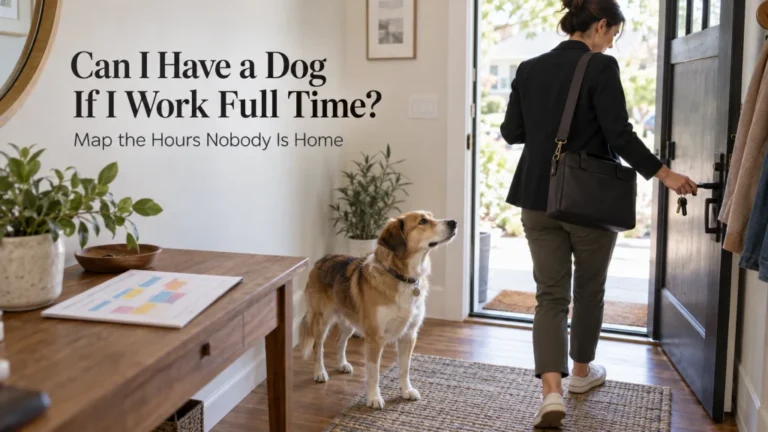
How much time does a dog need is better answered by mapping recurring responsibilities than by chasing one daily total. Care is spread across the day, while weekly and occasional tasks still take calendar space. The mix changes with age, health, temperament, coat, activity, and household routine. The useful test is whether those responsibilities fit an ordinary week and still have backup when plans change.
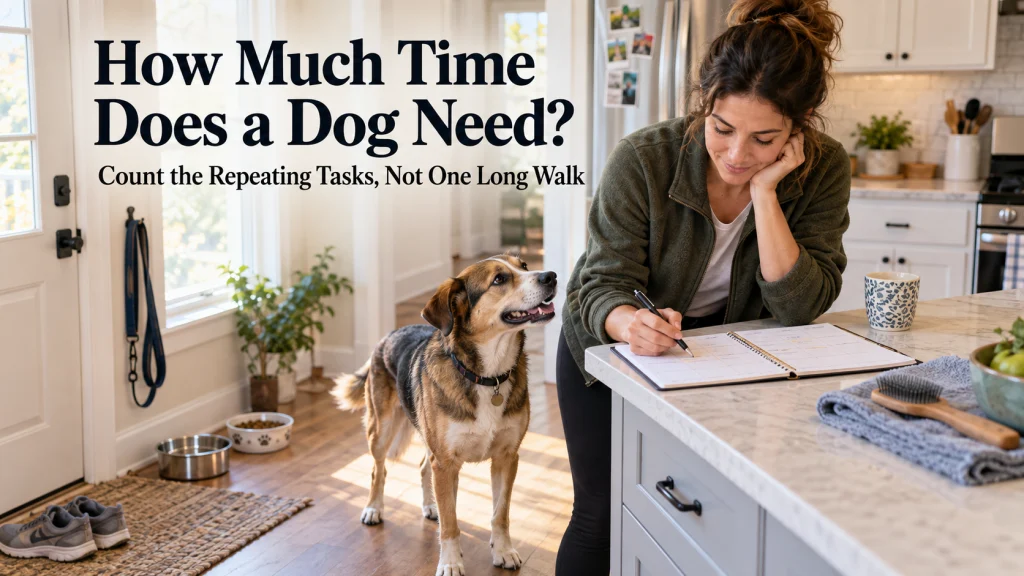
One daily total hides the real schedule problem
A single estimate can sound reassuring until care is split across bathroom access, meals, exercise, interaction, training reinforcement, cleanup, and later needs. The better question is whether you can cover those blocks when they occur, not how many free hours appear on paper. Before deciding whether a dog fits your life, use planning before getting a dog to identify schedule constraints that a weekend can hide. The wider dog care and ownership guide shows how these responsibilities connect with long term care.
Availability is different from active care. You may not be interacting with a dog every moment, but bathroom access, feeding, safe supervision, companionship, and other needs still need coverage. A schedule with plenty of free time can fail if all of it sits in one part of the day. Build the map around the dog and household you are actually considering, including who provides backup when a care block fails.
Separate active care time from being available and responsible
Active care is the part you can point to on a schedule: preparing meals, taking the dog outside, walking, playing, brushing, cleaning, practicing manners, or arranging transport. Responsibility is broader because it includes noticing when a planned block no longer works and making another arrangement. A dog may be resting while you work, but that does not erase the need for care before, during, and after that work period. Treat those two categories separately so a quiet stretch at home does not get mistaken for care that has already been covered.
This distinction is especially useful when comparing households. Someone who works from home may have easier access to the dog, yet still have meetings, deadlines, or rooms where the dog cannot safely stay. Someone who works away from home may have a reliable caregiver or a schedule that provides appropriate coverage. The question is not which work arrangement sounds more dog friendly in the abstract. The question is who is responsible for each recurring need and what happens when that person is unavailable.
Map the tasks that happen every day
Start with categories rather than estimates. Daily care commonly includes feeding, access for elimination, exercise or other activity, interaction, basic training reinforcement, water checks, and some amount of cleanup or reset. Not every dog will need the same amount of work in each category, and the balance can change as the dog settles into the household. Listing the categories first prevents one visible task, usually walking, from swallowing the entire time estimate.
The American Veterinary Medical Association identifies feeding, grooming, exercise, play, and elimination among daily needs, while also emphasizing companionship and lifelong responsibility. That frame treats ownership as several recurring duties rather than one activity. Add the household work those duties create, such as washing bowls, handling muddy paws, replacing water, or preparing a caregiver handoff. Then mark which tasks are fixed, flexible, or need backup.
| Task group | Daily or recurring question | What may change the workload |
|---|---|---|
| Meals and water | Who prepares, serves, checks, and cleans up? | Routine, food setup, household handoff |
| Bathroom access | Who is available when the dog needs to go out? | Age, health, housetraining status, home access |
| Exercise and interaction | Where do activity, play, and social time fit? | Activity level, temperament, weather, environment |
| Training reinforcement | Where can simple practice fit into normal routines? | Current skills, behavior context, household consistency |
| Grooming and cleanup | What needs checking, brushing, wiping, washing, or resetting? | Coat, shedding, weather, flooring, outdoor conditions |
Do not fill this table with borrowed numbers from somebody else’s dog. Use it as an inventory, then estimate each block only after you know the dog profile and household setup. Keep the numbers specific to that situation instead of turning an example into a care standard. Missing coverage should become visible as soon as you assign each task to a real part of the day.
Allow for recurring bathroom trips and outdoor access
Bathroom access is a schedule issue because it cannot always be pushed into the same block as exercise. A yard may make access easier, but a yard does not remove the need to open doors, supervise when appropriate, clean up, check conditions, or arrange care when nobody is home. Apartment living can add route time because the owner may need to move through hallways, elevators, stairs, or shared outdoor areas. The useful estimate comes from the actual route and access plan, not from the assumption that going outside is a single task.
Age, health, housetraining status, and individual routine can also change how much availability a dog needs. Puppies, older dogs, and dogs with medical concerns may require different planning, but this article is not the place to prescribe intervals or clinical routines. If a specific dog has unusual elimination needs, use guidance from the veterinarian or the appropriate life stage care page rather than turning a general ownership estimate into a fixed rule. For the workload map, simply mark every part of the day when bathroom coverage must be possible and identify who can provide it.
Add exercise and interaction as individual needs, not one universal walk quota
Exercise belongs on the time map, but it should not be reduced to a universal walk requirement. Dogs differ in activity level, age, health, temperament, physical ability, and the kind of activity that suits them. A calm adult dog, an energetic young dog, and a dog with medical limitations can create very different schedules even if they live in the same home. Use walking and exercise guidance when you need to plan the activity itself, then bring only the resulting workload back into this ownership map.
Interaction matters alongside physical activity. Play, sniffing, companionship, and other forms of engagement take attention even when they do not look like formal exercise. The AVMA also frames companionship as part of the owner’s responsibility, which is a reminder that a dog is not a set of chores that can be completed and ignored. When you build the schedule, reserve space for meaningful contact as well as task completion, then check whether that pattern still works on a tiring or busy day.
Add training reinforcement to the time map
Training is often underestimated because people picture it only as a formal session. In everyday ownership, reinforcement also happens when the dog waits at a door, settles while food is prepared, responds during a walk, greets people, or follows a household routine. Those moments are usually woven through normal care rather than isolated in one large block. That is good for planning because it means some training work can share context with tasks you already need to do.
It still requires attention and consistency from the people handling the dog. If several household members use different cues or allow different behavior, the time cost can show up later as repeated confusion and extra management. The basic dog training guide covers the method decisions that belong outside this article. Here, the planning job is simply to acknowledge that learning and reinforcement continue after the first few lessons, so they need a place in the ongoing workload.
Allow time for meals, coat care, and household cleanup
Meals can look like a small item on a schedule, but the full task may include measuring or preparing food, serving it, monitoring the routine, washing bowls, and keeping the feeding area usable. This article should not prescribe feeding frequency or nutrition because those decisions belong with the dog’s actual diet and care guidance. For time planning, count the complete household task rather than only the moment the bowl reaches the floor. If another person handles a meal, include the handoff and any preparation they need.
Coat care and cleanup can create the same hidden workload. A short coat in a dry home may require a different routine from a heavy coat, frequent mud, substantial shedding, or a household that needs more floor and furniture cleanup. Some grooming is daily for certain dogs while other tasks are less frequent, so the schedule should reflect the individual rather than a generic frequency. The point is not to inflate the estimate, but to prevent maintenance work from disappearing simply because it is less memorable than a walk.
- Food preparation, serving, bowl washing, and storage reset
- Water checks and bowl cleaning
- Brushing or coat checks when appropriate for the dog
- Paw wiping, mud cleanup, hair removal, and bedding reset when needed
- Preparing supplies for another household member or caregiver
Use this list as a prompt, not a fixed routine. Cross out what does not apply and add work your home or dog makes likely. Place each task in the daily or weekly part of the calendar. That keeps occasional maintenance visible without making it look like a daily requirement.
Add weekly and occasional tasks that still consume calendar space
Less frequent tasks still compete for time. Grooming appointments, veterinary visits, training classes, supply runs, bedding washes, deeper cleanup, transport, and travel care can land on an already busy week. They disappear easily from a daily estimate because they do not happen every morning or evening. Give them a separate place on the calendar.
Think in terms of calendar friction. An occasional task can still be difficult when it needs transport, another person’s availability, a trip across town, or a replacement plan for work and family obligations. A second caregiver can reduce that risk only if the person has agreed and can handle the dog. Identify the events that break the normal routine and the spare capacity available for them.
| Frequency group | Examples to map | Planning question |
|---|---|---|
| Daily | Meals, bathroom access, activity, interaction, routine cleanup | Who covers each block when the day is normal? |
| Weekly or periodic | Deeper cleaning, some grooming tasks, training support, supply management | Where does this fit without crowding out basic care? |
| Occasional | Appointments, travel care, transport, household disruptions | What backup plan keeps care covered? |
Separating these groups prevents a busy appointment week from becoming the permanent baseline. It also keeps recurring maintenance from disappearing just because it did not happen yesterday. Use the weekly view to test whether the household can absorb both routine care and extra tasks. What matters is whether there is room to recover when several demands land together.
Let age, health, coat, temperament, and life stage change the estimate
A useful time estimate has to be attached to a dog profile. Puppies can add supervision, housetraining, socialization, and learning demands, while some older dogs may need a different pace, easier access, or more health related coordination. Coat type can shift grooming work, and temperament can change how much management, decompression, training support, or structured interaction fits into the day. These differences are exactly why one universal total is a poor planning tool.
Health can change the schedule too, but a pre adoption workload article should not guess at medical routines. If you are considering a specific dog with known health needs, ask for the actual care requirements and confirm them with the appropriate veterinary guidance. If you are only comparing general dog profiles, keep the estimate at the level of likely workload categories and uncertainty. That gives you enough information to plan without pretending that age, breed label, or appearance can predict an exact daily schedule.
Put the tasks onto an actual weekday before deciding they fit
Place the tasks onto an ordinary workday, not a relaxed day off. Use the real sequence of waking, work, commuting if relevant, meals, errands, evening commitments, and sleep. Add dog care where it would actually happen rather than where you hope spare time will appear. If essential tasks compete for the same narrow block, that conflict matters more than the total free time on paper.
Leave the estimate fields blank until you know the dog and routine you are evaluating. That forces your assumptions into the open instead of borrowing a number that may not fit. If work coverage is the main concern, use the guide on having a dog with a full time job to examine that gap. Keep the broader ownership workload on this worksheet.
| Weekday block | Dog care tasks to place here | Your estimate | Backup if this block fails |
|---|---|---|---|
| Before work or main daytime commitments | Bathroom access, meal, interaction, activity, setup | __________ | __________ |
| During the main daytime block | Coverage needs, bathroom access, supervision or caregiver handoff if required | __________ | __________ |
| After work or main daytime commitments | Bathroom access, activity, interaction, meal, training reinforcement | __________ | __________ |
| Before settling for the night | Final care checks, bathroom access, water, cleanup, setup for the next day | __________ | __________ |
Once the blanks are filled, look for collisions. A longer commute can erase the planned bathroom handoff just as an evening obligation removes the next available care block. That conflict matters even without assigning a universal number of minutes. If no agreed backup can cover it, the schedule has exposed a real ownership constraint.
Add a buffer for late meetings, bad weather, and sick days
A schedule that works only when everything goes right is not much of a schedule. Work can run long, weather can make outdoor routines slower, a caregiver can become unavailable, transportation can fail, and the owner can get sick. None of those events is unusual enough to ignore when testing long term fit. Build a buffer by identifying which tasks can move, which cannot, and who can take over the ones that still need coverage.
The backup does not have to be complicated, but it has to be real. A household member who has never agreed to help is not a dependable plan, and remote work is not automatic coverage if the workday leaves no practical breaks. The AVMA specifically advises arranging care during planned or emergency absences, which is the right mindset for this part of the map. Your goal is to know what happens when the ordinary routine breaks, not to assume you will somehow find time later.
Know when a different dog profile may fit the same household better
Sometimes the time map shows that dog ownership could fit, but not every dog profile would fit equally well. A household may have dependable care blocks yet limited capacity for intensive grooming, frequent training support, very high activity, or a demanding transition period. That is not a reason to force the schedule or search for a dog that supposedly needs almost nothing. It is a reason to make the match itself part of the decision.
Use choosing a dog for your household to compare characteristics that can materially change the workload. Ask what the dog is known to need now, what is uncertain, and which responsibilities the household can reliably absorb. A good match reduces avoidable friction, but it does not eliminate the basic obligations of feeding, companionship, activity, health care, cleanup, and supervision. The right conclusion may be to choose a different profile, strengthen the support plan, or wait until the schedule has more capacity.
Final Thoughts: count the repeated blocks, not one impressive total
How much time a dog needs is best judged by where recurring responsibilities fit in a real schedule. Count daily care, activity, interaction, maintenance, appointments, and the handoffs that keep them covered. Test that plan against an ordinary workday and a disrupted one. If essential care only fits when everything can be postponed to one convenient block, the plan needs work.
You do not need a universal hour target to make the decision. You need a realistic dog profile, reliable coverage, and enough flexibility for disrupted days. Where a conflict appears, change the coverage, expectations, match, or timing of the decision. Readiness is stronger when the repeated work still fits after the easy assumptions are removed.
FAQs
🐕 How much time does a dog need per day?
There is no single daily total that fits every dog. Map feeding, bathroom access, exercise, interaction, training reinforcement, grooming or cleanup, and supervision according to the dog’s age, health, temperament, coat, activity level, and household routine.
🗓️ Should I plan dog care by the day or by the week?
Use both. The daily map shows whether recurring care fits around work and home obligations, while the weekly view catches grooming, cleaning, appointments, transport, and other tasks that do not happen every day.
🚶 Is walking the biggest part of the time commitment?
Walking may be a major block for some dogs, but it is only one part of ownership. Meals, bathroom access, play, companionship, training reinforcement, grooming, cleanup, appointments, and backup care can create significant work too.
🧹 How should grooming and cleanup affect the estimate?
Count the work that is realistic for the dog’s coat, shedding, weather exposure, and your home. Some tasks may be frequent while others are periodic, so place them in the correct daily or weekly block instead of forcing them into one average.
👥 What if another person in the household will help?
Include that help only when the responsibilities are clear and the person has agreed to them. Write down who covers each task and what happens when that person is unavailable, because assumed help is not the same as reliable coverage.
References and Sources
- American Veterinary Medical Association dog selection guidance: Supports the planning framework around feeding, grooming, exercise, play, elimination, companionship, workday fit, and backup care.
- American Kennel Club readiness guidance: Supports considering schedule, exercise, grooming, training, travel, and long term responsibility before getting a dog.