The main types of dog crates differ less by marketing label than by the physical job they can do in a home. Wire, plastic, soft sided, furniture style, and reinforced formats change airflow, visibility, cleaning, storage, weight, and resistance to chewing or escape attempts. The useful choice starts with the dog and the room, then narrows by the constraint that matters most. Travel requirements should be checked separately because home convenience does not establish transport or crash performance.

Choose the physical format from the job before comparing brands
If you are comparing types of dog crates, start with what the crate needs to do in your home rather than which category sounds most premium. A crate that works well beside a living room wall may be awkward to store, harder to clean after an accident, or too exposed for a dog that settles better with less visual stimulation. The broader home setup for a dog matters because floor space, traffic, noise, cleaning access, and routine all change what feels practical. If the crate itself is still the main decision, the dog crate guide provides the wider context for fit, setup, and everyday use.
I would narrow the choice with five checks: needed airflow and visibility, cleanup effort, folding or moving needs, chewing or escape behavior, and available floor space. Those checks separate useful formats faster than a material list alone. A puppy in a busy family room, a calm adult dog in a small apartment, and a dog that has damaged lightweight containment need different priorities. Choose the category that handles the most important demand without making daily care harder.
| Crate family | Usually strongest for | Main tradeoff to check |
|---|---|---|
| Wire | Airflow, visibility, folding, divider use | Exposure, noise, and suitability for dogs that attack bars |
| Plastic | More visual enclosure, contained mess, wipeable shell | Bulkier storage and less open visibility |
| Soft sided | Lightweight portability and compact storage | Fabric durability and escape resistance |
| Furniture style | Permanent placement in a living area | Cleaning access, usable interior space, and structural purpose |
| Reinforced | Higher structural demand when ordinary formats are being defeated | Weight, cost, room footprint, and exact hardware design |
Use that table to narrow the field, not to make the final purchase. Once one or two families remain, compare usable interior space, door layout, hardware, and care instructions. Category names describe construction but do not guarantee equal fit or strength. The dog and room still determine whether a specific model works.
Use wire crates when airflow, visibility, folding, and adjustable puppy space matter
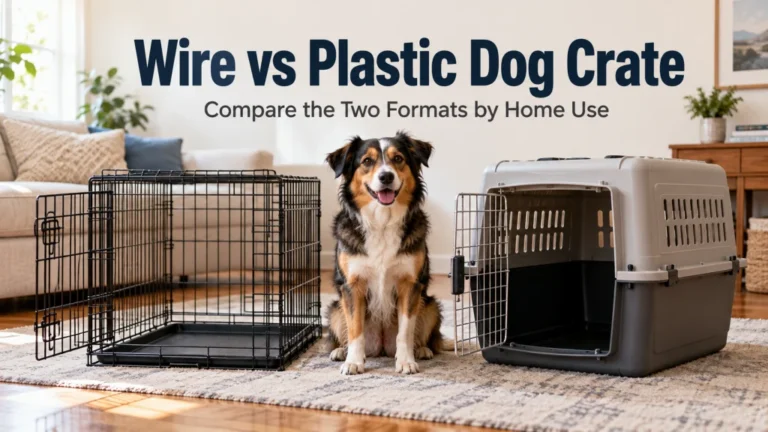
Wire crates make sense when an open structure is useful and the household needs a crate that can often fold flatter than a rigid shell. The open sides make it easy to see the dog and allow strong air movement, which can be useful in a room where heat and visual supervision matter. Many wire designs also use removable dividers, so the usable space can change as a puppy grows without replacing the entire crate immediately. That does not remove the need to measure the dog, so confirm standing, turning, resting, and usable interior room with the dog crate size guide before treating a divider as the solution.
The same openness can be a drawback in a busy room or for a dog that reacts to constant movement. A cover may reduce visual exposure, but it must preserve ventilation and does not strengthen the wire or hardware. Dogs that bite, bend, or force bars present a different problem from dogs that simply prefer more visual privacy. If the structure becomes a target for chewing or escape attempts, reassess containment strength and behavior context.
Use plastic crates when an enclosed shell and wipeable interior fit the home job
Plastic crates trade some of the openness of wire for a more enclosed shell, which can reduce visual exposure and keep more of a small mess inside the crate rather than on the surrounding floor. Smooth interior surfaces can also be straightforward to wipe when the design allows the top and bottom shell to separate. That can be useful for a dog whose crate sits near household traffic or for an owner who values contained cleanup over a folding frame. The decision still depends on the exact ventilation openings, interior dimensions, door design, and how easily the shell can be disassembled for cleaning.
The storage tradeoff is easy to underestimate because a rigid shell usually keeps most of its physical volume even when it is not in use. Some models can be taken apart, but that is different from a frame that folds flat and may still leave two large shell pieces to store. An enclosed crate can also make the dog less visible from across the room, which may be a benefit or a drawback depending on the routine. Choose plastic because the shell solves a real home problem, not because the material name sounds more secure or because a similar looking carrier is used for travel.
Use soft sided crates only when portability matters and the dog is reliable around fabric containment
Soft sided crates earn their place when low weight and compact storage are more important than resisting determined chewing or escape behavior. Fabric and mesh designs can be easier to carry between rooms and may collapse into a smaller storage package than a rigid crate. That makes them appealing for a calm dog that already settles reliably and does not claw, chew, or push hard against containment. The convenience disappears quickly if the dog treats seams, mesh, zippers, or fabric panels as something to work on.
This is a category where the dog’s behavior matters more than the visual softness of the product. Cornell notes that fabric or mesh crates are not very durable and may be damaged by puppies or chewers, which is a useful boundary for a home selection decision. A soft crate should not be used as an experiment to see whether fabric will hold a dog that has already tried to break out of other containment. If portability is the real priority but containment reliability is uncertain, choose a structure that matches the stronger requirement first and accept the added weight or storage burden.
Treat furniture crates as home furniture plus containment, not decoration alone
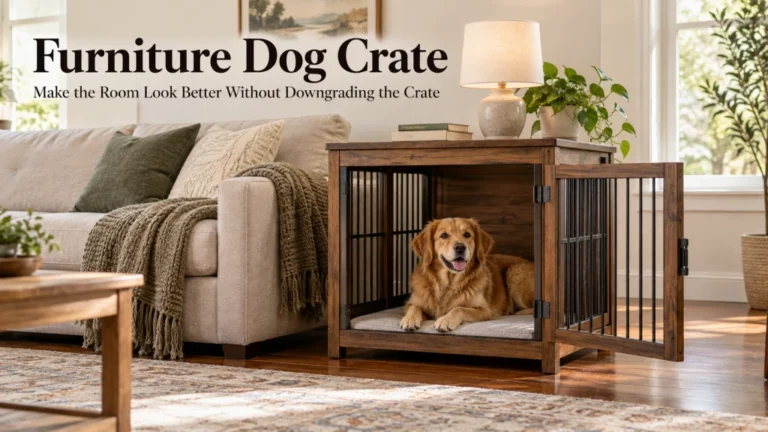
Furniture style crates can work when the crate will stay in one living area and the household wants the footprint to serve another visual or surface function. The useful question is not whether it looks better than wire or plastic, but whether the interior space, ventilation, door access, cleaning access, and construction still fit the dog. A thick outer frame or tabletop can make the exterior look substantial while leaving less usable interior room than expected. Measure the actual space the dog occupies rather than assuming the outside dimensions describe the resting area.
Cleaning is another reason to treat this as furniture plus containment instead of furniture first. Panels, corners, decorative surfaces, and fixed bases may be less convenient to wash than a removable tray or smooth plastic shell, especially if the dog tracks dirt or has an accident. The dedicated furniture dog crate guide is the better place to weigh those design tradeoffs in detail. For this broader crate type decision, furniture style makes sense only when permanent placement and room appearance matter without sacrificing the dog’s usable space or the owner’s ability to maintain the crate.
Move to reinforced construction only when durability or hardware failure truly requires it
Reinforced crates solve a different problem from ordinary household preference: the structure itself needs to tolerate more force or resist failure that lighter formats cannot handle. That can mean stronger panels, heavier framing, different latch systems, or hardware designed around a more demanding containment job. Those features also add weight, bulk, cost, and cleaning complexity, so they are not automatic upgrades for a calm dog. I would only move in this direction when there is a clear reason ordinary construction is not appropriate for the actual dog and setup.
Do not turn a reinforced crate into a shortcut for unresolved distress or panic around confinement. If a dog is persistently vocalizing, salivating, pacing, injuring the mouth, or making intense escape attempts, confinement itself may need to be reassessed rather than simply made harder to defeat. The heavy duty dog crate guide is the right place to compare reinforced construction when durability is truly the decision. On this page, the key boundary is simpler: stronger construction should answer a documented structural need, not a vague belief that heavier is always safer or better.
Compare wire and plastic directly when those are the two finalists
Wire and plastic often survive the first round because both can work for everyday home containment while solving different room and maintenance constraints. Wire usually favors visibility, airflow, and folding, while plastic usually favors a more enclosed shell, contained mess, and simple wipeable surfaces. Neither advantage makes one material universally better, because the dog may need more visual openness while the household needs compact storage, or the reverse. The useful comparison is which tradeoff matters every day in the actual room where the crate will live.
If these are your two finalists, compare them side by side on the same criteria rather than changing criteria midway through the purchase. Check usable interior room, door position, ventilation, tray or shell cleaning, storage volume, assembly burden, and how the dog reacts to visual exposure. The detailed wire versus plastic dog crate comparison handles that narrower decision without pulling in unrelated crate families. That separation keeps this page useful as a taxonomy while giving the close call its own deeper comparison.
| Household question | Wire usually favors | Plastic usually favors |
|---|---|---|
| Need to see the dog easily | More open visibility | More limited sight lines |
| Need stronger air movement | Open sided ventilation | Ventilation through designed openings |
| Need compact storage | Many designs fold | Rigid shell usually stays bulky |
| Need to contain small messes | Tray handles the crate floor area | Shell can contain more around the sides |
| Need less visual stimulation | May require a suitable cover | Solid panels provide more enclosure |
Use the table to identify the two differences that matter most in the room. Wire may lead when folding and open sight lines matter, while plastic may lead when enclosure and contained mess matter more. Chewing or determined escape attempts can override both preferences. Compare the two formats only after both remain suitable choices for the dog.
Check cleaning, storage, and room footprint before buying the heavier format
A crate can fit the dog and still be awkward to live with if routine upkeep is difficult. Check whether you can reach corners, remove trays or bedding, move the crate away from a wall, and dry cleaned surfaces without dismantling half the room. Also check what happens when the crate is not needed: it may fold, separate into bulky pieces, or stay assembled because moving it is impractical. Those details can matter more than a small difference in purchase price.
Room footprint includes door swing, walking clearance, nearby furniture, and space to approach the crate. Heavier construction can be justified when strength is necessary, but it also takes more effort to move. A light crate is no advantage if the dog can damage or defeat it. Balance structural need against the amount of handling the household can manage.
| Format | Cleaning pattern | Storage pattern |
|---|---|---|
| Wire | Tray plus exposed frame requires attention to bars and joints | Many designs fold flatter |
| Plastic | Smooth shell can wipe clean, but seams and door hardware still need access | Often bulky unless disassembled |
| Soft sided | Fabric and mesh care depends on the product instructions | Often collapses compactly |
| Furniture style | Finish, corners, fixed panels, and base design can complicate cleanup | Usually treated as permanent furniture |
| Reinforced | Heavy panels and hardware may require more effort to reach and move | Often demands dedicated floor and storage space |
Before buying, picture one normal cleanup and one room rearrangement. If either task looks awkward, account for that burden before moving to individual models. A harder maintenance routine can still be acceptable when the crate solves a more important need. The point is to know that tradeoff before the box arrives.
Keep travel and crash safety requirements separate from home convenience
A crate that is convenient in a bedroom or living room should not be assumed to meet a travel requirement just because the shape looks similar to a carrier or transport kennel. Airline acceptance can depend on the exact carrier, route, airline rules, destination, and current travel requirements, while vehicle safety depends on the exact restraint or crate system and how it is installed. Material alone does not establish either result. A plastic crate is not automatically suitable for a flight, and a strong household crate is not automatically a crash rated vehicle restraint.
Keep the home decision focused on fit, containment, visibility, airflow, cleaning, and storage, then open a separate checklist when the crate will be used in a car or for another transport task. The traveling with a dog guide is the better starting point when transport rules become the controlling constraint. This prevents a common category mistake where portability is treated as proof of travel safety. It also keeps you from rejecting a useful home crate simply because it is not designed to solve a different transportation problem.
Home versus travel boundary: choose a home crate for home fit and the household job. Travel is a separate check. Verify the exact product and current transport requirements. Do not carry home assumptions into a car or flight.
That boundary matters most when a product is marketed for several uses at once. Multiuse language can be convenient, but each use still needs its own evidence and setup check. If transport performance is important, treat that as a new decision rather than a bonus feature attached to the home purchase. Clear boundaries make the home choice simpler and reduce the temptation to infer safety from appearance.
Match the household job to the crate family that solves it first
The fastest way to use these categories is to identify what would make a crate unsuitable in daily life. A small apartment may make folding decisive, while a permanent living room setup may put more weight on appearance and access for upkeep. A dog that becomes overstimulated by visual traffic changes the value of open sides, and a dog that damages fabric changes the value of portability. Start with the hardest requirement, then use secondary preferences to break a tie.
This approach also helps avoid paying for construction you do not need. A calm adult dog that rests comfortably in an ordinary wire or plastic crate does not gain an automatic benefit from a much heavier frame. Likewise, the lightest option is not useful if the dog can damage it or the household cannot manage it well. Pick the family that meets fit and behavior needs while remaining workable in the room.
| Primary job | Format to consider first | What to verify next |
|---|---|---|
| Maximum airflow and easy visual checks | Wire | Bar and hardware suitability, tray cleaning, room exposure |
| More enclosure with contained cleanup | Plastic | Ventilation, interior room, shell storage |
| Frequent carrying and compact storage for a reliable dog | Soft sided | Fabric condition, closures, dog behavior around mesh and seams |
| Permanent placement in a furnished room | Furniture style | Interior fit, ventilation, cleaning access, structural purpose |
| Ordinary formats are failing under force | Reinforced | Exact construction, hardware, weight, placement, behavior context |
Once a family passes the matrix, move to a model level check before comparing extras or finishes. This is where exact measurements and hardware matter more than the category label. Verify the items below from the current product page, manual, or manufacturer documentation when available. If a detail is missing, do not assume another model in the same family works the same way.
- Usable interior length, width, and height for the dog.
- Door location, opening direction, and clearance in the intended room.
- Folded dimensions or disassembled footprint if the crate must be stored.
- Tray, shell, cover, or fabric care instructions and access for routine cleanup.
- Assembled weight if the crate will be moved for cleaning or room changes.
- Latch, hinge, panel, and frame construction that matches the dog’s behavior.
That checklist keeps the final comparison tied to details you will actually use. Two models in the same family can differ enough in door placement, usable space, or hardware to fit the home differently. If both pass the important checks, favor the one that is easier to manage in your routine. The category narrows the search; the exact model still has to earn its place.
Final Thoughts: choose the crate type that solves the physical job without creating a new household problem
Stop asking which crate type is best and decide which physical property matters most in the home. Wire favors openness and folding, plastic favors enclosure, soft sided designs favor low weight, furniture style designs favor permanent placement, and reinforced construction answers higher structural demand. Every advantage brings a compromise in visibility, upkeep, weight, durability, space, or cost. The dog and household determine which compromise is acceptable.
Then verify the exact model rather than relying on the family name. Keep transport requirements separate unless travel is the main task, and do not use stronger construction as a substitute for addressing serious distress around confinement. A straightforward crate can be the better choice when it already meets fit, behavior, and room needs. The goal is a format that works quietly in daily life instead of demanding constant accommodation.
FAQs
These questions cover common points that change a crate type decision. The answer usually depends on the dog, the room, and the daily job. Material names are useful shorthand, not a substitute for checking dimensions, ventilation, hardware, and care. Use these answers to narrow the next check rather than choose by label alone.
Intense escape behavior or confinement distress changes the question beyond material choice. A different containment plan and appropriate professional guidance may matter more than added strength. For ordinary home selection, focus on a dog that can use a crate calmly. Then choose the format that matches the clearest practical constraint.
🐕 Which type of dog crate is easiest to store?
Many wire and soft sided designs fold more compactly than rigid plastic or furniture style crates. Check the exact folded dimensions and weight because category alone does not tell you whether the crate will fit your closet, vehicle, or storage area.
🧼 Which dog crate type is easiest to clean?
Plastic shells can be straightforward to wipe, while wire crates often use a removable tray but still have bars and joints to clean. Furniture surfaces and fabric panels may need more product specific care, so check the exact cleaning instructions before buying.
🌬️ Are wire crates better for airflow?
Wire crates usually provide more open airflow because most sides are exposed. That openness also increases visibility, so a dog that settles better with less visual stimulation may need a different format or a suitable setup that preserves ventilation.
🪶 When does a soft sided crate make sense?
It makes the most sense when portability and compact storage matter and the dog is already reliable around fabric and mesh containment. It is a poor default for a dog that chews, claws, or makes determined escape attempts.
🏠 Is a furniture style crate better for a living room?
It can be a good fit when the crate will stay in one place and the design still provides adequate usable interior space, ventilation, access, and cleaning. Appearance should be a secondary filter after those functional checks.
✈️ Can I use the same crate at home and for travel?
Sometimes, but do not assume home suitability proves travel suitability. Verify the exact transport requirements, product instructions, and any airline or vehicle specific rules that apply to the trip.
References and Sources
Veterinary and canine guidance supports the claims that need more than household preference. The sources below cover broad differences among wire, plastic, and fabric crates. They do not replace documentation for a specific model. Check current manufacturer information for exact materials, latches, dimensions, cleaning, and transport use.
Travel is limited here because home material does not establish airline acceptance or crash performance. Transport rules and exact product testing require a separate decision. These sources directly support claims used in the article. They are included where a reader could otherwise make an unsafe assumption.
- Cornell University College of Veterinary Medicine: supports broad differences among wire, plastic, and fabric crates, including folding, enclosure, durability, and concerns with puppies or chewers using fabric containment.
- VCA Animal Hospitals: supports crate selection as a confinement decision and provides advantages and disadvantages for collapsible wire, plastic, and stronger metal formats.
- American Kennel Club: supports the practical distinction among plastic, metal, wood, and soft crate formats and the need to consider size, chewing, cleaning, assembly, and home use.