Consistent portions start with using the same measurement method every time, not with trusting the size of a scoop by sight. A digital kitchen scale set to grams is the most repeatable option for dry food when the feeding plan provides a gram amount, while a true standardized measuring cup can still work when weighing is not practical. The empty bowl or container should be tared before food is added, and the known daily amount should be divided across the household’s actual meal routine. Recheck the measurement whenever the food or dispensing method changes, because a familiar scoop or feeder setting does not automatically represent the same amount of a different food.
Separate the target amount from the measuring tool
How to measure dog food consistently starts with separating two questions that are easy to blend together. The first question is how much food belongs in the dog’s daily plan, while the second is how the household will reproduce that already known amount at each meal. This article owns the second question, so use the broader feeding a dog guide when you need the larger feeding context rather than a measurement technique. A scale, cup, scoop, or feeder setting cannot decide the correct daily amount by itself.
The practical test is simple: could another person feed the dog tomorrow and produce the same portion without guessing what you meant? A repeatable method matters most in homes where more than one person feeds, where meals are split across the day, or where the scoop tends to get filled differently each time. Keep the agreed amount and meal pattern visible so the measurement method supports the existing dog feeding schedule instead of quietly changing it. Once the target and the tool are separated, it becomes much easier to spot whether the inconsistency comes from the plan or from the way food is being measured.
Read the product’s feeding unit before choosing a measuring tool
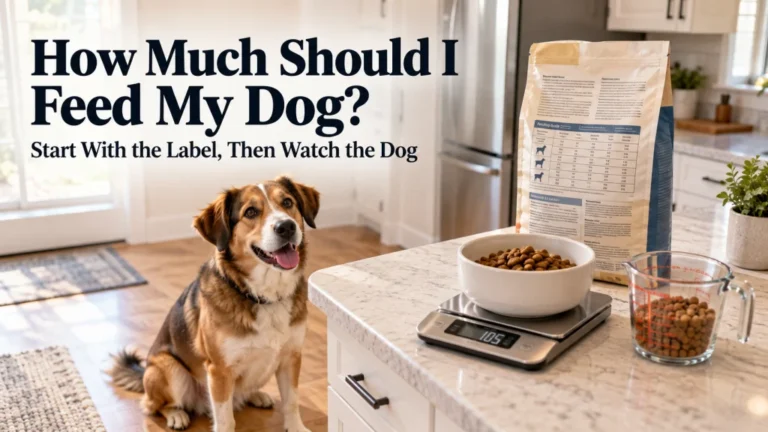
Start with the exact food package or current manufacturer information and identify the unit used for feeding directions and calorie information. In the United States, pet food labels commonly present feeding directions and calorie content in ways that can include weight based information and familiar units such as a cup or can. That does not mean a cup and a gram amount are interchangeable across foods, because volume and mass describe different things. Use the unit that matches the feeding plan whenever possible instead of inventing a conversion from another food.
If the existing plan is in grams, a scale gives you a direct path to that number without first translating it into cup volume. If the plan is in cups, use the cup information for that exact food unless the manufacturer also provides a gram equivalent that lets you move cleanly to weighing. Wet food may be listed by can, tray, pouch, or weight, so follow the exact label or manufacturer unit rather than borrowing a dry food cup conversion. This label first check prevents a common mistake: keeping the old measuring tool while the meaning of the old measurement has changed.
Use a digital kitchen scale for the most repeatable gram measurement
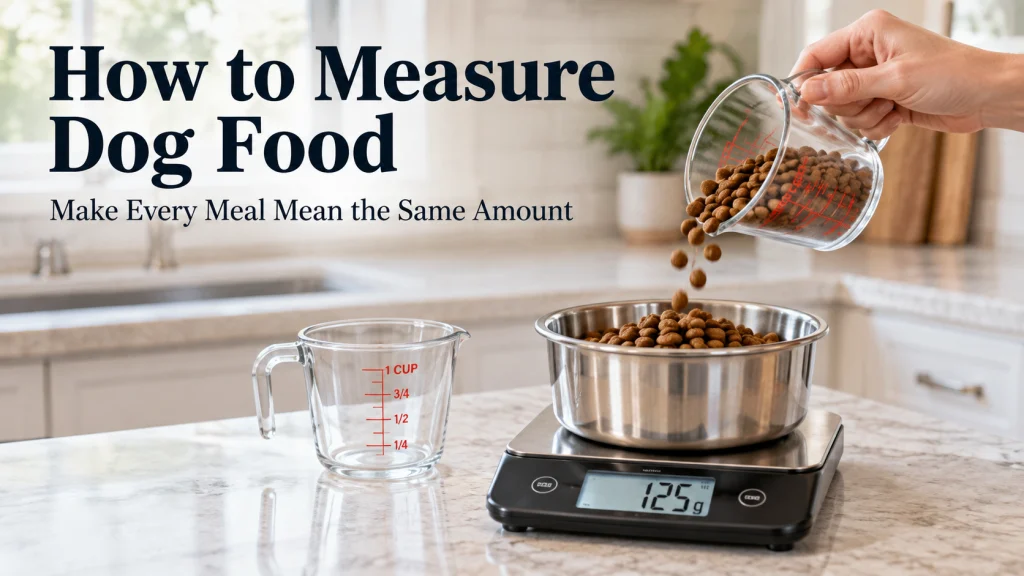
When the feeding amount is available in grams, I would prioritize a digital kitchen scale because it measures the food directly by mass. VCA Animal Hospitals specifically notes that weighing kibble in grams is the most accurate way to measure the same amount at each feeding. The scale does not need to solve nutrition decisions, and it does not need to be treated like laboratory equipment. It simply needs to hold the bowl or container securely, display grams clearly, and cover the normal amount of food you expect to weigh.
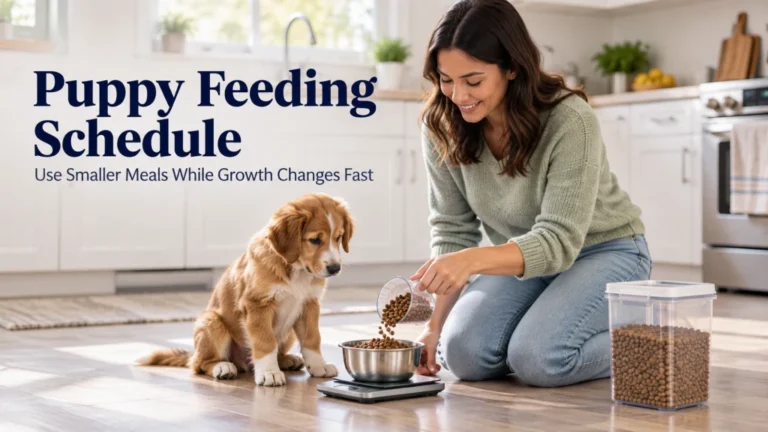
Place the scale on a firm, level surface, set the empty bowl or container on top, zero the display, and then add food until the intended gram amount is reached. For dry food, avoid trying to judge the portion by how full the bowl looks because bowl shape and kibble shape can make equal weights look different. For wet food, the same mass based workflow can be used when the plan is expressed in grams, as long as the container is tared first. A short written routine near the feeding area can make the process easy for anyone in the household to repeat.
- Put the scale on a stable surface.
- Place the empty bowl or measuring container on the scale.
- Press tare or zero before adding food.
- Add food until the display reaches the planned gram amount.
- Serve that measured amount without adding an unmeasured extra scoop.
The value of this sequence is consistency, not complexity. Once the same steps become routine, the scale turns a vague visual estimate into a number that another household member can reproduce. Keep the scale and the designated bowl in an easy feeding location so the correct method is also the convenient method. If the process starts to feel cumbersome, simplify the setup rather than falling back to unmeasured extras.
Tare the empty bowl or container before adding food
Tare tells the scale to ignore the weight of the empty bowl or container so the display reflects the food being added. Without that step, the display shows the combined weight of the container and food, which makes the number useless unless you subtract the container weight correctly every time. Taring is especially helpful when different bowls are used, because each bowl can have a different empty weight. The easiest household rule is to place the empty container on the scale first and zero it before any food goes in.
For example, imagine an empty bowl weighs 380 grams and the intended food amount is 120 grams. Without taring, the scale would show 500 grams after the food is added, while a tared scale would show the food amount directly as 120 grams. Those numbers are only a demonstration of the workflow, not a feeding recommendation for any dog. If several people share feeding duties, write the intended food amount and the instruction to tare first on a simple label near the food so the method stays the same from person to person.
Household label: Use the listed food amount for each meal. Tare the empty bowl first. Use the same measurement unit shown in the feeding plan. Recheck the amount whenever the food changes.
A label works best when it records the exact unit the household is actually using. Avoid mixing a gram target with an unlabeled scoop instruction, because that immediately reintroduces guesswork. Keep the wording short enough that anyone feeding the dog can follow it without interpreting what a full scoop is supposed to mean. If the routine changes, update the label at the same time so the written instruction and the actual feeding method stay aligned.
Weigh the daily amount once, then divide it across the actual meal routine
If the dog’s established plan gives one daily amount, convert that daily total into the portions that match the household’s real meal pattern. For equal meals, the arithmetic is simply the known daily amount divided by the number of meals, while unequal meals should still add back to the same planned daily total. For example only, a known daily amount of 300 grams split across three equal meals becomes 100 grams per meal. That example demonstrates portion splitting and does not suggest that 300 grams is appropriate for a particular dog.
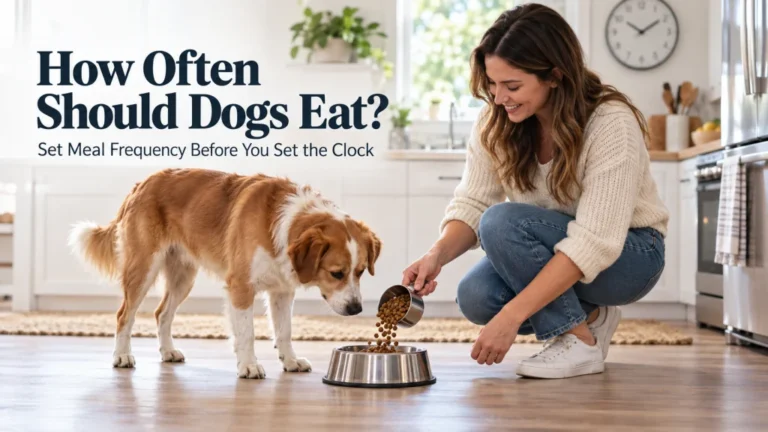
This is also where a written worksheet can prevent accidental double feeding or uneven handoffs between household members. If you are still deciding how many meals belong in the routine, handle that decision separately with the guide to how often dogs should eat rather than changing frequency just to make the math convenient. Once the meal pattern is established, record each portion and make sure the meal amounts add back to the intended daily total. The goal is to make the feeding plan observable enough that anyone can check whether the full day matched the plan.
| Daily amount | Meal pattern | Portion plan | Daily check |
|---|---|---|---|
| 300 g example | 3 equal meals | 100 g per meal | 100 + 100 + 100 = 300 g |
| Your known amount | Your established meal routine | Write each meal amount | Confirm the portions add to the daily amount |
The worksheet should mirror the routine you already follow rather than forcing every household into equal meals. What matters is that the separate servings can be traced back to the known daily amount. Keep treats, toppers, or other foods outside this measurement unless the existing feeding plan explicitly accounts for them in the same total. When the daily plan changes, update the worksheet first so old meal portions do not survive simply because they are familiar.
Use a standardized measuring cup consistently when weighing is not practical
A scale is not the only workable method, and a standardized measuring cup can be reasonable when the feeding directions are in cups or weighing is not practical. WSAVA nutritional assessment guidance specifically recommends confirming the use of an appropriate food measuring device and gives a standard measuring cup as an example. The key is that the cup should represent a known volume, not merely look cup shaped. A drinking mug, coffee cup, or decorative scoop may hold a different volume even when it feels familiar in the hand.
Use the same standardized cup, fill it in the same manner, and follow the exact cup amount for the food you are feeding. Avoid switching between a level fill one day and a heaped fill the next, because the household has changed the portion even though everyone still says they used one cup. If more than one person feeds the dog, store the designated measuring cup with the food and label its intended use. This keeps the volume method consistent without pretending that cups are identical to grams or that cups are always unacceptable.
| Measuring tool | What makes it repeatable | What can go wrong |
|---|---|---|
| Standardized measuring cup | Known volume, same cup, same fill method | Changing between level and heaped fills changes the portion |
| Random scoop or mug | No reliable reference unless its capacity has been checked | Different shapes and capacities can make the same verbal instruction produce different portions |
Use the table as a quick household check rather than as a reason to buy another tool automatically. If a standardized cup already matches the feeding unit and everyone uses it the same way, it can be sufficient. If the household scoop has no known capacity, replace the guess with a defined measurement or verify what that scoop actually represents for the current food. The useful distinction is not expensive versus cheap equipment, but known measurement versus an undefined container.
Avoid random mugs, unmarked scoops, and heaped portions
The most common measurement problem is not that a household owns the wrong object, but that the object has never been tied to a defined amount. A scoop that came in a storage bin may be convenient, yet its full capacity does not automatically equal a standard cup or the portion in the feeding plan. A mug has the same problem, and a heaped scoop adds another variable because the mound can change every time. These shortcuts make it hard to tell whether a feeding adjustment actually changed intake or only changed the way the food was served.
If a favorite scoop is convenient, calibrate the routine rather than guessing what the scoop means. Use the exact food, determine the intended portion with the scale or standard cup method that matches the plan, and mark the scoop only if the resulting fill level can be reproduced clearly. Recheck that shortcut periodically and whenever the food changes, because the same visual fill can represent a different mass with a different kibble. Convenience is useful only when it preserves the measurement instead of replacing it.
- Do not treat an unmarked storage scoop as a standard cup.
- Do not alternate between level and heaped portions.
- Do not use several household cups with different capacities for the same instruction.
- Do not eyeball an extra amount after the measured portion is already in the bowl.
A good shortcut should make the correct amount easier to repeat. If the shortcut cannot be checked against a defined unit, it is only a guess with a handle on it. Keep one defined method as the reference even if the household uses a faster shortcut for ordinary meals. That reference gives you a way to check the shortcut again whenever the scoop, food, or feeding routine changes.
Recheck the measurement whenever the food changes
Do not carry an old cup to gram conversion into a new food unless the new product’s own information supports it. Kibble pieces can differ in size, shape, and density, and pet foods can differ in calorie content, so the same cup volume should not be assumed to have the same mass or nutritional meaning across products. Read the new label, use the new food’s own serving information, and rebuild the household measurement from that source. This is one reason a written gram amount or clearly defined cup amount is more useful than a note that simply says one scoop.
Changing food can also change the correct daily amount, which is a different decision from measuring technique. If you need to determine the appropriate daily quantity for the new food, use the separate guide on how much to feed a dog rather than assuming the old target transfers unchanged. Once the daily amount is established, return to the scale or standardized cup and create a fresh repeatable measurement. The measurement system should follow the current food, not preserve an old number just because it is familiar.
Verify automatic feeder portions separately
An automatic feeder can repeat a programmed setting, but the setting itself should not be assumed to equal a verified gram amount. Check the current manual for the exact feeder to understand what its portion setting means, what food sizes or shapes it is designed to dispense, and whether the manufacturer describes any setup or calibration procedure. Then measure the actual output from your own unit under normal use before relying on the number in the app or on the control panel as the dog’s meal amount. This keeps the machine inside the same rule as every other tool: the device should reproduce the plan, not define it.
For a practical check, dispense the intended setting into an empty container, weigh the result, and compare that result with the amount already established for the meal. Repeat the check enough to notice whether the output is reasonably consistent for your food and setup, especially after changing kibble or feeder settings. If the device needs a different portion setting to reach the intended amount, follow the manufacturer’s operating limits rather than modifying the machine. The separate automatic dog feeder guide covers the broader device decision, while this article stays focused on measuring what the feeder actually delivers.
Final thoughts: consistent measurement makes the feeding plan observable
A feeding plan is much easier to follow when the portion can be reproduced without relying on memory or visual guesswork. Use grams when the plan supports grams and a kitchen scale is practical, or use a true standardized measuring cup consistently when volume is the workable method. Tare the container, record the amount, and make the household routine clear enough that another person can repeat it. Those steps do not decide what the dog should eat, but they make the chosen amount measurable.
Recheck the system whenever the food, scoop, meal routine, or dispensing device changes. A familiar tool should never be allowed to hide a changed quantity. If the target amount itself needs review, solve that question separately before recalibrating the measuring method. The useful standard is not perfect precision for its own sake, but a portion that means the same thing each time it is served.
FAQs
⚖️ Is it better to measure dog food by weight or by cups?
When a gram amount is available, weighing dry food in grams is the more repeatable method because it measures mass directly. A standardized measuring cup can still be practical when the plan is written in cups or a scale is not available, but use the same cup and fill method consistently.
🥣 Can I use a regular drinking cup to measure dog food?
A drinking cup is not a reliable substitute for a standardized measuring cup because its capacity may be different. If the feeding plan uses cups, use a known measuring cup or move to grams when the exact food provides a supported gram amount.
🍲 How do I weigh wet dog food?
Place the empty bowl on the scale, tare it to zero, and add wet food until the display reaches the gram amount in the established plan. If the food is prescribed or labeled by can, tray, or another unit instead, keep that exact unit unless the manufacturer or veterinary plan provides a supported weight conversion.
🔄 Do I need to tare the bowl every time?
Taring each time is the simplest way to make the display show food weight instead of bowl plus food weight. It also prevents errors when different bowls or containers have different empty weights.
📦 Should I remeasure when I switch dog food?
Yes, recheck the measurement for the new food instead of carrying over an old scoop or cup to gram conversion. The new product can have different kibble characteristics and calorie information, so rebuild the portion from the new label and the dog’s current feeding plan.
🤖 Can I trust an automatic feeder’s portion setting?
Treat the programmed setting as a device setting until you have checked what your exact feeder actually dispenses. Follow the current manual, weigh the output, and recheck after changing food or settings rather than assuming one programmed portion always equals a fixed gram amount.
References and sources
- VCA Animal Hospitals serving size guidance: Supports weighing kibble in grams as the most accurate way to reproduce the same amount at each feeding.
- WSAVA nutritional assessment guidelines: Supports measured feeding and use of an appropriate food measuring device.
- AAFCO pet food label guidance: Supports checking feeding directions and calorie content on the exact food label before choosing or changing a measuring method.