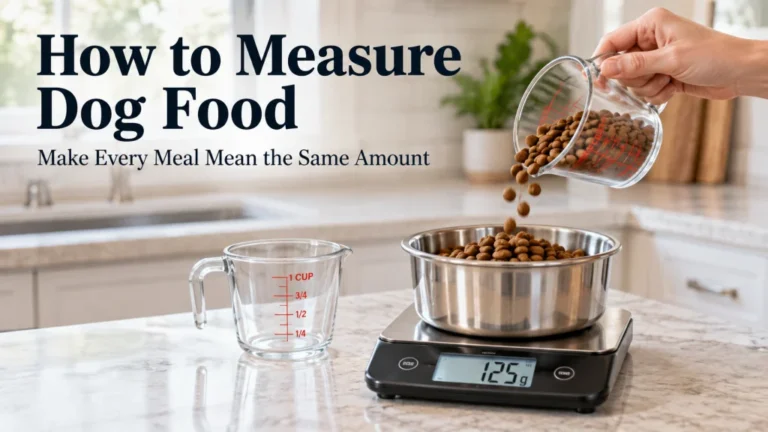
For most healthy adult dogs, two measured meals a day is a practical starting pattern, but it is not a rule that fits every dog. The better question is how many eating opportunities fit the dog’s age, size, routine, appetite pattern, and veterinary needs before the household worries about exact clock times. More meals should divide the same known daily amount rather than quietly increase it. Puppies and dogs with medical needs may require a different pattern, so meal frequency should stay flexible when the dog’s needs change.
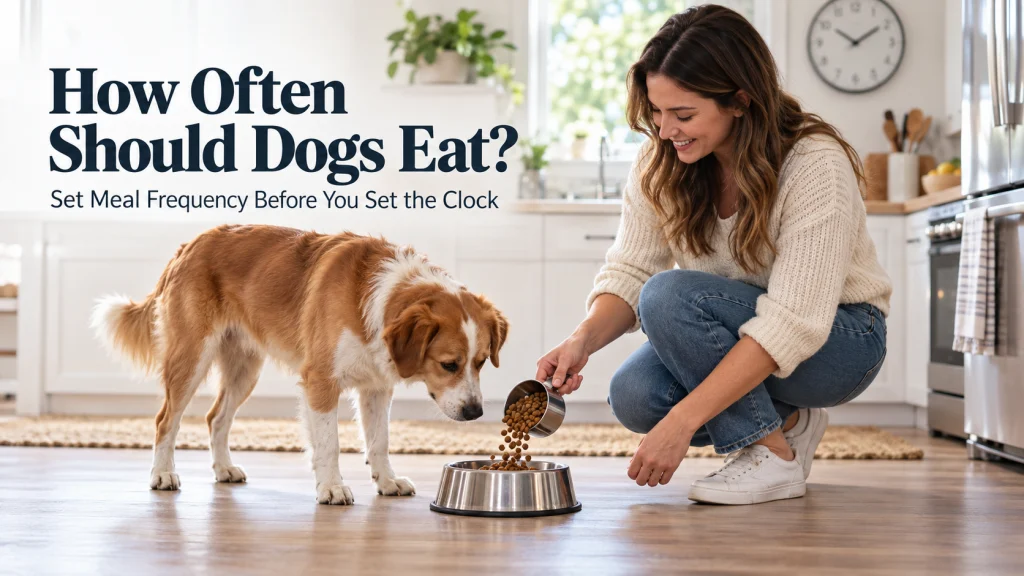
Choose meal frequency before you choose exact feeding times
If you are deciding how often your dog should eat, start with the number of meals rather than a perfect breakfast or dinner hour. A healthy adult dog often does well with two measured meals, while some dogs may reasonably eat once daily or need smaller meals more often. The useful decision is whether the current pattern gives the dog a manageable meal size, a predictable routine, and a way for you to notice changes in appetite. For the wider basics of food choice and routine, see how to feed a dog in everyday life.
Once the meal count makes sense, fit those meals into a routine the household can actually repeat. A schedule that works on workdays but collapses every weekend is less useful than a slightly flexible pattern built around reliable daily anchors. The broader dog feeding schedule guide covers how frequency, portions, household timing, and routine fit together. Here, the focus stays narrower: decide how many meals belong in the day, then place them at sensible points in that day.
Use two meals as a common adult starting pattern, not a universal law
For a healthy adult dog without a special veterinary feeding plan, two measured meals are a sensible place to start because they divide the day’s food into manageable servings and make intake easier to observe. Veterinary guidance also allows for individual variation, including dogs that may do well with one meal or benefit from more frequent smaller meals. That means the right answer is not a rigid number copied from a chart. I would use two meals as the default question to test, then adjust only when the dog’s condition, appetite pattern, routine, or veterinary advice gives you a reason.
Size by itself does not create one universal frequency rule for every adult dog, and activity does not automatically mean adding another full meal. What matters is whether the current pattern supports the dog’s known daily food amount without creating an impractically large serving or a household routine that is hard to maintain. A dog that comfortably eats two measured meals and maintains an appropriate body condition does not need extra feeding events just because another owner uses three. The table below is a decision guide, not a prescription.
| Situation | Practical starting point | What can change the decision |
|---|---|---|
| Healthy adult with a stable routine | Two measured meals is a common starting pattern | Individual appetite, meal tolerance, activity, and veterinary guidance |
| Healthy adult already doing well on another pattern | Do not change frequency only to match a generic rule | Body condition, intake, routine, and any new health concern |
| Young puppy | More frequent smaller meals are often appropriate | Age, size, growth, food, and veterinary guidance |
| Dog with a medical or therapeutic feeding plan | Follow the veterinary plan rather than a general schedule | Condition, medication, diet instructions, and treatment goals |
If an adult dog currently grazes with food available across much of the day, meal frequency can be harder to observe because there are no clear eating opportunities to compare. Start by measuring the dog’s known daily amount rather than repeatedly topping up the bowl, then note how much is actually eaten across the day. If you want a more structured routine, offer measured portions at regular eating opportunities and use what remains from the daily amount rather than creating extra food each time. A dog that maintains an appropriate intake while grazing may not need an abrupt change, but measured food and defined opportunities make appetite changes easier to notice and future schedule changes easier to manage.
The practical takeaway is to treat frequency as a structure for delivering the dog’s food, not as a health score by itself. If two meals already fit the dog and household well, there is no reason to complicate the routine simply because another pattern sounds more precise. Watch the dog’s actual intake and body condition instead of chasing a more elaborate schedule. Change the pattern when a real dog or household condition gives you a reason, not because a generic chart makes another number look superior.
Split the known daily amount instead of adding another full portion
Meal count and total food amount are separate decisions. If the dog already has an appropriate daily amount, changing from two meals to three should usually mean dividing that same total into three servings, not adding a third serving equal to breakfast or dinner. This is where an apparently harmless schedule change can turn into overfeeding without anyone intending it. If the daily amount itself is uncertain, settle that question first with the food label, body condition, and appropriate veterinary guidance rather than using meal frequency to guess.
The dedicated guide on how much to feed a dog owns the portion question because food amount depends on factors that meal count alone cannot answer. Once the daily total is known, the math is simple: one meal receives the whole daily amount, two meals divide it into two parts, and three meals divide it into three parts. Those parts do not have to be perfectly identical when the routine gives a good reason for a larger or smaller meal, but the day’s total still needs to stay controlled. Treats and training food also count toward intake rather than disappearing from the calculation because they were given outside the bowl.
| Meal pattern | How to use the known daily amount | Common mistake to avoid |
|---|---|---|
| One meal | Serve the full daily amount in one eating opportunity only when that pattern is appropriate for the individual dog | Assuming one large serving suits every healthy adult |
| Two meals | Divide the known daily amount across two measured servings | Topping up each meal because the bowl looks small |
| Three meals | Divide the known daily amount across three measured servings | Adding lunch on top of two already complete meals |
This distinction matters more than whether the household prefers one, two, or three feeding events. A frequency change should reorganize the daily food, not quietly create more of it. Measure before you split so each new meal has a defined place inside the existing daily total. That simple check keeps a schedule adjustment from becoming an unnoticed increase in intake.
Use more frequent smaller meals when puppy needs call for them
Young puppies are the clearest reason not to turn an adult feeding pattern into a universal rule. Veterinary feeding guidance commonly describes puppies as needing smaller meals more often because they are growing and may not handle the same meal pattern as a mature dog. The exact transition toward fewer meals varies with age, body size, growth, food, and veterinary advice, so this article should not become a detailed puppy age chart. What matters here is the handoff: a puppy may need a different frequency even when the household would prefer the convenience of an adult routine.
Use the dedicated puppy feeding schedule when you need to decide how the routine should change as a puppy grows. Very small puppies can deserve extra caution because the consequences of missed meals may be different from those for a healthy mature dog. Do not reduce meal frequency only because the puppy finishes food quickly or because an adult dog in the home eats less often. Growth, body condition, appetite, stool quality, and veterinary guidance should shape the transition rather than convenience alone.
Puppy handoff: Keep this article’s adult starting pattern separate from puppy feeding decisions. Growing dogs can need more frequent eating opportunities than healthy adults, and that need can change as the puppy matures. Do not cut meals simply to make the routine resemble an adult schedule. If the dog is still growing, use puppy specific guidance and the veterinarian’s advice before reducing meal frequency.
Consider once daily feeding only in the context of the individual healthy dog
Some healthy adult dogs may do well with one meal a day, and general veterinary guidance does not require every adult to eat exactly twice. That does not make once daily feeding the new default or a shortcut for every household. A single meal concentrates the day’s food into one serving, so the practical question is whether that serving is appropriate for the dog and whether the dog remains comfortable, maintains an appropriate body condition, and continues to eat predictably. If a veterinarian has given a different plan, that plan takes priority over a general article.
I would be cautious about switching to one meal simply to simplify the owner’s schedule when the dog is already doing well on two. Convenience is a valid household constraint, but it should not erase age, health, appetite, meal tolerance, or a treatment plan. A dog that starts acting unwell, repeatedly refuses food, or develops another concerning change needs assessment rather than a series of feeding schedule experiments. Frequency is adjustable, but it is not a diagnostic tool.
Use consistent daily anchors even when meal times shift
A useful feeding routine does not require the bowl to hit the floor at the same minute every day. For many households, dependable anchors work better: one meal after the household starts the morning routine and another during the evening routine, with a midday meal added when the dog genuinely needs a third eating opportunity. This keeps the pattern recognizable without pretending ordinary life runs like a laboratory schedule. Consistency should make care easier to repeat, not make the owner panic when a normal day shifts.
The better test is whether the dog receives the intended number of measured meals across a reasonably stable daily pattern. If work, school, travel, or another recurring commitment keeps pushing one meal out of place, adjust the structure rather than constantly improvising. A household might keep breakfast tied to the first settled part of the morning and dinner tied to the return home, while leaving room for modest variation between days. That kind of flexible anchor is often more sustainable than chasing exact clock times that the household cannot reliably keep.
- Choose anchors the household can repeat on ordinary days.
- Keep the number of planned meals consistent unless the dog’s needs change.
- Measure the day’s total so schedule flexibility does not become portion creep.
- Recheck the plan if appetite, activity, health, or routine changes materially.
After the routine is built, watch what actually happens rather than grading yourself on perfect timing. A feeding pattern is useful when it is stable enough to monitor and flexible enough to survive real life. If one anchor repeatedly fails, move the anchor instead of treating every day as an exception. The goal is a repeatable routine that makes intake easier to manage and changes easier to notice.
Use an automatic feeder when a recurring timing gap is the real problem
An automatic feeder can solve a narrow scheduling problem when the dog needs a measured meal during a recurring period when nobody is available to serve it. It should not be the first answer to an unclear feeding plan, because automation only repeats the instructions you give it. Decide the daily amount, meal count, and suitable portion for each feeding event before adding a device. The useful question is whether the feeder closes a real routine gap without creating new problems with food storage, cleaning, reliability, or access.
If that is the household problem, the automatic dog feeder guide can help with the equipment decision without changing the nutrition question. A feeder does not decide whether the dog should eat twice or three times, and it does not make an extra meal free of calories. It also may not fit every food format, household, or dog, so the exact device needs to match how it will be used. Solve the schedule first, then decide whether automation is worth the setup and maintenance.
Recheck frequency when age, activity, health, or the veterinary plan changes
A meal pattern that worked well in one stage of life does not have to remain fixed forever. Puppy growth, a major activity change, aging, a new health issue, or a therapeutic feeding plan can all make the old routine less appropriate. That does not mean every birthday or small routine change requires a new schedule. It means frequency should be reviewed when a meaningful condition changes the dog’s ability to eat, digest, maintain body condition, or follow veterinary instructions.
When you recheck the routine, separate the questions so one change does not hide another. Ask whether the dog’s total daily amount is still appropriate, whether the number of meals is still practical, whether the dog is consistently eating those meals, and whether the veterinarian has given any condition specific instructions. If only household timing changed, the same meal count may simply need different daily anchors. If the dog’s health changed, generic feeding advice should give way to the veterinary plan.
Treat sudden appetite change, repeated vomiting, or unexplained weight change as a veterinary issue
A feeding schedule can explain when food is offered, but it cannot tell you why a dog suddenly stops eating, vomits repeatedly, or loses weight without an obvious reason. Those changes can have many causes, and the right response is not to keep moving meals around until something appears to work. A significant appetite change, repeated vomiting, or unexplained weight loss deserves veterinary attention, especially when other signs of illness are present. The goal is to avoid turning a health signal into a home scheduling experiment.
This boundary matters because routine problems and medical problems can look similar at first. A dog may skip a meal because the household changed, but a new pattern of poor appetite can also accompany illness, and repeated vomiting can lead to dehydration or point to a problem that needs assessment. Keep notes on what the dog is eating, what changed, and any other signs you observe so the veterinary team has useful context. Do not prescribe fasting, medication timing, or disease specific meal schedules from a general feeding article.
Final Thoughts: Let meal frequency support the dog, not rule the household
For many healthy adult dogs, two measured meals are a practical place to begin, but the number is a starting structure rather than a universal law. Puppies, individual appetite patterns, household constraints, and veterinary needs can justify a different arrangement. Keep the daily food amount separate from the meal count so an extra feeding event does not become extra food by accident. Then place those meals at reliable points in the day that the household can actually maintain.
The best routine is the one that remains measurable, repeatable, and appropriate for the dog in front of you. Recheck it when the dog’s life stage, activity, health, appetite, or veterinary plan changes, and do not use schedule adjustments to explain away concerning symptoms. Frequency is useful because it organizes care, not because one number proves you are feeding correctly. Start with a sensible pattern, watch the dog, and let evidence and veterinary guidance override generic rules when needed.
FAQs
🐕 How many times a day should an adult dog eat?
Two measured meals are a common starting pattern for many healthy adult dogs. Some dogs may do well on another frequency, so consider appetite, body condition, routine, health, and veterinary guidance rather than treating two as a universal rule.
🍽️ Is feeding a dog once a day okay?
Some healthy adult dogs can do well on one daily meal, but it is not the best default for every dog. Consider the size of the single meal, the dog’s comfort and appetite pattern, and any veterinary instructions before changing from a routine that already works.
🐾 Do puppies need to eat more often than adult dogs?
Often, yes. Young puppies commonly need smaller meals more frequently, and the right transition toward fewer meals depends on age, size, growth, food, and veterinary guidance.
🥣 Does adding a third meal mean my dog should get more food?
Not by itself. If the daily amount is already appropriate, divide that same total across three meals rather than adding another full portion.
🏠 Do dog feeding times have to be exact every day?
No. A reasonably consistent pattern built around repeatable household anchors can be more practical than chasing an exact clock time, as long as the intended meals and daily amount stay controlled.
🤖 Can an automatic feeder fix an inconsistent schedule?
It can help when there is a predictable timing gap and the dog already has a clear meal plan. It cannot decide the correct daily amount or meal frequency, so settle those questions before automating delivery.
🩺 When should I call the veterinarian about a feeding change?
Contact the veterinary team when appetite changes significantly, vomiting repeats, weight changes without a clear reason, or another concerning symptom appears. Dogs with medical conditions or therapeutic diets may also need an individualized meal schedule rather than a general one.
References and Sources
- VCA feeding times and frequency guidance: Supports common adult meal patterns, individual variation, measured grazing, and transitions toward regular eating opportunities.
- AKC feeding frequency guidance: Supports using twice daily as a common starting point while accounting for age, health, and individual needs.
- AKC puppy feeding fundamentals: Supports the handoff to more frequent puppy meals and gradual changes as puppies grow.
- VCA abnormal weight loss guidance: Supports treating unexplained weight loss as a veterinary issue rather than a meal scheduling problem.