A dog feeding schedule works best when the household separates the total daily amount from the number of meals used to serve it. The food label can provide a starting point, but the actual amount may need adjustment with veterinary guidance and body condition feedback. A repeatable routine also depends on consistent measuring, a feeding method that makes intake visible, and a plan that fits puppy growth, workday constraints, food changes, and multi pet access.
Separate the daily amount from the number of meals
A dog feeding schedule has two decisions that are easy to mix together: how much food belongs in the whole day and how many meals will divide that amount. If the label or veterinarian gives a daily amount, that number should not automatically become the amount for each bowl. Start with the total for the day, then divide it according to the meal pattern that fits the dog and household. The broader feeding a dog guide covers the full mealtime system, while this page stays focused on timing, portion execution, and repeatability.
| Decision | What the household should write down | What it prevents |
|---|---|---|
| Daily amount | The total amount intended for the full day | Confusing a daily direction with a per meal portion |
| Meal count | How many servings will divide the daily total | Adding extra meals without reducing each serving |
| Feeder | Who serves each meal or fills the feeder | Duplicate feeding by different household members |
| Measuring method | The same cup, scale, or marked container used each time | Portion drift from unmarked scoops or visual guessing |
| Review trigger | What change means the plan should be checked again | Keeping an old routine after growth, weight, health, or food changes |
This distinction matters because a consistent clock routine can still overfeed a dog when the household doubles the intended daily amount by mistake. It also prevents the opposite problem, where one person treats a per meal amount as the whole day. I would write the daily amount where everyone who feeds the dog can see it, then define how that total is split. Once the daily total is clear, meal frequency can change without accidentally changing the amount offered.
Decide meal frequency before choosing exact meal times
Meal frequency should match the dog’s life stage, health needs, household routine, and ability to eat the planned portion comfortably. Many healthy adult dogs do well with measured meals divided across the day, while puppies generally need smaller meals more often because growth changes both energy needs and practical stomach capacity. That does not create one universal meal count for every dog. The better question is whether the chosen frequency makes the daily amount easier to serve, observe, and repeat without conflicting with veterinary instructions.
| Life stage or situation | Practical frequency direction | What should drive the next adjustment |
|---|---|---|
| Young puppy | Several smaller meals are commonly used | Growth, food directions, body condition, and veterinary guidance |
| Older puppy | Meal count commonly decreases as the puppy matures | Development, appetite pattern, body condition, and veterinary guidance |
| Healthy adult | Measured meals divided across the day are a common starting pattern | Body condition, activity, food energy density, and household consistency |
| Dog with medical or therapeutic feeding needs | Follow the veterinarian directed plan | The medical plan, not a generic schedule |
If you are unsure whether one, two, or more meals make sense for a healthy dog, the guide on how often dogs should eat handles that decision in more detail. I would choose frequency first, then fit those meals into the household routine instead of starting with arbitrary clock times. The useful pattern is one the household can repeat while still noticing changes in appetite and condition. Medical conditions, medication timing, therapeutic diets, and growth concerns belong with the veterinarian rather than a generic schedule.
Start the daily amount with the specific food directions
For a complete and balanced food, the package feeding directions provide a practical starting point for the relevant life stage, but they are still guidelines rather than an individualized prescription. Different foods can contain very different amounts of energy in the same cup or can, so a quantity that worked for the old food cannot be assumed to match the new one. Dog size matters, but so do body condition, activity, reproductive status, health, and the energy density of the exact food. When those factors make the correct amount unclear, veterinary guidance should override a generic chart.
The separate article on how much to feed a dog goes deeper into amount selection and monitoring. This schedule should take that known daily amount and make it executable, not recalculate a medical calorie target. I would also count treats and other routine food extras when the veterinarian or feeding plan expects them to fit within the day’s intake. If body condition or weight is moving in an unexpected direction, the answer is to reassess the plan rather than quietly making large cuts or additions.
Choose scheduled meals or free feeding by how well intake can be tracked
Scheduled meals make it easier to know what was offered, what was eaten, and whether appetite has changed. They also reduce confusion in households where more than one person might feed the dog. Free feeding can work for some dogs that regulate intake reliably, but it becomes harder to interpret consumption when food is continually topped up without measuring what entered and left the bowl. The decision should be based on visibility and control, not on the claim that one method is automatically right for every dog.
| Question | Scheduled meals | Free feeding |
|---|---|---|
| Can the household see how much was eaten? | Usually easier | Only if food offered and food remaining are measured |
| Can appetite changes be noticed quickly? | Usually easier | Can be harder when the bowl stays available |
| Does it fit a dog that grazes and self regulates? | Possible, but may change the dog’s preferred pattern | May fit some dogs if intake and body condition remain appropriate |
| Does it simplify multi pet access control? | Usually gives more control | Often makes individual intake harder to verify |
The comparison in free feeding versus scheduled feeding for dogs covers the tradeoffs in more depth. If a household uses free access, I would still measure what goes into the bowl and what remains. Multi pet homes need more caution because an empty bowl may only show that some animal ate the food. The feeding method should make the daily total easier to track, not hide it.
Measure the portion the same way every time
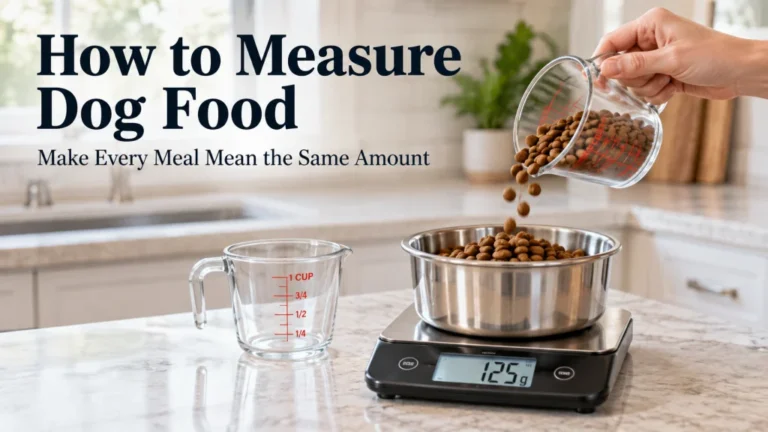
A schedule becomes unreliable when the amount changes with whoever happens to fill the bowl. An unmarked scoop, coffee mug, or handful can look consistent while producing a different portion from one meal to the next. Use one repeatable measuring method and make sure everyone knows whether the written amount refers to the whole day or one serving. Consistency matters more than making the setup elaborate.
- Write down the full daily amount before dividing it into meals.
- Use the same measuring method for every person who feeds the dog.
- Record treats or food used for training when they materially affect the daily plan.
- Do not refill an empty bowl automatically unless the refill is part of the measured daily amount.
- Recheck the portion when the food, body condition, life stage, or veterinary plan changes.
Portion handoff: Write the daily total in one place. Record the meal count and amount per meal beside it. Assign the person responsible for each serving. Add a backup so nobody has to guess whether the dog was fed.
The guide on how to measure dog food covers practical measuring choices in detail. A kitchen scale can improve repeatability when volume measuring is inconsistent, while a clearly marked measuring cup can be sufficient for many routines. I would avoid changing both the measuring tool and the portion target at once because that makes troubleshooting harder. Keep the method simple enough that the busiest person in the home can still follow it correctly.
Use a puppy specific schedule while growth changes the routine
Puppies usually need smaller meals more often than healthy adult dogs, but the schedule should change as the puppy grows rather than staying frozen at the first routine that worked. Age, expected adult size, growth rate, body condition, food formulation, and veterinary advice can all affect the transition. The main household task is to keep the daily amount clear while the number of servings changes. When a meal is removed later, its portion should be redistributed rather than silently disappearing or being added on top of the daily total.
| Life stage | Common meal pattern | Source basis | Household check |
|---|---|---|---|
| 6 to 12 weeks | Four meals per day is a common starting pattern | AKC: four daily feedings; VCA: four measured meals at roughly 5 to 12 weeks | Confirm food directions, expected adult size, growth, and veterinary guidance |
| 3 to 6 months | Meal count commonly moves from four toward three | AKC: reduce from four toward three; VCA: many puppies reach three meals by about 3 months | Redistribute the known daily amount as meal count changes |
| 6 to 12 months | Many puppies move toward two measured meals | AKC: begin twice daily; VCA: many breeds reach two meals earlier, with slower maturing breeds varying | Use development, body condition, food directions, and veterinary guidance rather than age alone |
| Adult routine | One or two measured meals are common, with some dogs benefiting from more divided meals | VCA general feeding guidance | Monitor body condition, intake, health needs, and household consistency |
The dedicated puppy feeding schedule explains growth stages in more detail. The age ranges above are source attributed reference points, not a universal timetable: AKC and VCA differ somewhat on when meal count commonly drops, and breed development can shift the transition. I would use the puppy’s food directions, body condition, expected adult size, and veterinary guidance rather than changing meals because the calendar alone reached a new range. Poor growth, repeated digestive problems, unusual lethargy, or other health concerns are not situations for forcing a generic schedule.
Use an automatic feeder only when timing is the real constraint
An automatic feeder can help when the household knows the daily amount and meal frequency but cannot reliably be present for one serving. It does not decide how much the dog should eat, notice whether the dog is ill, or guarantee that the intended dog receives the food. Capacity, portion mechanism, food type, cleaning, power, and access by other pets can all affect whether a feeder solves the actual problem. The device should execute a plan that already makes sense.
If timing equipment is the next decision, use the separate guide to choose an automatic dog feeder based on the household constraint. I would skip automation when a simple pre measured container and a reliable person can handle the meal with less setup. If the dog needs close appetite observation, medication coordination, or a medically controlled feeding plan, convenience should not replace the required monitoring. Automation is useful when it removes a timing bottleneck without making intake harder to verify.
Separate meals when pets should not have equal access to every bowl
A schedule can look precise on paper and still fail when one dog finishes another dog’s food. The problem is not meal timing at that point, but access control. Different pets may have different daily amounts, foods, eating speeds, or veterinary plans, so shared access can make individual intake impossible to confirm. A household should be able to tell which animal ate which portion.
The guide to feeding multiple dogs covers separation and access decisions in more detail. For this schedule, assign each measured portion to a specific dog and use a feeding location or supervision routine that lets the household verify the handoff. I would not assume identical dogs need identical portions simply because they eat together. If food guarding, serious conflict, or another behavior concern appears, the situation has moved beyond ordinary meal logistics and may need qualified behavior help.
Keep the routine repeatable without making every workday rigid
A useful schedule survives ordinary delays, meetings, errands, and household handoffs without turning every small shift into a feeding emergency. For a healthy dog without a medically required timing rule, consistency can mean a dependable sequence and measured daily total rather than the same minute every day. The goal is for everyone to know which meal has been served, what portion belongs to the next meal, and who is responsible. That is more practical than creating clock precision the household cannot maintain.
| Workday question | Simple household answer |
|---|---|
| Who owns each meal? | Assign one person or one clear backup |
| How is the daily total protected? | Pre measure or record the portions before serving |
| How does the next person know a meal was served? | Use a visible note, container position, or shared log |
| What if one meal is difficult to serve consistently? | Change the routine or use appropriate automation instead of guessing |
| What if medical instructions require precise timing? | Follow the veterinary plan rather than this generic routine |
For a worked example, suppose the dog’s established daily amount is 2 cups and the household uses two equal meals. One person measures 1 cup into each labeled container, serves the first, and marks it as completed. If the later feeder is delayed, the backup uses the remaining container instead of guessing or serving another portion. The 2 cup amount only demonstrates the handoff method, not a feeding recommendation; I would prioritize that visible system over a schedule that depends on perfect days.
Treat major appetite or weight changes as veterinary questions
A feeding routine can reveal useful information because measured meals make changes easier to see, but the schedule should not turn those changes into a diagnosis. Sudden appetite change, unexplained weight change, repeated vomiting, persistent digestive problems, or a therapeutic diet can all change what and how a dog should be fed. Those are reasons to contact the veterinary team rather than solve the problem by arbitrarily cutting, adding, or withholding food. Puppies and medically vulnerable dogs deserve especially cautious handling when intake changes.
Body condition feedback is useful for checking whether the current amount still fits the dog, but it should not become a home treatment plan for unexplained change. I would bring the food label, the measured daily amount, recent feeding notes, and any observed appetite change to the veterinary discussion. That information makes the household routine easier to evaluate without pretending the schedule itself explains the cause. Once the veterinary plan is clear, the schedule can return to its proper job of executing that plan consistently.
Switch foods gradually when the food itself changes
Changing food is different from changing meal timing. A new product can have different ingredients, energy density, serving directions, and portion units, so the old scoop amount should not be carried over automatically. Current owner guidance from veterinary and kennel club sources commonly recommends a gradual transition for routine food changes to reduce digestive upset. Dogs with medical diets, previous food reactions, or ongoing digestive problems need veterinary instructions rather than a generic transition.
The separate guide on how to switch dog food covers the transition process itself. For schedule purposes, write down the new food’s daily starting amount and keep the meal count clear while the old and new foods overlap. I would avoid changing food, meal frequency, measuring method, and feeding location all at once unless there is a specific reason, because several simultaneous changes make troubleshooting harder. When the transition is complete, the new food directions and the dog’s condition become the new reference points for the routine.
Final thoughts: Make the schedule easy to repeat and easy to measure
A reliable feeding routine starts with the daily amount, not the clock. Once that amount is known, the household can choose a meal frequency, feeding method, measuring system, and handoff that fit the dog and the people doing the feeding. The routine should make intake easier to see and easier to repeat. If it makes the daily amount harder to track, it is adding complexity without solving the real problem.
Recheck the plan when the dog grows, body condition changes, the food changes, household access changes, or veterinary guidance changes. Keep equipment and automation in a supporting role instead of letting them define the nutrition plan. For ordinary healthy dogs, a simple measured routine is often easier to maintain than a highly rigid one. The best schedule is the one the household can follow consistently while still noticing when the dog needs a different plan.
Explore related feeding decisions
The feeding schedule is easier to manage when timing, amount, measurement, and food changes are solved separately. Use the topics below when one part of the routine needs a deeper decision. Each page keeps the focus on measurable intake and household execution. That lets you change one part without losing control of the rest.
Start with the question blocking the routine now. A dog that needs a different meal count has a different problem from a household that cannot measure portions consistently. A puppy schedule also needs different reasoning from a routine food change. Keeping those decisions separate makes the overall plan easier to maintain.
| Topic | What you’ll find |
|---|---|
| How often should dogs eat? | Choose meal frequency by life stage, health context, and household routine. |
| How much should I feed my dog? | Separate the amount decision from the schedule and monitor whether the starting amount still fits the dog. |
| Free feeding versus scheduled feeding for dogs | Compare intake visibility, household control, and situations where each method becomes harder to manage. |
| How to measure dog food | Build a repeatable measuring method that different household members can follow. |
| Puppy feeding schedule | Adjust meal frequency as growth changes the routine without losing track of the daily amount. |
| How to switch dog food | Change foods gradually while keeping the feeding routine measurable and easy to troubleshoot. |
These decisions connect back to the same rule: know the daily amount, know who serves it, and know what change means the plan needs another look.
FAQs
🍽️ Should I feed my dog at the exact same time every day?
Not every healthy dog needs minute level timing. A repeatable sequence, measured daily amount, and clear household handoff can matter more, unless a veterinarian has given a timing requirement for a medical reason.
🥣 Is the amount on the dog food bag per meal or per day?
Read the exact feeding directions carefully because labels describe how the manufacturer intends the amount to be used. For many foods the guidance is a daily amount that must then be divided across meals, but follow the wording on the specific package and ask your veterinary team if the amount needs individual adjustment.
🐶 Do puppies need more meals than adult dogs?
Young puppies commonly need several smaller meals, and meal frequency usually decreases as they mature. Growth rate, breed size, food directions, body condition, and veterinary guidance can change the schedule.
📏 Is using the same scoop every day accurate enough?
It can be repeatable only if the scoop has a known measure and everyone fills it the same way. An unmarked scoop can hide portion differences, so use a marked measure or a scale when more consistency is needed.
🐕 Can I leave food out all day if my dog does not overeat?
Some dogs can maintain appropriate intake with free access, but the household still needs to measure what is offered and monitor body condition. Free access becomes less useful when intake is hard to verify, another pet can reach the bowl, or a veterinarian needs closer control.
⏱️ Can an automatic feeder fix an inconsistent schedule?
It can solve a predictable timing gap after the daily amount and meal size are already known. It does not replace appetite observation, veterinary instructions, or access control when another pet can reach the food.
References and sources
- AAFCO reading labels: Supports the use of feeding directions on complete and balanced food as guidelines that may need adjustment for the individual animal.
- WSAVA global nutrition guidelines: Supports individualized nutritional assessment, body condition evaluation, and veterinary guidance when a dog needs a tailored feeding plan.
- VCA general feeding guidelines: Supports measured meals, life stage differences, and individualized feeding decisions.
- VCA puppy general care: Supports measured puppy meals and age based changes in meal frequency.
- AKC puppy feeding fundamentals: Supports more frequent small meals for young puppies and reducing meal frequency as puppies mature.
- AKC food transition guidance: Supports gradual transitions when changing dog foods and monitoring the dog’s response.