Learning how to brush a dog starts with coat depth, not with counting strokes or buying the biggest brush set. The right routine depends on coat length, density, curl, friction zones, shedding pattern, and how easily a comb can reach the layers that matter. A useful brushing setup is usually small: choose the tool for the coat job, work gently in sections when needed, and use a comb check where hidden tangles are common. Tight or painful mats, irritated skin, wounds, or unusual hair loss are reasons to stop ordinary home brushing and get appropriate professional help.
Check what the brush reaches before counting strokes
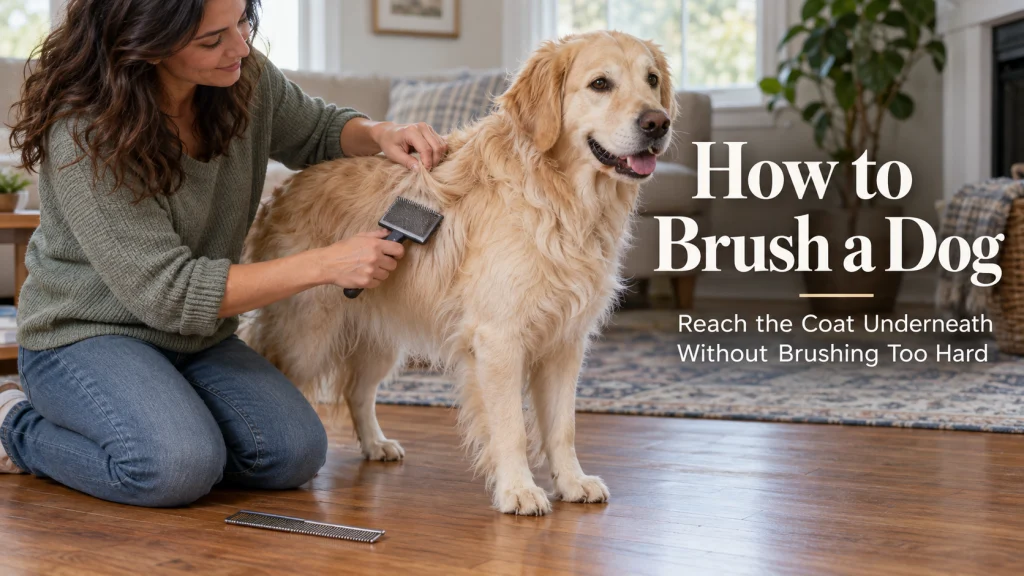
A dog can look brushed on top while tangles remain close to the skin, especially where a dense, long, or curly coat hides the lower layers. That is why brushing a dog well is less about making the surface look smooth and more about checking whether the tool is reaching the part of the coat that actually needs maintenance. Start by separating a small section with your fingers and watching where the pins, bristles, or teeth travel. If the tool only skims the outer coat, more strokes will repeat the same shallow job rather than clear the hidden layer.
This coat first approach also keeps brushing inside the larger home grooming routine instead of turning every coat problem into a tool problem. If you need the broader sequence for bathing, nails, coat checks, and ordinary maintenance, the guide on how to groom a dog provides that context. For brushing itself, the useful questions are simpler: what kind of coat is in front of you, what needs to be removed or separated, and can you reach that layer without scraping the skin. Once those answers are clear, choosing tools and frequency becomes much easier.
Choose the brush by coat and job rather than by one best brush label
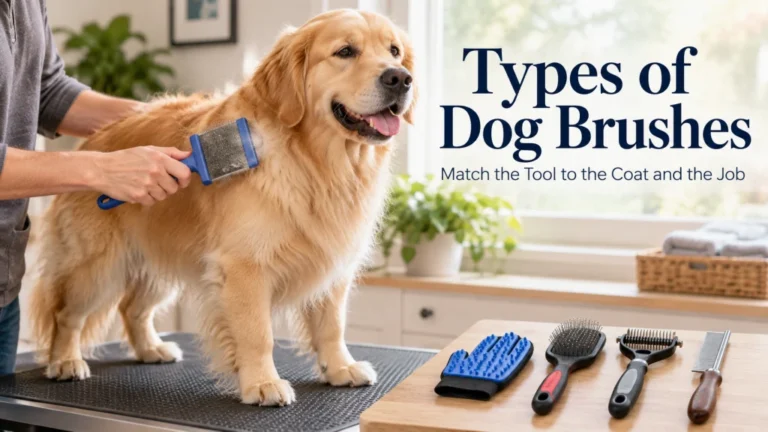
No single brush is the right answer for every coat because different tools contact the hair in different ways. Bristle brushes and rubber curry tools can suit many smooth or short coats where the main job is lifting loose hair and surface debris, while pin brushes can move through longer coats with less drag. Slicker brushes can help separate many medium, long, wire, or curly coats, but the pressure still needs to stay light enough that the pins are not driven into the skin. Undercoat rakes and similar tools belong to coats and jobs where there is an actual undercoat to reach, not to a rule that more teeth always mean better grooming.
The smallest useful kit is usually better than a drawer full of overlapping tools because each item should have a clear job. A brush can loosen and separate the coat, while a comb can reveal whether the section is actually clear rather than simply smooth on top. If you are unsure which tool shape fits the coat you have, the guide to types of dog brushes breaks down those jobs without treating one design as a universal winner. The practical goal is to match contact depth and coat structure while keeping pressure comfortable.
| Coat or job | Useful starting tool | What to check |
|---|---|---|
| Smooth or short coat | Rubber curry or suitable bristle brush | Loose hair lifts without scraping skin |
| Longer coat | Pin brush or suitable slicker | Sections separate without pulling at tangles |
| Dense double coat | Brush plus coat appropriate undercoat tool | The lower coat is reached gently |
| Curly coat | Suitable slicker plus comb | The comb can pass through the worked section |
| Tangle check | Comb | Resistance is found before it becomes a tighter mat |
Use the table as a starting point, then let the individual coat tell you whether the choice is working. If the tool catches repeatedly, bends the coat without reaching through it, or makes the dog flinch, change the setup rather than applying more force. A tool that is technically suitable for a coat type can still be a poor fit when its pin length, tooth spacing, head size, or handling angle does not suit the dog in front of you. Tool choice only helps when the contact remains gentle and the result can be checked.
Set brushing frequency from coat length, density, friction, and lifestyle
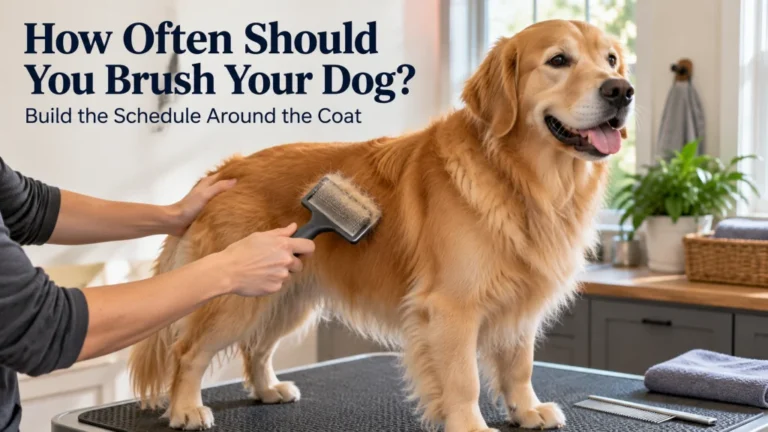
A fixed schedule for every dog misses the reasons coats tangle at different rates. A short smooth coat that stays clean indoors may need a very different routine from a long coat that collects debris on walks, a curly coat that tangles near the skin, or a dense coat moving through a heavier shedding period. Friction also matters because collars, harnesses, leg movement, lying positions, and moisture can make certain areas knot sooner than the rest of the body. The useful schedule is the one that keeps those problem zones manageable before brushing turns into a long detangling session.
Instead of starting with a calendar, check how quickly resistance returns after the coat has been cleared. The guide on how often you should brush your dog focuses on adjusting the routine to coat and lifestyle rather than forcing one interval onto every household. Increase attention when coat conditions change, then reduce it when the extra maintenance is no longer needed. The schedule should follow the coat you are actually seeing, not a generic number attached to coat length alone.
- Behind the ears: lift the ear gently and check where hair folds, rubs, and compresses close to the skin.
- Armpits: separate the coat where front leg movement repeatedly rubs hair together and where surface brushing can miss the lower layer.
- Chest and neck: inspect the coat under collars or harness straps because repeated contact can create localized tangles before the rest of the coat changes.
- Belly, groin, and feathering: check longer hair that can collect debris, moisture, and friction during normal movement.
- Tail and rear feathering: work through longer sections in small amounts so hidden resistance is found before it tightens near the skin.
These zones are not a substitute for checking the whole coat, but they are useful early warning areas. If one spot repeatedly tangles faster than the rest, spend more attention there rather than extending the entire session without a reason. Changes that involve soreness, redness, wounds, unusual hair loss, or skin odor are outside an ordinary brushing adjustment. Those signs call for an appropriate veterinary assessment rather than more brushing.
Use a simple surface maintenance routine for short coats
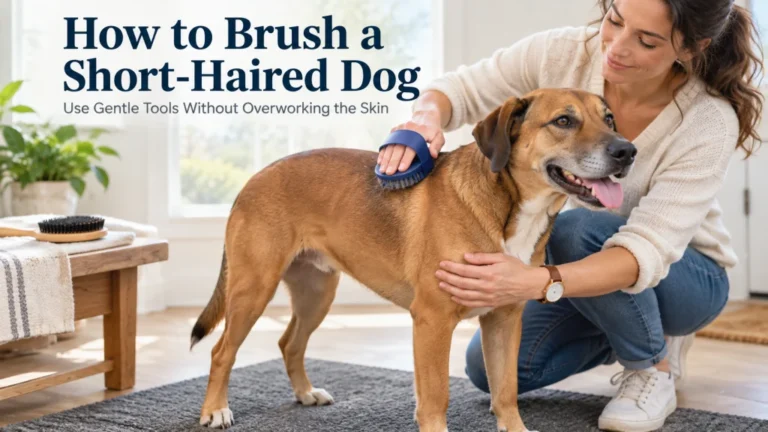
Short coats can be easy to maintain, but easy does not mean that every tool feels the same on the dog. The main job is often to lift loose hair, dust, and surface debris while keeping contact comfortable against skin that has less coat between it and the tool. A rubber curry or a suitable bristle brush can work well when it moves naturally with the coat and does not create harsh friction. Use enough pressure to contact the coat, but not so much that the skin drags under the tool.
Short coat brushing is also a useful chance to notice things that a longer coat might hide, including small scrapes, bumps, or areas of irritation. The detailed routine for how to brush a short haired dog keeps the method simple because this coat does not need a long coat sectioning routine just to make brushing look thorough. Brush the areas that collect loose hair, check the skin as you go, and stop if the dog shows discomfort that is not explained by ordinary handling. More tool passes are not automatically better once the loose hair and debris are already coming away easily.
Work in sections on long coats so tangles are not hidden under the top layer
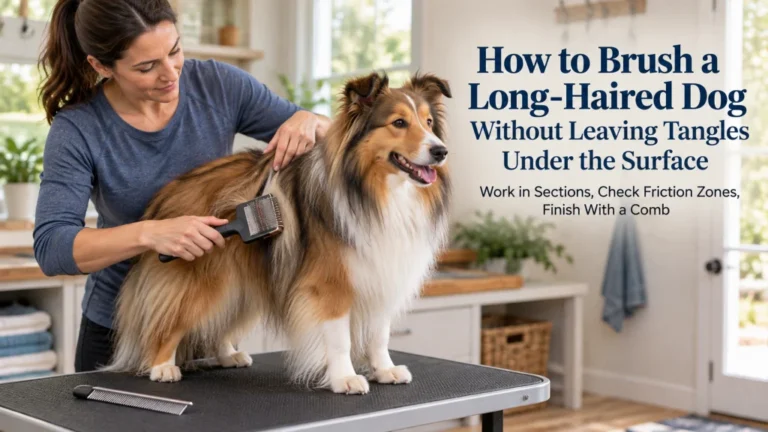
Long hair can lie neatly over a tangle, which is why brushing only the visible surface creates a false sense of completion. Separate the coat into manageable sections so you can see where the brush enters and whether it reaches through the length without dragging across the skin. Begin where the hair is easier to separate, then move gradually into denser or more friction prone areas rather than attacking the hardest knot first. Holding the coat near the skin can also reduce pulling when you work through a mild tangle farther down the hair shaft.
- Separate one small section so you can see the coat depth you are working through.
- Brush that section gently until the hair separates without repeated catching.
- Follow with a comb check through the same section rather than judging the result by surface smoothness.
- If the comb meets resistance, reduce the section size, brush again gently, and reassess instead of forcing the comb through.
- If resistance is tight, painful, or close to the skin, stop ordinary home detangling and move to the appropriate professional handoff.
The routine for how to brush a long haired dog uses sectioning because the method itself solves a visibility problem. The brush and comb have different jobs: the brush separates and loosens the coat, while the comb checks whether hidden resistance remains. Passing the comb comfortably through the worked section is a more useful finish check than a smooth top layer alone. The goal is hair that separates comfortably through the depth that the dog can safely tolerate at home.
Reach the undercoat without scraping skin or turning brushing into aggressive deshedding
A double coat has an outer layer and a softer undercoat, so a brush that only smooths the top can leave loose or tangled material beneath it. The answer is not to press harder with a slicker or rake. Instead, separate the coat enough to see what the tool is contacting, use light controlled strokes, and choose a tool whose teeth or pins suit the coat depth. If the tool catches abruptly or the skin moves sharply under each pass, the setup needs adjustment.
| Coat layer | What you are checking | What should change your approach |
|---|---|---|
| Topcoat | Whether the outer hairs separate cleanly and surface debris or loose hair is being lifted without harsh skin contact | A smooth surface does not prove the lower coat is clear |
| Undercoat | Whether the lower layer can be reached gently with a coat appropriate tool and checked without scraping the skin | Repeated catching, sharp skin movement, or dense resistance means reassess the tool, section size, or grooming goal |
The guide to how to brush a double coated dog focuses on reaching the lower layer without confusing ordinary maintenance with heavy shedding removal. When loose undercoat becomes the main household problem, the separate guide to dog shedding is the better place to handle that system. Brushing here is about keeping the coat clear and comfortable, not chasing the maximum amount of hair from the dog in one session. That distinction helps prevent a useful grooming tool from becoming a reason to overwork the same patch of skin.
Use sectioning and a comb check on curly coats that hide tangles close to the skin
Curly coats can look fluffy and even while small tangles are forming where the hair bends and compresses near the skin. Surface brushing may lift the outer curl without proving that the lower coat is clear, so sectioning becomes important even when the dog looks freshly brushed. Work on a small area, keep the brush angle controlled, and avoid scraping back and forth over the same skin. A comb can then be used as a check rather than as a tool for ripping through resistance.
The routine for how to brush a curly coated dog explains how the brush and comb can work as a pair. The brush separates and loosens the coat, while the comb tells you whether hidden resistance remains. If the comb repeatedly stops close to the skin, reduce the section size and reassess whether the tangle is still mild enough for comfortable home care. A neat surface is useful, but the real test is whether the coat underneath can be checked without pulling or forcing.
Use line brushing when coat depth makes surface brushing unreliable
Line brushing is useful when you need a repeatable way to expose the lower part of a dense or longer coat. Instead of brushing across the whole body at once, part a narrow line of coat, brush the exposed section, and then release another small layer over it. That makes it easier to see whether the tool is reaching the intended depth and reduces the temptation to press harder just because the coat is thick. The technique should still feel controlled and gentle, not like scraping the brush along the skin.
The step by step guide to line brushing a dog is most useful when ordinary surface passes keep missing hidden tangles. It is not a requirement for every coat, and a simple routine is better when the coat does not need section by section work. Use the method because coat depth creates a visibility problem, not because a more complicated routine sounds more thorough. If sectioning exposes tight mats, sore skin, or an area the dog cannot comfortably tolerate, stop and move to the appropriate next step.
Treat mats as a stop and assess problem rather than something to rip through
A small loose tangle and a tight mat against the skin are not the same home grooming problem. Mild tangles may separate with patient sectioning, gentle brushing, and a comb check, but dense mats can pull on the skin and hide irritation underneath. Do not respond by adding more force, repeatedly scraping the same spot, or cutting close to the skin with household scissors. Dog skin can be pulled up into the mat, which makes an apparently simple cut much riskier than it looks from the outside.
- Hand off to a groomer when a mat is tight against the skin and cannot be separated with gentle owner level brushing.
- Hand off when matting is extensive enough that working section by section would require prolonged pulling or repeated passes over the same skin.
- Stop when the dog shows pain around the matted area or when the mat sits close to ears, feet, groin, tail, or other delicate anatomy.
- Prioritize veterinary assessment when matting is associated with a wound, significant redness, discharge, unusual hair loss, or another notable skin change.
- Do not use household scissors close to a tight mat in an attempt to avoid professional help.
The guide on how to remove mats from dog hair helps separate mild owner level work from situations that should be handed off. When the coat problem has moved beyond routine brushing but the main issue is grooming access, the guide on how to choose a dog groomer can help with that next decision. A groomer handoff and a veterinary handoff are not interchangeable, because skin injury, unusual hair loss, or other significant skin change moves the problem outside ordinary coat maintenance. The goal is to stop before a difficult mat becomes a reason to force a risky home grooming attempt.
Move brushing resistance into cooperative care training instead of forcing longer sessions
Brushing resistance can come from many things, including unfamiliar handling, tool pressure, a snagged tangle, sensitive body areas, or a dog that has learned that grooming predicts restraint. The grooming response should be to check the physical setup first rather than assuming the dog simply needs to tolerate more. Make sure the tool is not catching, the skin is not irritated, and the coat is not hiding a painful mat. If the dog remains worried about handling after those ordinary coat issues are addressed, longer forced sessions are unlikely to improve the experience.
That is where brushing and training separate into different jobs. The guide to cooperative care dog training owns the process of teaching calmer participation in handling rather than turning this brushing guide into a behavior program. For the grooming session itself, keep the task small enough that you can maintain gentle contact and stop before handling becomes a struggle. A technically correct brush does not make forcing a fearful dog an appropriate grooming method.
Final Thoughts: good brushing reaches the coat depth that matters
Good brushing is not measured by how many passes you make or how large the tool kit becomes. It is measured by whether the coat is being maintained at the depth that matters for that dog, with a tool and technique that do not rely on force. Short coats may need a simple surface routine, while long, dense, curly, or double coats can require sectioning and a comb check to reveal what the top layer hides. Frequency should then follow how quickly tangles, loose coat, and friction return under the dog’s actual lifestyle.
Keep the decision practical: identify the coat, identify the job, choose the smallest useful tool set, and verify the result instead of trusting appearance alone. Mild tangles can often be managed early, but tight mats, painful areas, abnormal skin, or unusual hair loss change the problem and the appropriate next step. If handling fear is the main obstacle, move that work into cooperative care rather than turning brushing into restraint practice. The best routine is the one that keeps the coat clear while respecting the dog’s skin, comfort, and the limits of ordinary home grooming.
Explore more dog brushing topics
Use these focused guides when one part of brushing needs more detail than the general routine above. Start with the problem you are actually trying to solve, such as tool choice, frequency, coat depth, or a mat that has already formed. A short smooth coat does not need the same process as a dense double coat or a curly coat that hides resistance near the skin. Choosing the narrowest relevant guide keeps the routine practical instead of adding techniques that do not match the coat in front of you.
| Topic | What you’ll find |
|---|---|
| Types of dog brushes | How common brush and comb designs differ by coat and grooming job. |
| How often should you brush your dog | How coat, friction, lifestyle, and changing coat conditions affect frequency. |
| How to brush a short haired dog | A simple routine for loose hair, surface debris, and comfortable skin contact. |
| How to brush a long haired dog | Sectioning, tangle checks, and coat depth for longer hair. |
| How to brush a double coated dog | How to reach the lower coat without using excessive pressure. |
| How to brush a curly coated dog | Sectioning and comb checks for curls that can hide tangles near the skin. |
| Line brushing a dog | A structured method for coats where surface brushing does not show the full depth. |
| How to remove mats from dog hair | How to distinguish mild tangles from mats that need professional help. |
Choose the guide that matches the specific coat problem instead of adding more steps to a routine that does not need them. If the issue is mainly loose undercoat and household shedding, move into the shedding system rather than turning every brushing session into heavy coat removal. If fear or handling resistance is the main obstacle, treat that as a cooperative care problem instead of extending the grooming session. Keeping those jobs separate makes the next step clearer and reduces the chance of solving the wrong problem with a more complicated brushing routine.
FAQs
🐕 What is the easiest way to tell whether I brushed through the full coat?
Separate a small section and check whether the tool reaches the lower layer comfortably. On coats that hide tangles, follow the brush with a comb and treat resistance as a sign to work a smaller section rather than forcing through it.
🪮 Should I use a slicker brush on every dog?
No. Tool choice depends on coat structure and the job you need to do, and a slicker can be unnecessary for a simple smooth coat routine. When you do use one, keep pressure light and make sure the pins are working through coat rather than scraping skin.
🐾 Why does my dog still get mats even though I brush regularly?
The brush may be smoothing the surface without clearing the lower coat, or friction zones may be tangling faster than the rest of the body. Check behind the ears, under the legs, around harness contact, and anywhere the coat repeatedly rubs or folds.
🧴 Should I brush harder when the coat is dense?
No. Dense coat calls for better sectioning and an appropriate tool, not extra pressure against the skin. If the tool cannot reach the needed layer comfortably, change the technique or tool rather than pushing harder.
✋ When should I stop trying to remove a mat at home?
Stop when a mat is tight, extensive, painful, close to delicate anatomy, or difficult to separate without pulling on skin. Do not cut tight mats close to the skin with household scissors, and get professional help when the coat cannot be handled comfortably.
🏠 What if my dog will not stay still for brushing?
First check for snags, mats, irritated skin, or a tool that is causing discomfort. If the main problem is fear or handling resistance, use a cooperative care training approach rather than extending or forcing the grooming session.
References and Sources
- AKC guide to dog brushes: Supports brush functions, coat matching, and the need for light pressure with slicker brushes.
- AKC home grooming guide: Supports gentle brushing through the coat and checking for mats, debris, cuts, and other skin or coat concerns.
- AKC double coat grooming guide: Supports the distinction between topcoat and undercoat and coat specific maintenance.
- PetMD matting guidance: Supports the risks of tight mats and the warning against cutting mats out with household scissors.