A double coat needs maintenance at two levels: the visible topcoat and the softer undercoat beneath it. The practical goal is to reach loose and packed hair without scraping the skin, pulling through resistance, or treating every brushing session like an aggressive deshedding session. A light brush pass followed by a comb check makes it easier to tell whether you actually reached the undercoat. Tool depth, coat density, shedding level, moisture, and the dog’s tolerance should guide how much work each area needs.
Start by checking the coat below the surface
If you are learning how to brush a double-coated dog, do not judge the result only by how smooth the guard hairs look. Part the coat with your fingers in several areas and look at what is happening underneath, especially where the coat feels dense or slow to separate. The undercoat should not feel like a solid layer that your fingers cannot move through. For broader coat care decisions, use the site’s practical dog grooming guidance to keep brushing, bathing, trimming, and professional care in the right lanes.
Routine brushing is about maintaining access through both coat layers with the least force that works. A surface pass can leave compacted undercoat behind, while an overly aggressive tool can turn routine maintenance into unnecessary coat removal. The site’s dog brushing guide covers the general brushing process, while this page focuses on what changes when there is a dense second layer under the topcoat. That distinction matters because a double coat can look tidy from several feet away and still need attention close to the skin.
Identify the topcoat and undercoat before choosing the tool sequence
A double coat combines a protective outer layer with a softer, denser layer underneath. The visible topcoat may feel smoother, coarser, or longer, while the undercoat usually feels finer and more compressed close to the skin. Coat length and density vary widely, so two double-coated dogs may need different brush sizes, pin lengths, and section widths. Before you choose a sequence, part the coat in more than one place and note how easily you can see or feel through the undercoat.
| Coat layer | What you are checking | What a useful check looks like |
|---|---|---|
| Topcoat | Whether the visible guard hairs separate cleanly instead of hiding resistance underneath | The outer coat can be lifted or parted without needing hard brush pressure |
| Undercoat | Whether dense hair close to the skin is loose enough to part and comb through | You can reach the base of the coat gently and identify resistance before pulling through it |
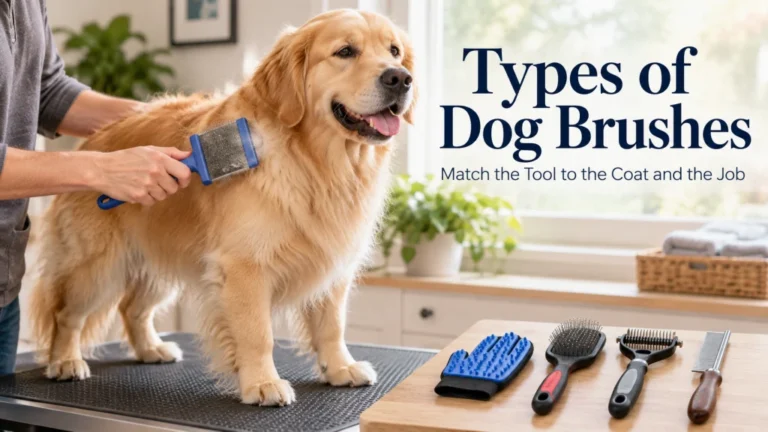
The goal is not to make every coat look or feel the same. A short double coat may let a suitable brush reach the undercoat with very little sectioning, while a long or very dense coat may need smaller sections so the tool can move without dragging. Areas with feathering, thick rear coat, a dense neck ruff, or friction from a collar can also behave differently from the back. If you are still deciding which tool type fits the coat in front of you, compare the main types of dog brushes by coat reach and intended job rather than choosing by marketing language alone.
Use a suitable brush with light pressure through the coat
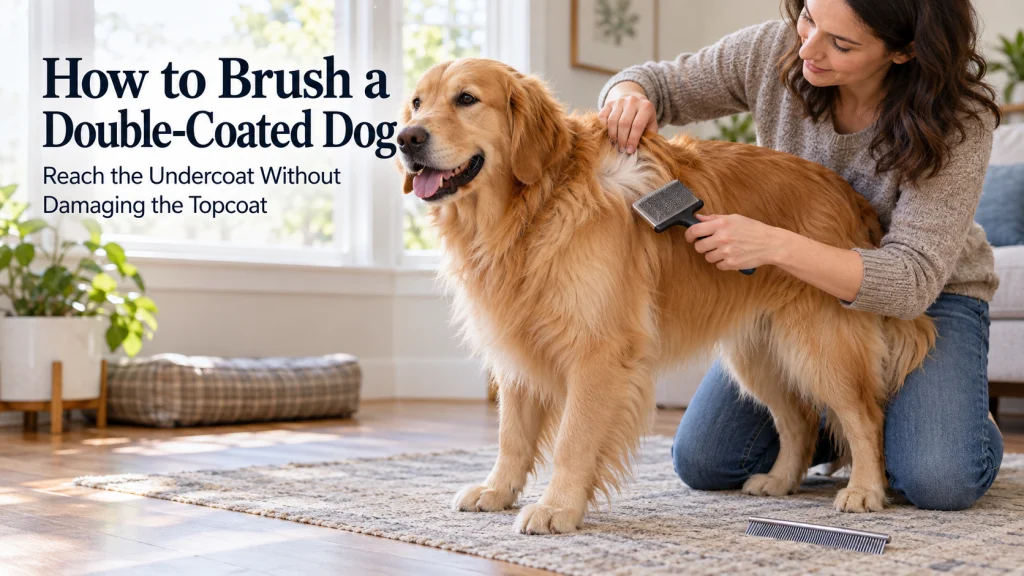
A slicker brush is commonly useful for double coats because its fine pins can collect loose hair from a dense coat, but pressure matters. The brush should work through hair rather than scrape across skin. Use short, controlled strokes on a manageable section, then lift the coat and repeat where needed instead of pressing harder to force the pins deeper. If the dog flinches, twists away, or the skin becomes pink from repeated contact, stop and reassess your pressure, tool size, and the amount of resistance in that section.
Brush reach should come from choosing a tool that matches the coat, not from leaning your body weight into the handle. Work in the direction that lets the coat separate without yanking, and use your free hand to support or part longer hair when that improves access. Dense coats often respond better to several light passes than one heavy pass. The useful sign is steady movement through the coat with loose hair coming free, not the largest possible pile of hair after one section.
Follow with a comb to check for packed hair close to the skin
A comb is useful because it can reveal resistance that a surface brush pass did not solve. After brushing a section, guide a suitable comb through the coat from the outer layer toward the base without driving it into the skin. If the comb glides through with light, even resistance, that section is probably clear enough for routine maintenance. If it repeatedly catches in the same place, stop pulling and inspect the coat with your fingers before doing more work.
Think of the comb as a check tool rather than a lever for forcing through compacted hair. Small snags can sometimes be separated with your fingers and then brushed again gently, but a tight felted area close to the skin is a different problem. Pulling harder can make grooming painful and can stress the hair and skin without actually solving the packed layer. A useful routine is brush, part, comb, and recheck, with each step telling you whether more home brushing is reasonable.
- Part the coat so you can see how densely the undercoat is packed.
- Brush the section with light pressure and controlled strokes.
- Use a comb to check whether resistance remains close to the skin.
- Stop forcing the section if the comb repeatedly catches or the dog becomes uncomfortable.
That sequence also prevents one tool from doing every job. A brush can loosen and collect hair, while the comb can show whether a section still has hidden resistance. When the check keeps failing despite gentle work, the next step is not automatically more pressure. It may be a sign that the coat needs a different tool, a smaller section, or professional help.
Match rake or comb depth to the coat instead of forcing short pins through dense fur
Undercoat rakes are designed to reach beneath the outer coat, but the pin length still has to match the dog’s coat length and density. Pins that are too short may skim above the layer you are trying to maintain, which can tempt you to press harder even though the tool still does not have enough reach. A rake that is too aggressive for the coat or used with excessive pressure can also make routine grooming uncomfortable. Choose reach first, then use the lightest pressure that lets the tool move through loose undercoat.
| What you notice | What it may mean about tool depth | What to change first |
|---|---|---|
| The tool moves only through the outer coat while the undercoat still feels packed | The pins or tines may not reach deeply enough for that section | Use a tool with suitable reach or work in a smaller section instead of pressing harder |
| The tool reaches the undercoat but drags sharply or makes the dog react | The tool may be too aggressive, the section may be too large, or resistance may be too tight for routine brushing | Reduce pressure and section size, then stop if the resistance does not ease |
| The tool reaches the base with light pressure and the comb check passes afterward | The reach is appropriate for that coat area | Keep the same light technique rather than escalating tool intensity |
Coat density can change across the same dog, so one fixed motion may not suit every area. The shoulder, back, rear coat, tail base, and areas under routine gear may give very different resistance. Shorten your stroke and reduce the amount of coat in each pass when the tool starts to drag. If you cannot reach the undercoat without pressing toward the skin, change the tool or technique rather than treating more force as the solution.
Increase loose undercoat work during coat blow without turning every session into deshedding
Many double-coated dogs release more undercoat during heavier shedding periods, so a routine that works during a quieter part of the year may suddenly leave loose hair behind. During those periods, you may need to brush more often or add a suitable coat rake for loose undercoat. That does not mean the most aggressive shedding tool should become the default for every session. The separate guide to managing dog shedding is the better place to handle seasonal shedding intensity as the primary job.
Use the coat in front of you to decide when routine brushing is enough. If a light brush and comb remove loose hair and the coat stays easy to part, there is little reason to escalate the session. If tufts release easily from the undercoat and the comb keeps meeting loose material, a little more undercoat work may be appropriate. Stop once the loose layer is managed rather than continuing simply because hair is still coming off the dog.
| Coat condition | Routine brushing response | When to change the approach |
|---|---|---|
| Topcoat smooth, undercoat easy to part | Light brush pass followed by a comb check | Change only if hidden resistance appears |
| Loose undercoat releasing easily | Increase brushing attention and use a suitable rake if needed | Route heavier seasonal shedding work to a shedding-focused routine |
| Dense resistance that does not loosen gently | Stop forcing the tool through the area | Use a smaller section, reassess the tool, or seek professional help |
The table is a reminder that routine brushing and heavy shedding management are related but not identical jobs. A dog can need more loose undercoat removal for a period without needing aggressive coat reduction every time a brush comes out. The useful decision is based on resistance, loose hair, and how clearly you can access the undercoat. That keeps the routine focused on maintenance rather than chasing a hair removal target.
Check humid or wet-prone areas where packed coat can hold moisture
Dense undercoat can make it harder to notice that an area near the skin is staying damp after rain, bathing, swimming, or routine outdoor activity. Pay extra attention to places where the coat is thick, folded, compressed by gear, or slow to separate with your fingers. The point is not to diagnose a skin problem during brushing, but to notice when the coat is no longer drying or moving normally. A packed layer that stays damp is a maintenance problem worth addressing before you keep brushing over the surface.
After the dog is dry, part the coat and check whether air can move through the section and whether the comb can pass without repeated snagging. If the skin looks irritated, the dog is painful, or the coat smells unusual, routine brushing is no longer the whole question and veterinary guidance may be appropriate. If the skin looks normal but the coat is tightly packed, a professional groomer can assess whether it can be worked out comfortably. Do not respond to a wet, compacted area by scraping harder with a rake, because more force does not improve drying access.
Do not shave a double coat as routine shedding control
Shaving is not a routine substitute for brushing a double coat. Removing the outer coat changes the protective layer over the skin and does not solve the basic maintenance problem of managing loose undercoat appropriately. Coat regrowth can also be uneven because the two hair layers do not necessarily return at the same rate. If shedding is the frustration, adjust brushing frequency and undercoat management instead of treating clipping close to the skin as the default answer.
There are situations where clipping may become part of professional care, such as severe matting that cannot be removed comfortably or a medical procedure directed by a veterinarian. Those exceptions are different from shaving a healthy double coat for convenience or seasonal shedding. The owner-level decision is simple: preserve the topcoat during normal maintenance and get help before tight matting turns brushing into a painful tug of war. That boundary protects both the coat and the dog’s tolerance for future grooming.
Warning: Do not use routine shaving as a shortcut for shedding control on a healthy double coat. When coat condition is too packed or matted for gentle home brushing, move the problem to professional care instead of escalating force.
Get professional help when the undercoat is packed tightly or the skin cannot dry normally
Home brushing should stop being the default when you cannot separate the coat without pulling, the comb cannot pass through a section after gentle work, or the dog is clearly uncomfortable. Tight packed coat can sit close to the skin, which makes it difficult to judge what you are pulling on and how much force is being transferred to the skin. Household scissors are especially risky around tight mats because skin can be drawn into the same area as the hair. A groomer can assess whether the coat can be saved comfortably, needs more specialized removal, or requires clipping as the least stressful option.
Choose a professional based on how clearly they explain coat condition, handling, and the limits of what can be done comfortably in one session. The guide to choosing a dog groomer can help you evaluate that handoff without turning this page into a professional grooming tutorial. If you also notice sore skin, bald patches, unusual hair loss, or a sudden change in coat condition, veterinary input may be appropriate because brushing alone cannot determine the cause. The goal of a good handoff is not to preserve every hair at any cost, but to restore manageable coat access without making the dog endure unnecessary force.
Final thoughts: maintain both coat layers without sacrificing the topcoat
Good double coat brushing is less about removing the maximum amount of hair and more about maintaining clean access through both layers. Part the coat, use a suitable brush with light pressure, and let a comb tell you whether resistance remains near the skin. Match tool depth to coat density, and increase loose undercoat work only when the coat is actually releasing more hair. That approach preserves the topcoat while keeping routine maintenance useful rather than aggressive.
When a section will not loosen gently, stop treating persistence as a grooming skill. Recheck the tool, reduce the section size, or move the problem to a professional groomer when the coat is tightly packed. Skin irritation, unusual hair loss, or a sudden coat change belongs outside a routine brushing article and may need veterinary evaluation. The best routine is the one that keeps the coat easy to part, comfortable to brush, and manageable before force becomes necessary.
FAQs
🐕 How often should I brush a double-coated dog?
Use coat condition and shedding level rather than one rigid schedule. Many double-coated dogs need consistent routine brushing, with more frequent work when loose undercoat is releasing heavily.
🪮 How do I know if I am reaching the undercoat?
Part the coat and check whether your tool is moving through the dense layer beneath the guard hairs. A comb should pass through the finished section with light, even resistance instead of repeatedly catching near the skin.
🐾 Should I use an undercoat rake every time I brush?
Not automatically. Use a rake when its depth and purpose match the coat in front of you, especially when loose undercoat needs more attention, and avoid making an aggressive undercoat pass the default for every session.
✂️ Should I shave a double coat to reduce shedding?
No, not as routine shedding control. Manage loose undercoat with appropriate brushing, and let a professional decide whether clipping is necessary when severe matting prevents comfortable coat maintenance.
🌧️ What should I check after a double coat gets wet?
Make sure dense areas dry normally and can still be parted once the dog is dry. If the coat stays packed, the skin looks irritated, or the dog seems painful, stop treating the issue as ordinary brushing.
🧑🔧 When is a professional groomer the better choice?
Get help when you cannot separate the coat without pulling, a comb cannot pass after gentle brushing, or the dog is becoming distressed. Professional care is also the better route for tight mats and packed coat that cannot be worked through comfortably at home.
References and sources
- AKC double coat grooming guidance: Supports the two layer coat explanation, brush and comb maintenance, professional handoff, and the warning against routine shaving.
- AKC dog brush guidance: Supports light slicker pressure, undercoat rake use, and matching rake pin length to coat length.
- AKC shedding guidance: Supports increasing brushing attention during heavier shedding periods and using tools that reach loose undercoat.
- AKC shaving guidance: Supports preserving the protective double coat instead of shaving it as routine heat or shedding management.