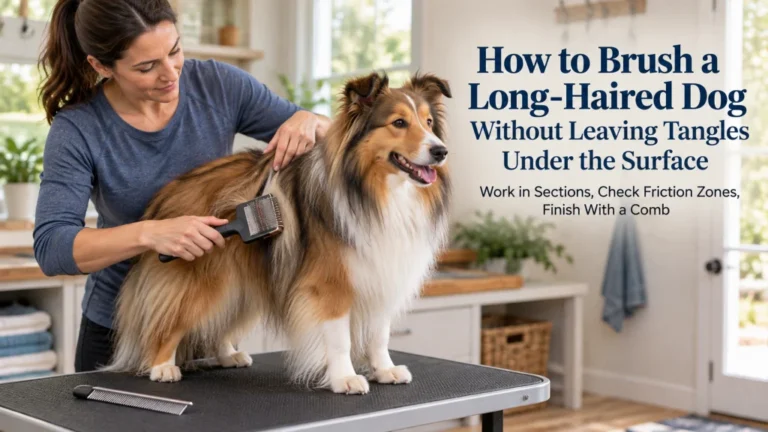
Brushing frequency should follow the coat in front of you, not a universal calendar. Short, smooth coats may stay comfortable with a wider interval, while long, dense, or curly coats often need much closer attention because tangles and trapped loose hair can build below the surface. Shedding, moisture, outdoor activity, collar and harness friction, and coat length can all shorten the interval that works. The best schedule is the longest practical interval that still leaves the coat clear, comfortable, and easy to comb before the next session.

Judge the interval by the coat before the next session
How often should you brush your dog? Start by asking what the coat looks and feels like just before the next planned session, because that is where an interval proves whether it works. A dog that still has a loose, clear coat may not need a shorter interval just because another owner brushes more often. A dog that already has small tangles, packed loose hair, or debris before the next session is showing that the current interval is too long. The calendar is only a reminder, while the coat is the feedback.
This article focuses on routine frequency rather than the brushing technique itself. If the motion, sectioning, tool contact, or order of brushing is the problem, use the dog brushing guide for the actual brushing process, and use the broader dog grooming routine when brushing is only one part of coat and hygiene care. Once the technique is sound, adjust the interval until loose hair and early tangles are being removed before they become harder to manage. That keeps frequency tied to a real maintenance result instead of a rule that may not fit the dog.
| Decision check | If yes | If no |
|---|---|---|
| Are small tangles, packed loose hair, or debris already present before the next planned session? | Move the next session closer and check whether the problem appears earlier in one specific zone. | Keep the current interval and continue to the next check. |
| Does a comb still catch below the surface after brushing? | Check technique and sectioning first. If technique is sound and the resistance keeps returning, shorten the interval. | The interval is probably reaching the coat before hidden tangles establish. |
| Did shedding, wet weather, outdoor activity, coat length, or gear friction increase? | Add an earlier coat check and shorten the interval only if buildup or tangling actually returns sooner. | Keep the baseline schedule unless another coat change appears. |
| Is there abnormal hair loss, redness, soreness, or a sudden painful response? | Stop treating frequency as the main problem and seek veterinary guidance. | Continue routine coat maintenance within the schedule that is working. |
Use the decision table in that order rather than jumping straight to more brushing. It separates a frequency problem from a technique problem, a temporary lifestyle change, and a coat or skin change that belongs outside routine grooming. That keeps the schedule responsive without turning every new tangle into a permanent increase in workload. The goal is a repeatable decision, not obedience to a calendar.
Start with coat length, density, and texture rather than breed name alone
Breed can offer a clue, but the actual coat is what you have to maintain. Two dogs of the same breed can carry different coat length, density, texture, and grooming history, especially when one is clipped shorter or has a fuller undercoat. Run your hands through the coat and notice whether it lies close to the body, separates into longer strands, holds a dense underlayer, or curls tightly enough to catch loose hair. Those physical features tell you how quickly debris, shed hair, and tangles can accumulate.
Density matters because a coat can look tidy from the outside while loose hair collects underneath. Texture matters because straight, silky, woolly, and curly hair do not move against neighboring hairs in the same way. Length matters because longer strands have more opportunity to cross, twist, and tighten around one another. That is why a useful dog brushing schedule begins with coat structure, then gets adjusted for the individual dog instead of being assigned from the breed label alone.
| Coat observation | Reasonable starting interval | What should change that starting point |
|---|---|---|
| Short and smooth | About once a week | Brush sooner when shedding or outdoor debris builds up faster than usual |
| Dense or double coat | About two or three times a week | Increase attention when loose undercoat packs quickly or shedding becomes heavy |
| Long or silky | About three or four times a week, with daily care reasonable when the coat tangles sooner | Use the first friction zone or comb resistance as the signal to shorten the interval |
| Curly or woolly | About twice a week to daily, depending on coat length and how quickly tangles return | Longer coat, trapped loose hair, moisture, and friction can move the schedule toward the frequent end |
These are starting intervals, not universal requirements. Published grooming guidance varies because hair length, undercoat, shedding, activity, and grooming technique can shift the workload even within the same broad coat group. Begin near the range that fits the coat, then use the first tangle, packed undercoat, or comb resistance as evidence for moving the next session closer. If the coat remains clear and comfortable, there is no reason to increase frequency just to match the most demanding end of the range.
Brush short coats often enough to clear loose hair and debris without unnecessary irritation
A short coat can create the impression that brushing barely matters because obvious tangles are uncommon. The practical goal is different: remove loose hair, lift dirt and outdoor debris, and notice skin changes while keeping contact gentle. If the coat still feels clean and loose when the next session arrives, there is little value in adding sessions simply to meet a fixed rule. More brushing is not automatically better when the coat is already maintained.
Dogs with short coats can still shed heavily, especially when coat turnover increases or activity brings more dust and debris into the hair. Use the skin and coat response as a limit, because repeated aggressive strokes or an unsuitable tool can turn a simple maintenance task into irritation. If you are deciding how to handle this coat type rather than just how often to schedule it, the guide to brushing a dog with a short coat covers the technique decision in more detail. Frequency should support that technique, not compensate for rough pressure or the wrong tool.
Increase frequency when long or curly coats begin tangling between sessions
Long and curly coats usually give you a clearer warning that the interval is stretching too far. Small tangles may appear behind the ears, around the legs, near the tail, or where the coat rubs against gear before the back and sides look untidy. If those tangles are already present every time you start brushing, shorten the interval enough that you reach them while they are still loose and easy to separate. Waiting until the coat looks messy from across the room is usually too late to judge preventive maintenance.
For long coats, the schedule also has to account for how much coat is currently being carried, because a shorter trim can change the workload even on the same dog. The guide to brushing a dog with a long coat is useful when the main challenge is reaching through length without skipping lower layers. Curly coats create another problem because shed hair may stay caught in the coat rather than falling away, so the guide to brushing a curly coated dog handles that technique separately. In both cases, increase frequency when the coat is tangling between sessions, not merely because the breed is usually described as high maintenance.
Increase undercoat attention during seasonal shedding without making every session aggressive
A schedule that works during a quieter part of the coat cycle may stop working when loose undercoat increases. The useful adjustment is usually more frequent gentle removal of loose hair, not turning every brushing session into an intense attempt to strip out as much coat as possible. Watch how much loose undercoat returns between sessions and whether it begins packing in dense areas. If the coat clears easily and stays comfortable, the shorter interval is doing its job.
Seasonal shedding deserves its own decision because frequency and intensity are not the same thing. You can brush more often while still using controlled pressure and stopping when you are no longer removing loose material easily. The broader guide to dog shedding covers the seasonal coat change itself, while this article only uses shedding as a reason to revisit the routine interval. When the heavy shedding period eases, test whether you can widen the interval again rather than keeping the most demanding schedule forever.
| What changed | Schedule adjustment | What not to assume |
|---|---|---|
| Loose undercoat returns quickly | Check and brush more often with gentle technique | More pressure is not automatically more effective |
| Shedding settles down | Test a wider interval and monitor the coat | The peak shedding schedule does not have to become permanent |
| Hair loss looks patchy or abnormal | Move out of routine grooming and seek veterinary guidance | Extra brushing is not a diagnosis or treatment |
The seasonal table is a reminder to change only what the coat is asking you to change. It keeps frequency responsive while preventing a normal shedding adjustment from becoming unnecessarily harsh grooming. A temporary increase in loose hair does not mean every pass needs more force or a more aggressive tool. The useful question is whether gentle, regular removal is keeping the undercoat from packing before the next session.
Check friction zones more often than the easy back and sides
The easiest parts of a dog to brush are often the least useful places for judging whether the schedule is adequate. Friction can speed up tangling where collars, harness straps, legs, ears, bedding, or normal movement repeatedly rub the coat. A dog may therefore look smooth across the back while a small knot is tightening in the armpit or behind an ear. Frequency needs to protect those harder areas, not just maintain the visible top line.
Build a quick friction check into the routine even when a full brushing session is not due. Feel behind the ears, under collar and harness contact points, around the front legs, along feathering, and anywhere the coat folds or rubs during movement. If one zone keeps tangling sooner than the rest of the coat, that zone may need a shorter local check interval while the rest of the body stays on the existing routine. This is often more efficient than brushing the entire dog more often just because one small area is failing first.
Key point: The first place that tangles should set the inspection interval for that area, even if the rest of the coat still looks easy to maintain. A small friction zone can fail before the visible coat gives you any warning. Check that area directly instead of assuming the whole dog needs the same increase in brushing. Local inspection can solve the problem with less unnecessary work.
Surface appearance is not enough when friction zones fail first. Record the area that repeatedly tangles and inspect it earlier on the next cycle. Keep that extra attention local unless the rest of the coat also starts deteriorating. This avoids adding unnecessary full coat sessions.
Recheck the schedule after swimming, rain, mud, gear use, or a longer coat
Coat type gives you a baseline, but lifestyle can change the maintenance load quickly. Water, mud, plant debris, and repeated gear contact can cause strands to cling, twist, or collect material that was not present during a quieter routine. A dog that swims, runs through brush, wears a harness for long outings, or carries a longer coat may need closer checks even if the underlying coat type has not changed. Treat those changes as a reason to reassess rather than forcing the old interval to keep working.
The adjustment does not always mean a full brushing session after every outing. Sometimes the useful response is to dry the coat thoroughly, remove obvious debris, and inspect the areas that usually tangle first. If those quick checks repeatedly find early tangles or packed loose hair, shorten the regular interval until the coat stays clear again. When activity, wet weather, or coat length changes back, widen the interval only after the coat shows that it can remain comfortable between sessions.
| Lifestyle factor | Question to ask | Possible response |
|---|---|---|
| Swimming or rain | Does the coat knot or stay damp in dense areas? | Dry fully and check areas prone to tangles sooner |
| Mud or outdoor debris | Does debris remain caught below the surface? | Remove debris and shorten the interval if buildup returns |
| Frequent collar or harness use | Do contact areas tangle before the rest of the coat? | Inspect those zones more often |
| Longer current coat | Are tangles appearing sooner than they did after a shorter trim? | Increase maintenance until the longer coat stays clear |
Use the comb check to tell whether the current interval is preventing hidden tangles
A brush can make the surface look finished while leaving resistance deeper in a long, dense, or curly coat. That is why the end point for a frequency decision should be more than appearance. After brushing, use an appropriate comb in the areas that are safe and practical to check, and notice whether it passes through the coat without repeatedly catching on hidden knots. If it does not, the problem may be technique, sectioning, or an interval that allows tangles to form before you reach them.
When the coat needs to be worked in small sections to reach lower layers, the guide to line brushing a dog explains that method separately. For frequency, the important lesson is that a schedule only succeeds if the full coat stays maintainable between sessions. Do not shorten the interval automatically until you have checked that the brushing itself is reaching the coat depth that matters. Once technique is sound, recurring hidden tangles are a strong reason to move the next session closer.
Note: Do not force a comb through a tight or painful mat. A difficult mat can sit close to the skin, and safe removal may require a professional groomer or veterinarian depending on the location and skin condition. Pulling harder does not turn a tight mat into a useful frequency check. Stop when the coat cannot be worked safely and move the problem to the appropriate level of care.
Build a brushing schedule from repeatable coat and lifestyle checks
A useful schedule should be easy to adjust when conditions change, so write down the few observations that actually affect maintenance. Start with coat length, density, texture, the areas that tangle first, current shedding level, and the activities that add moisture or debris. Then choose an interval that lets you reach the coat before knots, packed loose hair, or friction problems are established. After several sessions, keep the interval only if the coat is still clear when the next session begins.
This approach also prevents daily brushing from becoming a habit without a defined purpose. Some coats may benefit from very frequent attention, while others can stay comfortable with less, especially when the coat is short and the dog is not collecting much debris. The schedule should tighten when the coat repeatedly fails its check and loosen when the coat stays easy to maintain. That is a more useful answer to dog brushing frequency than treating one published number as a rule for every dog.
- Start with the coat based interval rather than the breed name alone.
- Check the first friction zone before deciding the whole coat needs more frequent brushing.
- Use comb resistance to separate a hidden tangle problem from a surface appearance problem.
- Reset the interval when shedding, moisture, activity, or coat length changes the maintenance load.
| Worksheet item | What to record | How it changes the next interval |
|---|---|---|
| Coat structure | Short, long, dense, double, curly, silky, or mixed texture | Sets the starting maintenance demand |
| First problem area | Where tangles, packed hair, or debris appear first | Sets the earliest inspection point |
| Shedding level | Stable, increasing, or easing | May shorten or widen the interval |
| Recent activity | Wet coat, mud, brush, gear friction, or ordinary indoor routine | Shows whether a temporary adjustment is needed |
| Comb result | Passes cleanly or catches below the surface | Confirms whether the interval and technique are working |
Keep the worksheet simple enough to use consistently. Record what changed, where the first problem appeared, and what the next coat check found. A repeating pattern is more useful than a complicated grooming log. Use that pattern to refine the interval without adding work that the coat does not need.
Seek veterinary advice when hair loss or skin change is abnormal instead of simply brushing more
Routine brushing can reveal changes that do not belong in a frequency decision. Patchy hair loss, new redness, sores, unusual scaling, persistent itching, marked tenderness, or a sudden coat change can point to a skin or health problem that brushing cannot diagnose. Adding more sessions may irritate uncomfortable skin and can delay the more useful next step. When the coat change looks abnormal for that dog, treat it as a veterinary question rather than a scheduling problem.
The same boundary applies when a dog suddenly resists brushing in an area that was previously comfortable. That reaction can have many causes, and the brushing schedule alone cannot tell you which one is responsible. Pause aggressive grooming over the affected area and seek appropriate veterinary guidance if the change is persistent, painful, or accompanied by visible skin or coat abnormalities. A good routine should help you notice these changes early, not encourage you to brush through them.
Final thoughts: use the longest interval that still keeps the coat comfortably maintained
The right brushing schedule is not the one that sounds most diligent. It is the one that removes loose hair and debris, prevents tangles from establishing, and leaves the skin comfortable without creating unnecessary work or irritation. Start with coat structure, then adjust for shedding, friction, moisture, outdoor activity, and current coat length. Let the condition of the coat before the next session tell you whether the interval is working.
Use the comb check when hidden tangles are a concern, and watch friction zones more closely than the easy back and sides. Change the interval only when those checks show that maintenance is slipping. If abnormal hair loss, skin change, or pain appears, routine frequency is no longer the main question. Move that concern to a veterinarian instead of simply brushing more.
Frequently asked questions
🐕 How often should I brush my dog?
There is no single interval that fits every dog. Start with coat length, density, texture, shedding level, activity, and friction areas, then shorten the interval if tangles, debris, or packed loose hair are already present before the next session.
🧴 Can I brush my dog too often?
Yes, especially if the tool, pressure, or technique irritates the skin or repeatedly works a coat that is already clear. More frequent brushing should solve a real maintenance need, not become a goal by itself.
🪮 Do long haired dogs need brushing more often?
Often they do because longer strands can tangle between sessions, but coat density, texture, current length, and activity still matter. Use hidden tangle checks and friction zones to decide whether the interval is short enough for the individual coat.
🌧️ Should I brush more often after rain or swimming?
Wetness can make some coats more prone to tangling, especially when they are long, dense, or curly. Dry the coat thoroughly, inspect the areas that usually tangle first, and shorten the regular interval only if those problems keep returning.
🧥 Does a harness change how often I should brush my dog?
It can change how often certain areas need checking because repeated rubbing may encourage tangles under straps or near moving edges. You may only need more frequent inspection of those contact zones rather than more full body sessions.
🩺 When should coat changes go to a veterinarian instead of a grooming routine?
Seek veterinary guidance when you notice abnormal hair loss, sores, marked redness, persistent itching, tenderness, or a sudden unexplained coat change. Those signs are not problems that should be managed simply by brushing more often.
References and sources
- AKC home grooming guidance: Supports the point that brushing frequency varies with coat type and lifestyle, with some long coats needing very frequent care.
- Petco coat frequency guide: Supports coat based starting intervals for short, double, curly, and long coats before individual adjustment.
- PetMD matting guidance: Supports the role of moisture, shedding, friction, coat length, and consistent grooming in mat prevention.
- VCA coat and skin guidance: Supports regular coat inspection and the boundary between routine grooming and abnormal coat or skin changes.