Getting a dog when children are part of the household is mainly a decision about adult responsibility, supervision capacity, and daily management. Children can participate in care, but the dog should never depend on a child’s consistency for essential needs or safe interactions. Readiness depends on the individual child, the adults, the home setup, and the dog being considered rather than on a single age or breed label. A workable plan gives the dog protected space, gives children clear rules, and gives adults a realistic way to supervise before the family commits.
Make adult responsibility the starting point
Getting a dog with kids works best when the adults assume from the start that they own the care plan. A child may sincerely promise to feed, walk, brush, and play with the dog, but school demands, illness, changing interests, and ordinary family disruptions can change what that child actually does. Before moving farther into the decision to bring a dog into the household, assign every essential responsibility to an adult who can complete it even when a child does not. That keeps the decision grounded in what the household can reliably provide rather than in a promise made during an exciting conversation.
The same logic belongs inside a broader practical dog ownership plan. Adults should know who will make sure the dog is fed, exercised, supervised, cleaned up after, taken for veterinary care, and managed around children. Children can still have meaningful jobs, and those jobs can grow as their judgment and consistency grow, but help should be treated as participation rather than the foundation of care. If the adults would resent doing the work when a child loses interest, that is a readiness problem to solve before choosing a dog.
Decide whether the adults want the dog too
A useful family discussion starts with a harder question than whether the children want a dog. Ask whether the adults would still choose the dog if every child chore had to be reassigned to an adult for a while. That thought experiment exposes the difference between a family decision and a child request that adults are merely agreeing to manage. If the answer is no, the household may need to revisit whether getting a dog is the right decision at all.
Adult commitment also matters when the dog creates work that children cannot safely or realistically own. Veterinary appointments, medication decisions, household expenses, training follow through, supervision, and handling unexpected problems remain adult responsibilities. A child can refill a water bowl or help with simple care under guidance, but the adult still checks that the task was completed correctly. The family should therefore judge readiness by the backup plan, not by the most optimistic version of everyone’s enthusiasm.
Treat child age as context, not a readiness guarantee
Age can change what a child understands, remembers, and physically manages, but it does not create a universal line between ready and not ready. Children at the same age can differ sharply in impulse control, comfort around animals, ability to follow instructions, and willingness to leave a dog alone when asked. The more useful question is whether the adults can match expectations to the child who actually lives in the home. That approach also avoids assuming that an older child can automatically supervise a younger child with the dog.
Look for observable behavior instead of a numeric score. Can the child follow a rule even when excited, stop touching when asked, accept that the dog may not want interaction, and tell an adult when something feels wrong? Can the adults repeat and enforce those rules without turning every interaction into an argument? If those pieces are not reliable yet, the answer may be stronger management, closer adult involvement, or waiting rather than pretending age alone solves the problem.
Check whether the child can follow calm, consistent rules
Readiness becomes easier to judge when the family converts vague advice such as “be gentle” into a few rules the child can actually follow. The child should be able to leave the dog alone while the dog is eating or sleeping, avoid taking toys or food away, keep faces away from the dog’s face, and stop an interaction when an adult asks. These are not tests the child passes once and never revisits. They are household expectations that adults continue to teach, model, and supervise.
Pay attention to what happens when excitement rises, because calm behavior in a quiet discussion does not guarantee calm behavior around a moving dog. A child who repeatedly chases, grabs, corners, climbs on, or ignores a request to give space needs more adult management than a child who can reliably disengage. The point is not to label the child as good or bad with animals. It is to decide how much supervision and separation the household would need to keep normal family activity manageable.
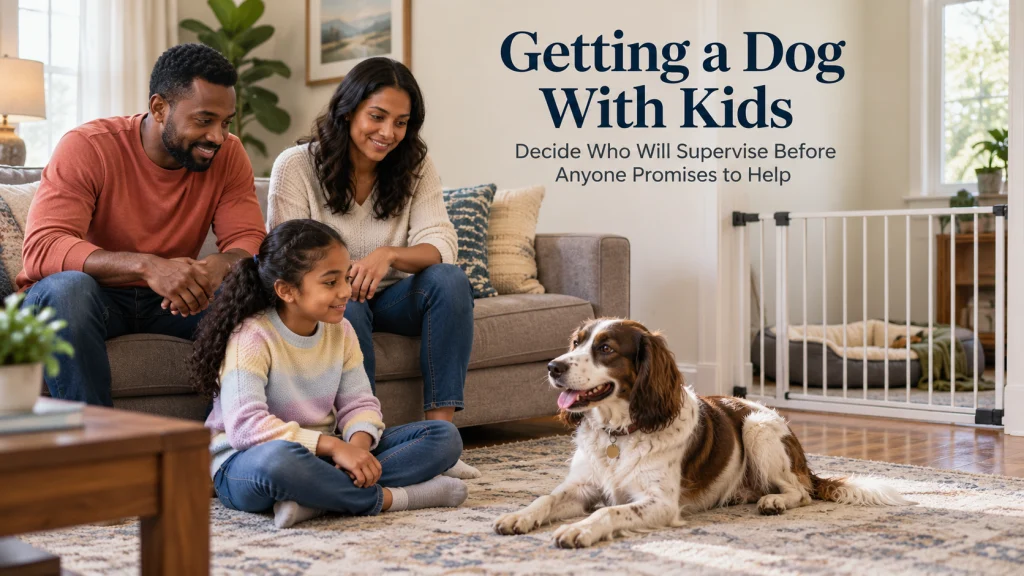
Plan active adult supervision for young children
Supervision should be treated as a real household task, not as a background assumption that someone will notice a problem. CDC guidance says young children should be supervised around dogs even when the dog is a familiar family pet, and HealthyChildren similarly advises against leaving a young child alone with an animal. That matters because familiarity does not remove the possibility of a bite or an interaction that becomes too intense. The family plan should therefore identify who is actively responsible when a child and dog share space.
Active supervision also needs a backup for moments when the adult cannot pay close attention. Cooking, helping another child, taking a call, carrying groceries, or dealing with a household problem can quickly turn “I am right here” into divided attention. In those moments, a gate, closed door, crate used appropriately, or another comfortable separation setup may be more realistic than trying to supervise two competing tasks. A good plan makes separation easy enough that adults will actually use it instead of relying on perfect attention.
- Identify which adult takes responsibility when children and the dog share a room.
- Choose a simple separation option for moments when attention is divided.
- Make sure children cannot freely enter the dog’s protected rest or eating area.
- Decide how visiting children will be managed instead of assuming household rules transfer automatically.
- Recheck the plan as the dog, children, and household routine change.
If this checklist feels difficult to support during ordinary household activity, that is useful information before adoption or purchase. The family may need a different setup, more adult availability, or a later start. Supervision capacity is not a statement about whether the family likes dogs enough. It is a practical constraint that should shape the decision.
Protect eating, sleeping, and retreat spaces
A dog needs places where normal child activity does not follow. Eating, sleeping, chewing a valued item, or choosing to move away should not become invitations for a child to approach, hug, climb on, or take something. CDC guidance specifically warns against disturbing a dog while eating or sleeping, and HealthyChildren gives similar advice for children around pets. The household setup should make those boundaries physically understandable, not depend only on repeated verbal reminders.
Choose the dog’s rest and feeding areas with traffic patterns in mind. A bed placed in the center of a busy play route may create more conflict than a protected area where the dog can settle without being stepped over or repeatedly approached. Gates, room boundaries, and access controlled by an adult can reduce the number of moments that depend on a child’s self control alone. The goal is not to isolate the dog from family life, but to make retreat an option that the family respects.
Give children realistic chores without making the dog depend on them
Children can contribute to dog care, but the adult should choose jobs that match the child’s judgment, strength, and consistency. A simple task such as helping prepare a measured meal, checking a water bowl with an adult, putting away safe toys, or joining a supervised walk can build participation without transferring full responsibility. More demanding tasks should stay with the adult when a mistake could leave the dog’s needs unmet or create a safety problem. The key is that every child task has an adult owner who checks or takes over when needed.
It helps to separate participation from accountability in writing before the dog arrives. The table below is not a universal chore chart, because children and dogs vary, but it shows how adults can keep responsibility where it belongs. Use it to decide who is accountable, then adjust the child’s role to what can be done calmly and consistently. If a task becomes a recurring conflict, the adult should absorb it rather than letting the dog’s care become leverage in a family argument.
| Care area | Child participation | Adult responsibility |
|---|---|---|
| Food and water | Help with a prepared routine when appropriate | Confirm the dog is fed correctly and has clean water |
| Exercise | Join suitable walks or play under adult direction | Provide enough safe activity for the individual dog |
| Training | Practice simple household cues with adult guidance | Keep methods consistent and manage situations the child cannot handle |
| Supervision | Follow rules and tell an adult when help is needed | Actively supervise interactions and separate when attention is unavailable |
| Health care | Participate only in age appropriate ways | Arrange veterinary care and make health decisions |
The table should make one thing obvious: chores can be shared, but accountability is not handed to the child. That distinction keeps the dog’s needs covered even when homework, activities, illness, or changing enthusiasm disrupt the plan. It also lets the child contribute without being assigned a job that exceeds current ability. The adult remains the safety net every time.
Check whether the household has capacity for child needs and dog needs
A family can have enough love for a dog and still lack enough usable attention for one right now. Map the parts of the routine when adults are already occupied with meals, homework, transportation, household chores, visitors, or a child’s emotional needs. Then add what a dog would require in those same periods, including exercise, feeding, bathroom access, training, cleanup, supervision, and quiet rest. The pressure points are more informative than a general statement that everyone is busy.
Consider a common scenario: one adult is preparing food while one child needs help and another wants to play with the dog. If no adult can actively supervise the interaction, the plan should already include a comfortable separation space rather than improvising after tension starts. If that kind of overlap happens throughout the household routine, the family may need to simplify the dog plan or change the timing of the decision. A workable plan should survive ordinary chaos, not only the calmest version of family life.
Carry household requirements into dog selection
Choosing a family dog with children in the home should start with household requirements, not a promise that a certain breed is automatically safe. Write down the conditions the adults need to manage well, such as the dog’s size and strength, activity needs, known behavior history, tolerance for normal household movement, grooming burden, and the amount of training the adults can support. Then use those requirements while choosing a dog that fits the household. A breed label or friendly first impression cannot guarantee future behavior.
Ask the shelter, rescue, breeder, or current caregiver what is actually known about the individual dog and what remains unknown. Separate documented history from prediction, especially when information about children is limited. If the household cannot safely manage a strong, highly active, easily overwhelmed, or poorly understood dog, that constraint should narrow the search rather than become a problem to solve after commitment. The right handoff from family readiness to dog selection is a list of requirements and limits, not a search for a “kid proof” dog.
Plan introductions with active adult supervision after the dog comes home
Planning before adoption should decide who will manage the first interactions, but it should not turn this article into a complete introduction protocol. Once the dog is actually coming home, follow a calm transition plan that gives the dog space, keeps children from crowding, and lets adults control the environment. The broader arrival process belongs in guidance on bringing home a new dog, where setup and transition can be handled in the right context. The family readiness decision simply needs to confirm that adults are prepared to lead that process.
Training expectations should be handled the same way. Children can participate in simple, supervised practice, but adults should maintain the household rules and avoid expecting a child to solve jumping, guarding, fear, or other difficult behavior alone. For everyday manners and basic skills, move into basic dog training guidance rather than expanding the child’s responsibility. If behavior raises a meaningful safety concern, general family training advice is no longer enough.
Know when health or safety questions need professional guidance
Some family questions should be resolved before the dog decision rather than discovered through trial and error. If a child has significant allergies, asthma concerns, or another health issue that may be affected by animal exposure, discuss that concern with the child’s appropriate health professional. If a dog under consideration has a known bite history, serious fear, or behavior that the household does not understand, do not treat a general readiness article as a safety assessment. Ask the organization or current caregiver for the documented history and seek qualified veterinary or behavior guidance when appropriate.
The same boundary applies when the adults disagree about the level of risk they can manage. A family should not pressure itself to proceed because the children are attached to an idea or to a particular dog. Uncertainty about health, prior bites, or serious behavior deserves a slower decision and better information. Delaying while those questions are clarified is a practical choice, not a failure to keep a promise.
Decide whether to proceed, change the plan, or delay
After working through responsibility, supervision, child behavior, household space, and routine, the family should be able to describe what would make dog ownership workable. Proceed when adults genuinely want the dog, essential care has adult ownership, supervision is realistic, the dog can have protected space, and selection requirements are clear. Change the plan when a manageable constraint can be solved through a better room setup, clearer adult roles, or a narrower dog search. Delay when the plan depends on a child becoming the primary caregiver or on adults providing attention they do not realistically have.
The strongest decision is the one the household can sustain after the excitement fades. A “not yet” answer can protect both the child and the future dog from a rushed match, while a well supported “yes” gives the family concrete responsibilities to carry into selection and arrival. Do not use a single age, breed stereotype, or child’s promise as the deciding factor. Use the actual household, the actual adults, and the requirements of the individual dog under consideration.
Final Thoughts: Choose the responsibility plan before the family dog
A child can be an enthusiastic and meaningful part of dog ownership, but the adult plan has to work without depending on that enthusiasm. Start with adult accountability, active supervision, protected dog spaces, realistic household rules, and a clear backup for moments when attention is divided. Those pieces tell you more about readiness than a breed list or a promise that a child will handle everything. They also give you practical requirements to use when evaluating an individual dog.
If the plan only works when every person behaves perfectly, it is too fragile. A stronger plan assumes that children get distracted, adults get busy, dogs need space, and routines change. Build around those normal conditions, then decide whether the household is ready to proceed, needs a different setup, or should wait. That is a more useful way to make the decision than asking children to prove they want a dog badly enough.
FAQs
🐾 Should we get a dog with kids if the children promise to help?
Only proceed if the adults are willing and able to own every essential care and supervision task. A child’s help can be valuable, but the dog’s needs should not depend on the child’s consistency.
👶 What changes when getting a dog with young children?
The household needs more deliberate adult supervision, easier separation options, and clear rules that protect eating, sleeping, and retreat spaces. The decision should reflect the individual child’s behavior and the adults’ ability to manage interactions, not a universal age rule.
🏠 Should the dog have a space children cannot enter freely?
Yes, a protected rest or retreat area can make household boundaries easier to manage. Adults should control access so the dog can eat, sleep, or move away without being followed or disturbed.
🦮 Can an older child be responsible for walking the dog alone?
Do not decide from age alone. The answer depends on the child’s judgment and physical ability, the dog’s size and behavior, the route, and the situations likely to occur, with an adult retaining responsibility for the dog’s care.
🧸 Is there a breed that is guaranteed to be safe with children?
No breed label can guarantee an individual dog’s behavior. Use household requirements, reliable history when available, individual fit, and realistic adult management instead of looking for a bite proof or kid proof breed.
🚪 What if we cannot supervise the dog and children all the time?
Plan a comfortable separation setup that adults can use whenever active supervision is unavailable. If the home cannot support either supervision or safe separation during normal routines, changing the setup or delaying the dog may be the better choice.
References and Sources
- CDC dog safety guidance: Supports supervision around young children, including familiar family dogs, and guidance about leaving dogs alone while eating or sleeping.
- HealthyChildren pet readiness guidance: Supports treating child development and individual maturity as factors rather than relying on one simple readiness assumption.
- HealthyChildren family pet safety guidance: Supports close supervision, respectful child behavior around pets, and avoiding disturbance while an animal is eating or sleeping.
- AVMA dog selection guidance: Supports adult responsibility for dog care, family involvement, and choosing a dog with the household’s needs and limitations in mind.