
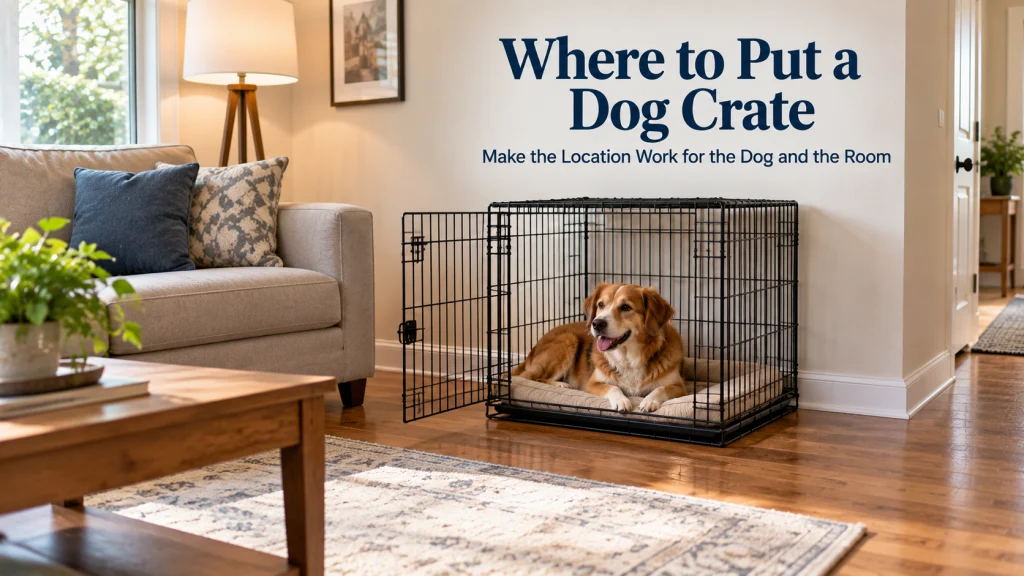
Where to put a dog crate depends on what the room is like during the times the dog is expected to rest there. A good location keeps the crate fully inside a comfortable indoor area, away from direct sun, strong heat or cooling sources, cords, door paths, and constant foot traffic. Bedroom, living room, and office placements can all work when they match the dog’s rest pattern and the household routine. The right choice is the location that stays practical when people are actually moving through the home.
Test the room before you test the corner
If you are deciding where to put a dog crate, start by judging the room rather than the empty patch of floor. A crate can fit perfectly beside a wall and still be a poor choice if afternoon sun heats that area, a vent blows directly across it, or people repeatedly squeeze past the door. The broader goal of setting up a home for a dog is to make daily movement, rest, and access work together. Crate placement is one part of that larger setup, but it deserves its own room level check because the dog may spend quiet periods there while the household keeps moving.
The crate itself also has to suit the dog and the way the household uses confinement, which is why placement should follow the basic dog crate decision rather than replace it. Walk through the room during a normal busy period and again when the dog would usually rest, then notice heat, glare, noise, door movement, children, other pets, and any reachable objects. A bedroom may be calm at night but inconvenient during the day, while a living room may offer company but too much traffic for a dog that wakes at every movement. The best starting point is the room that gives the crate a clear job without creating a new access or safety problem.
- Check whether direct sunlight reaches the crate area.
- Check whether heating or cooling air blows strongly across the crate.
- Check whether cords, outlets, plants, curtains, or small objects are within reach.
- Check whether people can open the crate door without blocking a walkway.
- Check whether the dog can rest without being isolated from normal household life.
Use this screen before comparing rooms by name. A bedroom is not automatically calm, and a living room is not automatically social in a useful way. What matters is what actually happens around that exact location during the dog’s rest periods. Once a room passes those basic checks, the next step is to look at the environmental details that can make an otherwise convenient corner uncomfortable.
Keep the crate out of direct sun and away from strong heat or cooling sources
A sunny window can make a crate location look pleasant while changing the temperature around the dog as the light moves across the room. Direct sunlight, fireplaces, radiators, baseboard heat, and strong airflow from heating or cooling vents are poor neighbors for a resting area because the dog cannot simply move the crate away. A comfortable room does not guarantee that every corner of that room feels the same. Check the exact floor area where the crate will sit, especially if windows, exterior doors, or vents create noticeably different conditions nearby.
Do not treat this as a reason to modify vents, outlets, or household systems around the crate. The simpler fix is usually to choose a different location that already has stable indoor conditions and normal ventilation. If the only available space is near a window, judge whether direct sun actually reaches the crate and whether the area becomes noticeably warmer or draftier than the rest of the room. Placement should reduce environmental problems rather than depend on a complicated workaround that the household has to remember every day.
Keep cords, outlets, and chewable household hazards out of reach
A crate creates a boundary, but it does not make everything outside the bars unreachable. Power cords, hanging blind cords, curtains, nearby plants, small objects, and anything that can be pulled toward the crate need to be considered from the dog’s actual reach, not just from the footprint of the crate. Puppies and dogs that investigate objects with their mouths make this check especially important. Look through the crate from the dog’s level and imagine what can be nosed, pawed, hooked, or pulled inward.
Do not solve a bad location by crowding more barriers around it or by improvising changes to electrical fixtures. Move the crate farther from the hazard or choose a cleaner section of the room whenever that is practical. Also check what other household members can bring into the area, such as charging cables, bags, children’s toys, or pet supplies that are normally left on the floor. A location is easier to manage when it stays safe through an ordinary day, not only when the room has just been tidied.
Choose enough family proximity without putting the crate in a traffic lane
Many dogs benefit from having the crate in a part of the home where normal family presence is nearby, but that does not mean placing it in the center of activity. A crate beside the main path between the kitchen and hallway may expose the dog to feet, door movement, voices, and repeated visual interruptions every few minutes. The goal is proximity without making the dog part of every pass through the room. A side wall, quiet corner, or area beside furniture can work better if the crate door remains easy to reach.
Watch how the household actually uses the room before committing to the location. A corner that seems quiet when everyone is sitting down may become a bottleneck when meals are prepared, children move between rooms, or another pet circles the furniture. The dog should not need to choose between resting and tracking every person who walks past. If the location feels like a hallway with a crate added to it, move outward from the traffic lane while keeping enough connection to the people the dog is used to being around.
Use the bedroom when nighttime proximity solves a real household need
A bedroom can be a practical crate location when the dog rests well there and the household wants the dog nearby during nighttime sleep. This can be especially useful with a new puppy when proximity makes it easier for the household to notice that the puppy is awake or unsettled. It is not a universal rule that a puppy must sleep in the owner’s bedroom, and a bedroom should still pass the same temperature, hazard, access, and traffic checks as any other room. The room earns the job because it fits the routine, not because bedrooms are automatically better for dogs.
Think beyond sleep before making a large crate a permanent bedroom fixture. If nobody uses the bedroom during the day, the crate may be inconvenient for daytime rest, feeding routines, or supervised practice around the crate. A large crate can also reduce walking space around the bed or interfere with closet and door access. If the bedroom solves the nighttime job well but creates problems for daytime use, that is a sign to compare a second location rather than forcing one spot to handle every purpose.
| Room | Often works well when | Check before choosing it |
|---|---|---|
| Bedroom | Nighttime proximity matters and the room stays calm | Daytime access, walking space, heat, cords, and whether the dog can rest there |
| Living room | Daytime family presence matters and a quiet edge of the room is available | Foot traffic, television noise, visitors, children, other pets, and door paths |
The comparison is less about choosing the correct room name and more about matching the room to the job. A household with a quiet living room may get a very different result from one where that room is the busiest path in the house. The same is true of bedrooms with different layouts and routines. Use the room’s real pattern, not a generic bedroom versus living room rule.
Use a living area when daytime rest and family presence matter more
A living room or family room can work well when the dog needs a resting place near ordinary household activity and there is a quieter edge away from the main walking route. This setup can make the crate easier to use during daytime routines because the dog is not placed in a room that stays empty for long stretches. It also gives the household a better chance to notice whether the dog is settling or reacting to every movement. The key is to keep the crate near life without turning the crate door into an obstacle course.
Noise tolerance varies, so judge the individual dog rather than assuming normal household sound is either helpful or harmful. One dog may sleep through conversation while another repeatedly sits up when someone crosses the room. If the dog cannot rest because the area is constantly active, move the crate to a calmer edge or compare another room rather than trying to outsmart the location with more stimulation. The room should support rest with the routine you already have, not require the whole household to behave unnaturally around the crate.
Use an office or quieter room only when the dog can rest there comfortably
An office, spare room, or quieter part of the home can be useful when the main living area is too busy for reliable rest. The tradeoff is that quiet can become isolation if the room is rarely used and the dog is not comfortable resting there. This article is about location, not about treating distress through placement, so watch the dog’s behavior without turning the room choice into a behavior diagnosis. A quiet room is a good option when it provides calm, safe access and a routine the dog already handles comfortably.
Home offices also change character across the day. A room may be quiet until calls begin, a rolling chair moves beside the crate, or cords and chargers accumulate around the desk. Check the setup as a working room, not as an empty room before the workday starts. If the crate blocks the chair path, sits beside a power strip, or forces the dog into constant startle from movement near the desk, choose a different wall or a different room.
Measure door clearance and walking space around a large crate
Large crates create room planning problems that are easy to miss when the decision is made from a product photo or an empty floor measurement. Check the footprint, the space directly in front of the crate, the crate door swing, the main walking side, and any nearby room door, drawer, or chair path as separate clearance zones. Measure the full crate footprint first, then confirm that each of those zones still works with the room arranged normally. A location that technically fits the rectangle can still fail if the crate door blocks circulation or someone has to step sideways around it every time they enter the room.
If the only workable location depends on treating the crate like permanent furniture, compare the tradeoffs before committing to that arrangement. A purpose built appearance can be appealing, but a furniture style dog crate still has to meet the dog’s size, access, ventilation, and household space needs. Do not let the room look decide whether the placement works. The practical test is whether both the dog and the people in the home can use the area safely without moving or climbing around the crate.
| Clearance zone | What to verify in the room |
|---|---|
| Under and around the footprint | The full crate sits flat with no vent, heater, doorway edge, or unstable furniture interfering with its position. |
| In front of the crate | The crate door can open fully and the dog can enter or exit without the door projecting into the household walking route. |
| Along the walking side | People can pass with a normal stride instead of turning sideways, stepping over belongings, or brushing the crate. |
| Beside nearby moving parts | Room doors, drawers, cabinet doors, and chairs can still open or move normally without striking the crate. |
Run this check with the room arranged the way it normally is used. Chairs pulled out, laundry baskets, pet beds, bags, and other ordinary objects can change a route that looked generous on an empty floor. If the crate turns every daily movement into a squeeze, the location is not truly large enough. Floor space has to include usable access, not just the footprint of the crate.
Use two crates when the locations solve different jobs
Two crates can make sense when one location clearly serves nighttime sleep and another serves daytime rest or household supervision. The reason to add a second crate is not that every dog needs multiple crates, but that moving one large crate back and forth may be impractical and one location may not fit both routines. VCA notes that a household may choose one crate in a main living area and another in a bedroom, while the American Kennel Club also describes multiple crate locations for different purposes. That supports a job based decision rather than a rule that one room must serve every part of the day.
Before adding another crate, check whether the second location genuinely removes a problem. If one safe, comfortable location already works for sleep, rest, and access, another crate may only add floor space, cleaning, and storage burden. If two locations do serve different jobs, keep the basic interior arrangement consistent enough that the dog is not facing a completely different routine in each place. For the broader process of arranging bedding, water decisions, safe items, and access, use the separate dog crate setup guide.
| Situation | One crate may be enough | Two crates may be useful |
|---|---|---|
| Room access | One location works for both rest periods and household access | Nighttime and daytime routines happen on different floors or in distant rooms |
| Crate size | The crate can stay in place without blocking daily movement | The crate is too large or awkward to move repeatedly |
| Dog comfort | The dog settles comfortably in the existing location | The dog already rests comfortably in both planned locations |
| Household burden | A second crate would mainly duplicate equipment | A second crate removes repeated moving and solves a clear routine problem |
The decision should stay simple. If the second crate has no distinct job, skip it. If it solves a real layout problem and both locations pass the same safety and comfort checks, it can be a practical household choice. More equipment is useful only when it removes friction from the routine.
Keep crate cover decisions separate from room placement
A crate cover can change light and visual exposure, but it should not be used to excuse a poor room location. A crate that sits in direct sun, beside a strong heat source, or in a crowded traffic lane still has a placement problem even if part of it is covered. Covering also changes airflow around some crate designs, so the decision needs to fit the crate, the environment, and the dog’s comfort. Choose the room first, then decide whether visual shielding is useful in that already suitable location.
If visual stimulation seems to be part of the problem, do not automatically drape whatever fabric is available over the crate. Check the separate guidance on whether to cover a dog crate so material, airflow, reach, and the dog’s response are considered on their own. This keeps two different decisions from becoming tangled together. Placement controls the room conditions around the crate, while a cover only changes part of the immediate crate environment.
Use gradual training when the dog still struggles with nighttime crate comfort
Moving the crate can solve a location mismatch, but it does not replace the process of teaching a dog to relax when confined. If a dog remains distressed, vocalizes persistently, tries to escape, or cannot settle even in a reasonable location, treat that as a training or welfare question rather than endlessly shifting the crate from room to room. VCA specifically advises seeking veterinary guidance when signs of distress raise concern about the dog’s comfort. This article should not turn those signs into a diagnosis or promise that bedroom placement will fix them.
For a dog that simply needs help learning the routine, use a gradual, positive approach rather than making the location carry all the work. The separate guide to crate training a dog covers that process in the appropriate context. Keep placement changes easy to interpret by changing one practical factor at a time, such as moving out of a traffic lane or choosing a quieter room. When the dog can rest comfortably, the household can judge the location by how well it continues to work in normal daily life.
Final Thoughts: choose the location that works during the household’s real routine
The best crate location is not automatically the bedroom, living room, or quietest corner. It is the place where the crate fits fully, the dog can rest, temperature and airflow stay reasonable, hazards remain out of reach, and people can use the room without constantly crossing the crate door. Judge the location during the parts of the day when it will actually be used, because the same corner can feel very different when the household becomes active. That real routine is a better test than a room label.
If one location handles both daytime and nighttime needs, keep the setup simple. If two locations solve clearly different jobs, a second crate can be reasonable when the added space and maintenance are worth it. Do not use a cover, extra barrier, or complicated room modification to rescue a location that fails the basic screen. A good placement should make the household routine easier while giving the dog a predictable place to rest.
FAQs
🏠 Where should a dog crate go in the house?
Choose a low traffic indoor area where the dog can rest near normal household life without sitting in the main walking path. Check direct sun, strong heat or cooling sources, cords, reachable objects, and room access before choosing the exact corner.
🛏️ Should a puppy crate be in the bedroom?
A bedroom can be useful when nighttime proximity helps the household notice that a puppy is awake or unsettled, but it is not mandatory. The bedroom still needs to be comfortable, safe, and practical for the household and the individual puppy.
🛋️ Is the living room a good place for a dog crate?
It can be when the crate sits near family activity but outside the main traffic lane. If the dog repeatedly wakes or reacts to movement, television, visitors, children, or other pets, a quieter edge of the room or another room may work better.
🌡️ Can a dog crate go near a window or vent?
Avoid locations where direct sun, strong heating or cooling airflow, or drafts noticeably change the conditions around the crate. Check the exact spot rather than assuming the whole room has the same temperature and airflow.
🐕 Is it okay to have two dog crates at home?
Yes, when the two locations solve different practical jobs, such as nighttime sleep in one room and daytime rest in another. If one crate already works for both routines, a second crate may only add floor space and maintenance.
🚪 How much space should I leave around a large crate?
Leave enough usable space for the crate door to open fully and for people to walk past without squeezing around it. Also verify that nearby room doors, drawers, chairs, and cabinets still work normally with the crate in place.
References and Sources
- Preventive Vet crate setup guidance: Supports low traffic placement, temperature control, and keeping outlets, cords, and other household hazards away from the crate.
- VCA Animal Hospitals crate training guidance: Supports family proximity, quiet rest, the option of separate living area and bedroom crates, and the boundary for dogs showing distress during confinement.
- American Kennel Club crate training guidance: Supports using different crate locations when they serve different household purposes.